A neck lift tightens the deeper muscle layer and skin of the neck to redefine the jawline and remove the slack beneath the chin. Neck lift recovery follows a predictable course, from a tight, swollen neck in the first days to sutures out behind the ears at around day 10 to 14, and knowing that course ahead of time keeps the early days from feeling alarming. This is a realistic, day-by-day timeline for a neck lift, grounded in how the procedure is actually performed.
The short answer
The first few days bring the most swelling, tightness and bruising around the neck and jaw. This is expected and eases steadily over the first week.
Sutures from the submental and post-auricular incisions typically come out at around day 10 to 14, depending on healing.
Many people feel ready to return to desk work and quiet social activity at roughly two weeks, while deeper swelling keeps settling for weeks to months.
The same board-certified surgeon reviews your recovery at structured follow-ups of 1, 3 and 6 months, including remote check-ins if you have travelled home.
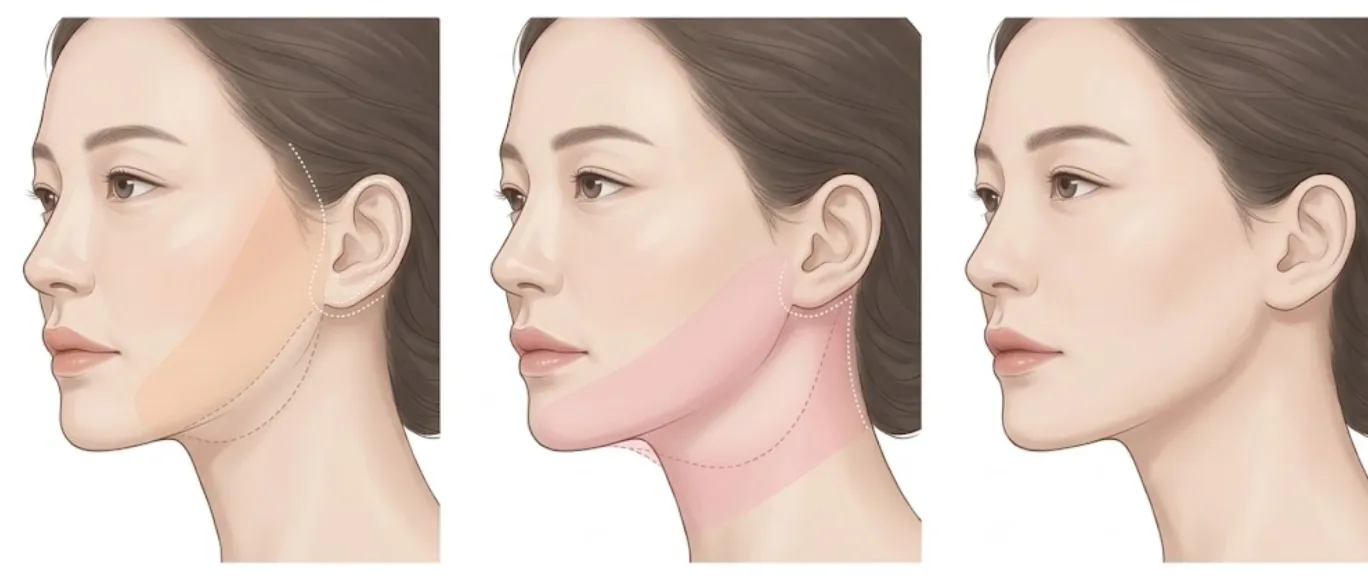
The first two to three days are the most intense part of neck lift recovery, and they are entirely expected. A neck lift is a SMAS-platysma lift: the surgeon tightens the platysma muscle band of the neck, sometimes with a corset platysmaplasty, through a small incision under the chin (submental) and incisions behind the ears (post-auricular). After that work, the neck and jaw feel tight, swollen and bruised, and you may have a snug dressing or a supportive garment to help the tissues settle in their new position.
Illustration: through a fine line around the ear (dotted), the sagging lower face and neck are lifted up and back toward the ear (shaded); the dashed outline shows the old contour.
With the platysma freshly tightened, these days call for your head to stay raised, even in sleep, for cold compresses and wound care exactly as instructed, and for no bending, lifting or straining that pushes pressure into the neck. Eat soft foods and avoid wide jaw movements while the area is tight. Discomfort is usually a tight, pulling sensation under the chin and behind the ears, and it is managed well with the medication your surgeon provides.
Resist the urge to judge your result now. The neck looks fullest and most swollen in these first days, and that has nothing to do with the final contour. For the technique itself, see the parent guide on the neck lift.
Week 1
The first week: swelling and bruising recede
Across the first week the most visible swelling and bruising begin to recede. The tightness eases gradually, sleeping becomes more comfortable, and the dressing or support garment is worn as instructed. You keep wound care gentle and consistent, stay upright as much as possible, and continue to avoid strenuous activity and anything that strains the neck.
By the end of the first week most people feel notably better than they did on day two: the bruising is fading, the worst of the swelling has passed, and the neck feels less foreign. It will still feel tight and look swollen compared with the eventual result; this is normal at this stage. Numbness or odd sensation over parts of the neck and behind the ears is also common as the tissues heal, and it settles over the following weeks.
In this first week, the neck heals best when you stay quiet and follow the dressing and garment instructions to the letter. The single most useful thing you can do for your scars and your contour is to follow the surgeon's instructions closely and let the deeper tissues knit together undisturbed.
Sutures out
Suture removal: around days 10 to 14
Sutures from a neck lift typically come out at around day 10 to 14, depending on how your incisions are healing; some patients have them removed nearer day 10, others closer to 2 weeks. The incisions are placed to hide well: the submental incision sits in the natural crease under the chin, and the post-auricular incisions tuck in and behind the ears.
Removing sutures on schedule helps the incision lines settle quietly. After they are out, the surgeon will give you scar-care guidance for the weeks and months ahead — keeping the lines protected, out of strong sun, and supported as advised. The incisions continue to mature for months, fading and flattening gradually over that time.
For a neck lift patient from abroad, the day 10 to 14 suture removal behind the ears sets the length of the stay, with a short review in Seoul afterwards before the flight home. The day-to-day care principles for recovering away from home are covered in recovering in Seoul after surgery.
Weeks 2–6
Weeks 2 to 6: returning to normal life
At about 2 weeks after a neck lift, with the chin and neck bruising mostly gone, many people go back to desk work and quiet social plans. The bruising has typically resolved, the incisions are healing, and while the neck still feels tight and there is residual swelling, you generally look presentable. A physical job usually needs longer than a desk role, and your own healing sets the exact date.
Through weeks three to six the deeper swelling keeps softening and the jawline definition becomes clearer. Light exercise comes back in stages once your surgeon clears it, with strenuous training saved for later so the tightened platysma is not strained. Numbness under the jaw and behind the ears keeps fading through these weeks, more slowly in some spots.
At 2 weeks the neck contour is still some way from its final form. A neck lift keeps refining for weeks into months as the last swelling resolves and the tissues fully settle. For how the result evolves and when it settles into its final form, see when will I see neck lift results and how a neck lift holds over the long term.
Normal vs red flags
What is normal, and what is a red flag
Most of what you feel in the first weeks is normal: tightness and a pulling sensation, swelling that is worse in the mornings, bruising that shifts colour as it fades, numbness or tingling over the neck and behind the ears, and a contour that looks fuller than it will eventually be. All of these fade as the neck heals.
Some signs, however, warrant prompt contact with your surgeon without waiting: rapidly increasing or one-sided swelling, especially if the neck feels tense and is growing quickly; fever; spreading redness, heat or discharge around an incision; or pain that keeps escalating. These are uncommon after a neck lift, and when they do occur a quick message to your surgeon is the right first step.
At a single-surgeon clinic, any concern about your neck goes straight to the surgeon who tightened it. From home, a photo by messenger gets you early guidance, including whether to see a local doctor.
Follow-up
Follow-up at 1, 3 and 6 months
The neck keeps changing for months after the sutures behind the ears come out, which is why follow-up is structured. Garnet reviews neck lift patients at 1, 3 and 6 months, which maps onto how the result actually evolves: by one month the early swelling has largely settled and the shape is emerging; by three months the contour is clearer and the incisions are maturing; and by six months the neck and jawline have settled close to their final form.
If you have flown home, the 1, 3 and 6-month neck reviews happen remotely. You send photos so the surgeon can check how the incisions and contour are settling, ask questions as they come up, and get clearance to resume the activities you have been holding off on. At a single-surgeon clinic one surgeon handles your consultation, neck lift and every review.
If you are planning a neck lift from abroad and want to map the recovery against a realistic trip, the neck lift for international patients guide walks through the stay, and you can begin with an online consultation for a pre-assessment.
Dr. In-Soo Baek
Director & sole operating surgeon
Korean medical licence no. 77407
Operate on what you came for. Trained at Korea University Medical Center. Every case planned, performed and reviewed by the same hands.
1Operating surgeon
~2Surgeries per day
7Registered techniques
Board-certified plastic surgeon
Plastic surgery training at Korea University College of Medicine & graduate school
Korean Society of Plastic and Reconstructive Surgeons member, in its facial-contour, eye & rhinoplasty groups
Consults, operates and follows up each case himself
Peer-reviewed papers behind the facts on this page. Each describes findings in its own study group — not results at Garnet — and none predicts your own outcome.
Batniji RK. Complications/Sequelae of Neck Rejuvenation. Facial Plastic Surgery Clinics of North America. 2014. doi:10.1016/j.fsc.2014.01.007
Yellin S et al. Direct Cervicoplasty. Facial Plastic Surgery. 2014. doi:10.1055/s-0034-1383553
Hamilton MM et al. Adjunctive Procedures to Neck Rejuvenation. Facial Plastic Surgery Clinics of North America. 2014. doi:10.1016/j.fsc.2014.01.008
FAQ
Common questions
How long does neck lift recovery take?
The most intense phase is the first few days; the worst swelling and bruising recede over the first week; sutures come out at around day 10 to 14; and many people return to desk work at roughly two weeks. Deeper swelling keeps settling for weeks to months, with the neck refining toward its final shape by around six months.
What is neck lift recovery like day by day?
Days 1 to 3 are the tightest and most swollen and call for rest and head elevation. Through the first week the bruising and swelling recede. Sutures come out at about day 10 to 14. Weeks two to six bring a return to normal life and clearer jawline definition as the deeper swelling softens.
When can I return to work after a neck lift?
Many people feel ready for desk work and quiet social activity at around two weeks, once the bruising has settled and the incisions are healing. Physical or manual work generally needs longer. Your surgeon sets the return date for your neck based on your job and your healing.
When do the sutures come out after a neck lift?
Sutures from the submental and post-auricular incisions typically come out at around day 10 to 14, depending on how the incisions are healing. Some patients have them removed nearer day 10 and others closer to two weeks.
When can I exercise again after a neck lift?
Light activity is usually reintroduced gradually from a few weeks out as your surgeon clears you, building back up before strenuous training. Heavier exercise comes later. Your surgeon's specific clearance matters more than any fixed date.
Is swelling and numbness normal after a neck lift?
Yes. Swelling that is worse in the mornings, a tight pulling sensation, and numbness or tingling over the neck and behind the ears are all normal as the tissues heal. Most of this fades over the next few weeks; numbness under the jaw can take longer.
What are the red flags during neck lift recovery?
Contact your surgeon promptly for rapidly increasing or one-sided swelling with a tense, growing neck; fever; spreading redness, heat or discharge around an incision; or pain that keeps escalating. These are uncommon, and a prompt message lets the surgeon check your neck early.
When will I see the final neck lift result?
Not at two weeks. The neck keeps refining for weeks into months as the last swelling resolves and the tissues settle, typically looking close to its final form by around 6 months. The early, swollen appearance is not a guide to the eventual contour.
How does follow-up work after a neck lift?
Garnet reviews neck lift patients at structured follow-ups of 1, 3 and 6 months, which matches how the result evolves. For patients who have flown home these reviews continue remotely by messenger, with the same surgeon checking your progress from photos and answering questions.
Can I recover from a neck lift away from home?
Yes, many international patients do. The key dates are suture removal at around day 10 to 14 and a safe flying window afterwards, and recovery then continues remotely with the operating surgeon reviewing your progress by messenger at 1, 3 and 6 months.
My mom recently had a brow lift and lower blepharoplasty with Dr. Baek, and our experience has been wonderful so far. The Garnet team was incredibly kind and welcoming, with Kelly assisting us as our English consultant—she made everything…
I’m so happy I chose this clinic for my lower blepharoplasty. I was traveling from abroad by myself, so I was a little nervous, but from the beginning I felt comfortable and truly cared for. Everyone was kind, patient, and professional…
Came in for an in-person consult and ended up choosing Garnet and Dr.Baek for my non-incisional DES and tiplasty/alarplasty. I communicated with Kelly (English consultant) from the start till now (3 weeks post-op). She really help me feel…
My under-eyes have been sagging and folding for years... I tried to cover it up with makeup, but it actually got stuck in the wrinkles and made it stand out even more. While going for consultations, I noticed that the bigger the hospital…
If you are planning a neck lift and want a realistic recovery timeline for your case, send photos for a no-obligation pre-assessment and we'll walk you through what to expect.
Send photos and your question before you travel. An English-speaking coordinator reviews every neck lift enquiry and replies with guidance on whether surgery is appropriate, the likely plan and timing.
✓ Reviewed by the clinic coordinator, not a bot
✓ Photo-based pre-assessment before you fly
✓ Foreign-patient scheduling & after-care
✓ One surgeon for consultation, surgery and follow-up
Prefer to chat now? Reach the coordinator directly:









 T S7 months ago



