Right after epicanthoplasty the inner corner of the eye looks open but swollen, and the sutures stay in until around day 7, so day one is far too early to judge the result. The timeline is gradual: the dramatic early swelling eases over the first weeks, the small incision line settles and fades over months, and the natural, final inner-corner shape emerges as both swelling and scar mature. This page walks through that arc stage by stage, so you know what is normal at each point and when to actually judge your result.
The short answer
Epicanthoplasty looks open but swollen immediately; the sutures come out at around day 7, and that marks the start of settling. The final result comes later.
Most of the obvious swelling eases over the first few weeks, and the inner corner gradually relaxes into a more natural shape.
The incision line keeps fading and softening for months; early redness is normal and is not the end state.
The genuine final inner-corner shape typically emerges over roughly three to six months as swelling fully resolves and the scar matures.
In the days straight after epicanthoplasty the inner corner is visibly more open — you can see the change the Two-way™ release has made, but it sits behind noticeable swelling and a fresh incision line. The corner may look tight, pink and a little exaggerated, and that is exactly what early healing looks like. The fine sutures hold the inner-canthal incision while it knits, and they come out at around day seven.
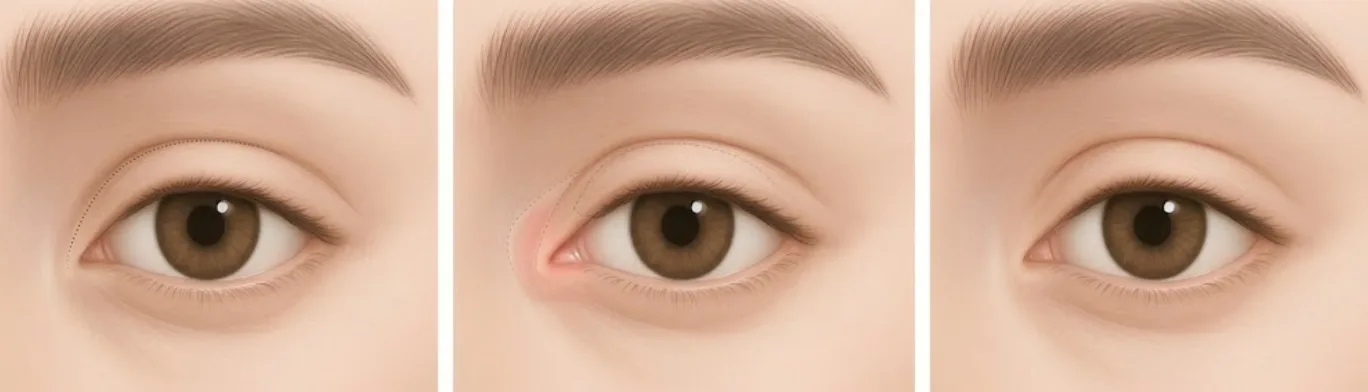
Illustration: the skin fold covering the inner corner is released along the dotted line so the inner corner opens slightly while the eye keeps its own shape.
Try not to read too much into this stage. Swelling distorts shape, redness draws the eye to the line, and the corner has not yet relaxed into its settled position. Many patients feel the opening looks larger or sharper than they expected in the first days; this usually softens as the swelling resolves. Suture removal at around day 7 is a milestone, but it marks the beginning of settling and the corner is still far from finished.
For a fuller picture of what to do during these early days (rest, swelling management and the practicalities), our note on recovering in Seoul after surgery covers the recovery side that runs alongside this results timeline.
First weeks
The first weeks: swelling eases and the corner relaxes
Over the first few weeks the most obvious swelling subsides, and this is when the result starts to look more like itself. As the puffiness around the inner corner settles, the opening relaxes from the tight, slightly exaggerated early look into a softer, more natural shape. Most people notice a clear difference between week one and week three or four, even though the corner is still not fully settled.
Residual swelling can linger subtly for longer than people expect, particularly in delicate tissue around the eye. So while the corner looks much more natural by a few weeks in, small refinements continue beneath the surface. The shape you see at one month is close, but it is not the absolute final word. This is normal and not a reason for concern; it is simply how soft-tissue surgery settles.
If you had epicanthoplasty combined with double-eyelid surgery, the eyelid swelling follows a similar but slightly more noticeable arc over these weeks, which can make the whole eye look more swollen for a little longer. Either way, the trend over the first month is steadily toward a more natural, settled inner corner.
The line
Redness and the settling incision line
Separate from the shape, the incision line has its own timeline. In the early weeks the small inner-corner line often looks pink or slightly firm. This is ordinary early healing as new blood vessels form and the tissue remodels. This redness is one of the things that makes the result look unfinished early on, because it draws attention to the corner even once the swelling has eased.
The line fades gradually. Over the following months it typically flattens and the pinkness settles, often passing through a lighter phase before it calms, until it becomes much harder to notice. This is slow work, measured in months, and it is why the result keeps quietly improving well after the corner's shape looks settled. The eye looks more natural still once the line has faded into the background.
Because the scar's settling is such a big part of the overall impression, it is worth understanding it in its own right. Our page on epicanthoplasty scars and healing goes through where the line sits, why it can look visible early, and what scar care genuinely helps it settle.
Final shape
When the final inner-corner shape emerges
The genuine final result of epicanthoplasty emerges as two things finish together: the last of the swelling resolving and the scar maturing. As a guide, the corner usually looks substantially settled by around three months, with the truly final shape and a well-faded line emerging over roughly three to six months. By six months most patients are seeing the result the surgery was planned for, with the line continuing to settle quietly toward the one-year mark.
What "final" looks like is an inner corner that is more open in a way that suits your face, with the change reading as natural and not surgical, and a line that is difficult to notice in normal conditions. A careful surgeon plans the release to land there: a measured opening that opens the eye without looking overdone. A specific dramatic transformation is not something to promise.
Individual healing varies, so treat these as typical ranges and not fixed dates. Skin type, the amount of release and your own healing all shift the pace a little. The dependable message is direction: from swollen and pink early, steadily toward natural and settled over months.
When to judge
When you should actually judge your result
The single most useful expectation to set is when to judge. The early weeks are for healing. Swelling and redness make the corner look more exaggerated and the line more obvious than they will be. Judging your epicanthoplasty at one or two weeks almost always leads to unnecessary worry, because you are looking at a result that has not happened yet.
A fairer first assessment comes once the obvious swelling has eased, around the one-month mark, and the genuine result around three to six months, when the line has faded and the corner has settled. If something looks asymmetric or uneven in the early weeks, it is far more often uneven swelling than an uneven result; the right response is to raise it at a follow-up and hold off on any conclusion.
This is exactly why structured follow-up matters more than a single check. Being able to ask "is this normal at this stage?" and have the same surgeon confirm the corner is settling on track is what keeps the months between surgery and final result reassuring. That is the continuity of a single-surgeon clinic.
At Garnet
How Garnet follows your result over time
Garnet is a single-surgeon plastic surgery clinic in Apgujeong, Seoul. Dr. In-Soo Baek, a board-certified plastic surgeon (Korean medical licence no. 77407), is the only operating doctor. He plans the epicanthoplasty, performs the Two-way™ release himself and reviews your inner corners as they settle. Because the same surgeon sees the corner from the swollen first days through to the final shape, the settling can be tracked properly over months.
The clinic runs structured follow-ups at 1, 3 and 6 months, which maps almost exactly onto the results timeline above: the window over which the swelling resolves and the line matures. For international patients much of that review is handled remotely through photos, so you can confirm the corner is on track and ask what is normal at each stage even after you have flown home.
If you want a realistic picture of what your result will look like and when, a sensible first step is a no-obligation online assessment. Send clear photos of your eyes and you will get an individual view of the change epicanthoplasty would make and the timeline over which it would settle, before you decide anything.
Dr. In-Soo Baek
Director & sole operating surgeon
Korean medical licence no. 77407
Operate on what you came for. Trained at Korea University Medical Center. Every case planned, performed and reviewed by the same hands.
1Operating surgeon
~2Surgeries per day
7Registered techniques
Board-certified plastic surgeon
Plastic surgery training at Korea University College of Medicine & graduate school
Korean Society of Plastic and Reconstructive Surgeons member, in its facial-contour, eye & rhinoplasty groups
Consults, operates and follows up each case himself
Peer-reviewed papers behind the facts on this page. Each describes findings in its own study group — not results at Garnet — and none predicts your own outcome.
Wijaya WA et al. A Novel Thunderbolt Z-Epicanthoplasty for Asians. Aesthetic Plastic Surgery. 2022. doi:10.1007/s00266-022-02934-3
Mao R et al. Dual‐plane epicanthoplasty in Chinese blepharoplasty. Journal of Cosmetic Dermatology. 2020. doi:10.1111/jocd.13418
Yang L et al. Epicanthoplasty With Rotated-advanced-back Cut Flap. Journal of Craniofacial Surgery. 2020. doi:10.1097/scs.0000000000007164
FAQ
Common questions
When will I see the final results of epicanthoplasty?
The genuine final result emerges over roughly three to six months, as the last of the swelling resolves and the incision line matures. The corner usually looks substantially settled by around three months, with the line continuing to fade quietly toward the one-year mark. The first weeks are for healing, and judging the result then is far too early.
How does the result of epicanthoplasty change over time?
It moves steadily from swollen and pink toward natural and settled. Early on the corner looks open but tight and the line is red; over the first weeks the swelling eases and the shape relaxes; over the following months the line fades and the inner corner settles into its final, more natural shape. The direction is reliable even though the exact pace varies.
When is swelling gone after epicanthoplasty?
Most of the obvious swelling eases over the first few weeks, so the corner looks much more natural by around one month. Subtle residual swelling in the delicate tissue around the eye can linger longer, which is why the truly final shape emerges over three to six months and not at one month.
Why does my inner corner look exaggerated right after surgery?
Early swelling distorts the shape and the fresh line draws the eye, so the opening can look larger or sharper than it will be. As the swelling resolves over the first weeks the corner relaxes into a softer, more natural shape. This early exaggerated look is ordinary healing and will soften.
When can I judge whether my epicanthoplasty is even on both sides?
Not in the first weeks. Early asymmetry is far more often uneven swelling than an uneven result, and it usually evens out as the swelling settles. A fairer assessment comes around one month, and the genuine result around three to six months. If something concerns you, raise it at a follow-up before drawing any conclusion.
How long does the redness in the inner corner last?
The small incision line is often pink or slightly firm in the early weeks as it heals, then fades gradually over the following months, usually passing through a lighter phase before it calms. Sun protection helps the colour settle. Full fading can take six months to a year, which is why the result keeps improving after the shape looks settled.
Does combining epicanthoplasty with double-eyelid surgery change the timeline?
The overall arc is similar, but combined eyelid swelling is more noticeable and can make the whole eye look swollen for a little longer. Both procedures settle over the same kind of months-long window, so the final result still emerges over roughly three to six months, just with a slightly fuller-looking early phase.
How is my result followed up, especially from abroad?
At a single-surgeon clinic the same surgeon who operated reviews the result as it settles. Garnet runs structured follow-ups at 1, 3 and 6 months, matching the results timeline, and for international patients much of that review is handled remotely through photos, so you can confirm the corner is on track even after flying home.
Is it normal for the result to keep changing for months?
Yes. Soft-tissue surgery around the eye settles gradually: swelling resolves over weeks, and the scar matures over months, so the inner corner quietly keeps improving well after surgery. A result that is still refining at one to three months is normal and expected. It does not mean anything is wrong.
My mom recently had a brow lift and lower blepharoplasty with Dr. Baek, and our experience has been wonderful so far. The Garnet team was incredibly kind and welcoming, with Kelly assisting us as our English consultant—she made everything…
I’m so happy I chose this clinic for my lower blepharoplasty. I was traveling from abroad by myself, so I was a little nervous, but from the beginning I felt comfortable and truly cared for. Everyone was kind, patient, and professional…
Came in for an in-person consult and ended up choosing Garnet and Dr.Baek for my non-incisional DES and tiplasty/alarplasty. I communicated with Kelly (English consultant) from the start till now (3 weeks post-op). She really help me feel…
My under-eyes have been sagging and folding for years... I tried to cover it up with makeup, but it actually got stuck in the wrinkles and made it stand out even more. While going for consultations, I noticed that the bigger the hospital…
Want a realistic picture of what your epicanthoplasty result will look like and when it will settle? Send clear photos of your eyes for a no-obligation pre-assessment before you decide anything.
Send photos and your question before you travel. An English-speaking coordinator reviews every enquiry and replies with guidance on whether surgery is appropriate, the likely plan and timing.
✓ Reviewed by the clinic coordinator, not a bot
✓ Photo-based pre-assessment before you fly
✓ Foreign-patient scheduling & after-care
✓ One surgeon for consultation, surgery and follow-up
Prefer to chat now? Reach the coordinator directly:









 T S7 months ago



