Epicanthoplasty is one of the most common eye procedures international patients travel to Korea for, and the logistics are more manageable than people expect. It is a short, focused operation, the only fixed appointment after surgery is suture removal at around day seven, and most of the decision-making can be done from home through an online consultation before you ever book a flight. This page walks through the journey end to end so you can plan with realistic expectations.
The short answer
Epicanthoplasty is a short, local-anaesthetic eye procedure; the one appointment you must stay in Korea for is suture removal at around day seven.
Plan for roughly seven to ten days in Seoul so the stitches can come out before you fly, with a little buffer for swelling and any combined procedure.
It is very often combined with double-eyelid surgery in the same sitting. It is worth deciding before you travel, as it affects recovery and how long you stay.
You can settle candidacy, technique and expectations in an online consultation with photos before booking, and the same surgeon reviews you at 1, 3 and 6 months after you return home.
How epicanthoplasty works for an international patient
For someone travelling from abroad, the sequence is straightforward. You begin with an online consultation from home, sending clear photos of your eyes so the surgeon can assess your inner corners, the Mongolian fold and what a realistic change would look like for you. From there you receive a clear view on whether epicanthoplasty suits you, what technique would be used, and whether a second procedure such as double-eyelid surgery should be considered at the same time.
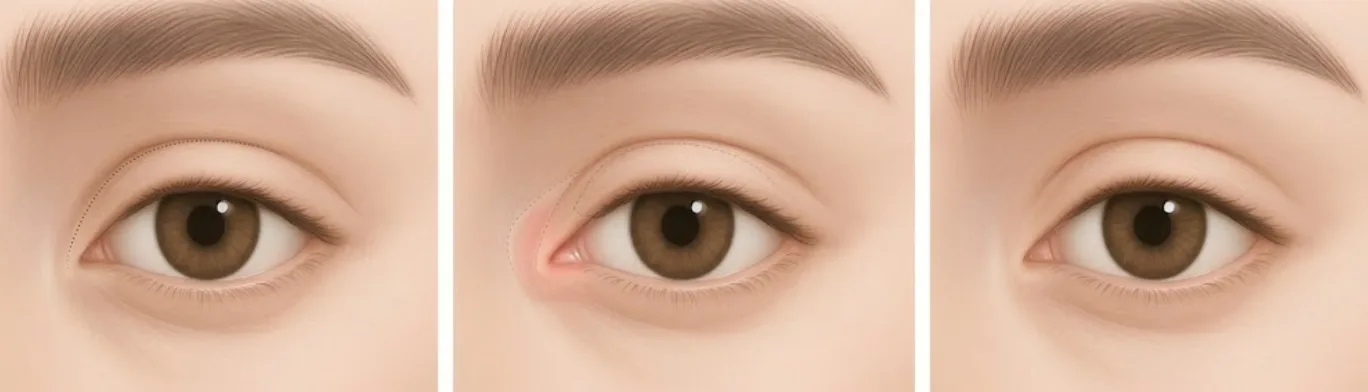
Illustration: the skin fold covering the inner corner is released along the dotted line so the inner corner opens slightly while the eye keeps its own shape.
Epicanthoplasty itself is a short, focused operation done under local anaesthesia. At Garnet the technique is a Two-way™ release of the Mongolian-fold band: a combined medial and upper release worked through a fine inner-canthal incision. A single, more aggressive cut is not used. Because it is local and contained, you walk out the same day; there is no general anaesthetic and no hospital admission to plan around.
The only fixed point in your calendar after surgery is suture removal. The stitches sit in the inner corner and come out at around day seven, so your stay is built around getting to that one appointment before you fly. Everything else (swelling settling, the line fading) happens gradually and can continue after you are home, reviewed remotely and then in person at the structured follow-ups.
How long to stay
How long should you stay in Korea?
The practical answer is built around suture removal at around day seven. As a guide, plan for roughly seven to ten days in Seoul: surgery early in your trip, a few quiet days while the initial swelling eases, then the suture-removal appointment before you fly home. The shorter end works if epicanthoplasty is your only procedure and your schedule is tight; the longer end gives you a buffer for swelling, photographs and a more comfortable flight.
If you are combining epicanthoplasty with double-eyelid surgery, which is common, the timeline does not change dramatically, because the eyelid stitches are usually removed on a similar schedule, but the swelling is more noticeable and a slightly longer stay makes the journey home easier. Our guide on how long to stay in Korea for surgery goes through this trade-off in more detail.
Two timing details are worth settling before you book flights. First, do not schedule your return flight for the day after surgery; you want the sutures out and the eyes settling first. Second, ask specifically when it is sensible to fly. Air travel and eye swelling interact, and the surgeon can give you a date that fits your case. Our note on when you can fly after surgery covers the general principles.
Combined surgery
Why epicanthoplasty is so often combined with double-eyelid surgery
Epicanthoplasty and double-eyelid surgery address two different things, but they sit right next to each other and are frequently done together. Epicanthoplasty opens the inner corner by releasing the Mongolian fold, which lengthens the visible eye horizontally; double-eyelid surgery creates or refines the upper crease, which opens the eye vertically. For many patients the two changes complement each other, and combining them in one sitting means one recovery and one trip.
This is exactly the kind of decision that benefits from a pre-assessment of your eyes; a menu of options will not settle it. Not everyone who wants one needs both, and at a clinic that does not over-recommend, you may be advised that epicanthoplasty alone, or a more conservative inner-corner change, is enough for your eyes. If a combined plan does suit you, it is far better to know that before you travel so your stay, your recovery and your expectations are all set up for it.
If double-eyelid surgery is on your mind, it is worth reading about the two approaches in our pages on incision double-eyelid for international patients explain how that procedure travels alongside epicanthoplasty. Deciding the combination at the online-consultation stage keeps everything in one well-planned trip.
Online consultation
What an online consultation can settle before you fly
A good online consultation does most of the heavy lifting before you commit to travel. With clear, well-lit photos of your eyes (open, closed and looking in a few directions) the surgeon can assess how prominent your Mongolian fold is, how much inner-corner exposure would look natural on your face, and whether epicanthoplasty alone or a combined plan makes sense. You can ask the questions that matter to you and get a realistic, individual answer.
Crucially, this is also where you confirm the safety basics: that the surgeon you are speaking with is the board-certified plastic surgeon who will actually perform your operation, and that the same surgeon will review your recovery. For an international patient who cannot easily pop back for a second opinion, settling this remotely is the difference between a confident trip and an anxious one.
An online assessment is also the moment to be open about your own goals and to hear a straight answer back, including "this may not be necessary for you." You can read more about how this works in our guide to the online consultation from abroad, and about what a first in-person visit covers in your first consultation at Garnet.
After you fly home
Follow-up once you are back home
The trip does not end your care. After epicanthoplasty the inner-corner line keeps maturing for months as redness fades, the scar softens and the final shape settles, so meaningful follow-up happens long after you have flown home. A clinic set up for international patients plans for this and does not simply wave you off at the airport.
At Garnet the same surgeon who consulted and operated reviews your recovery, and the clinic runs structured follow-ups at 1, 3 and 6 months. For an international patient those reviews are usually handled remotely: you send updated photos and the surgeon checks that the corner is healing on track and answers any questions about scar care or what is normal at each stage. If anything needs in-person attention, you will be told clearly.
Knowing in advance who manages your recovery from a distance is one of the most reassuring parts of planning surgery abroad. Continuity, with the same surgeon throughout and no handover to whoever is on duty, is the practical advantage of a single-surgeon clinic when your follow-up has to cross a border.
At Garnet
How Garnet treats international patients
Garnet is a single-surgeon plastic surgery clinic in Apgujeong, Seoul, registered with Korea's foreign-patient programme (registration no. M-2023-01-08-6867). Dr. In-Soo Baek is a board-certified plastic surgeon (Korean medical licence no. 77407) and the only operating doctor. He consults, performs the epicanthoplasty himself and reviews every follow-up, and the clinic caps the day so each case has unhurried time.
For an international patient that model removes the two biggest uncertainties of surgery abroad: you know exactly who operates, and you know the same surgeon sees you through recovery at 1, 3 and 6 months. A dedicated coordinator stays with you from the first online message through scheduling, your stay in Seoul and remote after-care once you are home.
The sensible first step is a no-obligation online assessment: send clear photos of your eyes, and you will get a clear view on whether epicanthoplasty suits you, whether to combine it with double-eyelid surgery, and how long to plan to stay, before you book anything.
Dr. In-Soo Baek
Director & sole operating surgeon
Korean medical licence no. 77407
Operate on what you came for. Trained at Korea University Medical Center. Every case planned, performed and reviewed by the same hands.
1Operating surgeon
~2Surgeries per day
7Registered techniques
Board-certified plastic surgeon
Plastic surgery training at Korea University College of Medicine & graduate school
Korean Society of Plastic and Reconstructive Surgeons member, in its facial-contour, eye & rhinoplasty groups
Consults, operates and follows up each case himself
Peer-reviewed papers behind the facts on this page. Each describes findings in its own study group — not results at Garnet — and none predicts your own outcome.
Yang L et al. Epicanthoplasty With Rotated-advanced-back Cut Flap. Journal of Craniofacial Surgery. 2020. doi:10.1097/scs.0000000000007164
McAuliffe PB et al. Complications of Aesthetic Surgical Tourism Treated in the USA: A Systematic Review. Aesthetic Plastic Surgery. 2022. doi:10.1007/s00266-022-03041-z
Zeng L et al. Epicanthoplasty with Epicanthal Dermatic Tension-Releasing Incision Based on Skin Projection of Inner Canthal Ligament. Aesthetic Plastic Surgery. 2017. doi:10.1007/s00266-017-0829-8
Varma P et al. Cosmetic tourism during the COVID-19 pandemic: Dealing with the aftermath. Journal of Plastic, Reconstructive & Aesthetic Surgery. 2022. doi:10.1016/j.bjps.2021.11.013
FAQ
Common questions
How do international patients get epicanthoplasty in Korea?
The process starts remotely: you send photos of your eyes for an online consultation, receive an assessment of whether epicanthoplasty suits you and what technique would be used, then travel to Seoul for the short local-anaesthetic procedure. The only fixed in-person appointment afterwards is suture removal at around day seven, and follow-up continues remotely once you are home.
How long should I stay in Korea for epicanthoplasty?
Plan for roughly seven to ten days. Epicanthoplasty is done early in the trip, you rest while the initial swelling eases, and the sutures in the inner corner are removed at around day 7, so your stay is built around getting to that appointment before you fly. A slightly longer stay gives a buffer for swelling and a more comfortable flight, especially if you combine it with another procedure.
Can I start with an online consultation for epicanthoplasty?
Yes. With clear photos of your eyes the surgeon can assess your Mongolian fold and inner corners, advise whether epicanthoplasty alone or a combined plan suits you, and confirm that the same board-certified surgeon will perform your operation. Settling all of this before you book a flight is the most useful thing an international patient can do.
Is epicanthoplasty usually combined with double-eyelid surgery?
It often is, because the two changes complement each other: epicanthoplasty lengthens the eye horizontally by opening the inner corner, while double-eyelid surgery opens it vertically. They can be done in one sitting with a single recovery. Needing both is an individual question best settled at the online consultation, since not everyone who wants both needs both.
When can I fly home after epicanthoplasty?
Most patients fly after the sutures are removed at around day seven, once the eyes are settling. Do not schedule your return flight for the day after surgery. Air travel and eye swelling interact, so it is best to ask the surgeon for a specific date that fits your case.
Will the inner-corner result look finished before I leave Korea?
No, and that is normal. When you fly home the inner corner is still settling, and some redness and firmness in the small incision line is expected. The scar matures and the final shape emerges over the following months, which is why remote follow-up after you return home matters as much as the trip itself.
Who looks after my recovery once I return home?
At a single-surgeon clinic the same surgeon who operated reviews your recovery, usually through updated photos for an international patient. Garnet runs structured follow-ups at 1, 3 and 6 months, and you can ask about scar care and what is normal at each stage. If anything needs in-person attention, you will be told clearly.
Do I need a translator or someone with me for epicanthoplasty in Korea?
Epicanthoplasty is a short outpatient procedure under local anaesthesia, so you are alert and mobile the same day. A clinic set up for international patients coordinates your consultation, scheduling and after-care, and a dedicated coordinator stays with you through the trip. Many patients travel alone, though some prefer a companion for the first day or two of swelling.
Does Garnet treat international patients for epicanthoplasty?
Yes. Garnet is registered with Korea's foreign-patient programme and coordinates consultation, scheduling and after-care for international visitors. The same board-certified plastic surgeon, Dr. In-Soo Baek, consults, performs the surgery and handles your follow-ups at 1, 3 and 6 months, including remote review after you return home.
How much does it cost for an international patient and is anything extra?
Cost depends on your specific plan, for example whether epicanthoplasty is done alone or combined with double-eyelid surgery, so it is confirmed at consultation and never quoted blind. Garnet does not charge a consultation or CT fee and does not pressure same-day booking, so you can get a clear plan and figure before you commit to travel.
My mom recently had a brow lift and lower blepharoplasty with Dr. Baek, and our experience has been wonderful so far. The Garnet team was incredibly kind and welcoming, with Kelly assisting us as our English consultant—she made everything…
I’m so happy I chose this clinic for my lower blepharoplasty. I was traveling from abroad by myself, so I was a little nervous, but from the beginning I felt comfortable and truly cared for. Everyone was kind, patient, and professional…
Came in for an in-person consult and ended up choosing Garnet and Dr.Baek for my non-incisional DES and tiplasty/alarplasty. I communicated with Kelly (English consultant) from the start till now (3 weeks post-op). She really help me feel…
My under-eyes have been sagging and folding for years... I tried to cover it up with makeup, but it actually got stuck in the wrinkles and made it stand out even more. While going for consultations, I noticed that the bigger the hospital…
Thinking about epicanthoplasty in Korea? Send clear photos of your eyes for a no-obligation pre-assessment, including whether to combine it with double-eyelid surgery and how long to plan to stay, before you book a trip.
Send photos and your question before you travel. An English-speaking coordinator reviews every enquiry and replies with guidance on whether surgery is appropriate, the likely plan and timing.
✓ Reviewed by the clinic coordinator, not a bot
✓ Photo-based pre-assessment before you fly
✓ Foreign-patient scheduling & after-care
✓ One surgeon for consultation, surgery and follow-up
Prefer to chat now? Reach the coordinator directly:









 T S7 months ago



