"Will it leave a scar?" is the first question most people ask about a forehead lift, and it is a fair one: the forehead is the last place anyone wants a visible line. The answer depends entirely on technique. An endoscopic forehead lift does not use a long incision across the brow; it works through small ports concealed in the hair-bearing scalp. This page explains exactly where those incisions sit, how they heal week by week, and what you can do to help them fade.
The short answer
An endoscopic forehead lift uses small scalp-port incisions hidden behind the hairline; there is no long incision across the forehead.
Because the ports sit in hair-bearing scalp, they are concealed by the hair as it settles and never cross visible skin.
Early on the ports may feel tender or numb; over the months they soften and become difficult to see, and final scar maturation takes time.
Healing depends on technique, your skin and your aftercare. Gentle scalp care and sun sense in the early phase help the result settle well.
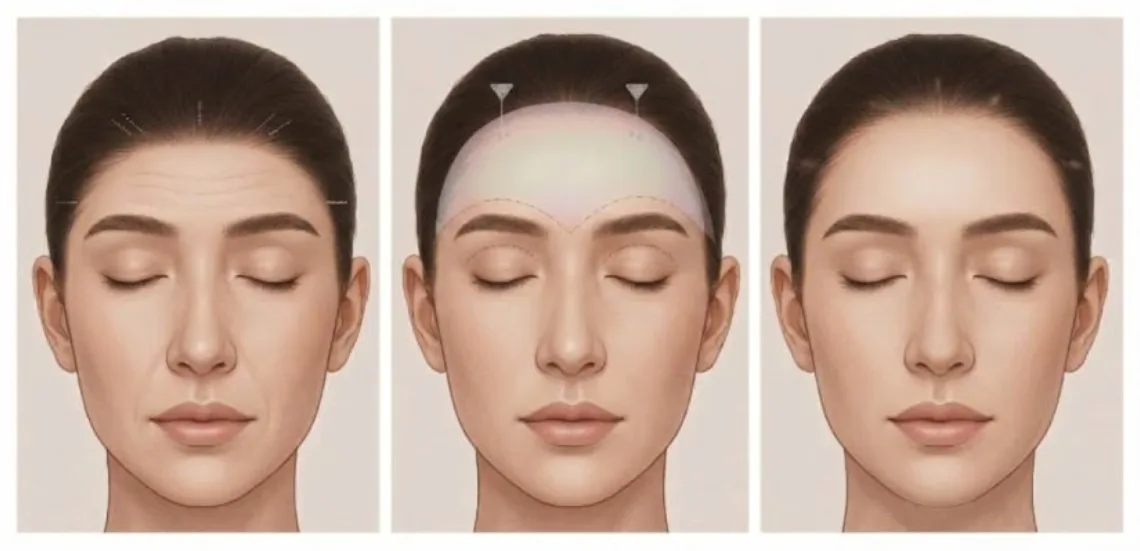
The image many people carry is of an old-style brow lift, with a long incision running ear to ear across the top of the head or along the hairline. That is not how a modern endoscopic forehead lift works. Instead of one long cut, the surgeon makes a few small ports in the hair-bearing scalp, set back behind the hairline. The endoscope and instruments pass through these to release and lift the brow, so there is no incision crossing the open skin of the forehead itself.
Illustration: the forehead and brow are lifted from within and held at fixation points behind the hairline (Pentafix™), rather than pulled at the skin.
At Garnet the technique is an endoscopic five-point fixation (the trademarked Pentafix™ method), which holds the lifted brow using fixation points and small tunnels in the bone. All of this is done through those concealed scalp ports, without a visible line. Because the ports sit within hair, the scalp's own hair grows around and over them, which is what makes them so much harder to see than a forehead incision would ever be.
This placement is the single biggest reason the "will it scar?" worry is usually misplaced for an endoscopic lift: the access points are deliberately put where hair will cover them.
Why endoscopic
Why the endoscopic approach means small, hidden ports
An endoscope is a small camera that lets the surgeon see and work beneath the skin through tiny openings without opening the whole area. For a forehead lift, that means the release and lifting of the brow can be done through a handful of short ports instead of a long incision. There is less cutting across visible skin, and the access is deliberately tucked into the hairline.
The trade-off is that endoscopic work is technically demanding and depends heavily on the surgeon's experience, which is one reason the operation is suited to an experienced board-certified plastic surgeon and should not be chosen on price alone. The benefit, when it is done well, is precisely the scar outcome people care about: small, hair-concealed ports and no forehead line.
Endoscopic access changes some things and leaves others alone. It changes where the incisions sit and how small they are; it does not make incisions vanish or guarantee an invisible result for everyone. Skin heals differently from person to person. What the technique reliably offers is the most favourable possible placement: out of sight, within the hair. To understand how this fits the whole operation, the parent forehead lift page covers the technique in full.
The first weeks
The first weeks: what the incision points feel like
In the first days the scalp ports are closed with small sutures, which at Garnet are removed at around day 10. Until then the area is tender, and you should expect some tightness, swelling across the brow and forehead, and possibly bruising that settles over the first week or two. Numbness or odd sensations around the ports and the top of the scalp are common early on and usually ease over the following weeks as nerves recover. This can take longer than the visible healing.
Hair around the ports is generally not shaved for these small openings, so the scalp hair itself helps conceal the sites from early on. You will be given clear guidance on how to keep the area clean, when you can wash your hair and how gently, and how to handle the ports in the first days. Following that early-care advice carefully is part of getting a clean, well-settled result.
For the full picture of swelling, bruising and what each week looks like beyond the incisions themselves, the forehead lift recovery timeline goes day by day; this page stays focused on the scars.
Healing over months
How the scars heal and fade over the months
Scar maturation is slow everywhere on the body, and the scalp is no exception. After the sutures come out, the small ports go through the normal phases of healing: an early phase where the site can look or feel firm, then a longer remodelling phase over the following months where it softens and quietens down. With hair-bearing scalp ports, this maturation happens out of sight, which is exactly why they become so hard to find once healed.
Most people stop noticing the ports within a few months as the hair settles back over them and the sites mature. That said, healing is individual: skin type, how a particular person scars, and aftercare all influence the final appearance. A realistic expectation is that the ports become difficult to see, though they do not cease to exist. That standard is still far better than a long forehead line could ever reach.
Because the brow itself also continues to settle into its final, relaxed position over months, the later follow-up reviews are about more than scars. They let the surgeon track both the lift and the healing of the ports together. At Garnet those reviews are structured at 1, 3 and 6 months.
Aftercare
How to help your scars heal well
You cannot change your skin type, but aftercare genuinely influences how well incisions settle. The basics for scalp ports: keep the area clean and follow the washing guidance you are given, avoid picking at scabs or crusts, and protect your healing skin from strong sun in the early phase. Sun on fresh scars is one of the avoidable factors that can affect how they mature. Your coordinator will give you specific instructions tailored to your healing.
Avoiding heavy straining, vigorous exercise and anything that spikes swelling in the early days also supports clean healing, as does not putting tension on the brow before it has settled. None of this is exotic; it is steady, sensible care over the first weeks. The surgeon will tell you when you can return to normal hair care, exercise and routines.
If you have a history of unusual scarring (keloids, for example), raise it at your consultation, including in your online consultation if you are coming from abroad. It is exactly the kind of detail a pre-assessment needs to know about, so the surgeon can factor it into the plan and your expectations from the start.
Normal vs ask
What is normal after a forehead lift, and when to ask
Knowing what is expected makes recovery far less anxious. Tenderness around the ports, tightness, swelling, bruising and patches of numbness across the scalp and brow are all normal in the early weeks and settle with time. The ports gradually becoming firmer before they soften is also part of normal scar maturation. It does not mean something is wrong.
What is worth flagging promptly is the usual short list for any incision: spreading redness, pain that is getting worse, warmth, or any discharge from a port. These are the kinds of changes you should not sit on. Because Garnet's follow-up is structured and the same surgeon reviews you, you have a clear route to ask. For international patients that continues remotely after you return home, with photo check-ins between the 1, 3 and 6-month reviews.
If you are an international patient, the forehead lift for international patients page explains how this remote follow-up works in practice, so a question about a healing port is never left to guesswork once you are back in your own country.
Prices
Price at Garnet
Pentafix™ forehead lift
From₩5,000,000 + VATExcluding VAT (10% VAT is added at payment)Book now
Same price as Korean patients. Prices shown exclude 10% VAT; your written quote, issued after the in-person consultation, shows the full amount payable.
Dr. In-Soo Baek
Director & sole operating surgeon
Korean medical licence no. 77407
Operate on what you came for. Trained at Korea University Medical Center. Every case planned, performed and reviewed by the same hands.
1Operating surgeon
~2Surgeries per day
7Registered techniques
Board-certified plastic surgeon
Plastic surgery training at Korea University College of Medicine & graduate school
Korean Society of Plastic and Reconstructive Surgeons member, in its facial-contour, eye & rhinoplasty groups
Consults, operates and follows up each case himself
Peer-reviewed papers behind the facts on this page. Each describes findings in its own study group — not results at Garnet — and none predicts your own outcome.
Starkman SJ et al. Association of Corrugator Supercilii and Procerus Myectomy With Endoscopic Browlift Outcomes. JAMA Facial Plastic Surgery. 2019. doi:10.1001/jamafacial.2018.2084
Quatela V et al. Endoscopic Browplasty. Facial Plastic Surgery. 2018. doi:10.1055/s-0038-1637728
McGuire CS et al. Novel Pretrichial Browlift Technique and Review of Methods and Complications. Dermatologic Surgery. 2009. doi:10.1111/j.1524-4725.2009.01247.x
FAQ
Common questions
Where are the scars after a forehead lift?
With an endoscopic forehead lift the incisions are small ports placed in the hair-bearing scalp, set back behind the hairline, so no long incision crosses the forehead. Because the ports sit within hair, the scalp's own hair conceals them as it settles, which is the main reason a forehead lift done this way usually does not leave a visible facial scar.
Will forehead lift scars be visible?
For an endoscopic lift, the access points are deliberately hidden in the hairline, so most people find them difficult to see once healed and the hair has settled over them. Healing is individual, since skin type and how you scar matter, so the realistic standard is that the ports become hard to see without disappearing entirely. That is still a far better outcome than a forehead incision would give.
Does a forehead lift use a long incision across my forehead?
Not an endoscopic one. Older brow-lift techniques sometimes used a long incision, but a modern endoscopic forehead lift works through a few small scalp ports using a small camera, so the brow can be released and lifted without a line across the open skin of the forehead. The incisions are tucked into the hair-bearing scalp instead.
How do forehead lift scars heal over time?
Like all scars, the scalp ports mature slowly. After the sutures come out at around day 10, they go through an early firm phase and then a longer remodelling phase over the following months, softening and quietening as they settle. Because they sit within the hair, this happens out of sight, which is why most people stop noticing them within a few months.
When are the sutures removed?
At Garnet the small scalp-port sutures are removed at around day 10. For international patients, the length of stay in Korea is planned around this so the surgeon can take the stitches out and check the healing in person before a long flight home, so no sutures stay in for the journey.
Will my hair be shaved for the incisions?
Generally the small ports used in an endoscopic forehead lift do not require shaving the scalp, and the surrounding hair actually helps conceal the sites from early on. You will be given clear guidance on how and when to wash your hair gently as the ports heal, and when you can return to your normal hair care.
Is numbness around the scars normal?
Yes. Numbness or unusual sensations around the ports and across the top of the scalp are common in the early weeks and usually ease as the nerves recover, which can take longer than the visible healing. It is a normal part of recovery and not a sign of a problem, though anything that worsens or concerns you is always worth raising at a follow-up.
What can I do to help the scars fade?
Keep the ports clean and follow your washing guidance, avoid picking at scabs or crusts, protect healing skin from strong sun in the early phase, and avoid heavy straining or vigorous exercise that spikes swelling early on. Your coordinator gives you specific aftercare for your healing. If you scar unusually (keloids, for example), raise it at the consultation so it can be factored into the plan.
When should I be concerned about a healing incision?
Flag spreading redness, pain that keeps increasing, warmth around a port, or any discharge. These are the changes not to sit on. Because Garnet's follow-up is structured and the same surgeon reviews you, you have a clear route to ask, and for international patients this continues remotely with photo check-ins between the 1, 3 and 6-month reviews.
Are the scars different at a single-surgeon clinic?
The scar outcome of an endoscopic forehead lift depends heavily on the surgeon's technique, so who actually performs the operation matters. At Garnet the same board-certified surgeon consults, operates and follows up with no hand-off to another doctor, so the person who plans your incisions is the one who places them and reviews how they heal.
My mom recently had a brow lift and lower blepharoplasty with Dr. Baek, and our experience has been wonderful so far. The Garnet team was incredibly kind and welcoming, with Kelly assisting us as our English consultant—she made everything…
I’m so happy I chose this clinic for my lower blepharoplasty. I was traveling from abroad by myself, so I was a little nervous, but from the beginning I felt comfortable and truly cared for. Everyone was kind, patient, and professional…
Came in for an in-person consult and ended up choosing Garnet and Dr.Baek for my non-incisional DES and tiplasty/alarplasty. I communicated with Kelly (English consultant) from the start till now (3 weeks post-op). She really help me feel…
My under-eyes have been sagging and folding for years... I tried to cover it up with makeup, but it actually got stuck in the wrinkles and made it stand out even more. While going for consultations, I noticed that the bigger the hospital…
Worried about scarring from a forehead lift? Send photos for a no-obligation assessment, including any history of unusual scarring, and we'll explain exactly where the incisions would sit and how they heal.
Send photos and your question before you travel. An English-speaking coordinator reviews every enquiry and replies with plain guidance on whether a forehead lift is appropriate for you, the likely plan and timing.
✓ Reviewed by the clinic coordinator, not a bot
✓ Photo-based pre-assessment before you fly
✓ Foreign-patient scheduling & after-care
✓ One surgeon for consultation, surgery and follow-up
Prefer to chat now? Reach the coordinator directly:









 T S7 months ago



