An endoscopic forehead lift heals through small scalp incisions with no long open cut, so recovery is more comfortable than many people fear. It still follows a predictable arc. This is what each stage really looks like, from the first tight, numb evening to the settled result months later.
The short answer
An endoscopic forehead lift is done through small ports hidden in the scalp, so there is no long visible incision and recovery is mostly swelling, tightness and numbness around the forehead and scalp.
Sutures or staples at the scalp ports are removed at around day 10; most visible swelling and bruising settle over the first one to two weeks.
Many international patients feel comfortable in public by around two weeks and return to non-physical work within roughly one to two weeks, with strenuous exercise held longer.
At Garnet the same board-certified surgeon who operates also reviews your recovery, with structured follow-ups at 1, 3 and 6 months.
Why an endoscopic forehead lift recovers the way it does
Recovery makes far more sense once you know how the operation is done. Garnet's forehead lift is an endoscopic procedure performed through several small ports hidden within the hairline. It does not use a long coronal incision across the scalp. Through these ports the surgeon releases the tissues that let the brow drift downward, lifts the forehead and brow as a unit, and secures the new position. With no long open wound, most of what you feel in recovery is swelling, tightness and numbness; the pain of a large incision is absent.
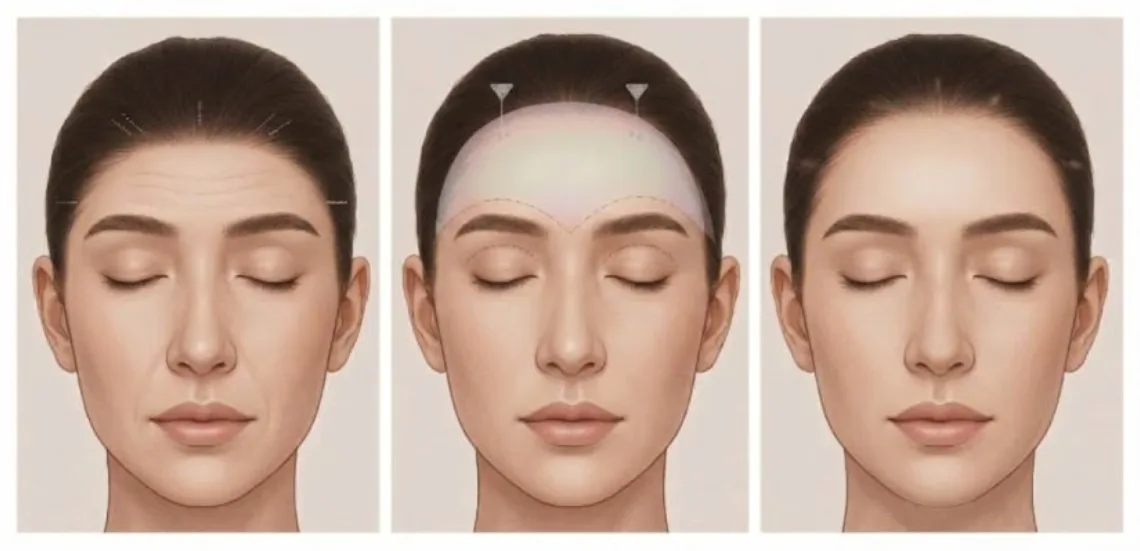
Illustration: the forehead and brow are lifted from within and held at fixation points behind the hairline (Pentafix™), rather than pulled at the skin.
The lift is held in place using a fixation technique branded Pentafix Forehead Lift™, an endoscopic five-point fixation that combines two absorbable Endotine fixation devices with bone-tunnel anchoring. The Endotines hold the lifted brow steady internally while your own tissues heal into their new position over the following weeks, then dissolve over time. That internal fixation is the reason the early weeks ask you to avoid heavy straining: you are giving those anchor points time to settle.
Numbness and a tight, slightly tingly feeling across the forehead and scalp are expected because small sensory nerves are stretched during the lift. This is temporary for the great majority of patients and fades gradually over weeks to months. Knowing this in advance is part of a sound recovery plan, and your surgeon should tell you what to expect before you ever sit in the chair.
First few days
Days 0 to 3: the first few days
On the day of surgery your forehead will feel tight, heavy and numb, and you will usually wear a light head dressing or band. Most patients are not in severe pain. The dominant sensation is pressure and tightness across the forehead, and simple prescribed pain relief is generally enough. You will be advised to rest with your head elevated, even while sleeping, because keeping the head above the heart is the single most effective way to limit swelling in these first days.
Days one to three are typically the peak of swelling and any bruising. Swelling can spread downward with gravity, so it is common to see puffiness around the upper eyelids or a slightly heavy-eyed look in the first mornings even though the surgery was on the forehead. Cool compresses (kept gentle and never pressing hard on the fixation area), staying upright during the day, and avoiding bending over all help. Light walking around your room or hotel is encouraged from early on to keep circulation moving.
These first days are exactly why many international patients plan to stay in Seoul for the early part of recovery before flying out. Being close to the clinic means that if anything feels off, the same surgeon who operated can see you quickly. You can read more about settling in for this period in our guide to recovering in Seoul after surgery.
Week 1 to 2
Week one to two: swelling settles and sutures come out
Across the first week the worst of the swelling and bruising begins to recede, and the tight, heavy feeling slowly eases into a more manageable tightness. Many patients notice that by the end of week one they look puffy and a little altered but not dramatically bruised. The difference between day 3 and day 7 is usually encouraging. Numbness over the scalp and forehead persists and is entirely normal at this stage.
The key milestone in this window is suture removal. At Garnet the scalp incisions are typically closed and the sutures or staples are removed at around day 10. This is a quick, in-clinic visit, and because the ports sit within the hairline they are hidden from view as your hair grows. After suture removal many people feel a noticeable lift in confidence, as the sense of a healing wound gives way to the sense of simply recovering.
By around two weeks a large proportion of international patients feel comfortable being seen in public and meeting people, with residual swelling that is usually subtle to others even if you can still feel it. Makeup can generally be reintroduced once incisions are healed and your surgeon confirms it is fine. This two-week mark is one reason forehead lift recovery suits a planned trip; you can read how to structure the stay in how long to stay in Korea for surgery.
Weeks to months
Weeks to months: the result settles
Between roughly two and six weeks, recovery becomes much more about refinement than visible healing. Residual swelling continues to drain, the brow position settles as the internal fixation and your own tissues integrate, and the lifted, more open look around the brow and upper eyelids becomes clearer. Many patients say the result looks slightly high or surprised in the very early weeks and then softens into a natural position as swelling fully resolves. This settling of the brow is normal and expected.
Sensation returns gradually. The numbness and occasional tingling across the scalp typically improves steadily over the first one to three months, with the final patches of altered sensation sometimes taking longer to normalise fully. Light cardiovascular activity such as walking can usually resume early, while more strenuous exercise, heavy lifting, saunas and anything that raises blood pressure in the head is held back for several weeks on your surgeon's specific guidance. This protects the fixation while it is still maturing.
By around the three-month mark most patients are seeing close to their settled result, and the six-month review is where the forehead lift's effect is fully appreciated. Because Garnet is a single-surgeon clinic, the same board-certified surgeon who performed your lift is the one assessing this settling at each stage; no different team takes over your follow-up.
Normal vs not
What's normal and what deserves a call
It helps enormously to know in advance which sensations are part of normal healing. Tightness across the forehead, numbness and tingling of the scalp, a feeling that the brows sit a little high early on, mild itching as nerves recover, and uneven swelling from one side to the other are all common and usually settle with time. A faint pulling or awareness at the fixation points as you heal is also expected.
Signs outside routine recovery, which should prompt you to contact the clinic promptly, include rapidly increasing swelling on one side, spreading redness or warmth around an incision, fever, discharge or worsening pain after it had been improving, or any sudden change in vision. These are uncommon, but the right response to any of them is simple: contact your surgeon promptly. A good clinic explains these warning signs to you before surgery.
If you have already returned home by the time a question comes up, you are not on your own. The operating surgeon can continue to review your progress remotely and advise whether something is normal settling or worth checking locally. That is why confirming who manages your after-care, covered in is plastic surgery in Korea safe, matters before you book.
Follow-up & flying
Follow-up reviews and flying home
Garnet structures after-care around scheduled reviews at 1, 3 and 6 months, with the same surgeon at each visit. The one-month review confirms the brow is settling well and that sensation is on the expected path; the three-month review assesses the maturing result; and the six-month review is where the final, settled outcome is evaluated. For international patients these later reviews are typically handled by photo and messenger once you have travelled home, so the structure follows you home after you leave Seoul.
On flying: most patients are advised to keep the very early, peak-swelling days on the ground and close to the clinic, and to agree a safe travel date individually with the surgeon before booking a return flight. Long flights, cabin pressure and the temptation to lift heavy luggage all argue for not rushing the journey home. Our guide on when you can fly after plastic surgery explains how to plan this sensibly around your suture-removal date.
If you are weighing this procedure and want a realistic recovery plan mapped to your own travel dates, you can ask all of it before committing to a trip. An online consultation from abroad lets the surgeon review your photos and give you an individual timeline, including how long to stay and when you can fly.
Prices
Price at Garnet
Pentafix™ forehead lift
From₩5,000,000 + VATExcluding VAT (10% VAT is added at payment)Book now
Same price as Korean patients. Prices shown exclude 10% VAT; your written quote, issued after the in-person consultation, shows the full amount payable.
Dr. In-Soo Baek
Director & sole operating surgeon
Korean medical licence no. 77407
Operate on what you came for. Trained at Korea University Medical Center. Every case planned, performed and reviewed by the same hands.
1Operating surgeon
~2Surgeries per day
7Registered techniques
Board-certified plastic surgeon
Plastic surgery training at Korea University College of Medicine & graduate school
Korean Society of Plastic and Reconstructive Surgeons member, in its facial-contour, eye & rhinoplasty groups
Consults, operates and follows up each case himself
Peer-reviewed papers behind the facts on this page. Each describes findings in its own study group — not results at Garnet — and none predicts your own outcome.
Rihani J. Male Browlift. Facial Plastic Surgery. 2025. doi:10.1055/a-2709-6915
Austell PJ et al. Male Brow Lift and Blepharoplasty. Facial Plastic Surgery Clinics of North America. 2024. doi:10.1016/j.fsc.2024.03.002
Zins JE et al. Endoscopic Brow Lift. Clinics in Plastic Surgery. 2022. doi:10.1016/j.cps.2022.02.003
FAQ
Common questions
How long does forehead lift recovery take?
Most of the visible recovery from an endoscopic forehead lift happens over the first one to two weeks, with sutures removed at around day 10. Many patients feel comfortable in public by about two weeks, while swelling fully resolves and sensation normalises over the following weeks to a few months, with the settled result clearest by around three to six months.
What is forehead lift recovery like day by day?
Days zero to three bring peak swelling, tightness and numbness, eased by keeping your head elevated. Through the first week swelling recedes; sutures come out around day 10. By two weeks many people feel presentable, and from two to six weeks the brow position settles and sensation gradually returns as the internal fixation matures.
When can I return to work after a forehead lift?
Many international patients return to non-physical, desk-based work within roughly one to two weeks, often timed around suture removal at day 10. Physically demanding work and anything that raises blood pressure in the head is held back longer. Your surgeon gives you a date specific to your job and how you are healing.
When does the swelling and bruising go down?
Swelling and any bruising usually peak in the first three days and then recede noticeably through the first week. By around two weeks residual swelling is often subtle to others, though you may still feel it. Full resolution and the final settled brow position continue over the following weeks to a few months.
When are the sutures removed?
At Garnet the scalp-port sutures or staples are typically removed at around day 10 in a quick in-clinic visit. Because the incisions sit within the hairline, they are hidden as your hair grows, and there is no long visible scar across the forehead.
Is forehead lift recovery painful?
Most patients describe the dominant sensation as tightness, pressure and numbness, with little sharp pain, because the endoscopic technique avoids a long open incision. Prescribed pain relief is generally enough for the early days. Discomfort eases steadily as swelling settles over the first week or two.
When can I exercise after a forehead lift?
Light walking is encouraged early to keep circulation moving, but strenuous exercise, heavy lifting, saunas and anything that raises blood pressure in the head are held back for several weeks. The exact timing is individual and confirmed by your surgeon, because it protects the internal fixation while it matures.
How long should I stay in Korea after a forehead lift?
Many international patients plan to stay through the early swelling phase and ideally until suture removal at around day 10, so the operating surgeon can check the incisions before you fly. The precise stay depends on your healing and travel plans, which the surgeon confirms with you individually.
When will the numbness go away?
Numbness and tingling across the scalp and forehead are expected because small sensory nerves are stretched during the lift. For most patients this improves steadily over the first one to three months, with any final altered patches sometimes taking a little longer to normalise fully.
Will the same surgeon follow up my recovery?
Yes. Garnet is a single-surgeon clinic, so the same board-certified surgeon who performs your forehead lift also reviews your recovery, with structured follow-ups at 1, 3 and 6 months, handled by photo and messenger once you have returned home.
My mom recently had a brow lift and lower blepharoplasty with Dr. Baek, and our experience has been wonderful so far. The Garnet team was incredibly kind and welcoming, with Kelly assisting us as our English consultant—she made everything…
I’m so happy I chose this clinic for my lower blepharoplasty. I was traveling from abroad by myself, so I was a little nervous, but from the beginning I felt comfortable and truly cared for. Everyone was kind, patient, and professional…
Came in for an in-person consult and ended up choosing Garnet and Dr.Baek for my non-incisional DES and tiplasty/alarplasty. I communicated with Kelly (English consultant) from the start till now (3 weeks post-op). She really help me feel…
My under-eyes have been sagging and folding for years... I tried to cover it up with makeup, but it actually got stuck in the wrinkles and made it stand out even more. While going for consultations, I noticed that the bigger the hospital…
Send photos and your question before you travel. An English-speaking coordinator reviews every enquiry and replies with guidance on whether surgery is appropriate, the likely plan and timing.
✓ Reviewed by the clinic coordinator, not a bot
✓ Photo-based pre-assessment before you fly
✓ Foreign-patient scheduling & after-care
✓ One surgeon for consultation, surgery and follow-up
Prefer to chat now? Reach the coordinator directly:









 T S7 months ago



