Sub-brow lift removes a strip of skin just beneath the eyebrow and re-suspends the underlying muscle to lift a heavy upper lid, and recovery is one of the gentler ones in eyelid surgery. This page walks through it day by day: the swelling and bruising of the first week, sutures coming out around day seven, when you can return to work and fly home, and what your surgeon watches for at each follow-up.
The short answer
Sub-brow lift is a skin-and-muscle procedure: a fine incision below the eyebrow, with the orbicularis muscle re-suspended to support the lift. Recovery is generally mild.
Sutures are typically removed around day 7, which is the milestone most international patients plan their stay around.
Most swelling and bruising settle within the first one to two weeks; the fine scar continues to mature and fade over the following months.
At Garnet the same board-certified surgeon, Dr. In-Soo Baek, reviews your healing personally and follows up at 1, 3 and 6 months, including by messenger after you fly home.
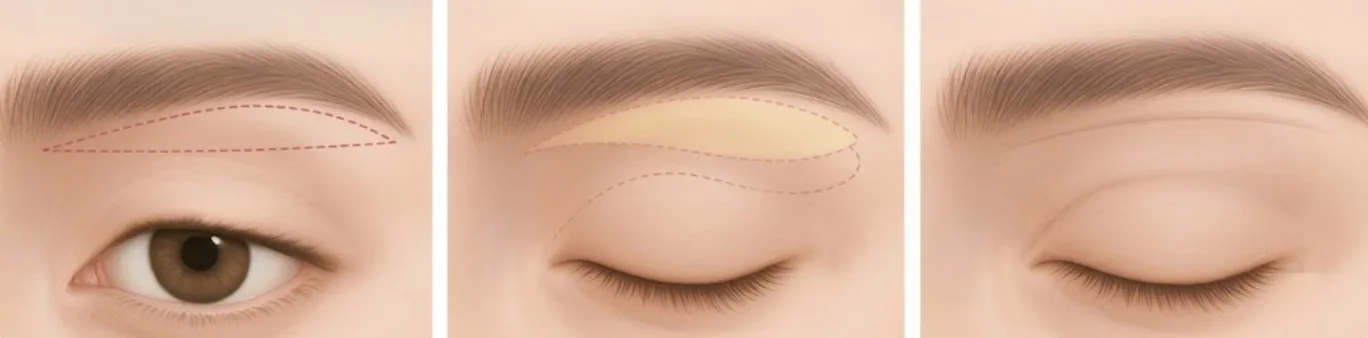
A sub-brow lift (sometimes called a brow-pexy or sub-eyebrow lift) removes a fine strip of skin just beneath the eyebrow and re-suspends the underlying orbicularis muscle, lifting heavy, hooding upper-lid skin without cutting across the eyelid itself. Because the incision sits in the lower edge of the brow and the work is relatively superficial, this is one of the gentler eyelid operations to recover from, and most people are presentable in public sooner than they expect.
Illustration: a strip of excess skin is taken from just below the eyebrow (dotted line), so the heavy upper lid opens without touching the eyelid itself. The fine line sits along the lower brow edge.
Recovery still follows a predictable arc: a few days of swelling and possible bruising, sutures removed at about a week, then a longer, quieter phase where the fine scar matures and fades. Knowing what each stage should look like makes the difference between calm recovery and needless worry. For the procedure itself, including how the incision and muscle suspension are done, see the main sub-brow lift page, and for the related cost question, what a sub-brow lift costs in Korea.
The timeline below is a general guide. Your own pace depends on your skin, how much was lifted, and how closely you follow after-care. That is why it matters that the same surgeon reviews you at each stage.
Days 1–3
Days 1 to 3: swelling peaks
You go home the same day. The brow and upper-lid area will feel tight and a little tender, and swelling typically builds over the first 48 to 72 hours before it begins to settle. This peak is normal. Some bruising along the brow or upper lid is common and varies a lot from person to person; it is gravity-dependent, so it may drift slightly downward as it resolves.
Cold compresses in the first day or two, keeping your head elevated (including propped up while you sleep), and avoiding bending, straining or heavy lifting all help the swelling go down faster. Keep the incision clean and dry as instructed, take any prescribed medication, and avoid alcohol and vigorous activity. Discomfort at this stage is usually mild, and simple pain relief is normally enough.
If you are recovering in Seoul, these first days are best spent resting near the clinic, with sightseeing left for later. See recovering in Seoul after surgery for how to plan them.
Days 4–7
Days 4 to 7: bruising fades and sutures come out
By the middle of the first week the worst of the swelling is easing and any bruising starts to fade and change colour. The brow will still look a little swollen and the scar line fresh, but you will feel noticeably more like yourself than on day two. Many people are comfortable being seen in public around now, especially with glasses.
The key milestone is suture removal, which for sub-brow lift is typically around day 7. This is a quick, in-clinic step, and at Garnet it is also when the surgeon reviews how the brow is settling, checking the lift, the incision and the early scar before you travel onward. This is why most international patients build their stay around a one-week window: the sutures come out and the wound is checked in person, so you do not need to find that care abroad.
Once the sutures are out the scar enters its maturing phase, and you can usually wear light makeup over the area after the surgeon confirms the incision has sealed. For how that scar develops over the longer term, see sub-brow lift scars and healing, and for the bruising and swelling pattern in more detail, swelling and bruising.
Weeks 2–4
Weeks 2 to 4: back to normal life
Through the second to fourth weeks the remaining swelling continues to subside and most people return to normal daily life and desk work; many feel ready for office work within a week or so of surgery, and certainly by the second week, depending on how visible the residual bruising is and how comfortable you feel. The lifted shape becomes cleaner as the last puffiness resolves and the brow position settles.
Light activity is fine, but ease back into vigorous exercise, heavy lifting and anything that raises blood pressure to the face gradually over these weeks. Your surgeon will give you a specific timeline. Continue to protect the healing scar from strong sun, which can darken a fresh scar; sun protection is one of the simplest things you can do for a good long-term result.
Most people who travelled for the surgery have flown home well before this stage. If you are wondering about the flight itself, see when you can fly after plastic surgery.
Months 1–6
Months 1 to 6: the scar matures
By one month the visible recovery is largely behind you: swelling is minimal, the lift looks natural, and the brow sits in its settled position. What continues quietly is the scar. A sub-brow incision sits in the lower edge of the eyebrow where it is well concealed, and it typically begins as a faint pink or red line that gradually softens, flattens and fades toward your skin tone over the following months.
Scar maturation takes months, usually improving across 3 to 6 months and beyond. Protecting it from the sun, not picking at it, and following any scar-care advice all help it settle well. Your surgeon assesses the final, fully matured appearance of the sub-brow scar at the later follow-ups.
This is exactly why structured follow-up matters. Garnet reviews healing at 1, 3 and 6 months so the lift and the scar are checked through their full course, well beyond the first busy week.
Normal vs red flag
What's normal after a sub-brow lift, and what is not
Normal in the first week: tightness, swelling that peaks around days two to three, bruising that fades and shifts colour, a fresh pink scar line, and mild discomfort managed with simple pain relief. Mild asymmetry in swelling between the two sides early on is also common and usually evens out as it settles. None of these need alarm.
Contact the clinic promptly, on the other hand, if you have swelling that suddenly worsens after it had started improving, pain that keeps increasing, spreading redness or warmth around the incision, discharge or a fever, or any change in vision. These are uncommon but worth reporting early. Knowing who to contact before you travel home is part of safe planning. At a single-surgeon clinic the operating surgeon stays reachable himself.
If anything worries you after you have flown home, you can reach the surgeon by messenger for guidance on whether it is normal or needs local review. See how Garnet handles after-care in an online consultation.
At Garnet
How Garnet follows your recovery
Garnet, a plastic surgery clinic in Apgujeong, Seoul, has a single surgeon: Dr. In-Soo Baek, board-certified in plastic surgery (Korean medical licence no. 77407). He performs your sub-brow lift himself and personally reviews your healing, including suture removal at around day seven and structured follow-ups at 1, 3 and 6 months. Because the same surgeon sees you at each stage, small questions during recovery go to the person who actually operated.
The clinic caps the day at two surgeries and one patient per hour, and a dedicated coordinator stays with you from consultation through recovery. Garnet is registered with Korea's foreign-patient programme, and after you fly home the surgeon can continue to review your progress by messenger. You can plan the whole timeline (surgery, the one-week suture window and your flight) in a no-obligation online assessment before you travel.
Prices
Price at Garnet
Sub-brow lift
From₩2,500,000 + VATExcluding VAT (10% VAT is added at payment)Book now
Same price as Korean patients. Prices shown exclude 10% VAT; your written quote, issued after the in-person consultation, shows the full amount payable.
Dr. In-Soo Baek
Director & sole operating surgeon
Korean medical licence no. 77407
Operate on what you came for. Trained at Korea University Medical Center. Every case planned, performed and reviewed by the same hands.
1Operating surgeon
~2Surgeries per day
7Registered techniques
Board-certified plastic surgeon
Plastic surgery training at Korea University College of Medicine & graduate school
Korean Society of Plastic and Reconstructive Surgeons member, in its facial-contour, eye & rhinoplasty groups
Consults, operates and follows up each case himself
Peer-reviewed papers behind the facts on this page. Each describes findings in its own study group — not results at Garnet — and none predicts your own outcome.
Wang D et al. Upper Blepharoplasty through Infrabrow Skin Excision to Treat Dermatochalasis with Lateral Hooding and Medial Orbital Fat Loss in Selected Patients. Annals of Plastic Surgery. 2024. doi:10.1097/sap.0000000000004006
Yang X et al. Shortened Infrabrow Excision Blepharoplasty Combined with the Removal of Orbicularis Oculi Muscle for Dermatochalasis in Asians. Journal of Craniofacial Surgery. 2022. doi:10.1097/scs.0000000000008685
Eid L et al. Subbrow Blepharoplasty in Caucasians. Plastic & Reconstructive Surgery. 2021. doi:10.1097/prs.0000000000007633
FAQ
Common questions
How long does sub-brow lift recovery take?
The visible early recovery takes about one to two weeks: swelling peaks around days two to three, bruising fades over the first week, and sutures come out around day 7. Most people return to normal daily life and desk work within roughly one to two weeks. The fine scar then continues to mature and fade over the following three to six months.
When are the sutures removed after a sub-brow lift?
Sutures are typically removed around day 7. At Garnet this visit is also when the surgeon reviews how the brow is settling (the lift, the incision and the early scar), which is why most international patients plan a stay of about a week so they can have it done in person before travelling on.
When can I return to work after a sub-brow lift?
Many people feel ready for desk or office work within about a week, and most by the second week, depending on how visible any residual bruising is and how comfortable you feel being seen. Easing back into vigorous exercise and heavy lifting takes a little longer; your surgeon will give you a specific timeline.
What does sub-brow lift recovery feel like day by day?
Days 1–3: tightness and swelling that peaks, with possible bruising. Days 4–7: swelling eases, bruising fades, sutures come out around day 7. Weeks 2–4: back to normal life as the last puffiness settles. Months 1–6: the visible recovery is done and the fine scar matures and fades.
How long until the swelling and bruising go down?
Swelling usually peaks around days two to three and settles substantially over the first one to two weeks; any bruising fades and changes colour across the first week. Cold compresses early on, keeping your head elevated, and avoiding bending or straining all help it resolve faster. Minor residual puffiness can linger a little longer before fully settling.
How long do I need to stay in Korea for a sub-brow lift?
A stay of roughly a week is typical, so you can have your sutures removed and the wound checked around day 7 before flying home. Building your trip around that one-week window means your in-person after-care is done by the surgeon who operated, in Seoul. See the guidance on how long to stay in Korea for surgery for full planning.
When can I fly home after a sub-brow lift?
Many people are comfortable flying after suture removal around the one-week mark, once the surgeon has confirmed the wound is healing well. The exact timing depends on your healing and flight length, so confirm it with the surgeon before booking a return flight too tightly. See "when can I fly after plastic surgery" for the full picture.
What aftercare follows a sub-brow lift?
Keep the incision clean and dry, use cold compresses and head elevation early on, avoid bending, straining, alcohol and vigorous activity in the first days, take any prescribed medication, and protect the healing scar from strong sun. Sutures come out around day 7, and the surgeon reviews your healing at 1, 3 and 6 months.
When should I be concerned during recovery?
Contact the clinic if swelling suddenly worsens after improving, pain keeps increasing, redness or warmth spreads around the incision, or there is discharge, fever or any change in vision. These are uncommon but worth reporting early. At a single-surgeon clinic the operating surgeon stays reachable, including by messenger after you return home.
My mom recently had a brow lift and lower blepharoplasty with Dr. Baek, and our experience has been wonderful so far. The Garnet team was incredibly kind and welcoming, with Kelly assisting us as our English consultant—she made everything…
I’m so happy I chose this clinic for my lower blepharoplasty. I was traveling from abroad by myself, so I was a little nervous, but from the beginning I felt comfortable and truly cared for. Everyone was kind, patient, and professional…
Came in for an in-person consult and ended up choosing Garnet and Dr.Baek for my non-incisional DES and tiplasty/alarplasty. I communicated with Kelly (English consultant) from the start till now (3 weeks post-op). She really help me feel…
My under-eyes have been sagging and folding for years... I tried to cover it up with makeup, but it actually got stuck in the wrinkles and made it stand out even more. While going for consultations, I noticed that the bigger the hospital…
If you are planning a sub-brow lift around your travel dates, send photos for a pre-assessment and we'll map out the surgery, suture-removal week and your flight home.
Send photos and your question before you travel. An English-speaking coordinator reviews every enquiry and replies with guidance on whether a sub-brow lift is appropriate for you, the likely plan and timing.
✓ Reviewed by the clinic coordinator, not a bot
✓ Photo-based pre-assessment before you fly
✓ Foreign-patient scheduling & after-care
✓ One surgeon for consultation, surgery and follow-up
Prefer to chat now? Reach the coordinator directly:










 T S7 months ago



