Swelling and a little bruising around the brow and eyelid are a normal part of healing after a sub-brow lift and do not mean a complication. Knowing roughly how long they last, and the simple things that help them settle, is the difference between a calm recovery and an anxious one.
The short answer
Swelling and bruising peak in the first two to three days, then ease noticeably over the first week as the sutures come out around day 7.
Most visible swelling settles over the following weeks, with the brow looking far more natural by around the first month; subtle puffiness can linger longer.
Simple measures help reduce swelling and bruising: head elevation, cold compresses early on, rest, and avoiding alcohol and strenuous activity.
Symmetrical, steadily improving swelling is normal; spreading redness, increasing pain, warmth or one-sided rapid swelling should be flagged to your surgeon.
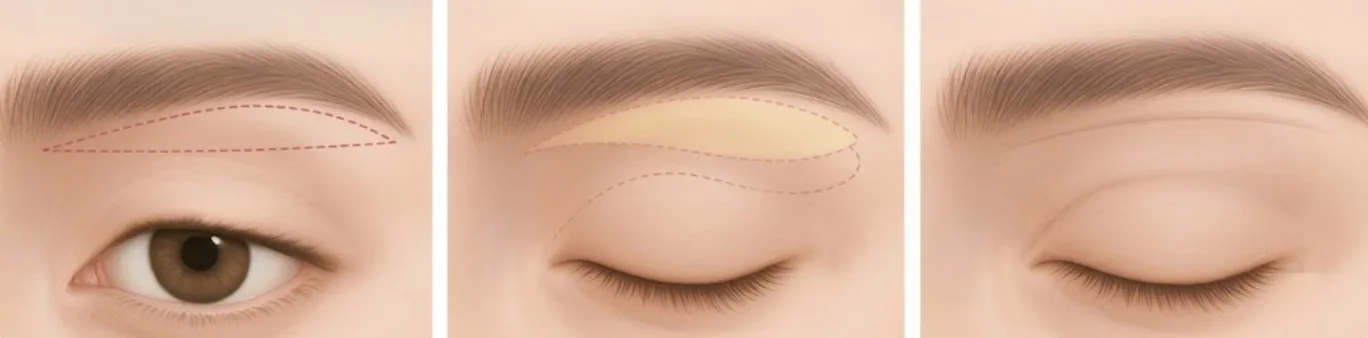
A sub-brow lift removes a strip of skin at the lower brow border and secures the lift with an orbicularis suspension fixation, which uses internal sutures through the muscle. Any surgery in the delicate brow and eyelid area disturbs small blood vessels and tissue, and the body's normal response is to send fluid to the site. That fluid is the swelling, and small vessel leakage near the surface is the bruising.
Illustration: a strip of excess skin is taken from just below the eyebrow (dotted line), so the heavy upper lid opens without touching the eyelid itself. The fine line sits along the lower brow edge.
The brow and eyelid swell easily because the skin there is thin and the tissue is loose, so even a modest amount of fluid looks puffy. This is also why swelling here tends to be gravity-dependent. It can look worse first thing in the morning and settle through the day as you stay upright.
None of this means anything has gone wrong; it is the expected aftermath of a procedure done in a forgiving but reactive part of the face. What varies between people is how much they swell and bruise and how quickly it clears, which depends partly on individual healing and partly on how carefully the early days are managed.
How long
How long swelling and bruising last
Swelling and bruising typically peak in the first two to three days, which is the puffiest, most discoloured the area will look. From there they ease fairly steadily through the first week. At Garnet the sutures come out at around day 7, and by that point the brow usually looks markedly calmer than it did at day two or three.
Over the following two to three weeks most of the visible swelling resolves, and by around the first month the brow generally looks natural enough to be seen socially. A degree of subtle, deeper puffiness can persist longer and continues to settle quietly over the following weeks. This is the residual swelling that masks the true result, and it is nothing to worry about.
Bruising usually clears faster than swelling, often fading from purple through yellow-green over one to two weeks as it reabsorbs. The full day-by-day picture of this recovery, including activity milestones, is set out in the sub-brow lift recovery timeline, and how it affects when you see your final look is covered in when will I see results.
Reducing it
Practical ways to reduce swelling and bruising
The most effective early measure is keeping your head elevated, including propping yourself up with an extra pillow when you sleep for the first several nights. Gravity then drains fluid away from the brow so it does not pool overnight. Gentle cold compresses around the area in the first 48 hours, applied as your surgeon directs and never pressed hard on the wound, also help limit swelling and bruising.
Rest matters more than people expect: avoiding strenuous activity, heavy lifting and bending forward in the early days keeps blood pressure in the head down and reduces both swelling and the risk of fresh bruising. Alcohol and, where relevant, blood-thinning habits work against you here, so following the pre- and post-operative instructions on those is worth taking seriously.
Staying hydrated, eating sensibly and easing back into normal activity at the pace your surgeon advises all support a smooth settle. Avoid the temptation to test the result by frowning or rubbing the brow. Leaving the area undisturbed lets the swelling clear and the closure heal without interference.
Bruising
Bruising around the eye and how it travels
Because the brow sits just above the eye, bruising from a sub-brow lift can track downward into the upper or even lower eyelid over the first days, because gravity pulls the discolouration lower before it clears. Waking up with a bruised-looking eyelid a couple of days after surgery can be alarming if you are not expecting it, but it is a normal pattern and not a sign of a problem.
Bruising typically changes colour as it heals, moving from red-purple to green and yellow before fading, usually within one to two weeks. People who bruise easily, or who were on anything that affects clotting, may bruise more. That is one reason a careful pre-operative review of your history matters.
Once the wound is fully sealed, light camouflage makeup can cover residual bruising if you have somewhere to be, and the brow's natural shadow helps. If you are planning to fly home soon after surgery, timing the flight after the worst of the swelling and bruising has settled is sensible. The flying-after-surgery guide covers eye-area timing.
Normal vs not
What is normal swelling after a sub-brow lift, and what is worth flagging
Swelling and bruising that are roughly symmetrical and improving day by day are the normal, expected course. Mild tightness, puffiness that is worse in the morning, and bruising that tracks down toward the eyelid are all part of ordinary healing and tend to settle on their own.
What is worth reporting promptly is swelling that suddenly increases instead of easing, especially on one side; spreading redness; warmth; pain that is increasing; or any discharge from the wound. These are uncommon after a sub-brow lift, but they are the signs to raise with your surgeon promptly, particularly once you are back home.
This is exactly where having the operating surgeon reachable matters. If you are unsure whether your swelling is normal, you can ask the doctor who performed the surgery, which at a single-surgeon clinic is the same person at every consultation and follow-up.
At Garnet
How Garnet supports you through the swelling phase
Garnet is a single-surgeon clinic in Apgujeong, Seoul. Dr. In-Soo Baek is a board-certified plastic surgeon (Korean medical licence no. 77407) who consults, performs the operation himself and reviews every follow-up. If you are worried about swelling in the first weeks, the person you ask is the one who operated.
Because the day is capped at two surgeries, your early recovery is reviewed unhurriedly, and a dedicated coordinator stays with you from consultation through recovery. The structured follow-ups at 1, 3 and 6 months give clear checkpoints for confirming the swelling is settling as expected and the result is emerging.
For international patients who fly home while still settling, the same surgeon can continue to review photos and reassure you about normal swelling as it clears. If you are still deciding, you can send photos for a no-obligation online assessment and ask exactly what your recovery would involve before you travel.
Prices
Price at Garnet
Sub-brow lift
From₩2,500,000 + VATExcluding VAT (10% VAT is added at payment)Book now
Same price as Korean patients. Prices shown exclude 10% VAT; your written quote, issued after the in-person consultation, shows the full amount payable.
Dr. In-Soo Baek
Director & sole operating surgeon
Korean medical licence no. 77407
Operate on what you came for. Trained at Korea University Medical Center. Every case planned, performed and reviewed by the same hands.
1Operating surgeon
~2Surgeries per day
7Registered techniques
Board-certified plastic surgeon
Plastic surgery training at Korea University College of Medicine & graduate school
Korean Society of Plastic and Reconstructive Surgeons member, in its facial-contour, eye & rhinoplasty groups
Consults, operates and follows up each case himself
Peer-reviewed papers behind the facts on this page. Each describes findings in its own study group — not results at Garnet — and none predicts your own outcome.
Kim YS et al. Infrabrow Excision Blepharoplasty: Applications and Outcomes in Upper Blepharoplasty in Asian Women. Plastic and Reconstructive Surgery. 2008. doi:10.1097/prs.0b013e3181858fc0
Parkes ML et al. Infrabrow lift. The Laryngoscope. 1976. doi:10.1002/lary.5540861213
Pascali M et al. Brows Asymmetry Correction With the Direct Approach. Journal of Craniofacial Surgery. 2016. doi:10.1097/scs.0000000000002408
FAQ
Common questions
How long does swelling last after a sub-brow lift?
Swelling peaks in the first two to three days, then eases through the first week, with sutures out around day 7. Most visible swelling resolves over the following two to three weeks, and the brow usually looks natural by around the first month, though subtle puffiness can linger longer.
How long does bruising last after a sub-brow lift?
Bruising usually clears faster than swelling, typically fading over one to two weeks as it changes colour from purple to green and yellow. It can track down toward the eyelid in the first days, which is a normal gravity effect.
How can I reduce swelling and bruising after surgery?
Keep your head elevated, including when sleeping for the first several nights, and use gentle cold compresses in the first 48 hours as directed. Rest, avoid strenuous activity, bending and heavy lifting, avoid alcohol, stay hydrated, and leave the brow undisturbed.
Is swelling after a sub-brow lift normal?
Yes. Swelling and some bruising are a normal part of healing in the thin, reactive skin of the brow and eyelid. They are not a complication. Swelling that is roughly symmetrical and improving day by day is the expected course and settles over the first weeks.
Why is my eyelid bruised when the incision is at the brow?
Gravity pulls bruising downward, so discolouration from a brow incision often tracks into the upper or lower eyelid over the first days before clearing. Waking with a bruised-looking eyelid a couple of days after surgery is a normal pattern.
Why does my brow look puffier in the morning?
Swelling in the brow and eyelid is gravity-dependent, so fluid pools overnight while you lie flat and the area looks puffier first thing, then settles through the day as you stay upright. Sleeping propped up for the first several nights helps reduce this.
When should I be concerned about swelling or bruising?
Flag swelling that suddenly increases, especially on one side, along with spreading redness, warmth, increasing pain or any discharge. These are uncommon but should be raised with your surgeon promptly, particularly once you are home.
Can the same surgeon reassure me about swelling after I fly home?
At a single-surgeon clinic the operating surgeon manages your recovery, so the doctor who performed your lift can review photos and tell you whether your swelling is settling normally after you return home, through Garnet's structured 1, 3 and 6-month follow-ups.
My mom recently had a brow lift and lower blepharoplasty with Dr. Baek, and our experience has been wonderful so far. The Garnet team was incredibly kind and welcoming, with Kelly assisting us as our English consultant—she made everything…
I’m so happy I chose this clinic for my lower blepharoplasty. I was traveling from abroad by myself, so I was a little nervous, but from the beginning I felt comfortable and truly cared for. Everyone was kind, patient, and professional…
Came in for an in-person consult and ended up choosing Garnet and Dr.Baek for my non-incisional DES and tiplasty/alarplasty. I communicated with Kelly (English consultant) from the start till now (3 weeks post-op). She really help me feel…
My under-eyes have been sagging and folding for years... I tried to cover it up with makeup, but it actually got stuck in the wrinkles and made it stand out even more. While going for consultations, I noticed that the bigger the hospital…
To learn what recovery from a sub-brow lift would involve for you, send photos for a no-obligation assessment and ask exactly what swelling and downtime to expect before you plan a trip.
Send photos and your question before you travel. An English-speaking coordinator reviews every enquiry and replies with guidance on whether surgery is appropriate, the likely plan and timing.
✓ Reviewed by the clinic coordinator, not a bot
✓ Photo-based pre-assessment before you fly
✓ Foreign-patient scheduling & after-care
✓ One surgeon for consultation, surgery and follow-up
Prefer to chat now? Reach the coordinator directly:









 T S7 months ago



