The single most common worry after incision double eyelid surgery is that the crease looks too high, too deep or too tight in the first weeks. That early appearance is swelling in the upper lid. The true final shape of an incisional crease emerges slowly, softening and dropping into its natural position over 3 to 6 months. Knowing that timeline in advance turns an anxious early phase into a predictable one.
The short answer
The crease looks high, deep and tight in the first weeks because of swelling. This is expected, and the final crease comes later.
Most patients look presentable for everyday life by around two to three weeks, once the obvious swelling has faded and bruising has cleared.
The crease keeps softening and settling toward its natural height for roughly three to six months, sometimes longer for deeper or revision work.
Because the same board-certified surgeon reviews you at 1, 3 and 6 months, the settling can be tracked against what was planned at your consultation.
Why incision double eyelid results take time to appear
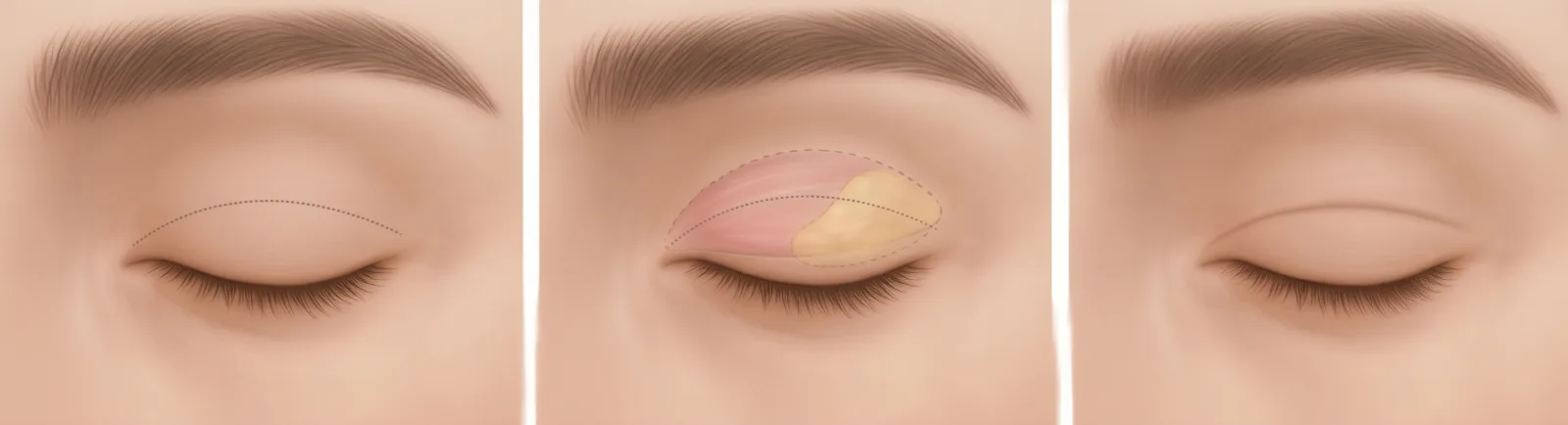
Incision double eyelid surgery forms a defined crease through a full upper-lid incision, sometimes with adjustment of skin, fat or muscle, and ptosis correction can be added in the same operation where the lid also needs lifting. Because it is an open technique and uses more than a few buried stitches, the eyelid swells more in the early phase and takes longer to show its true shape than the non-incision method. The trade-off is a more durable, clearly defined fold once everything settles. The full overview of the operation is on the parent cell, incision double eyelid.
Illustration: the crease is set through an incision along the planned fold; the tissue beneath (muscle in pink, fat in yellow) is adjusted so the crease holds.
Results emerge in two overlapping stages. First, swelling subsides over the early weeks, which is what makes the crease look gradually lower and softer. Second, the deeper tissues continue to relax and the scar matures, so the fold keeps refining its height and curve for months after the swelling has visibly gone. Most patients underestimate this second, slower stage, which is exactly where the natural final look is decided.
The practical takeaway is patience. The crease you see at the suture-removal visit is a swollen, exaggerated version of your eventual result and sits higher and tighter than it will end up. Judging the outcome too early is the single most common source of unnecessary worry, and almost never reflects the settled fold.
First weeks
The first weeks: a high, tight crease is normal
Sutures from the incision are typically removed at around day 7, and that is usually the moment patients first study the crease closely. At this point the fold sits high on the lid and looks deep and firm, because the tissue underneath is still swollen and the new crease has not yet relaxed. This is the expected appearance and does not mean the crease was set too high. For the full early-recovery breakdown, the day-by-day milestones are covered on incision double eyelid recovery timeline.
Through weeks two and three the most obvious swelling fades and any bruising clears, so the crease begins to look less harsh and more like a natural fold. Most people feel comfortable in everyday social and work settings around this point, though the eyelid is still subtly fuller than it will eventually be, and the two eyes may settle at slightly different speeds. Asymmetry in these early weeks is common and usually evens out as swelling resolves.
What you should not do during this window is conclude that the crease is wrong. The early weeks are about swelling leaving the lid; the final shape arrives later. Expect steady, visible improvement week by week, with the crease looking progressively softer and lower as the lid de-swells.
Settling
Months one to six: the crease softens and settles
Once the early swelling has gone, a slower and quieter phase takes over. Over roughly the first one to three months the crease continues to drop slightly and soften, losing the tight, sculpted look of the early weeks and beginning to move and fold more naturally when you blink or look down. This is the stage where the result starts to genuinely resemble what was planned, and the swollen version seen at suture removal fades.
Between three and six months the scar line along the crease matures and pales, residual fullness in the lid finishes resolving, and the fold reaches a stable height and curve. For most single, straightforward cases the result is close to final by around three months and fully settled by six. Deeper work, revision cases, or eyelids that also had ptosis correction can take toward the longer end of that range to look completely finished.
Comparing your eyes with early post-operative photos is the most reliable way to see this progress. The mirror each morning shows too little. Day-to-day the change is too gradual to notice; month to month it is clear. If you are weighing this against a quicker-settling option, the trade-offs are laid out on non-incision vs incision double eyelid.
Final result
When the incision double eyelid result is truly final
As a working rule, the crease is largely settled by around three months and considered final at about six months, when the swelling is fully gone and the scar has matured. This is why a careful surgeon will not judge the height or symmetry of the fold as finished until that point. Any conversation about whether the result meets the plan belongs at the 3- and 6-month follow-ups.
A defined incisional crease is durable and is designed to hold its shape over the long term, which is part of why patients choose it over a softer, buried-suture line. Once settled, the fold continues to age naturally with the rest of the face, but it does not normally need re-doing on a schedule. If a true revision is ever warranted, it is usually only considered once the crease has fully matured.
Because the operating surgeon also reviews recovery, the settling can be checked against what was discussed before surgery. You can ask, before you ever travel, exactly what timeline to expect for your specific eyelid in an online consultation.
A good result
What a good incision double eyelid result looks like
A well-judged incisional crease looks like a natural fold for your face and avoids a high, carved line. It should fold softly when you blink, sit at a height that suits your eye shape and brow, and look balanced between the two sides once swelling has fully resolved. Slight differences between the eyes during healing are normal; the goal is symmetry at the settled stage, well after week one.
A pre-assessment matters here, because the right crease height depends on your existing lid skin, fat and any underlying ptosis. A single fashionable look applied to everyone ignores those. A surgeon who explains what shape your anatomy will realistically support, and who declines to promise a specific dramatic look, is giving you the most useful information. Candidacy and shape are covered on who is a good candidate for incision double eyelid.
Above all, a good result is one you judge at the right time. The fold that looks slightly high and firm at three weeks, and natural and settled at four to six months, has behaved exactly as it should.
At Garnet
How Garnet tracks your result over time
Garnet is a single-surgeon clinic in Apgujeong, Seoul. Dr. In-Soo Baek is a board-certified plastic surgeon (Korean medical licence no. 77407) and the only operating doctor. He marks the crease himself, performs the incision double eyelid surgery and personally reviews every follow-up. Because the same surgeon sees the crease at consultation and at recovery, the way it settles can be measured against exactly what was planned for your eyelid.
Follow-up is structured at 1, 3 and 6 months, which maps directly onto the result timeline: the 1-month visit confirms swelling is leaving on schedule, the 3-month visit shows the crease close to its settled shape, and the 6-month visit confirms the final result. For international patients, these reviews can continue by messenger after you return home, and Garnet is registered with Korea's foreign-patient programme.
If you want to understand the realistic timeline for your own eyes before committing to travel, you can send photos for a pre-assessment through an online assessment, including a frank view of what crease height your anatomy will naturally hold.
Real Results
Before & After
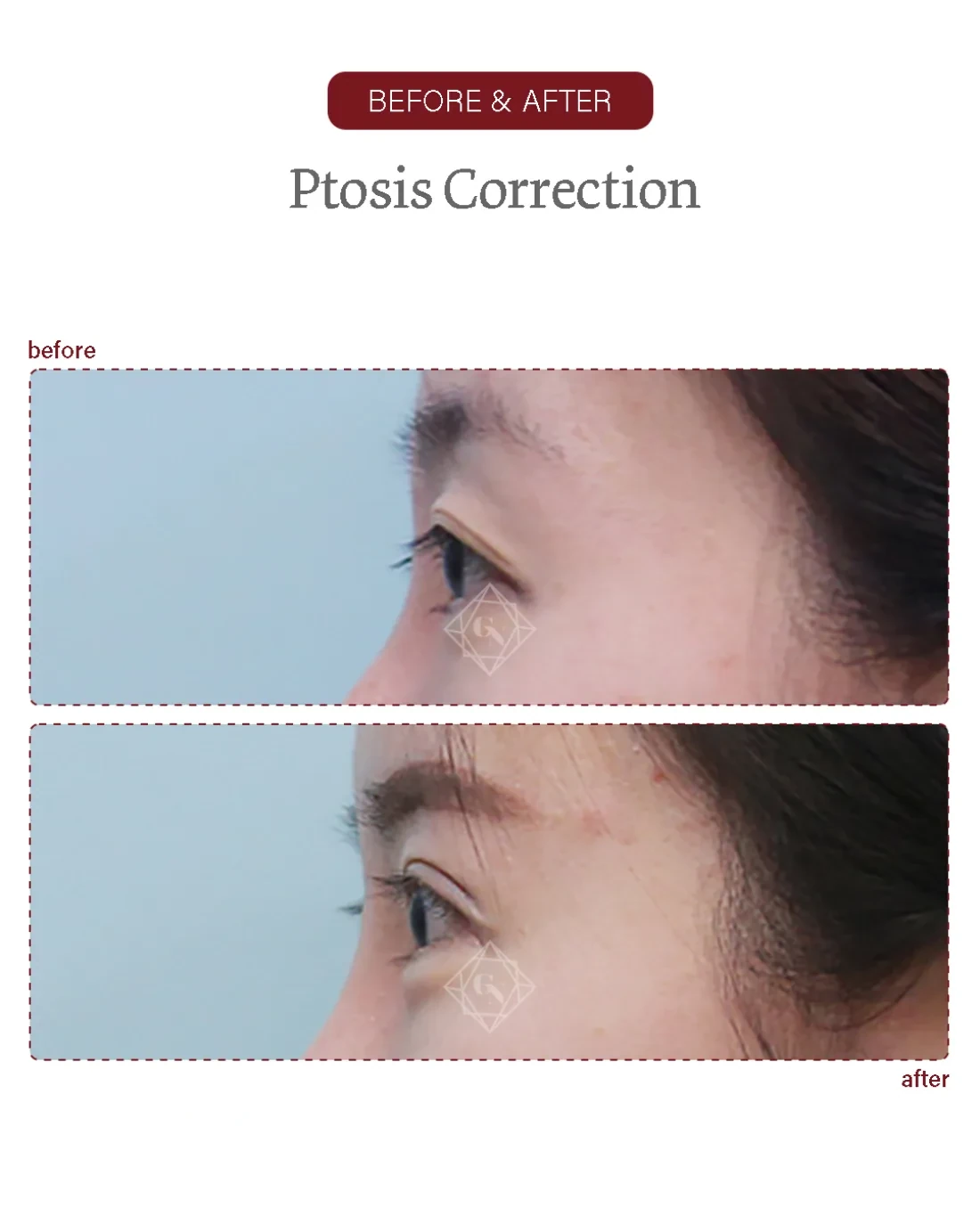
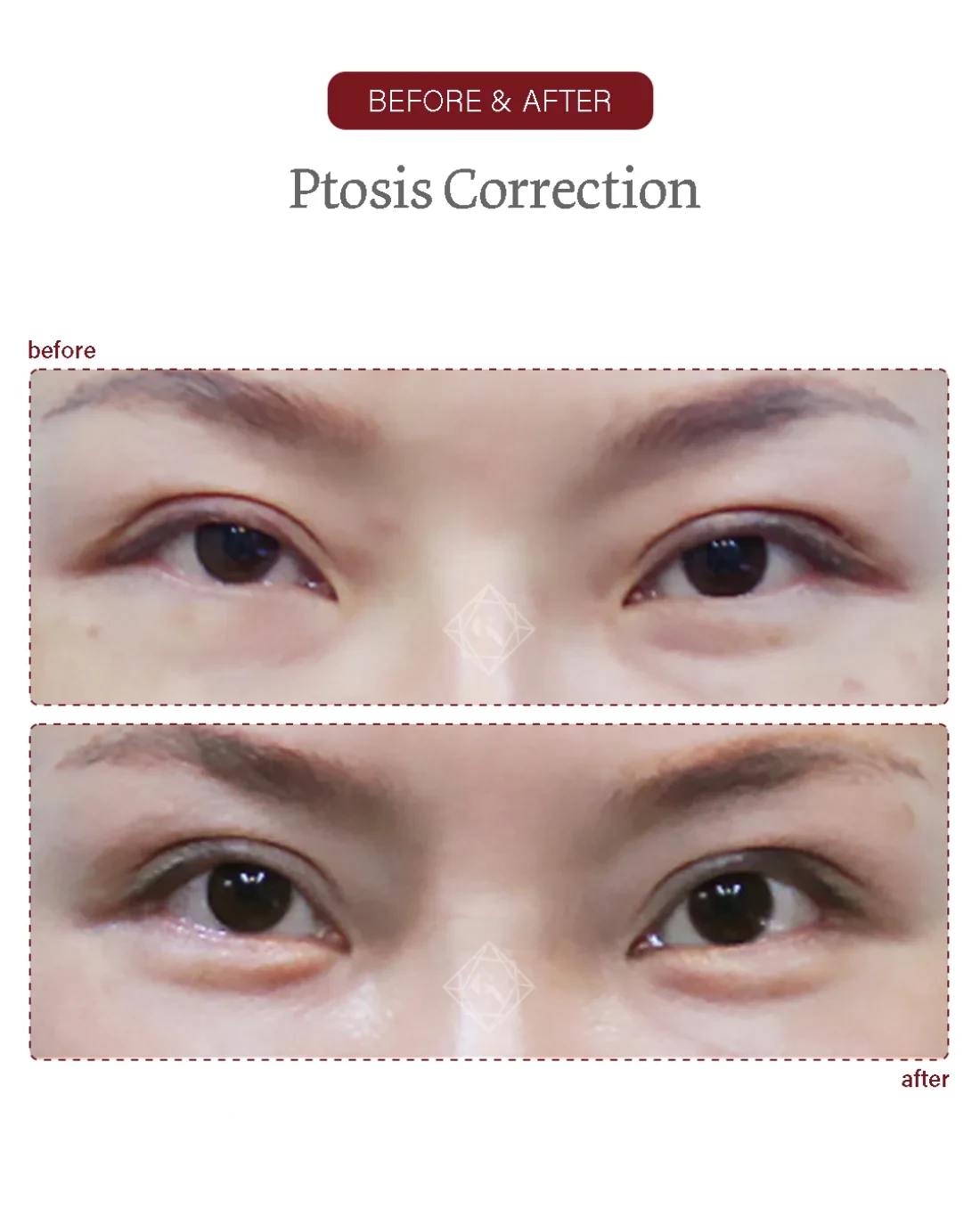
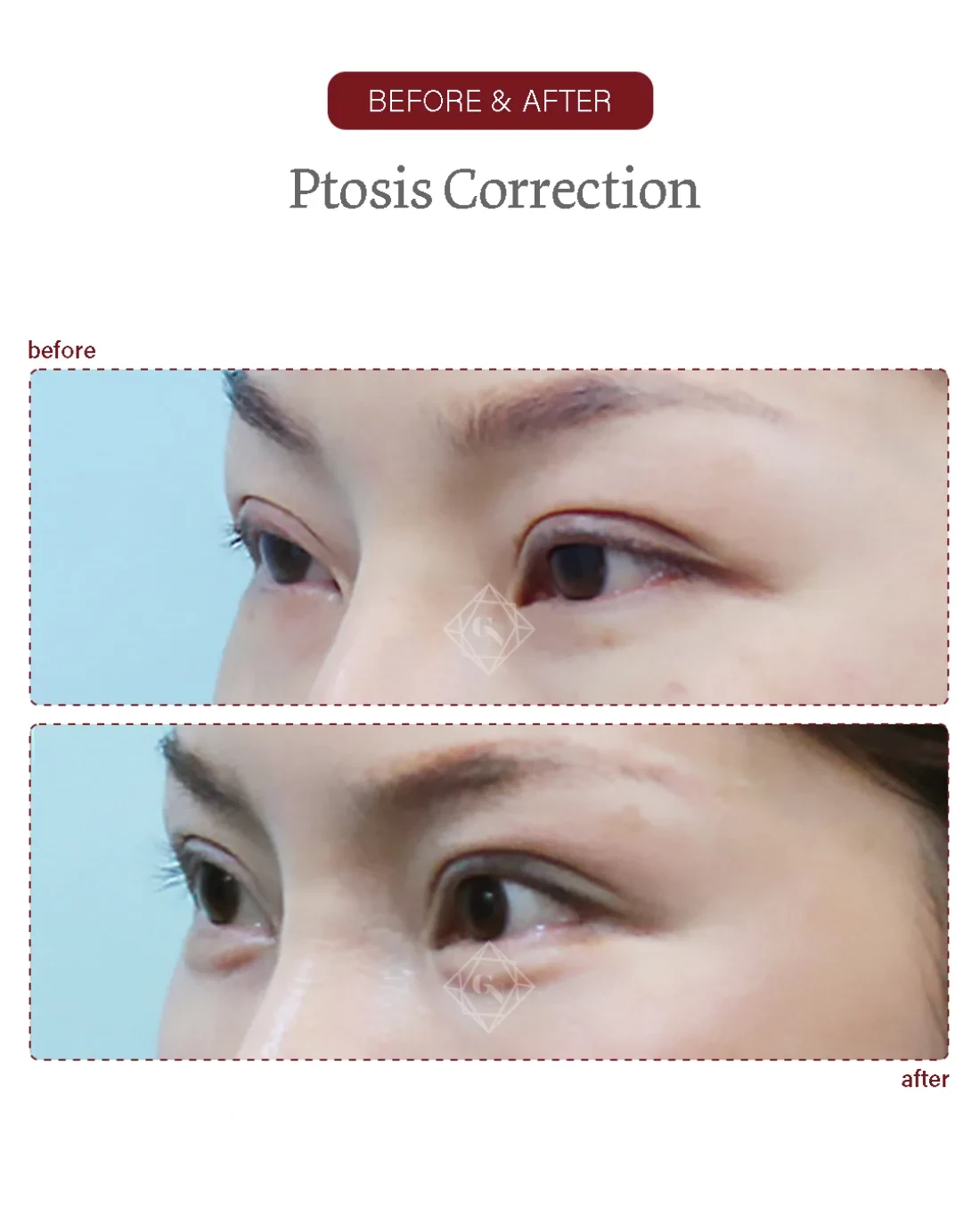
Ptosis-correction before/after examples of actual Garnet patients (published with consent). Results, recovery and suitability vary by individual and are not guaranteed; the right approach is decided at an in-person consultation.
Dr. In-Soo Baek
Director & sole operating surgeon
Korean medical licence no. 77407
Operate on what you came for. Trained at Korea University Medical Center. Every case planned, performed and reviewed by the same hands.
1Operating surgeon
~2Surgeries per day
7Registered techniques
Board-certified plastic surgeon
Plastic surgery training at Korea University College of Medicine & graduate school
Korean Society of Plastic and Reconstructive Surgeons member, in its facial-contour, eye & rhinoplasty groups
Consults, operates and follows up each case himself
Peer-reviewed papers behind the facts on this page. Each describes findings in its own study group — not results at Garnet — and none predicts your own outcome.
Zhang Y et al. Less Is Better: Full-Incision Double-Eyelid Blepharoplasty with Rapid Recovery. Plastic & Reconstructive Surgery. 2023. doi:10.1097/prs.0000000000010700
Yu P et al. Small-Incisional Techniques for Double-Eyelid Blepharoplasty: A Systematic Review. Aesthetic Plastic Surgery. 2022. doi:10.1007/s00266-022-03154-5
Lam SM. Asian Blepharoplasty. Facial Plastic Surgery Clinics of North America. 2014. doi:10.1016/j.fsc.2014.04.002
FAQ
Common questions
When will I see the final results of incision double eyelid?
The crease is largely settled by around three months and considered final at about six months. The early weeks show a swollen, high version of the fold; the natural final shape only appears once swelling has fully resolved and the scar has matured, so judging the result before three months is misleading.
Why does my crease look too high after incision double eyelid?
A high, deep, tight-looking crease in the first weeks is caused by swelling in the lid. It does not mean the crease was set too high. As the swelling subsides over the following weeks and months, the fold drops and softens into its natural position. This early appearance is expected and almost always resolves.
How does the result change over time?
It softens. In the first weeks swelling fades, so the crease looks gradually lower and more natural. Over one to six months the deeper tissue relaxes and the scar matures, and the fold settles to its final height and curve, folding naturally when you blink instead of sitting as a tight line.
When is the swelling gone after incision double eyelid?
The most obvious swelling fades over the first two to three weeks, which is when most people feel presentable for everyday life. Subtle residual fullness in the lid continues to resolve for several weeks beyond that, and the eyelid is usually fully de-swollen by around three months.
When can I return to work after incision double eyelid?
Many patients return to everyday work and social settings around two to three weeks, once bruising has cleared and the most visible swelling has gone. The crease will still be subtly fuller and slightly higher than its final shape at that point, but it is generally presentable. The full schedule is on the recovery timeline page.
Do both eyes settle at the same speed?
Not always. It is common for the two eyes to swell and settle at slightly different rates in the early weeks, which can make the creases look briefly uneven. This usually evens out as swelling resolves. Symmetry is judged at the settled stage around three to six months.
How long does an incision double eyelid result last?
A defined incisional crease is durable and designed to hold its shape over the long term, which is why many patients choose it over a softer buried-suture line. Once settled it ages naturally with the rest of the face but does not normally need re-doing on a schedule.
Can I see my expected timeline before travelling to Korea?
Yes. You can send photos and discuss the realistic result timeline for your specific eyelid in an online consultation before you book any trip, including a frank view of what crease height your anatomy will support and how long it will take to settle.
Does Garnet follow up after my result settles?
Yes. The same board-certified surgeon who operates reviews recovery at 1, 3 and 6 months, which maps onto the result timeline. For international patients these reviews can continue by messenger after returning home, so the settling crease is tracked against the original plan.
My mom recently had a brow lift and lower blepharoplasty with Dr. Baek, and our experience has been wonderful so far. The Garnet team was incredibly kind and welcoming, with Kelly assisting us as our English consultant—she made everything…
I’m so happy I chose this clinic for my lower blepharoplasty. I was traveling from abroad by myself, so I was a little nervous, but from the beginning I felt comfortable and truly cared for. Everyone was kind, patient, and professional…
Came in for an in-person consult and ended up choosing Garnet and Dr.Baek for my non-incisional DES and tiplasty/alarplasty. I communicated with Kelly (English consultant) from the start till now (3 weeks post-op). She really help me feel…
My under-eyes have been sagging and folding for years... I tried to cover it up with makeup, but it actually got stuck in the wrinkles and made it stand out even more. While going for consultations, I noticed that the bigger the hospital…
Send photos and your question before you travel. An English-speaking coordinator reviews every enquiry and replies with guidance on whether surgery is appropriate, the likely plan and timing.
✓ Reviewed by the clinic coordinator, not a bot
✓ Photo-based pre-assessment before you fly
✓ Foreign-patient scheduling & after-care
✓ One surgeon for consultation, surgery and follow-up
Prefer to chat now? Reach the coordinator directly:









 T S7 months ago



