Incision double eyelid surgery has a recovery that is very predictable once you know the milestones. The early week is about swelling and bruising and the stitches coming out around day 7; the months that follow are about the crease softening and settling into its natural final shape. Knowing the rhythm in advance makes the visible first week far less worrying.
The short answer
Incision double eyelid uses a full upper-lid incision, so swelling and bruising in the first week are more pronounced than with non-incision methods. That is entirely expected.
The upper-lid stitches come out at around day 7, and most patients build their time off around that visit.
Most people feel presentable for everyday life around two to three weeks, with residual swelling continuing to fade for weeks beyond that.
The crease looks high and tight at first and gradually softens to its natural final position over the following months. This settling is part of the normal timeline.
Incision double eyelid surgery creates a permanent crease through a full incision along the upper lid, sometimes combined with adjustment of skin, fat or muscle, and ptosis correction can be added in the same operation where the lid also needs lifting. It is an open technique, where the non-incision method relies on a few buried stitches. The recovery is therefore more involved, and that trade-off buys a more durable, clearly defined crease. The full overview of the operation is on the parent guide, incision double eyelid.
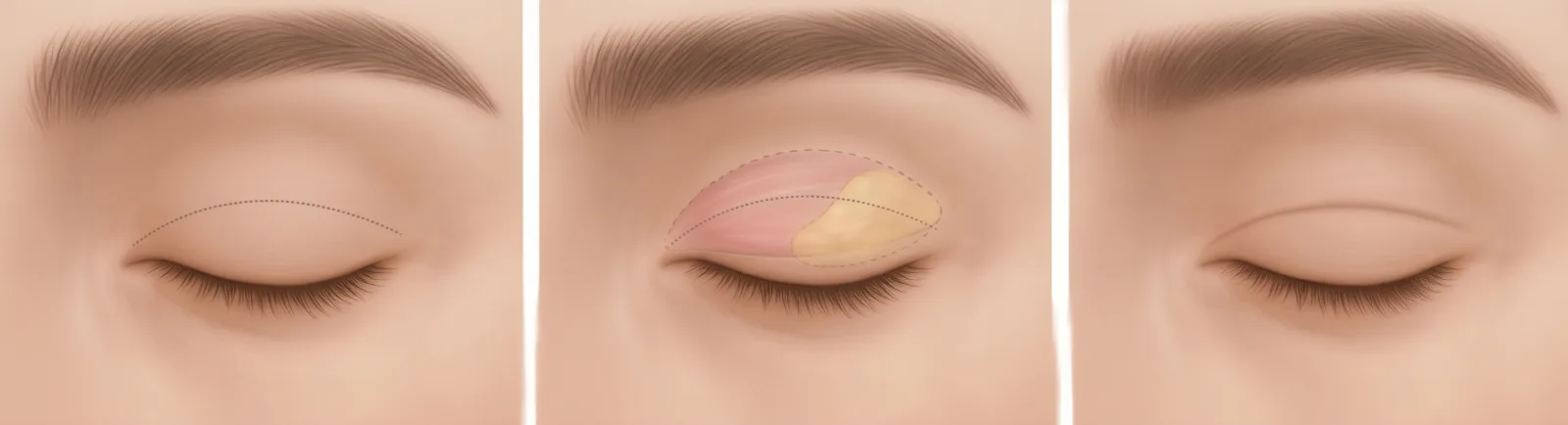
Illustration: the crease is set through an incision along the planned fold; the tissue beneath (muscle in pink, fat in yellow) is adjusted so the crease holds.
The recovery has two distinct chapters. The first is the visible early week dominated by swelling, bruising and the sutures, which come out at around day 7. The second is the quieter, longer phase over the following weeks and months in which the crease softens from its high, tight initial look down to its natural final position. Most patients underestimate how much settling happens after the obvious swelling has gone.
If you are deciding between methods, the contrast in downtime is one of the main differences. That comparison is laid out in incision vs non-incision double eyelid. This page assumes you are having the incision method and focuses on its recovery in detail.
First week
Days 1 to 7: the first week, hour by hour
On the day of surgery and the first two to three days, swelling and some bruising peak. Your eyelids will feel tight and look puffy, the crease will sit high, and your eyes may water or feel a little sticky — all expected. Cold compresses as directed, keeping your head elevated (including while sleeping), and resting your eyes from screens and reading help the swelling come down faster. Most discomfort in this window is mild, and simple measures usually manage it without strong pain relief.
From roughly day 3 to day 6 the worst of the swelling begins to ease and bruising starts to change colour as it fades. The incision line is healing and may look pink and slightly raised; this is normal early scar behaviour. You can usually do quiet activities at home, but you should still avoid bending, heavy lifting, alcohol and anything that raises blood pressure to the face, since these can worsen swelling and bruising.
Around day 7 the sutures are removed, the milestone most patients organise their trip or time off around. Once the stitches are out the lids feel lighter and the incision seals over, though noticeable swelling remains. Many people choose glasses or a fringe and feel comfortable in low-key settings from this point, while accepting that the eyes still look clearly operated-on for a while longer.
Weeks 2–6
Weeks 2 to 6: settling into everyday life
From the second week the recovery becomes much easier to live with. Bruising usually fades within about two weeks and can be covered with light makeup once the incision is fully closed and your surgeon has cleared it. The crease still looks higher and tighter than it eventually will, and there is often visible swelling along the lid, but the daily change is steadily in the right direction.
By around two to three weeks most patients feel presentable for ordinary work and social life, especially desk-based roles. The eyes can still look a little swollen on close inspection and may feel tight when you blink or look up, which eases as the tissues relax. Light activity is fine, but strenuous exercise, swimming, saunas and anything that pounds blood to the face are usually still kept on hold until your surgeon clears them.
Through weeks four to six the swelling continues to drop and the crease begins to look more natural and symmetrical. Mild asymmetry between the two eyes during this phase is common, because each side settles at a slightly different rate. It typically evens out as healing continues. How the result looks across this period is covered in more detail in when will I see my results.
Months
Months: how the crease matures to its final shape
After the first month or so the dramatic changes are behind you, but the crease continues to refine for several months. The fold that looked high and tight gradually softens and settles to a more natural height, and the last of the deep swelling resolves. For most patients the crease looks essentially natural by around three months, with subtle final settling continuing beyond that toward the longer end of the timeline.
The incision line follows its own course alongside this. Early redness and firmness fade over the months as the scar matures and pales, and because the line sits within the crease it becomes very difficult to see when the eyes are open. How that line heals is covered in scars and healing; here the point is simply that scar maturation and crease settling run on parallel, months-long clocks.
It is worth judging your final result patiently, over months. The structure of the crease is set at surgery, but the way it shows through the lid only finishes declaring itself once the swelling has fully gone. That is why surgeons assess the final outcome over months.
Aftercare
Aftercare essentials and red flags
Good aftercare shortens the visible phase and protects the result. Keep your head elevated and use cold then later warm compresses as instructed, keep the incision clean and dry, avoid rubbing or stretching your eyes, stay off contact lenses and eye makeup until cleared, and protect your eyes from strong sun. Sleep on your back early on, and hold off on strenuous exercise, swimming, saunas and alcohol until your surgeon gives the go-ahead. Attending your follow-ups is part of the aftercare.
Most of what you notice early is normal: swelling, bruising, tightness, watering, mild asymmetry and a high-looking crease. It is worth contacting the clinic, though, if you see signs outside ordinary healing: pain that increases, spreading redness, warmth, discharge, an incision that opens, sudden marked swelling of one eye, or any change in vision. These are uncommon but respond best to prompt review.
Pain itself is usually modest and short-lived; how it is managed during and after surgery is covered in pain and anaesthesia. If you are travelling, factor the day-7 suture removal into your plans so you are not flying home before the stitches are out.
At Garnet
How Garnet supports your recovery
At Garnet, a single-surgeon clinic in Apgujeong, Seoul, Dr. In-Soo Baek is a board-certified plastic surgeon (Korean medical licence no. 77407) who consults, performs the surgery himself and reviews every follow-up. For eyelid recovery that continuity is reassuring: the same surgeon who created your crease removes your sutures at around day 7 and judges how the fold is settling at structured follow-ups at 1, 3 and 6 months. There is no handover between operation and after-care.
You leave with clear written aftercare and a dedicated coordinator who stays with you from consultation through recovery, which matters most for international patients managing a trip. Garnet is registered with Korea's foreign-patient programme, so suture removal, follow-up and travel are coordinated around the day-7 milestone, and you can continue to share photos for assessment after you fly home.
If you are planning from abroad, you can send photos for a pre-assessment and discuss a realistic recovery timeline, including how long to stay in Korea, before you book. To decide whether the incision method is right for you in the first place, compare it with the alternative in incision vs non-incision double eyelid.
Real Results
Before & After
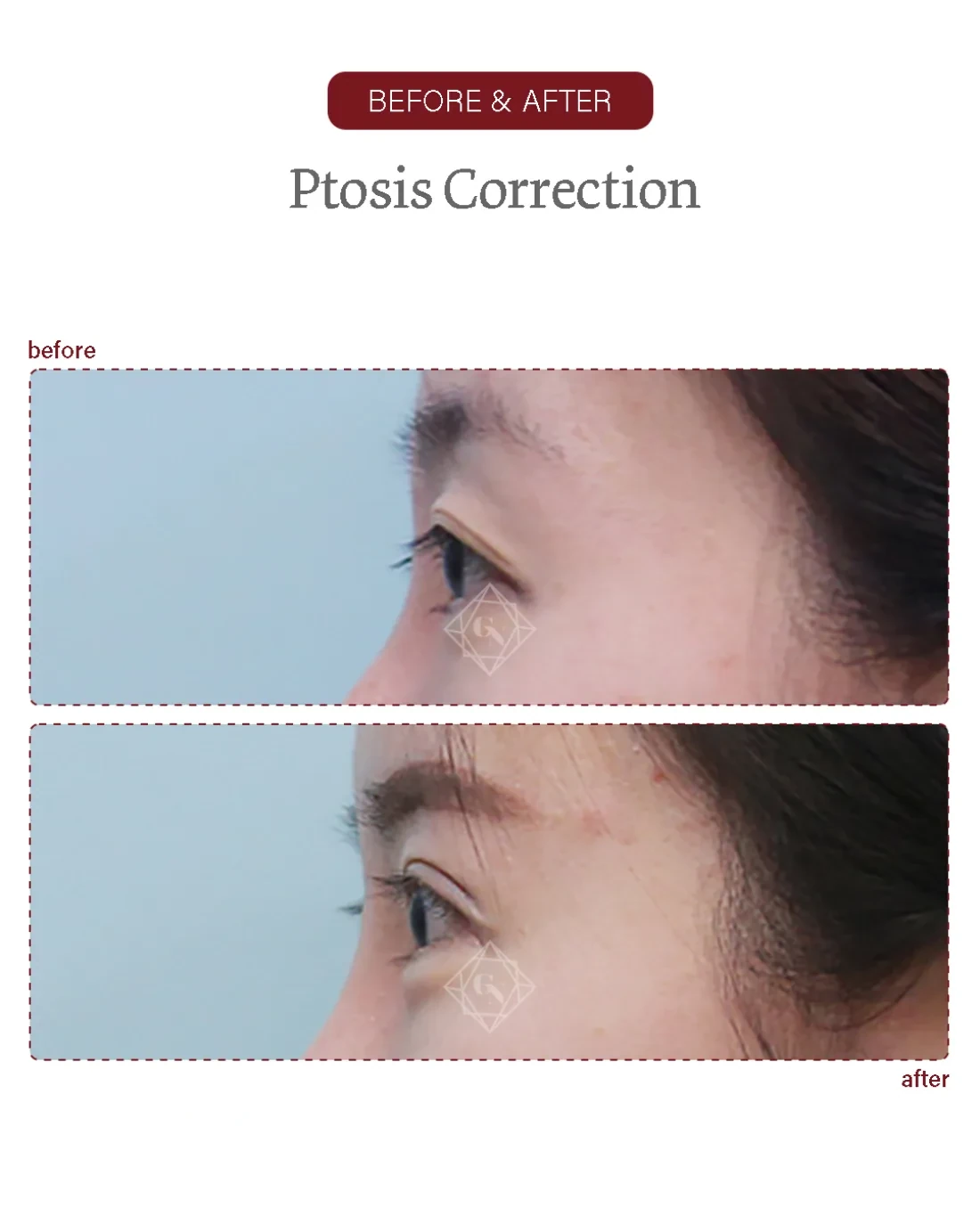
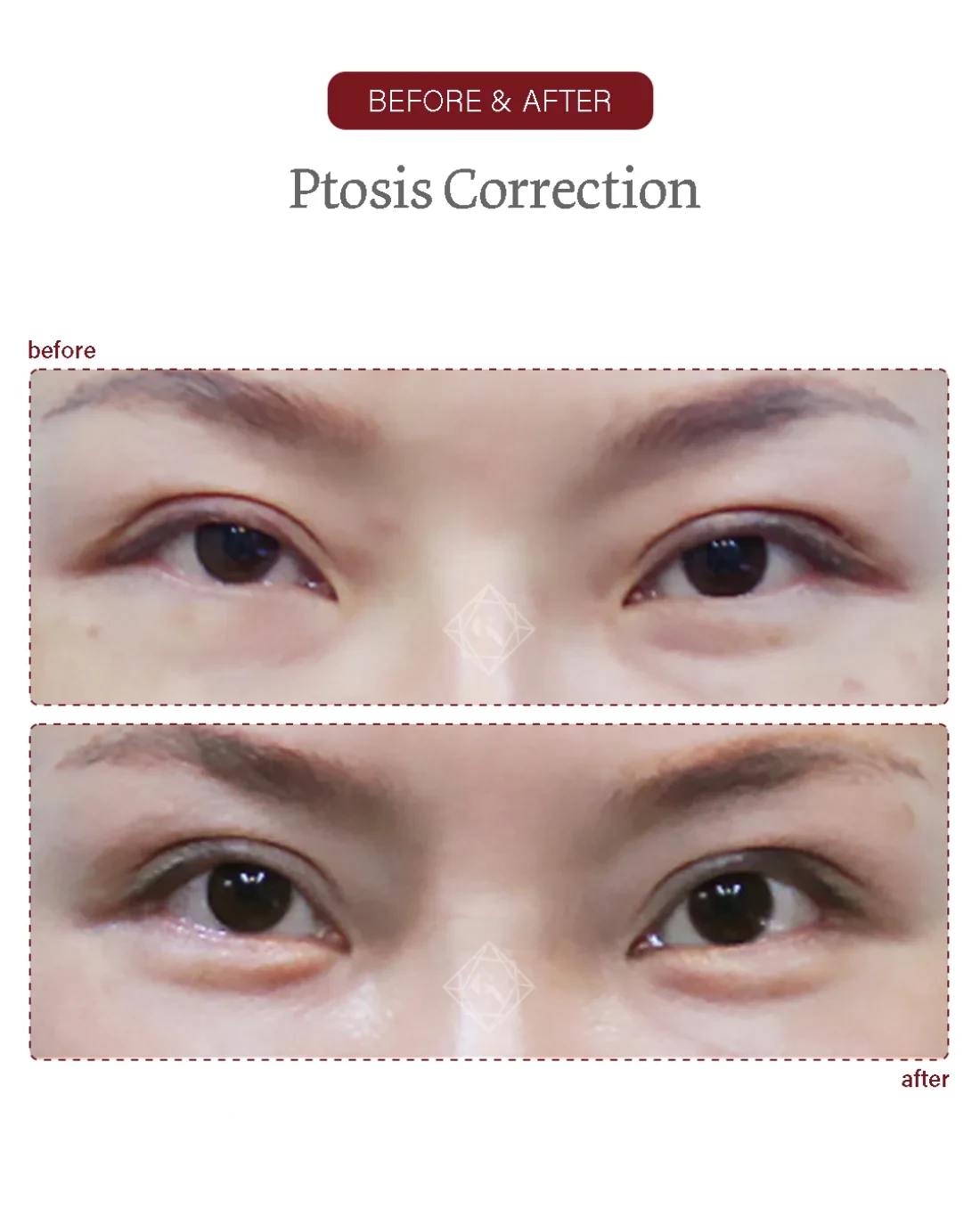
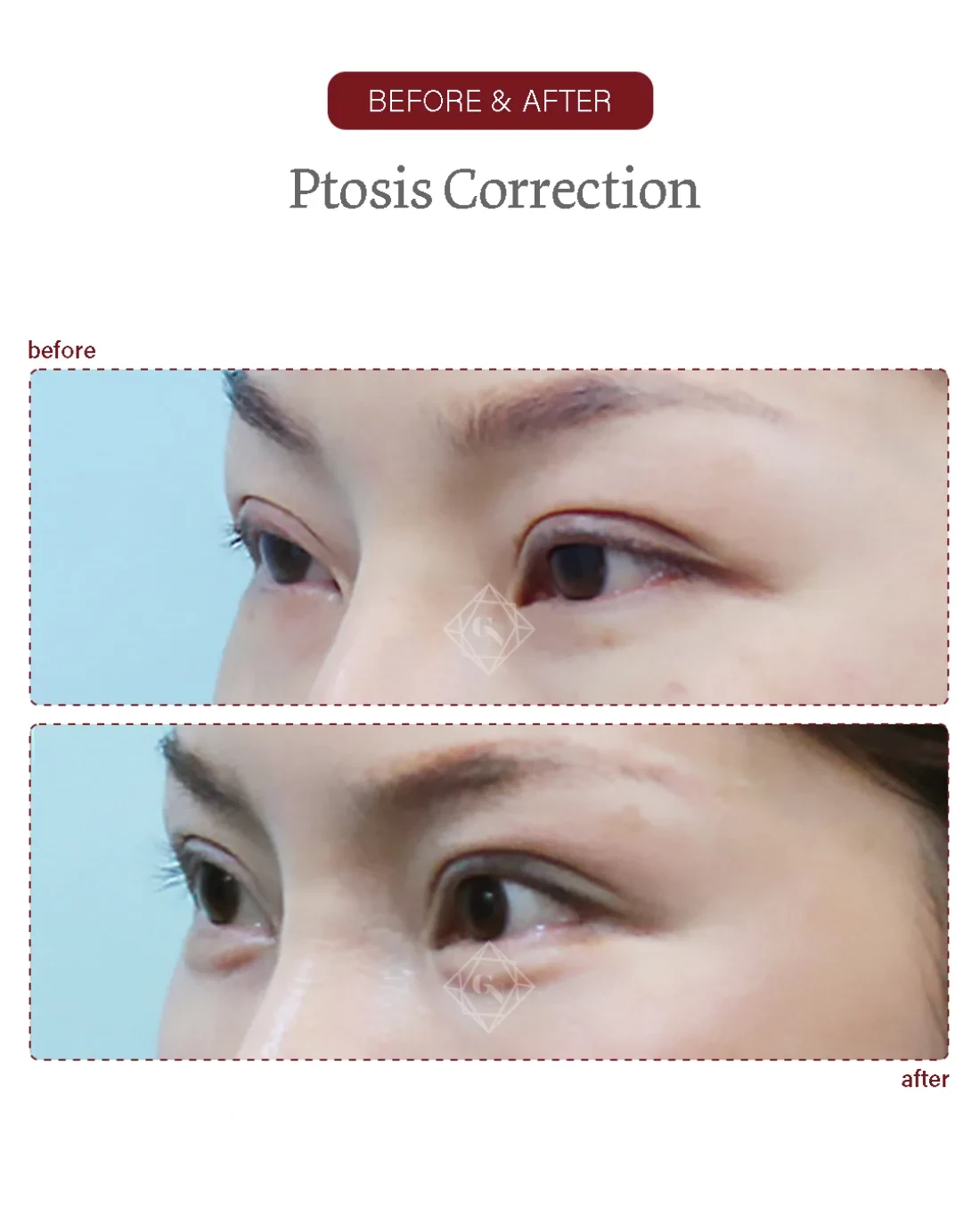
Ptosis-correction before/after examples of actual Garnet patients (published with consent). Results, recovery and suitability vary by individual and are not guaranteed; the right approach is decided at an in-person consultation.
Dr. In-Soo Baek
Director & sole operating surgeon
Korean medical licence no. 77407
Operate on what you came for. Trained at Korea University Medical Center. Every case planned, performed and reviewed by the same hands.
1Operating surgeon
~2Surgeries per day
7Registered techniques
Board-certified plastic surgeon
Plastic surgery training at Korea University College of Medicine & graduate school
Korean Society of Plastic and Reconstructive Surgeons member, in its facial-contour, eye & rhinoplasty groups
Consults, operates and follows up each case himself
Peer-reviewed papers behind the facts on this page. Each describes findings in its own study group — not results at Garnet — and none predicts your own outcome.
Zhang Y et al. Less Is Better: Full-Incision Double-Eyelid Blepharoplasty with Rapid Recovery. Plastic & Reconstructive Surgery. 2023. doi:10.1097/prs.0000000000010700
Yu P et al. Small-Incisional Techniques for Double-Eyelid Blepharoplasty: A Systematic Review. Aesthetic Plastic Surgery. 2022. doi:10.1007/s00266-022-03154-5
Kao WK et al. Managing the Asian Eyelid. Facial Plastic Surgery Clinics of North America. 2022. doi:10.1016/j.fsc.2022.07.009
FAQ
Common questions
How long does incision double eyelid recovery take?
The visible early week is dominated by swelling and bruising, with sutures removed around day 7. Most patients feel presentable for everyday life around two to three weeks, and the crease continues to soften to its natural final shape over the following months, looking essentially natural by around three months.
What is incision double eyelid recovery like day by day?
Swelling and bruising peak in the first two to three days, then ease from about day 3 to 6 as bruising fades. Sutures come out around day 7, after which the lids feel lighter. Through weeks two to six the swelling steadily drops and the crease begins to look more natural, with final settling over the months that follow.
When are the stitches removed?
The incision stitches along the upper lid are removed at around day 7. Patients usually plan their time off or trip around that visit, so if you are travelling it is best not to fly home before the stitches are out.
When can I return to work after incision double eyelid?
Many people return to desk-based work around one to two weeks, especially after the sutures are out at day 7 and with glasses to soften the look. Most feel comfortable in ordinary work and social settings by about two to three weeks, accepting that mild swelling can still be visible on close inspection.
When does the swelling go down?
The worst swelling eases over the first week, and most obvious swelling settles over two to three weeks. Bruising usually fades within about two weeks. Residual and deeper swelling continues to resolve for several weeks beyond that, with the crease looking essentially natural by around three months.
Why does my crease look too high at first?
A high, tight-looking crease in the early weeks is normal. The fold gradually softens and settles to a more natural height as swelling resolves over the following months. The final crease position is judged over months, so it is best not to assess height in the first weeks.
What aftercare follows incision double eyelid?
Keep your head elevated, use compresses as directed, keep the incision clean and dry, avoid rubbing your eyes, and stay off contact lenses and eye makeup until cleared. Avoid strenuous exercise, swimming, saunas and alcohol until your surgeon approves, sleep on your back early on, and attend your follow-ups.
When can I exercise or wear makeup again?
Light makeup can usually be used once the incision is fully closed and your surgeon has cleared it, often after bruising fades around two weeks. Strenuous exercise, swimming and saunas are typically kept on hold for several weeks until your surgeon gives the go-ahead, to avoid worsening swelling.
What recovery signs should I report to the clinic?
Swelling, bruising, tightness, watering and mild asymmetry are normal. Contact the clinic if you notice increasing pain, spreading redness, warmth, discharge, an incision that opens, sudden marked swelling of one eye, or any change in vision. These are uncommon but respond best to prompt review.
Will the same surgeon handle my follow-up and suture removal?
Yes. Garnet is a single-surgeon clinic, so the board-certified surgeon who performed your operation removes your sutures around day 7 and reviews how the crease is settling at structured follow-ups at 1, 3 and 6 months. Once you are home, you can keep sending photos of your eyelids for him to check.
My mom recently had a brow lift and lower blepharoplasty with Dr. Baek, and our experience has been wonderful so far. The Garnet team was incredibly kind and welcoming, with Kelly assisting us as our English consultant—she made everything…
I’m so happy I chose this clinic for my lower blepharoplasty. I was traveling from abroad by myself, so I was a little nervous, but from the beginning I felt comfortable and truly cared for. Everyone was kind, patient, and professional…
Came in for an in-person consult and ended up choosing Garnet and Dr.Baek for my non-incisional DES and tiplasty/alarplasty. I communicated with Kelly (English consultant) from the start till now (3 weeks post-op). She really help me feel…
My under-eyes have been sagging and folding for years... I tried to cover it up with makeup, but it actually got stuck in the wrinkles and made it stand out even more. While going for consultations, I noticed that the bigger the hospital…
Send photos and your question before you travel. An English-speaking coordinator reviews every enquiry and replies with guidance on whether surgery is appropriate, the likely plan and timing.
✓ Reviewed by the clinic coordinator, not a bot
✓ Photo-based pre-assessment before you fly
✓ Foreign-patient scheduling & after-care
✓ One surgeon for consultation, surgery and follow-up
Prefer to chat now? Reach the coordinator directly:









 T S7 months ago



