If your jawline is starting to soften and the lines either side of your mouth are deepening, you will see both treatments suggested: a thread lift and a mini facelift. They are two different things. One is a surgical procedure that repositions tissue; the other is a non-surgical lift that suspends it with threads. Which is better for you depends entirely on how much laxity you have and what you want from the result.
The short answer
A mini facelift is surgery: a short incision around the ear repositions sagging tissue; a thread lift is non-surgical, suspending tissue with barbed threads through tiny entry points.
A mini facelift lifts more and lasts years; a thread lift lifts less and is temporary, but needs almost no downtime.
Threads suit early, mild sagging or someone not ready for surgery; a mini facelift suits genuine lower-face laxity that threads can no longer hold.
The decision should follow an assessment of your jawline and cheek tissue. A fixed preference for the simpler option is a poor guide.
How a mini facelift and a thread lift actually work
A mini facelift is a surgical procedure. Through a short incision placed in front of and behind the ear, the surgeon lifts the skin, works on the soft tissue beneath, and repositions it upward and backward before removing a small amount of slack skin and closing. At Garnet the dissection is kept superficial and is focused on softening the nasolabial fold and the early jowl, with sutures removed at around 10 days. Because tissue is physically moved and re-anchored, the change is structural and goes deeper than a surface tightening.
Illustration: through a shorter incision in front of the ear (dotted line), the lower face and jawline (shaded) are lifted.
A thread lift is non-surgical. Fine barbed or cogged threads are introduced through tiny cannula entry points and passed under the skin along the line of sag; the barbs grip the soft tissue, and when the thread is gently tensioned it suspends that tissue in a higher position. There is no incision around the ear and no skin is removed. Over the following months the threads also stimulate some collagen along their path, which contributes a little firmness beyond the initial mechanical lift.
The simplest way to hold the difference in your head: a mini facelift relocates and trims tissue through a real, if short, surgical incision; a thread lift suspends existing tissue without removing anything. That single distinction explains almost everything that follows: the amount of lift, how long it lasts, the downtime and the scar.
How much lift
How much each one actually lifts
A mini facelift can address a meaningful amount of lower-face laxity. Because the surgeon repositions tissue and removes surplus skin, it can soften a sagging jawline, lift the early jowl and improve a deepening nasolabial fold in a way that looks like the tissue has genuinely been moved, because it has. It does not, however, do everything a full facelift does. A mini facelift concentrates on the lower face and the area around the mouth and jaw and leaves the neck and mid-face alone, so it is best matched to laxity that is real but still limited in extent.
A thread lift produces a gentler, more modest lift. It can refresh an early jowl or lift a soft cheek a few millimetres and give a tidier jaw outline, which can be genuinely satisfying when the starting point is mild. But threads work by holding tissue up without removing the excess, so once there is a true fold of loose skin, threads have less to grip and the visible result is smaller. Asking a thread lift to do a surgical job is the most common reason people feel let down by one.
There is a middle ground too. If your concern is mostly skin quality and very early softening, neither a mini facelift nor a thread lift may be the right first step; energy-based skin tightening or simply waiting may suit you better. Sometimes the comparison that matters is your readiness for any lifting procedure at all.
Longevity
How long the results last
This is where the two diverge most clearly. A mini facelift gives a long-lasting result. Tissue has been repositioned and excess skin removed, so the improvement holds for years; you continue to age naturally from a younger-looking baseline. No facelift stops ageing, and a mini facelift is a smaller operation than a full one, so its longevity sits below that of a full facelift. It is still measured in years.
A thread lift is temporary. The mechanical lift fades as the threads soften and the tissue gradually settles, and most people find the visible benefit lasts somewhere in the range of a year to around 18 months before it drifts back toward the starting point. Repeat sessions can maintain the effect, which means a thread lift is best understood as an ongoing commitment.
Put the cost over time alongside the longevity and the picture sharpens. A mini facelift is a larger upfront step that you do once and live with for years; a thread lift is a smaller step repeated periodically. Neither is inherently better value; it depends on how much lift you need and how you prefer to manage it over the next decade.
Downtime & scars
Downtime, scars and recovery compared
A thread lift wins clearly on downtime. There is no incision around the ear, so most people have only some tenderness, mild swelling and a slightly tight or pulled sensation for a few days, and many return to ordinary routines quickly. The trade-off is that you accept a smaller, temporary result in exchange for that ease, which is a fair bargain when the laxity is mild and you cannot take time off.
A mini facelift asks more of you because it is surgery. Expect swelling and bruising that are most noticeable in the first week, with the short incision sutures removed at around 10 days and the bulk of the obvious recovery settling over a few weeks before the final result refines over months. The incision is deliberately placed in the natural creases in front of and behind the ear so that, once healed and faded, the scar is designed to be discreet. It is still a real scar, where a thread lift leaves only tiny entry points.
If you want a fuller picture of the surgical side, the mini facelift overview covers the procedure in depth, and patients weighing a larger operation often compare it against a deep-mini versus full facelift as well. The point of this section is narrower: a thread lift is the lighter, faster, more temporary option, and a mini facelift is the more involved but more lasting one.
Who fits which
Which one fits your face: thread lift or mini facelift
A thread lift tends to fit someone with early, mild laxity (a softening jawline or a slightly heavy cheek) who wants a subtle refresh, has little time for recovery, or is simply not ready to commit to surgery. It can be a sensible first step, and for the right person the modest result is exactly what they wanted.
A mini facelift tends to fit someone whose lower-face sagging is genuine: a jowl forming along the jaw, a nasolabial fold that has deepened, skin that no longer springs back. For this person threads usually under-deliver, because there is now real excess to address as well as tissue to suspend. A mini facelift is the procedure that matches that degree of change. If the laxity extends into the neck or mid-face, the right answer may instead be a fuller lift, which is a conversation worth having before settling on the smaller operation.
There is no universal winner here, and a good clinic will not pretend there is. The sensible sequence is to assess your tissue first and let that decide: where the laxity is mild, threads may be enough; where it is established, a mini facelift does what threads cannot; where it is advanced, neither mini option is the answer. You can begin that assessment without travelling, in an online consultation.
At Garnet
How Garnet assesses thread versus mini facelift
Garnet is a single-surgeon clinic in Apgujeong, Seoul. Dr. In-Soo Baek is a board-certified plastic surgeon (Korean medical licence no. 77407) and the only operating doctor. He consults, performs the surgery himself and reviews every follow-up, with structured check-ins at 1, 3 and 6 months. Because the same surgeon both assesses and operates, the recommendation you receive is one he is prepared to carry out personally.
In practice that means a careful reading of your tissue, with no push toward whichever option is simpler to sell. If your laxity is mild, you may be told a less invasive route is reasonable; if it is established, you will hear plainly that a mini facelift will do what a thread lift cannot; and if the sagging extends further, the conversation turns to a fuller lift. You can start with photos and a no-obligation online assessment before planning any trip to Korea.
Real Results
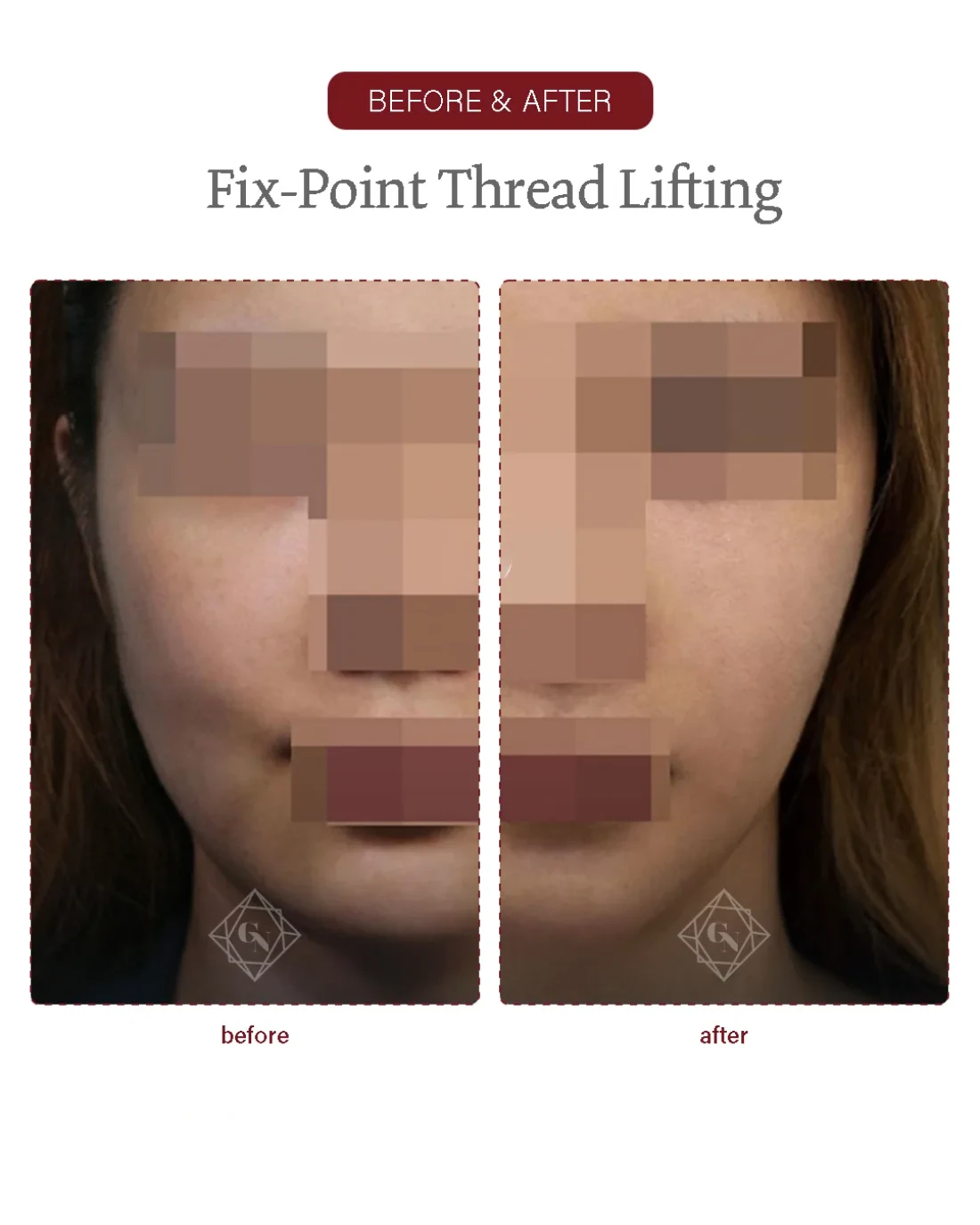
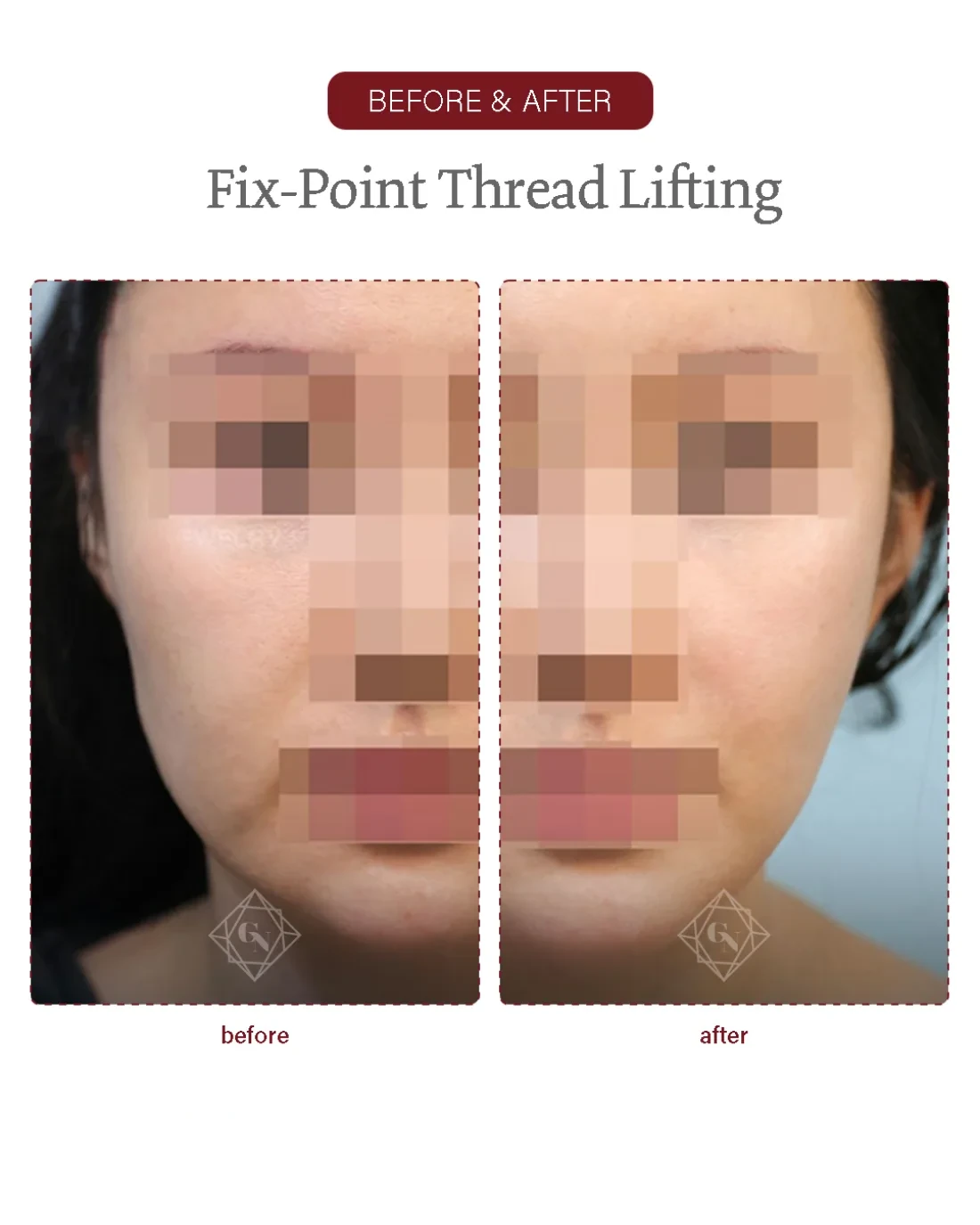
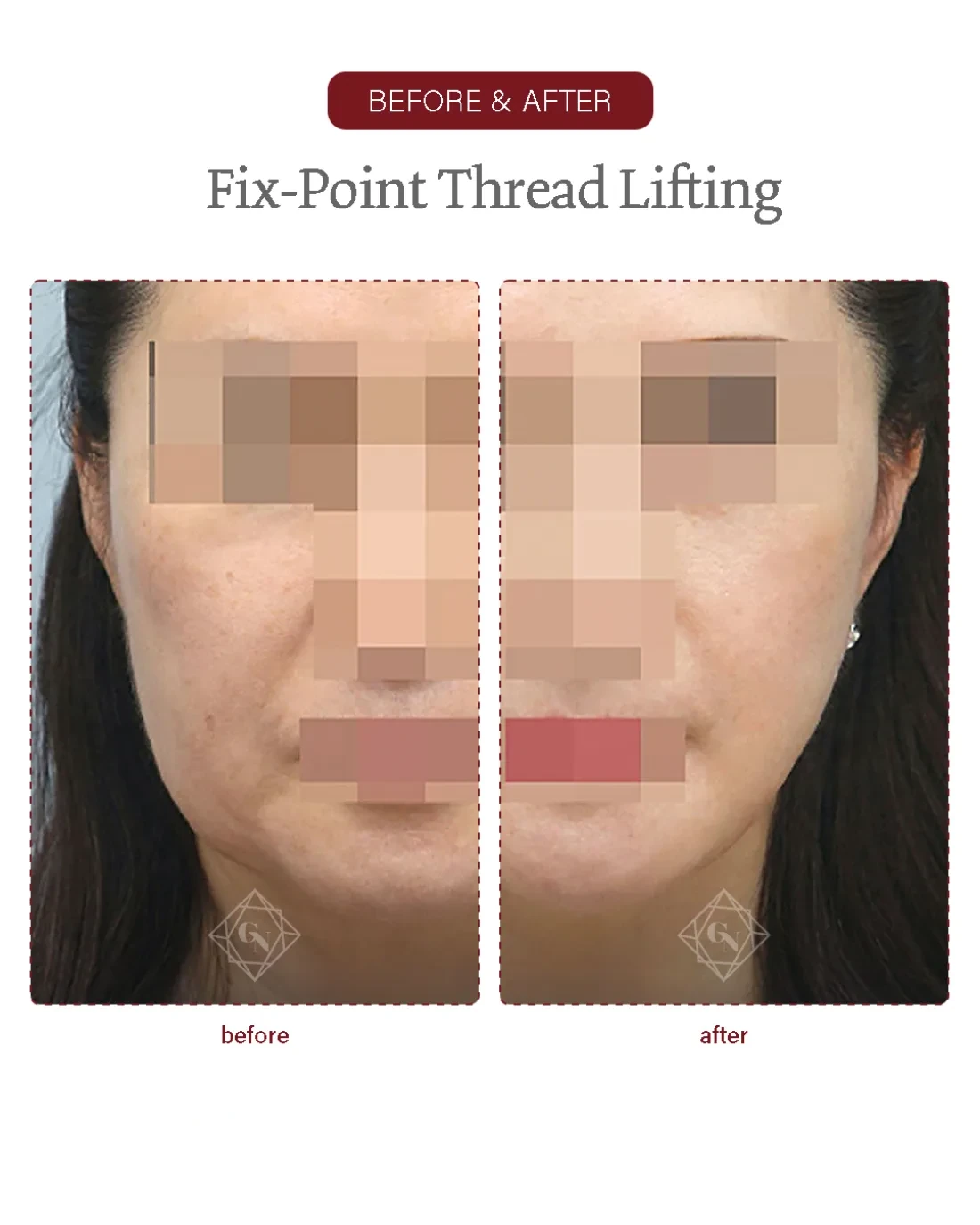
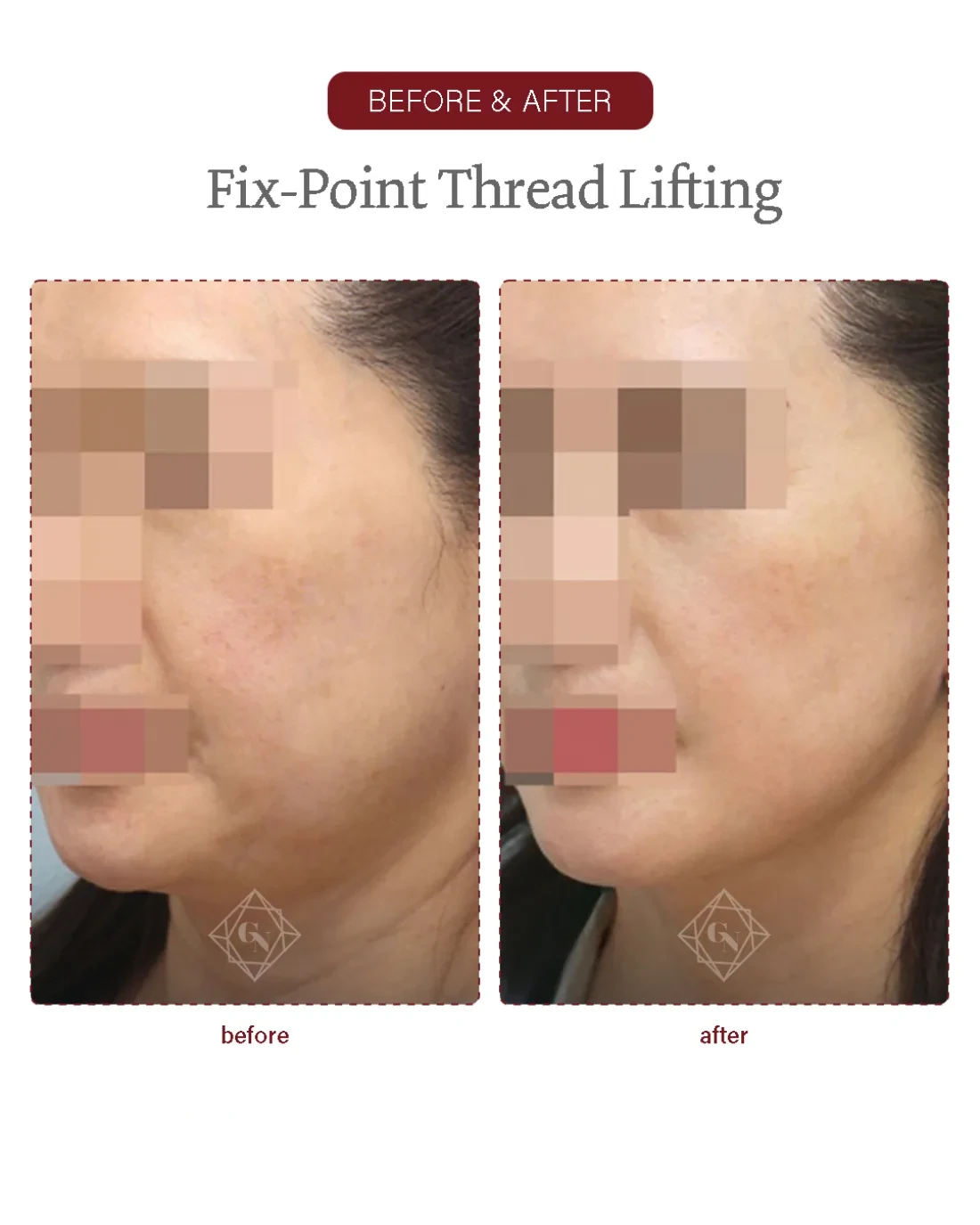
Before & After
Thread-lift and contouring results of actual Garnet patients (published with consent, with date, procedure and clinic labelled). The lift is temporary and results, recovery and suitability vary by individual and are not guaranteed.
Prices
Price at Garnet
Thread lift
From₩100,000 + VAT per threadExcluding VAT (10% VAT is added at payment)Book now
Same price as Korean patients. Prices shown exclude 10% VAT; your written quote, issued after the in-person consultation, shows the full amount payable.
Dr. In-Soo Baek
Director & sole operating surgeon
Korean medical licence no. 77407
Operate on what you came for. Trained at Korea University Medical Center. Every case planned, performed and reviewed by the same hands.
1Operating surgeon
~2Surgeries per day
7Registered techniques
Board-certified plastic surgeon
Plastic surgery training at Korea University College of Medicine & graduate school
Korean Society of Plastic and Reconstructive Surgeons member, in its facial-contour, eye & rhinoplasty groups
Consults, operates and follows up each case himself
Peer-reviewed papers behind the facts on this page. Each describes findings in its own study group — not results at Garnet — and none predicts your own outcome.
Citarella ER et al. Endoscopically assisted limited-incision rhytidectomy: A 10-year prospective study. Journal of Plastic, Reconstructive & Aesthetic Surgery. 2010. doi:10.1016/j.bjps.2009.11.021
Verpaele A et al. The third suture in MACS-lifting: making midface-lifting simple and safe. Journal of Plastic, Reconstructive & Aesthetic Surgery. 2007. doi:10.1016/j.bjps.2006.12.012
Prado A et al. A Clinical Retrospective Study Comparing Two Short-Scar Face Lifts: Minimal Access Cranial Suspension versus Lateral SMASectomy. Plastic and Reconstructive Surgery. 2006. doi:10.1097/01.prs.0000207402.53411.1e
FAQ
Common questions
What is the difference between a mini facelift and a thread lift?
A mini facelift is surgery: through a short incision around the ear the surgeon repositions sagging tissue and removes a little excess skin, giving a lasting result with real downtime. A thread lift is non-surgical: barbed threads suspend tissue through tiny entry points, giving a smaller, temporary lift with very little downtime. One relocates tissue; the other holds it up.
Is a mini facelift or a thread lift better for me?
Neither is better in general; it depends on how much laxity you have. Mild, early softening often suits a thread lift; genuine lower-face sagging with a forming jowl usually needs a mini facelift, because threads have less to grip once there is real excess skin. An assessment of your tissue should make the decision.
How long does each one last?
A mini facelift lasts years, because tissue is repositioned and surplus skin removed. A thread lift is temporary. Most people find the visible benefit lasts roughly a year to around 18 months before it drifts back, and repeat sessions are needed to maintain it.
Does a thread lift have less downtime than a mini facelift?
Yes. A thread lift usually means only mild tenderness, some swelling and a tight sensation for a few days, with no incision around the ear. A mini facelift involves swelling and bruising that are most noticeable in the first week, with sutures removed around 10 days and a few weeks before the obvious recovery settles.
Will a thread lift give the same result as a mini facelift?
No, and it is not meant to. A thread lift gives a gentler, more modest lift suited to early, mild laxity. A mini facelift addresses a greater degree of sagging because it physically moves tissue and removes excess skin. Expecting a thread lift to match surgery is the most common reason people feel disappointed by one.
Can I have a thread lift first and a mini facelift later?
Often, yes. Many people start with a thread lift while laxity is mild and consider a mini facelift later when sagging is more established. This is best confirmed in a personal assessment, as previous threads and your current tissue both shape what the right next step is and when to take it.
Is a mini facelift scar visible compared to a thread lift?
A thread lift leaves only tiny entry points and no real scar. A mini facelift leaves a real but short incision placed in the natural creases in front of and behind the ear, designed to be discreet once healed and faded. If a barely-there mark is your priority and your laxity is mild, that difference matters; if you need a meaningful lift, the trade is usually worth it.
Which one is cheaper?
A thread lift is a smaller step but typically repeated periodically, while a mini facelift is a larger one-time procedure that lasts years, so comparing a single price is misleading. The fairer comparison is cost over time against the lift you actually need. Garnet does not publish surgical prices online; a personalised quote is confirmed at consultation.
What if my sagging is more than a mini facelift can handle?
Then neither a thread lift nor a mini facelift is the right answer, and you should be told so plainly. Laxity that extends into the neck or mid-face usually calls for a fuller lift. A good clinic assesses the extent first and recommends the procedure that matches it, even when that is the larger operation.
Can I decide between them without flying to Korea?
You can get most of the way there. In an online consultation you can send photos, describe your concern and receive a pre-assessment of whether your laxity points toward a thread lift, a mini facelift or a fuller procedure, and what each would realistically involve, before committing to travel.
My mom recently had a brow lift and lower blepharoplasty with Dr. Baek, and our experience has been wonderful so far. The Garnet team was incredibly kind and welcoming, with Kelly assisting us as our English consultant—she made everything…
I’m so happy I chose this clinic for my lower blepharoplasty. I was traveling from abroad by myself, so I was a little nervous, but from the beginning I felt comfortable and truly cared for. Everyone was kind, patient, and professional…
Came in for an in-person consult and ended up choosing Garnet and Dr.Baek for my non-incisional DES and tiplasty/alarplasty. I communicated with Kelly (English consultant) from the start till now (3 weeks post-op). She really help me feel…
My under-eyes have been sagging and folding for years... I tried to cover it up with makeup, but it actually got stuck in the wrinkles and made it stand out even more. While going for consultations, I noticed that the bigger the hospital…
Send photos and your question before you travel. An English-speaking coordinator reviews every enquiry and replies with guidance on whether surgery is appropriate, the likely plan and timing.
✓ Reviewed by the clinic coordinator, not a bot
✓ Photo-based pre-assessment before you fly
✓ Foreign-patient scheduling & after-care
✓ One surgeon for consultation, surgery and follow-up
Prefer to chat now? Reach the coordinator directly:










 T S7 months ago



