A revision rhinoplasty is a second operation on the nose, so the question of how long it lasts carries extra weight. Longevity depends heavily on the material chosen for your particular case (rib, dermis, fascia or septal and ear cartilage) and on the scar tissue left by the first operation. That is exactly why a considered revision is planned to be a durable, ideally final, correction.
The short answer
Longevity in a revision depends on the material selected for your case: autologous rib, donor rib, dermis, temporalis fascia, or septal and ear cartilage, each with its own long-term behaviour.
A sturdier structural graft such as rib cartilage tends to give the most robust, lasting rebuild, while softer grafts serve different roles; the choice is matched to what your nose needs.
Scar tissue and weakened structure from the first surgery make a revision more complex, so a careful, well-supported rebuild is what makes the second result hold.
No rhinoplasty stops ageing, but a well-planned revision aims to be a durable correction and ideally the last one you need.
Why the chosen material drives how long a revision lasts
Unlike a first-time nose surgery, a revision rhinoplasty is not one fixed procedure. The approach, and the material used to rebuild, is chosen for your particular case. Depending on what needs correcting and what tissue is still available after the first operation, the surgeon may use autologous rib cartilage, donor rib, dermis taken from the hip, temporalis fascia, or your septal and ear cartilage. Because these materials behave differently over time, any estimate of how long the nose will last begins with which one is right for you.
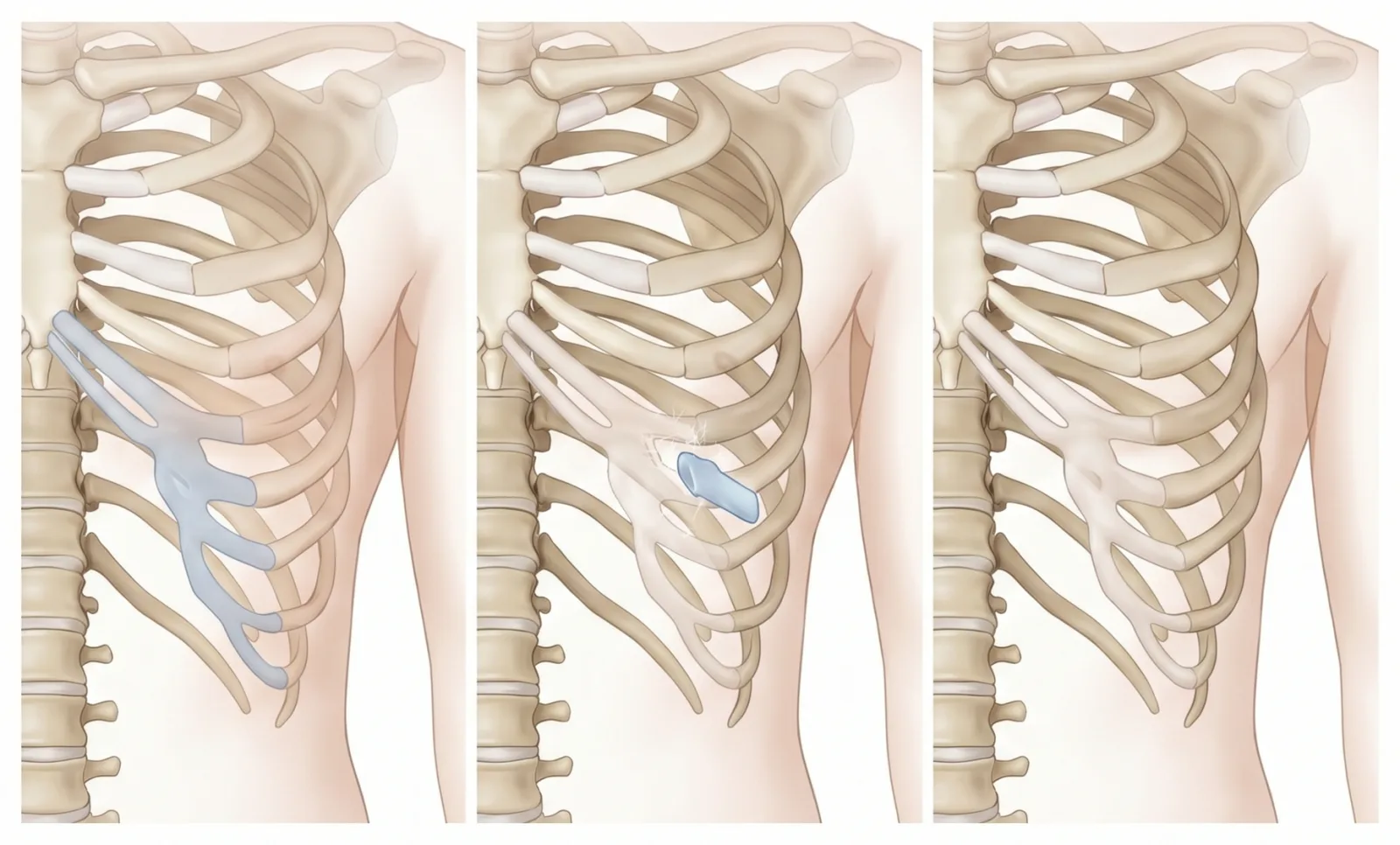
Illustration: the previous implant (outlined) is removed and the framework is rebuilt with the patient's own cartilage for support.
This is the central difference from a primary rhinoplasty. In a first surgery there is usually plenty of your own septal and ear cartilage to work with; in a revision, some of that may have been used or altered already, so the surgeon reaches for stronger or alternative grafts to rebuild reliable structure. The material decision is therefore the main driver of how robust and lasting the second result will be.
No single number fits every case. The durability of a revision is best understood material by material, matched to the state of your nose. Understanding that upfront helps set realistic expectations, and it is why a thorough assessment of what was done before is the starting point for any sound revision plan.
By material
How each material holds up over time
Rib cartilage, whether your own (autologous) or donor rib, provides the sturdiest structural rebuild, which is why it is often chosen when a nose needs strong, lasting support restored. It integrates and is meant to remain, giving robust long-term structure; its known trade-off is that costal cartilage can, in some cases, warp over time, so it must be carved and stabilised with care. For a nose that needs its framework genuinely rebuilt, this is frequently the most durable option, and our rib cartilage rhinoplasty page covers it in depth.
Illustration: where rib cartilage (blue) sits on the chest wall, and the small segment taken to build a stronger nasal framework.
Septal and ear cartilage, where still available, integrate well and are ideal for tip refinement and moderate support, though ear cartilage is softer and springier. Temporalis fascia and dermis play a different role. They are soft-tissue grafts used to smooth contours, camouflage irregularities or add a covering layer over thin skin; they do not provide rigid structure. Each of these is meant to remain as autologous tissue, and each is chosen for what it does best because the grafts are not interchangeable.
The practical point is that a revision is a considered assembly of the right materials for your nose: a strong structural graft where support is needed, softer grafts where camouflage or fine refinement is needed. When each is used for its proper purpose and secured with care, the combined result holds up well. The longevity comes from matching material to need more than from any single material.
Scar tissue
How scar tissue and the first surgery affect durability
A revision is inherently more complex than a first rhinoplasty because of what the previous surgery left behind. Scar tissue forms after any operation, and in the nose it can distort structure, reduce blood supply to grafts, and make the tissue planes harder to work in. Weakened or missing cartilage from the first surgery also means there is less native structure to build on. All of this influences how a revision heals and how durably it holds.
This is precisely why the material choice and the surgical care matter so much for a revision's longevity. Rebuilding reliable support in a scarred, previously operated nose calls for stronger grafts and meticulous, unhurried technique. The durability has to be engineered in, because the nose is not starting from a clean slate. A rushed revision on compromised tissue is far more likely to need further correction.
It also means a careful assessment of your existing nose is essential before any plan is made. Understanding what was done, what tissue remains, and how the previous result healed lets the surgeon choose the right material and approach to give a result that lasts without repeating the problem. For those weighing whether a first nose surgery would need revising at all, our how long rhinoplasty lasts guide gives useful context.
How it ages
How the nose still ages after a revision
As with any nose surgery, a revision does not stop the nose from ageing. The rebuilt framework holds, but the living tissue around it keeps changing: skin can thin over the years, the tip may shift slightly as support softens, and facial soft tissue evolves. These are gradual, normal changes that happen to everyone, and a revision resets the clock; it does not switch it off.
What a well-planned revision gives you is a corrected, reshaped starting point from which the nose ages gently. Years later your nose will reflect the corrected structure, looking like an older version of that corrected result. It does not go back to the pre-revision problem. The durable rebuild is what you are living with; the natural ageing on top of it is slow and subtle.
This realistic framing matters especially in revision, where patients understandably want reassurance. A durable, well-supported revision is designed to age gracefully, and anyone promising it will look identical forever is overstating what surgery can do. The realistic goal is a lasting correction that then ages naturally; a permanently frozen nose is not possible.
The last one
Why a good revision aims to be the final one
The guiding principle of a considered revision is that it should ideally be the last surgery your nose needs. Each operation adds scar tissue and works with progressively altered anatomy, so the aim is to rebuild reliable structure thoroughly and durably in one well-planned procedure instead of making small adjustments over time. Choosing the right material for genuine structural support is central to that aim.
That is why a revision is not somewhere to cut corners on planning, material or surgical time. The strongest, most appropriate grafts, placed with meticulous care in an unhurried operation, give the best chance of a stable, lasting correction that does not need revisiting. The whole logic of a good revision is durability: a result robust enough that further surgery becomes unlikely.
There is, of course, no guarantee about the future, and revisions are complex operations. But a well-executed revision, with the right material for your nose and a surgeon who has fully assessed what came before, is planned precisely so that it holds, ideally for good. That intent is the difference between a durable correction and another temporary fix.
At Garnet
Garnet's approach to a durable revision
Garnet is a single-surgeon clinic in Apgujeong, Seoul. Dr. In-Soo Baek, a board-certified plastic surgeon (Korean medical licence no. 77407), is the only operating doctor. He assesses your existing nose, selects the material, performs the revision himself and reviews every follow-up, and the clinic keeps to two surgeries a day so a demanding revision case has the unhurried time it needs. With over ten years focused on nose surgery, the emphasis in revision is on rebuilding durable structure with the material best suited to each nose.
Because a revision's longevity is built during surgery, that single-surgeon model matters: the same surgeon judges the scarred anatomy, chooses between rib, donor rib, dermis, fascia or septal and ear cartilage, and secures the rebuild, then follows your healing with dressing changes on day one and three and suture removal timed to the donor site (around 7 days for the nose and up to 2 weeks for a rib or hip donor site), with structured reviews at 1, 3 and 6 months, and by messenger after you fly home. Garnet's registration with Korea's foreign-patient programme covers patients travelling for a revision.
If you would like a realistic view of how a revision could last for your nose specifically, including which material would suit your case and a frank read of the scar tissue involved, the ideal first step is a no-obligation online assessment. Send photos and details of your previous surgery for a straight answer before you plan any travel.
Prices
Price at Garnet
Revision rhinoplasty
From₩4,000,000 + VATExcluding VAT (10% VAT is added at payment)Book now
Same price as Korean patients. Prices shown exclude 10% VAT; your written quote, issued after the in-person consultation, shows the full amount payable.
Dr. In-Soo Baek
Director & sole operating surgeon
Korean medical licence no. 77407
Operate on what you came for. Trained at Korea University Medical Center. Every case planned, performed and reviewed by the same hands.
1Operating surgeon
~2Surgeries per day
7Registered techniques
Board-certified plastic surgeon
Plastic surgery training at Korea University College of Medicine & graduate school
Korean Society of Plastic and Reconstructive Surgeons member, in its facial-contour, eye & rhinoplasty groups
Consults, operates and follows up each case himself
Peer-reviewed papers behind the facts on this page. Each describes findings in its own study group — not results at Garnet — and none predicts your own outcome.
Sazgar AA et al. Use of Bone-Cartilaginous Unit in Revision Rhinoplasty. Aesthetic Surgery Journal. 2018. doi:10.1093/asj/sjy319
Loyo M et al. Revision Rhinoplasty. Clinics in Plastic Surgery. 2016. doi:10.1016/j.cps.2015.09.009
Rosenberger ES et al. Controversies in Revision Rhinoplasty. Facial Plastic Surgery Clinics of North America. 2016. doi:10.1016/j.fsc.2016.03.010
FAQ
Common questions
How long does revision rhinoplasty last?
It depends heavily on the material chosen for your case. A sturdy structural graft such as rib cartilage gives a robust, lasting rebuild that is meant to remain, while softer grafts like ear cartilage, fascia or dermis serve refinement and camouflage roles. Scar tissue from the first surgery adds complexity, so a careful, well-supported revision is planned to be a durable, ideally final, correction.
Is revision rhinoplasty permanent?
The rebuilt framework is a lasting structural change, and the grafts are autologous tissue meant to remain, so the correction endures. But nothing stops the nose ageing, and each revision works with scarred, altered anatomy. It is fair to describe a well-planned revision as a durable correction designed to be the last one; it would be wrong to promise it is unchanging forever.
Which material lasts longest in a revision?
For rebuilding genuine structural support, rib cartilage (your own or donor rib) is often the most robust and lasting choice, though costal cartilage must be carved carefully because it can warp. Septal and ear cartilage suit tip work and moderate support, while dermis and temporalis fascia are soft-tissue grafts for camouflage. The right material is matched to what your nose needs, with longevity as one factor among several.
Why is a revision more complex than the first surgery?
The first operation leaves scar tissue and often uses up or alters native cartilage, so a revision works with compromised, harder-to-navigate tissue and less structure to build on. Scarring can also reduce blood supply to grafts. This is why revisions call for stronger grafts and meticulous, unhurried technique. The durability has to be engineered in; it cannot be assumed.
Does revision rhinoplasty change with age?
Yes, gently. The rebuilt framework holds, but the living tissue keeps ageing: skin can thin, the tip may shift a little as support softens, and facial soft tissue changes over the years. These are gradual, normal changes. After a revision the nose ages slowly from its corrected shape and does not return to the problem that was fixed.
Will I need another revision after this one?
The goal of a well-planned revision is that you should not; it aims to be the final surgery your nose needs. Choosing strong, appropriate grafts and rebuilding durable structure in one unhurried operation gives the best chance of a stable result. There is no guarantee about the future, but a thorough, well-supported revision is designed specifically so that further surgery becomes unlikely.
Does scar tissue affect how long the result lasts?
It affects the surgery more than the finished result. Scar tissue makes the revision harder to perform and can reduce blood supply to grafts during healing, which is why material choice and careful technique matter so much. Once a revision has healed with well-integrated grafts, the corrected structure is lasting. The scarring is a challenge to work through during surgery and does not put a time limit on the result.
Does having the same surgeon help with long-term results?
It helps considerably. When the same board-certified surgeon assesses your previous surgery, selects the material, performs the rebuild and follows your healing at 1, 3 and 6 months, the whole plan is coherent and monitored as intended. Continuity is especially valuable in revision, where understanding exactly what was done before shapes a durable result.
Can I get an estimate of how long my revision would last before travelling?
Yes. In an online consultation from abroad you can send photos and details of your previous surgery, and the surgeon can give a candid view of what a revision could achieve, which material would suit your case, and how durable the correction is likely to be, before you commit to any travel.
My mom recently had a brow lift and lower blepharoplasty with Dr. Baek, and our experience has been wonderful so far. The Garnet team was incredibly kind and welcoming, with Kelly assisting us as our English consultant—she made everything…
I’m so happy I chose this clinic for my lower blepharoplasty. I was traveling from abroad by myself, so I was a little nervous, but from the beginning I felt comfortable and truly cared for. Everyone was kind, patient, and professional…
Came in for an in-person consult and ended up choosing Garnet and Dr.Baek for my non-incisional DES and tiplasty/alarplasty. I communicated with Kelly (English consultant) from the start till now (3 weeks post-op). She really help me feel…
My under-eyes have been sagging and folding for years... I tried to cover it up with makeup, but it actually got stuck in the wrinkles and made it stand out even more. While going for consultations, I noticed that the bigger the hospital…
Want a realistic view of how long a revision rhinoplasty could last for your nose? Send photos and details of your previous surgery for a no-obligation pre-assessment before you plan a trip.
Send photos and your question before you travel. An English-speaking coordinator reviews every enquiry and replies with guidance on whether surgery is appropriate, the likely plan and timing.
✓ Reviewed by the clinic coordinator, not a bot
✓ Photo-based pre-assessment before you fly
✓ Foreign-patient scheduling & after-care
✓ One surgeon for consultation, surgery and follow-up
Prefer to chat now? Reach the coordinator directly:









 T S7 months ago



