The cost of revision rhinoplasty depends on how the nose was operated on before and which graft it now needs, from septal or ear cartilage to rib, scalp fascia or hip dermis. A quoted figure could mislead you, so this page explains what genuinely drives the cost of a revision in Korea, what a complete quote should include, and how to weigh value against the cheapest option. Your own figure is confirmed only after the surgeon has assessed your case.
The short answer
A revision almost always costs more than a first rhinoplasty. It is longer, more complex, and frequently needs a separate donor site, each of which adds to the work involved.
The biggest cost drivers are which grafting material is needed (rib, scalp fascia, hip dermis, ear or septal cartilage), the complexity of the correction, and how much scar tissue must be worked through.
A proper quote covers the surgery, anaesthesia, the donor-site procedure, the dressing changes and suture removals, and the structured 1, 3 and 6-month follow-up, on top of the operating-room time.
The cheapest revision is rarely the right one; a redo done poorly can leave less tissue for any future option, so value and the surgeon's judgement matter more here than price alone.
Why revision rhinoplasty costs more than a first nose
It is reasonable to expect a revision to cost more than a primary rhinoplasty, and understanding why helps you read a quote sensibly. A first nose is a relatively self-contained operation through fresh tissue. A revision is longer and more demanding: the surgeon dissects through scar tissue, often rebuilds with material from a separate donor site, and works with less margin for error. More operating time, more surgical complexity and an extra procedure all sit behind the figure.
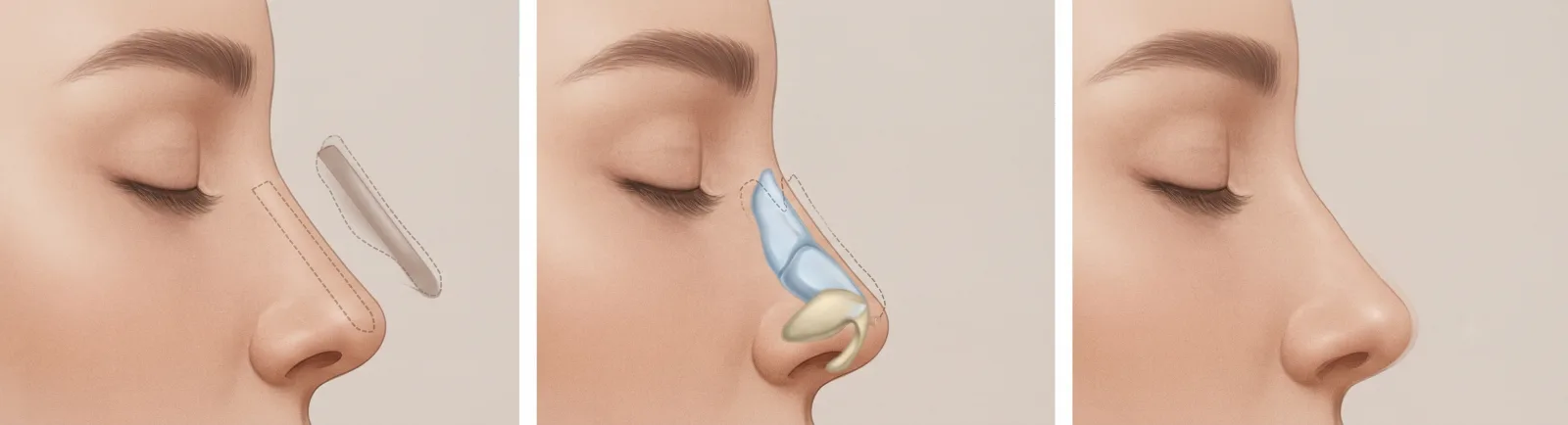
Illustration: the previous implant (outlined) is removed and the framework is rebuilt with the patient's own cartilage for support.
You are paying for a more difficult operation, which is more than a repeat of the first one. The reasons a revision is harder are the same reasons it is priced differently, and they are set out in full on revision vs primary rhinoplasty.
This page does not list prices. Under Korean medical advertising rules, and because every previously operated nose is genuinely different, a meaningful figure can only come from an individual assessment. What follows is how that figure is built, so you can have an informed conversation without chasing a number online. The procedure itself is covered on the revision rhinoplasty overview.
Factors
What affects the cost of a revision
The largest single factor is the grafting material your case needs. At Garnet the material is chosen per case: septal or ear cartilage, temporalis fascia from the scalp, autologous or donor rib, or a strip of dermis from the hip. A revision that can be done with remaining local cartilage involves less work than one that requires harvesting rib or hip dermis, which adds a whole donor-site procedure and a longer recovery.
Beyond the material, complexity drives the cost: how much scar tissue must be released, whether the correction is a focused adjustment or a more complete reconstruction of support, whether breathing function needs restoring as well as shape, and how much of the original work has to be undone before rebuilding can begin. A nose that has had more than one previous surgery is usually more involved than one with a single prior operation.
Other inputs include the length of the operation and the anaesthesia it requires. None of these can be judged from a photo alone, which is why a figure quoted before assessment is unreliable. The same words, 'revision rhinoplasty', can describe very different amounts of surgery.
Included
What a proper quote should include
A quote is only useful if you know what it covers. A complete revision quote should account for the surgery itself, the anaesthesia, any separate donor-site procedure, the early dressing changes on day 1 and day 3, the suture removals across the relevant sites, and the structured follow-up. At Garnet that follow-up is scheduled at 1, 3 and 6 months with the same surgeon and is included in the care.
It is worth asking explicitly whether the donor-site procedure, the post-operative visits and the follow-up are inside the quoted figure, because a low headline number that excludes them is not truly cheaper. A clear, itemised quote also shows how openly a clinic communicates, which is useful information in its own right.
For how quotes are structured more generally and what tends to be bundled or separate, see what affects plastic surgery cost and the broader plastic surgery cost in Korea guide.
Value
Why the cheapest revision is rarely the right one
Revision rhinoplasty is the procedure where chasing the lowest price carries the most risk. A revision is, by definition, a correction of an earlier operation, and a revision done poorly can consume the limited tissue and structure that a future option would depend on. There is only so much cartilage and scar margin to work with, so getting it wrong can cost you a good further chance as well as money.
That is why value here is better measured by the surgeon's experience and judgement than by the headline figure. A surgeon who assesses you candidly, including telling you when a revision is not advisable or when waiting longer is wiser, is protecting an outcome that a cheaper, faster booking may not. Being talked out of unnecessary surgery is part of the value.
Garnet's model is built around that judgement: a single board-certified surgeon, addressing only the area you came for, with no pressure to book on the day. You can read why that structure matters on what is a single-surgeon clinic.
International
Costs for international patients
International patients reasonably ask how a Korean revision compares with prices at home, and many find Korea offers strong value for complex nose work given the experience available. A straight figure-against-figure comparison misleads, though: a revision abroad and a revision in Seoul may describe different amounts of surgery, different materials and different follow-up, so a like-for-like comparison only exists after both have assessed your specific case.
When budgeting for Korea, factor in the practicalities alongside the surgical fee: the longer stay a revision asks for, accommodation while you heal, and the donor-site recovery if rib or hip dermis is used. These are covered in how long to stay in Korea for surgery and revision rhinoplasty for international patients. Garnet is registered with Korea's foreign-patient programme and a dedicated coordinator stays with you from consultation through recovery.
For how payment works as a visitor (methods, timing and what to confirm in advance), see paying as a foreign patient.
Confirming
How your own figure is confirmed
Because the cost depends so heavily on material, complexity and how much scar tissue is involved, your figure can only be confirmed after the surgeon has assessed your nose and your history. The practical first step is a no-obligation online consultation: you send photos and a description of your previous surgery, and the surgeon tells you what your case is likely to involve.
Garnet charges no consultation or CT fee and applies no pressure to book the same day, so you can get an informed assessment before committing to anything. Because the same board-certified surgeon, Dr. In-Soo Baek (Korean medical licence no. 77407), consults, operates and follows up, the person who scopes the work is the person who will do it. The quote you receive therefore reflects the actual plan.
From there, an in-person consultation in Apgujeong confirms the material, the complexity and the final figure, with a clear, itemised explanation of what is included. The goal is that you understand exactly what you are paying for before you decide.
Prices
Price at Garnet
Revision rhinoplasty
From₩4,000,000 + VATExcluding VAT (10% VAT is added at payment)Book now
Same price as Korean patients. Prices shown exclude 10% VAT; your written quote, issued after the in-person consultation, shows the full amount payable.
Dr. In-Soo Baek
Director & sole operating surgeon
Korean medical licence no. 77407
Operate on what you came for. Trained at Korea University Medical Center. Every case planned, performed and reviewed by the same hands.
1Operating surgeon
~2Surgeries per day
7Registered techniques
Board-certified plastic surgeon
Plastic surgery training at Korea University College of Medicine & graduate school
Korean Society of Plastic and Reconstructive Surgeons member, in its facial-contour, eye & rhinoplasty groups
Consults, operates and follows up each case himself
Peer-reviewed papers behind the facts on this page. Each describes findings in its own study group — not results at Garnet — and none predicts your own outcome.
Longino ES et al. Revision Rhinoplasty. Facial Plastic Surgery Clinics of North America. 2026. doi:10.1016/j.fsc.2026.01.009
Farid M et al. Complications of Cosmetic Surgery Abroad – Cost Analysis and Patient Perception. Plastic and Reconstructive Surgery - Global Open. 2019. doi:10.1097/gox.0000000000002281
Jiang A et al. Revision Rhinoplasty: With Introduction of a Novel Preoperative Assessment Classification System. Seminars in Plastic Surgery. 2021. doi:10.1055/s-0041-1727271
Davison SP et al. The Price of Medical Tourism: The Legal Implications of Surgery Abroad. Plastic & Reconstructive Surgery. 2018. doi:10.1097/prs.0000000000004816
FAQ
Common questions
How much does revision rhinoplasty cost in Korea?
A meaningful figure can only be given after an individual assessment, because the cost depends on the grafting material needed, the complexity of the correction and how much scar tissue is involved. A revision is generally more than a first rhinoplasty. This page explains what drives the figure and quotes none; your own is confirmed at consultation, and Garnet charges no consultation or CT fee.
Why does revision rhinoplasty cost more than a first nose job?
Because it is a longer, more complex operation. The surgeon dissects through scar tissue, the case often needs a separate donor-site procedure to harvest cartilage or dermis, and there is less margin for error. More operating time, added surgical complexity and an extra procedure all sit behind the higher figure.
What affects the cost of a revision rhinoplasty?
The main drivers are the grafting material required (remaining local cartilage versus harvesting rib, scalp fascia or hip dermis), the complexity of the correction, how much scar tissue must be released, whether breathing function also needs restoring, and how many previous surgeries the nose has had. None of this can be judged from a photo alone.
What is included in a revision rhinoplasty quote?
A complete quote should cover the surgery, the anaesthesia, any separate donor-site procedure, the early dressing changes on day 1 and 3, the suture removals across the relevant sites, and the structured 1, 3 and 6-month follow-up. Ask explicitly whether the donor-site procedure and follow-up are inside the figure, as a low number that excludes them is not truly cheaper.
Is revision rhinoplasty in Korea cheaper than other countries?
Many international patients find Korea offers strong value for complex nose work, but a like-for-like comparison only exists after assessment, because a revision abroad and a revision in Seoul may involve different amounts of surgery, materials and follow-up. Compare what is actually included as well as the headline figures, and factor in the longer stay a revision requires.
Should I choose the cheapest revision rhinoplasty?
It is rarely wise. A revision corrects an earlier operation, and a poorly done redo can use up the limited tissue and structure a future option would depend on. Value here is better measured by the surgeon's experience and candour, including the willingness to advise against surgery, than by the lowest price.
Does the donor site change the cost?
Yes. A revision that can use remaining septal or ear cartilage involves less work than one needing harvesting from the rib or a strip of dermis from the hip, which adds a whole donor-site procedure and a longer recovery. The material your case requires is one of the largest single factors in the cost.
Are consultation and follow-up charged separately?
At Garnet there is no consultation or CT fee, and the structured follow-up at 1, 3 and 6 months is part of the care. Always confirm with any clinic whether consultation, post-operative visits and follow-up are included, since these affect the true total even when the surgical headline looks low.
How do international patients budget for a revision in Korea?
Beyond the surgical fee, budget for the longer stay a revision asks for, accommodation while you heal, and donor-site recovery if rib or hip dermis is used. Garnet is registered with Korea's foreign-patient programme and a coordinator stays with you from consultation through recovery; payment practicalities are covered in the paying-as-a-foreign-patient guide.
How do I find out my own revision cost?
Start with a no-obligation online consultation: send photos and your surgical history, and the surgeon tells you what your case involves. An in-person consultation in Apgujeong then confirms the material, complexity and final figure with a clear, itemised breakdown, so you know exactly what you are paying for before deciding.
My mom recently had a brow lift and lower blepharoplasty with Dr. Baek, and our experience has been wonderful so far. The Garnet team was incredibly kind and welcoming, with Kelly assisting us as our English consultant—she made everything…
I’m so happy I chose this clinic for my lower blepharoplasty. I was traveling from abroad by myself, so I was a little nervous, but from the beginning I felt comfortable and truly cared for. Everyone was kind, patient, and professional…
Came in for an in-person consult and ended up choosing Garnet and Dr.Baek for my non-incisional DES and tiplasty/alarplasty. I communicated with Kelly (English consultant) from the start till now (3 weeks post-op). She really help me feel…
My under-eyes have been sagging and folding for years... I tried to cover it up with makeup, but it actually got stuck in the wrinkles and made it stand out even more. While going for consultations, I noticed that the bigger the hospital…
To learn what your revision would involve before talking numbers, send photos and your surgical history for a no-obligation pre-assessment, with no consultation or CT fee.
Send photos and your question before you travel. An English-speaking coordinator reviews every enquiry and replies with guidance on whether surgery is appropriate, the likely plan and timing.
✓ Reviewed by the clinic coordinator, not a bot
✓ Photo-based pre-assessment before you fly
✓ Foreign-patient scheduling & after-care
✓ One surgeon for consultation, surgery and follow-up
Prefer to chat now? Reach the coordinator directly:









 T S7 months ago



