Primary rhinoplasty starts with an untouched nose; revision rhinoplasty starts with one that has already been operated on. That single difference changes almost everything that follows: the scar tissue the surgeon works through, the material available to rebuild with, the complexity of the plan, the realistic goal, and the recovery. This page compares the two so you can understand which operation yours really is.
The short answer
Primary rhinoplasty works through fresh, predictable tissue; a revision works through scar tissue from the previous surgery, which is stiffer, less forgiving and harder to read.
A first nose can often use the patient's own septal or ear cartilage; a revision frequently faces depleted local cartilage and reaches for a donor site such as rib, scalp fascia or hip dermis.
The goal differs: a primary builds toward an ideal; a revision corrects a specific problem while respecting what tissue and structure remain.
A revision is typically a longer, more complex operation with a longer recovery. That is why assessing whether to operate at all matters before booking.
The core difference: a fresh nose versus a previously operated one
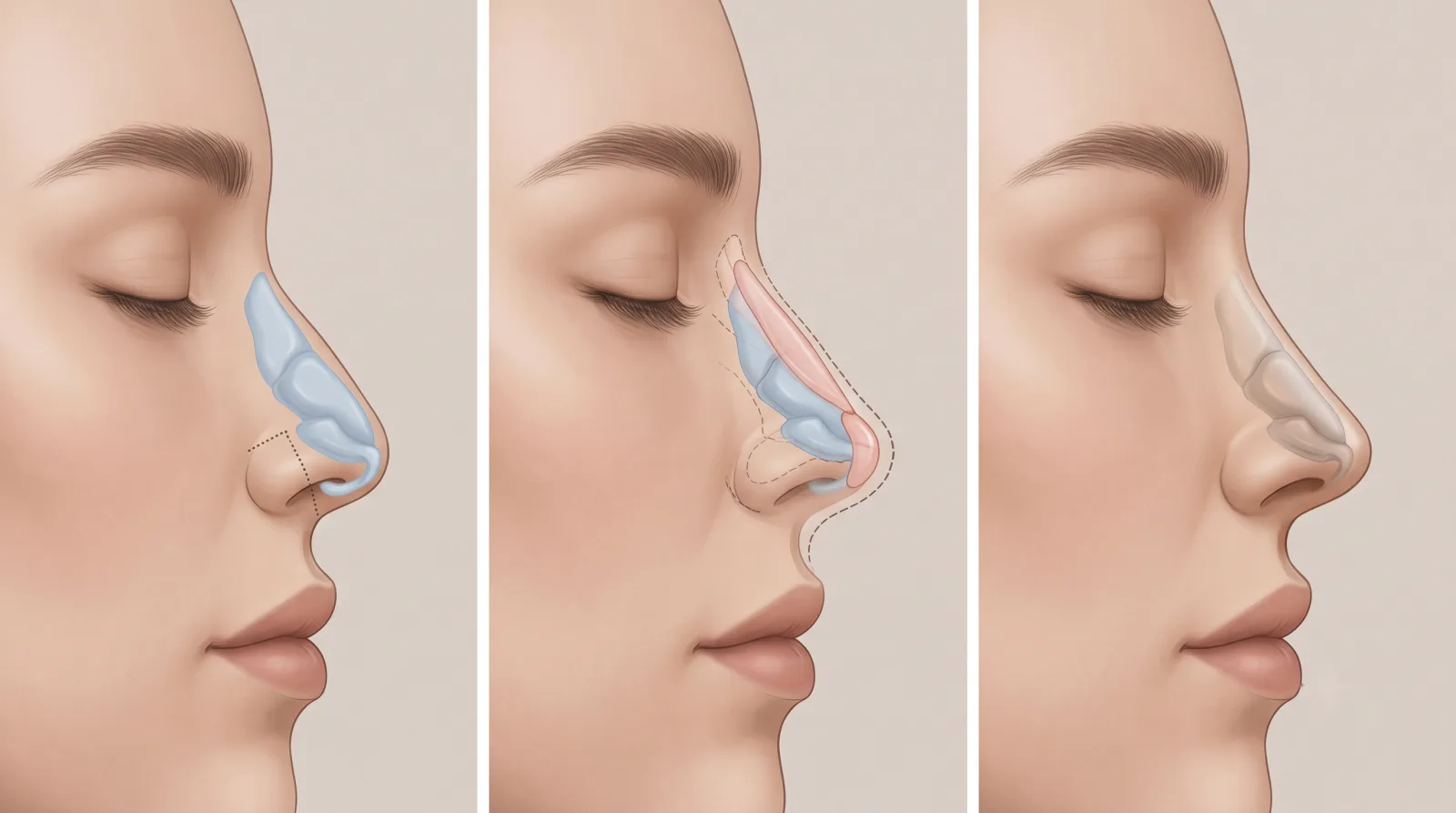
A primary rhinoplasty is a first-time nose operation. The surgeon works with anatomy as nature made it: predictable tissue planes, intact cartilage, and a blood supply that behaves the way the textbooks describe. At Garnet a primary rhinoplasty typically combines a dorsal augmentation with the patient's own tip cartilage taken from the septum or ear. It is a well-mapped operation through clean tissue.
Illustration: the nasal framework (blue) is reshaped to raise the bridge and refine the tip. The dashed outline shows the original contour.
A revision rhinoplasty begins where a previous operation left off. The internal landscape has been altered: tissue planes are fused by scar, some cartilage may have been removed or reshaped, and the original implant or graft may need adjusting or replacing. The surgeon is reading and reworking someone else's chapter, often without a complete record of what was done. That is why a revision is planned more cautiously and explained more carefully than a first nose.
Understanding this distinction is the foundation for everything else on this page. If you are not sure which category you fall into, the revision rhinoplasty overview and a consultation will clarify it.
Scar tissue
Why operating through scar tissue is harder
Scar tissue is the single biggest reason a revision is more demanding than a primary. After a first surgery the nose heals by laying down dense, fibrous tissue that binds the layers together. When the surgeon reopens the nose, those clean planes that make a primary predictable are gone. Dissecting the layers apart is slower, the tissue is stiffer, and the blood supply is more fragile, which raises the stakes on every move.
This also affects healing afterwards. Scarred tissue holds swelling longer and refines more slowly, so a revision result takes longer to emerge than a first nose. It is one of the practical reasons revision recovery runs on a longer clock, covered in detail on the revision rhinoplasty recovery timeline.
The implication for the patient is patience and realism. A revision asks the surgeon to do more delicate work in less forgiving conditions, and asks the patient to wait longer to see the result settle. Neither is a flaw in the operation. It is the nature of working on a nose that has already healed once.
Material
Cartilage depletion and where the rebuild comes from
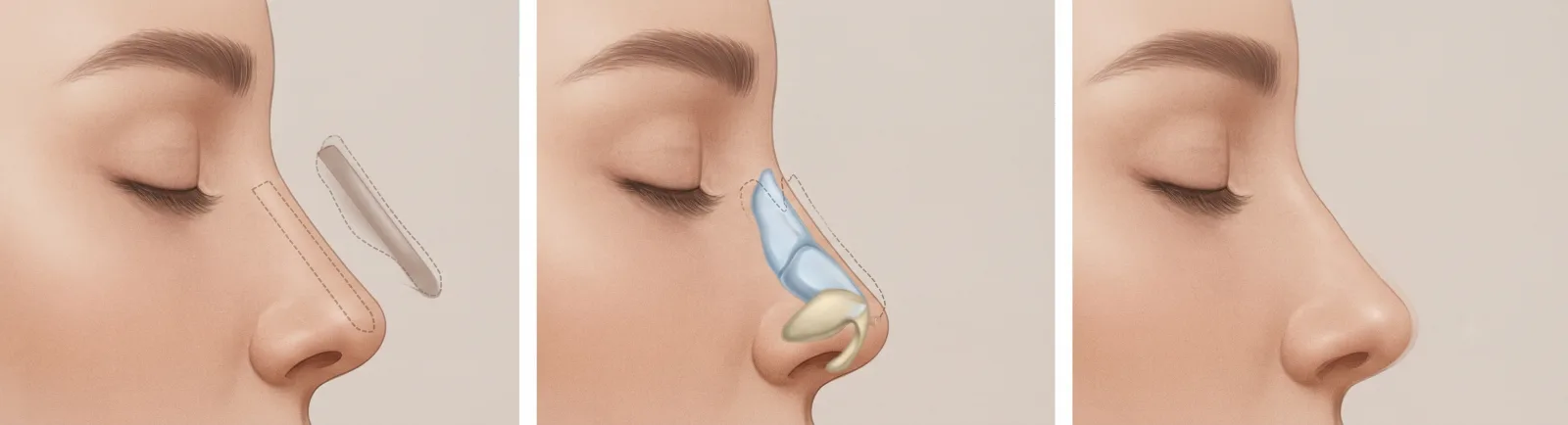
A primary rhinoplasty usually has a comfortable supply of the patient's own cartilage to work with, since the septum and the ears are intact donor sources. A revision often does not. The previous surgery may have used or weakened the septal cartilage, and there may simply not be enough strong local tissue left to rebuild the support a nose needs. This is what surgeons mean by cartilage depletion, and it shapes the whole plan.
Illustration: the previous implant (outlined) is removed and the framework is rebuilt with the patient's own cartilage for support.
When local cartilage is insufficient, a revision reaches further. At Garnet the material is chosen per case: autologous rib cartilage, donor rib, temporalis fascia from the scalp, a strip of dermis from the hip, or whatever septal and ear cartilage remains. Each of these is a separate donor site with its own incision, its own healing, and its own suture-removal timing, which is why a revision involves more than just the nose.
Here the two operations divide most clearly. A primary is usually self-contained, while a revision frequently borrows from elsewhere on the body to reconstruct what is missing. It is a key reason a revision asks for more recovery time and more planning, and it is something an online consultation can begin to scope before you travel.
Complexity
Complexity, the goal, and managing expectations
The two operations also differ in what they are trying to achieve. A primary rhinoplasty builds toward an aesthetic ideal from a known starting point: refining a bridge, defining a tip, balancing the profile. A revision usually has a more defined, corrective goal. It fixes a specific problem from the first surgery (a deviation, a collapse, an over-resected tip, breathing difficulty, or a shape that never settled) while protecting the structure and tissue that remain.
That makes a revision both more complex and more constrained. The surgeon has less margin to work with and must weigh every change against the limited tissue available, so the conversation is as much about what is realistically achievable as about what is ideal. A careful surgeon will sometimes advise that the realistic improvement is meaningful but partial, or that waiting longer before operating is wiser. A single-surgeon clinic is built to give that kind of judgement.
Garnet's approach is to address only the area you came for, without over-recommending. That restraint matters more in revision work, where doing less can preserve the structure a future option might depend on.
Recovery
How recovery differs between the two
Both operations share the same early rhythm: dressing changes on day 1 and day 3, a cast that comes off within the first week, and nose sutures around day 7. But a revision adds time on two fronts. First, the donor site for the rebuild has its own suture-removal schedule: around day 10 for ear, scalp fascia or rib, and around day 14 for a hip dermis site. Second, the scarred nasal tissue holds swelling longer, so the final shape takes longer to refine.
In practice this means a revision usually asks for a longer stay in Seoul and a more patient recovery than a first nose. The visible bruising fades on a similar schedule, but the deeper settling, especially at the tip, runs on a longer clock. The full week-by-week picture is on the revision rhinoplasty recovery timeline, and trip-length planning on how long to stay in Korea for surgery.
None of this makes a revision unmanageable. It just makes it different. The most useful way to prepare is to expect the longer arc of a revision from the start.
Which is mine
Is my case really a revision?
Any nose that has already had surgery (even a minor procedure, a filler-related complication, or a previous operation you were broadly happy with) falls into revision territory once it is reopened, because the scar tissue is there regardless. A nose that has never been operated on is a primary, even if it has been injured. The line is whether the inside has been surgically altered before.
This matters because it determines the realistic plan, the likely need for a donor site, the recovery time, and the cost. A revision is generally a longer, more complex operation, which is part of why its pricing is structured differently, as explained on revision rhinoplasty cost in Korea.
If you are unsure how your history will be classified, that is exactly what a consultation establishes. Sending photos and a description of your previous surgery lets the surgeon tell you plainly whether your case is a straightforward correction or a more involved reconstruction.
Choosing
How to choose well for a revision
Because a revision is more demanding, who performs it matters even more than for a first nose. The most useful safeguards are confirming that a board-certified plastic surgeon will do the operation, that the same surgeon who consults you also operates and follows up, and that the assessment is candid about what is achievable.
Garnet is a single-surgeon clinic in Apgujeong, Seoul. Every operation there is performed by Dr. In-Soo Baek, a board-certified plastic surgeon (Korean medical licence no. 77407) and the clinic's only operating doctor. He consults on your nose, performs the revision or primary operation himself, and reviews every follow-up at 1, 3 and 6 months. For a revision, that continuity removes the guesswork of who is in the room and keeps one set of hands accountable for a complex result. You can read more about the model on what is a single-surgeon clinic.
Start with a no-obligation online assessment: send photos and your surgical history, and get a clear read on whether a revision would help and how.
Prices
Price at Garnet
Revision rhinoplasty
From₩4,000,000 + VATExcluding VAT (10% VAT is added at payment)Book now
Same price as Korean patients. Prices shown exclude 10% VAT; your written quote, issued after the in-person consultation, shows the full amount payable.
Dr. In-Soo Baek
Director & sole operating surgeon
Korean medical licence no. 77407
Operate on what you came for. Trained at Korea University Medical Center. Every case planned, performed and reviewed by the same hands.
1Operating surgeon
~2Surgeries per day
7Registered techniques
Board-certified plastic surgeon
Plastic surgery training at Korea University College of Medicine & graduate school
Korean Society of Plastic and Reconstructive Surgeons member, in its facial-contour, eye & rhinoplasty groups
Consults, operates and follows up each case himself
Peer-reviewed papers behind the facts on this page. Each describes findings in its own study group — not results at Garnet — and none predicts your own outcome.
Shomorony A et al. Endonasal Secondary Rhinoplasty Techniques. Facial Plastic Surgery Clinics of North America. 2026. doi:10.1016/j.fsc.2026.01.004
Frederick JW et al. Asian Male Blepharoplasty and Rhinoplasty. Facial Plastic Surgery Clinics of North America. 2024. doi:10.1016/j.fsc.2024.03.005
Tasman AJ. Camouflage Techniques in Secondary Rhinoplasty. Facial Plastic Surgery Clinics of North America. 2026. doi:10.1016/j.fsc.2026.01.007
Wei J et al. Revision Rhinoplasty in Asians. Clinics in Plastic Surgery. 2023. doi:10.1016/j.cps.2022.08.004
FAQ
Common questions
What is the difference between revision rhinoplasty and primary rhinoplasty?
Primary rhinoplasty is a first-time nose operation through fresh, predictable tissue, usually using the patient's own septal or ear cartilage. Revision rhinoplasty reworks a nose that has already been operated on, working through scar tissue and often with depleted local cartilage that requires a donor site like rib, scalp fascia or hip dermis. The revision is generally more complex with a longer recovery.
Why is revision rhinoplasty harder than a first nose job?
Mainly because of scar tissue. After a first surgery the nose heals with dense fibrous tissue that fuses the layers, so the clean planes a primary relies on are gone. Dissection is slower, the tissue is stiffer, and the blood supply is more fragile. Revisions also often face cartilage depletion, requiring material from a separate donor site.
Does revision rhinoplasty always need cartilage from a donor site?
Not always, but often. A first surgery may have used or weakened the septal cartilage, leaving too little strong local tissue to rebuild support. When that happens, a revision reaches for a donor site such as rib, temporalis fascia from the scalp, or dermis from the hip. A consultation determines whether your case is likely to need this.
Is the goal of a revision different from a primary?
Yes. A primary builds toward an aesthetic ideal from an untouched starting point. A revision usually has a corrective goal, fixing a specific problem like a deviation, collapse, over-resected tip or breathing difficulty, while protecting the limited structure and tissue that remain. The conversation centres on what is realistically achievable as well as what is ideal.
Is recovery longer for a revision than a primary?
Generally yes. Both share the early rhythm (dressing changes on day 1 and 3, cast off within the first week, nose sutures around day 7), but a revision adds the donor site's own suture timing (around day 10 for ear, scalp or rib; around day 14 for hip dermis) and scarred tissue holds swelling longer, so the final shape takes longer to settle.
How do I know if my case is a revision or a primary?
If your nose has been surgically operated on before, it is a revision once reopened, because the scar tissue is present regardless of how the first result looked. A nose that has never had surgery is a primary, even if it has been injured. The deciding factor is whether the inside of the nose has been surgically altered before.
Is revision rhinoplasty or primary rhinoplasty better for me?
Neither is universally better. They apply to different situations. If you have never had nose surgery, you need a primary; if you have, and a problem remains, you may be a candidate for a revision. The right choice for you depends on your nasal surgery history and goals, which the consultation establishes before any plan is made.
Why does choosing the surgeon matter even more for a revision?
Because a revision is more delicate work in less forgiving conditions, with limited tissue and higher complexity. Confirming a board-certified plastic surgeon will perform it, that the same surgeon consults and operates, and that the assessment is candid about what is achievable, protects you far more than for a first, more predictable operation.
Can a revision fully correct a previous rhinoplasty?
Sometimes the improvement can be substantial, but a revision works within the constraints of scarred tissue and whatever structure remains, so a careful surgeon will frame the realistic outcome and will not promise a complete reset. Setting that expectation early, including the possibility of waiting before operating, is part of a responsible plan.
How do I start if I think I need a revision?
Send photos and a description of your previous surgery for a no-obligation online pre-assessment. A board-certified surgeon can tell you whether your case is a straightforward correction or a more involved reconstruction, what material it may need, and how long recovery would take, before you commit to travelling.
My mom recently had a brow lift and lower blepharoplasty with Dr. Baek, and our experience has been wonderful so far. The Garnet team was incredibly kind and welcoming, with Kelly assisting us as our English consultant—she made everything…
I’m so happy I chose this clinic for my lower blepharoplasty. I was traveling from abroad by myself, so I was a little nervous, but from the beginning I felt comfortable and truly cared for. Everyone was kind, patient, and professional…
Came in for an in-person consult and ended up choosing Garnet and Dr.Baek for my non-incisional DES and tiplasty/alarplasty. I communicated with Kelly (English consultant) from the start till now (3 weeks post-op). She really help me feel…
My under-eyes have been sagging and folding for years... I tried to cover it up with makeup, but it actually got stuck in the wrinkles and made it stand out even more. While going for consultations, I noticed that the bigger the hospital…
If you are unsure whether your nose needs a revision or a first operation, send photos and your history for a no-obligation pre-assessment before you plan a trip.
Send photos and your question before you travel. An English-speaking coordinator reviews every enquiry and replies with guidance on whether nose surgery is appropriate for you, the likely plan and timing.
✓ Reviewed by the clinic coordinator, not a bot
✓ Photo-based pre-assessment before you fly
✓ Foreign-patient scheduling & after-care
✓ One surgeon for consultation, surgery and follow-up
Prefer to chat now? Reach the coordinator directly:









 T S7 months ago



