Recovery after revision rhinoplasty starts with dressing changes on day 1 and day 3 and follows a longer, more patient arc than a first nose operation. Scar tissue from the previous surgery, the cartilage or tissue used to rebuild the nose, and the donor site it came from all shape how your days and weeks unfold. This page walks through the timeline for a revision nose specifically.
The short answer
Plan for two early dressing changes, on day 1 and day 3 after surgery, before the cast and packing come off.
Suture removal depends on the donor site: nose sutures around day 7, ear or temporalis fascia or rib around day 10, and a hip dermis donor site around day 14.
The cast usually comes off in the first week, but a revision nose swells longer than a primary nose. Early refinement takes weeks and the final shape settles over many months.
A single-surgeon clinic means the same board-certified surgeon who operated reviews your healing at 1, 3 and 6 months, including by messenger once you fly home.
The first days are the most managed part of recovery. After a revision rhinoplasty you leave with an external cast or splint protecting the new framework, and usually internal support inside the nostrils. At Garnet the early plan includes a dressing change on day 1 and again on day 3. These short visits let the surgeon check the wound, change packing and confirm the rebuild is settling as intended. Because revision surgery works through previously operated, scarred tissue, this early monitoring matters more than it does after a straightforward first operation.
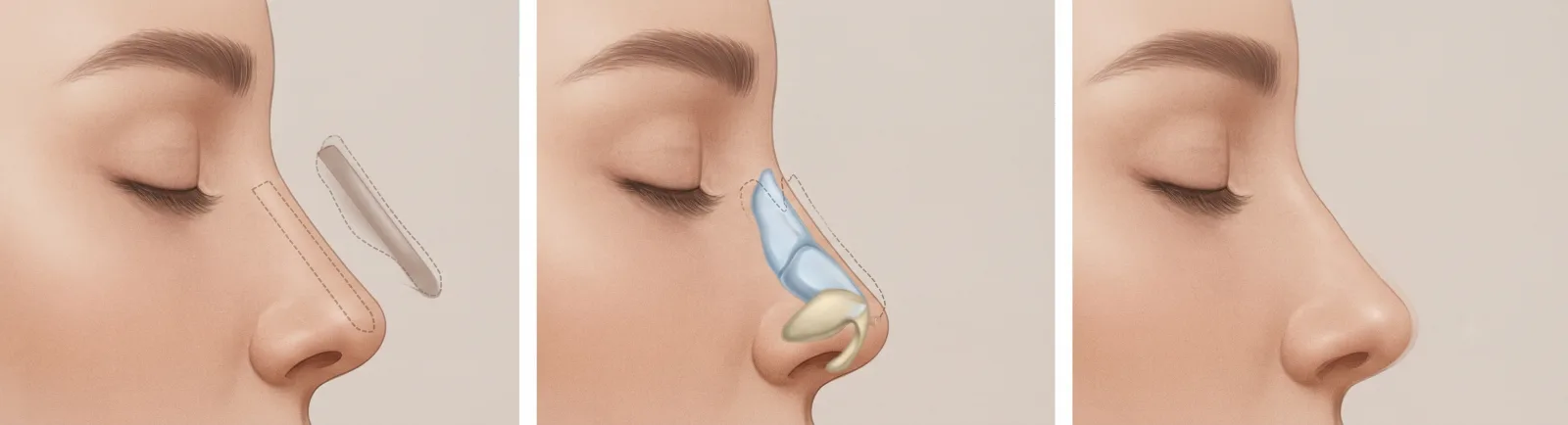
Illustration: the previous implant (outlined) is removed and the framework is rebuilt with the patient's own cartilage for support.
Through the first week you should expect a blocked, congested nose, mild oozing, and bruising or puffiness that often shows more around the eyes than on the nose itself. Sleeping propped up on two pillows, avoiding bending and heavy lifting, and keeping the cast dry all help. You breathe through your mouth for these days, which is normal while the inside of the nose is supported and swollen.
The external cast typically comes off within the first week. Seeing your nose for the first time without the cast can be a surprise. It will look swollen and slightly upturned, and that is expected. A revision nose at one week is not the finished result; it is the starting line of a longer settling process described below. For the full picture of the operation itself, see the revision rhinoplasty overview.
Sutures
Suture removal depends on the donor site
Revision rhinoplasty often needs grafting material to rebuild what was lost, weakened or distorted in the first surgery, and the donor site that material comes from sets its own healing clock. This is one of the biggest differences from a primary nose, where there is usually only the nose itself to heal. The material is chosen per case: septal or ear cartilage, temporalis fascia from the scalp, rib cartilage, or a strip of dermis from the hip.
As a guide to the timing your surgeon will confirm for you: nose sutures come out around day 7; an ear cartilage donor site around day 10; a temporalis fascia (scalp) site around day 10; a rib cartilage site around day 10; and a hip dermis donor site around day 14, as it is the slowest of these to close. If more than one site was used, the longest one governs when you are fully out of sutures.
These extra donor sites are why a revision plan asks you to budget more time in Seoul than a first rhinoplasty would. It is worth confirming, before you travel, exactly which material is likely for your case so you can plan suture-removal visits. You can do this in an online consultation before booking flights.
Weeks 2–6
Weeks two to six: looking presentable again
Once the cast is off and sutures are out, the visible bruising fades and most patients feel comfortable being seen in public again somewhere between week two and week three. Residual swelling concentrates at the tip and along the bridge, and the nose can still feel firm, numb or tight. These are normal sensations as nerves and tissue recover through old scar planes.
Many international patients return to desk-based work within one to two weeks, though a revision schedule is more conservative than a primary one because of the donor sites. Light activity resumes gradually; avoid strenuous exercise, saunas, swimming and anything that risks a knock to the nose for the first several weeks. Glasses that rest on the bridge should be kept off until your surgeon clears them.
By around six weeks the nose looks settled enough that most people feel it reads as natural to others, even though refinement continues underneath. This is also when the deeper, slower part of healing, which produces the final shape, is just getting underway.
Swelling
How swelling settles over the months
Swelling is the defining feature of any nose recovery, and revision noses hold it longer. Scarred tissue from the previous operation has a less forgiving blood supply and a stiffer healing response, so fluid lingers, particularly at the tip, which is the last area to refine. The broad bridge swelling resolves first over the early weeks; the tip can stay subtly fuller for many months.
A realistic expectation is that the majority of swelling subsides over the first few months, while the genuinely final, refined shape (the small contours of the tip and the way the nose sits in profile) continues to mature well beyond that. This is normal and not a sign anything is wrong; it is the trade-off of rebuilding through previously operated tissue.
You can support this stage by keeping salt intake moderate, staying upright through the day in the early weeks, protecting the nose from sun and impact, and following any taping or massage guidance your surgeon gives. Patience is the main tool. For how this compares with a first operation, see revision vs primary rhinoplasty, and for scar-specific healing see revision rhinoplasty scars and healing.
Red flags
What is normal recovery and what is not
Normal recovery includes congestion, a blocked-up feeling, bruising around the eyes, numbness of the tip and upper lip, occasional shooting tingles as nerves wake up, asymmetric swelling that evens out, and a nose that looks too upturned at first. Mild discomfort is usually well controlled with the medication your surgeon prescribes; revision surgery is generally described as pressure and stiffness, with little sharp pain. This is covered in more depth on revision rhinoplasty pain and anaesthesia.
Contact your clinic promptly if you have a fever, spreading redness or warmth, pain that grows after the first days, heavy or persistent bleeding, a foul discharge, or sudden one-sided swelling at the nose or at any donor site such as the ear, scalp, rib or hip. These are uncommon, but they are the signals worth acting on early.
The advantage of a continuous-care model is that there is always one surgeon who knows your case to ask. At a single-surgeon clinic, the doctor who rebuilt your nose is the one who answers when something feels off, including after you have travelled home.
Flying home
When it is safe to fly home
Most patients are advised not to plan a flight until the cast is off and the early swelling has begun to settle. In practice this means staying in Seoul through the first dressing changes and at least the nose-suture removal, and longer if a slower donor site like the hip was used. Cabin pressure and a long flight are tolerable once your surgeon confirms the wounds and donor sites are healing well, but flying too early risks pressure discomfort and removes you from easy follow-up if something needs attention.
Because revision recovery depends on which donor site was used, the safe-to-fly date is set individually for each patient. Build flexibility into your return ticket, and let your suture-removal schedule decide the date. General guidance on timing air travel is in when can I fly after plastic surgery, and trip-length planning in how long to stay in Korea for surgery.
Follow-up
Follow-up with the same surgeon at 1, 3 and 6 months
Revision rhinoplasty is judged over months, which makes structured follow-up part of the result itself. Garnet schedules reviews at 1, 3 and 6 months, tracking how the swelling resolves and how the tip refines over the months when a revision nose reveals its final shape. Because the same board-certified surgeon, Dr. In-Soo Baek (Korean medical licence no. 77407), consulted, operated and follows up, each review is read against what he did in theatre, first-hand.
For international patients who fly home before the six-month mark, these reviews continue by messenger: you send photos at the milestones and the surgeon assesses healing and advises remotely. That continuity is the point of a single-surgeon clinic: the person who knows your nose stays with it. You can begin with a no-obligation online assessment and read about the clinic's wider support for visitors on revision rhinoplasty for international patients.
Prices
Price at Garnet
Revision rhinoplasty
From₩4,000,000 + VATExcluding VAT (10% VAT is added at payment)Book now
Same price as Korean patients. Prices shown exclude 10% VAT; your written quote, issued after the in-person consultation, shows the full amount payable.
Dr. In-Soo Baek
Director & sole operating surgeon
Korean medical licence no. 77407
Operate on what you came for. Trained at Korea University Medical Center. Every case planned, performed and reviewed by the same hands.
1Operating surgeon
~2Surgeries per day
7Registered techniques
Board-certified plastic surgeon
Plastic surgery training at Korea University College of Medicine & graduate school
Korean Society of Plastic and Reconstructive Surgeons member, in its facial-contour, eye & rhinoplasty groups
Consults, operates and follows up each case himself
Peer-reviewed papers behind the facts on this page. Each describes findings in its own study group — not results at Garnet — and none predicts your own outcome.
Tasman AJ. Camouflage Techniques in Secondary Rhinoplasty. Facial Plastic Surgery Clinics of North America. 2026. doi:10.1016/j.fsc.2026.01.007
Longino ES et al. Revision Rhinoplasty. Facial Plastic Surgery Clinics of North America. 2026. doi:10.1016/j.fsc.2026.01.009
Jiang A et al. Revision Rhinoplasty: With Introduction of a Novel Preoperative Assessment Classification System. Seminars in Plastic Surgery. 2021. doi:10.1055/s-0041-1727271
FAQ
Common questions
How long does revision rhinoplasty recovery take?
The managed early phase runs through the first week, with dressing changes on day 1 and day 3 and the cast usually off within the first week. Most people look presentable again by two to three weeks, but a revision nose swells longer than a first operation. The majority of swelling settles over the first few months and the final, refined shape continues to mature well beyond that.
What is revision rhinoplasty recovery like day by day in the first week?
Day 1 and day 3 are dressing changes where the surgeon checks the wound and packing. Expect congestion, a blocked nose, and bruising around the eyes through the week. The external cast typically comes off within the first week, revealing a swollen, slightly upturned nose, which is the normal starting point of healing.
When do the sutures come out after revision rhinoplasty?
It depends on the donor site used to rebuild the nose: nose sutures around day 7, an ear cartilage or temporalis fascia or rib cartilage donor site around day 10, and a hip dermis donor site around day 14. If more than one site was used, the longest one decides when you are fully out of sutures.
Why does revision rhinoplasty take longer to recover than a first nose job?
Two reasons: the surgery works through scar tissue from the previous operation, which heals more slowly and holds swelling longer, and it usually needs grafting material from a donor site (ear, scalp, rib or hip) that has its own healing time. Both factors extend the timeline compared with a primary rhinoplasty.
When can I return to work after revision rhinoplasty?
Many international patients return to desk-based work within one to two weeks, once the cast is off and visible bruising has faded. Physically demanding work, exercise, saunas and swimming should wait several weeks, and you should avoid any risk of a knock to the nose during early healing. Your surgeon will give you a date specific to your case and donor site.
How long does swelling last after revision rhinoplasty?
Bridge swelling resolves over the early weeks; tip swelling lasts longest because the tip is the last area to refine and revision tissue is scarred. The majority of swelling subsides over the first few months, while the genuinely final shape continues to settle for many months. This is normal and not a sign of a problem.
When is it safe to fly home after revision rhinoplasty?
Plan to stay in Seoul at least until the cast is off and the nose sutures are removed, and longer if a slower donor site such as the hip was used. The safe-to-fly date is individual because it depends on which donor site was involved, so keep your return flexible and let your suture-removal schedule decide.
What aftercare follows revision rhinoplasty?
Keep the cast dry, sleep propped up, avoid bending, heavy lifting, exercise, saunas and swimming in the early weeks, keep glasses off the bridge until cleared, and protect the nose from sun and impact. Attend the dressing changes and suture removals, and follow any taping or massage guidance. Garnet then reviews healing at 1, 3 and 6 months.
What warning signs should I watch for during recovery?
Contact the clinic promptly for fever, spreading redness or warmth, pain that increases instead of decreasing after the first days, heavy or persistent bleeding, foul discharge, or sudden one-sided swelling at the nose or at any donor site (ear, scalp, rib or hip). These are uncommon but worth acting on early.
Will the same surgeon follow my recovery if I live abroad?
Yes. Garnet is a single-surgeon clinic, so the board-certified surgeon who operated reviews your healing at 1, 3 and 6 months, in person while you are in Korea and by messenger with photos once you have flown home, so the person who knows your nose stays with your recovery.
My mom recently had a brow lift and lower blepharoplasty with Dr. Baek, and our experience has been wonderful so far. The Garnet team was incredibly kind and welcoming, with Kelly assisting us as our English consultant—she made everything…
I’m so happy I chose this clinic for my lower blepharoplasty. I was traveling from abroad by myself, so I was a little nervous, but from the beginning I felt comfortable and truly cared for. Everyone was kind, patient, and professional…
Came in for an in-person consult and ended up choosing Garnet and Dr.Baek for my non-incisional DES and tiplasty/alarplasty. I communicated with Kelly (English consultant) from the start till now (3 weeks post-op). She really help me feel…
My under-eyes have been sagging and folding for years... I tried to cover it up with makeup, but it actually got stuck in the wrinkles and made it stand out even more. While going for consultations, I noticed that the bigger the hospital…
Wondering how long your own revision recovery would take? Send nose photos and your surgical history for a no-obligation pre-assessment before you plan a trip to Seoul.
Send photos and your question before you travel. An English-speaking coordinator reviews every enquiry and replies with guidance on whether surgery is appropriate, the likely plan and timing.
✓ Reviewed by the clinic coordinator, not a bot
✓ Photo-based pre-assessment before you fly
✓ Foreign-patient scheduling & after-care
✓ One surgeon for consultation, surgery and follow-up
Prefer to chat now? Reach the coordinator directly:










 T S7 months ago



