Revision rhinoplasty rebuilds the nose under anaesthesia, so you feel nothing during the operation itself. Afterwards, most people describe pressure, congestion and a blocked, swollen feeling more than sharp pain. A revision also often borrows cartilage from another part of the body, and that donor site is the part most patients underestimate when they picture recovery.
The short answer
You feel nothing during the operation: revision rhinoplasty is performed under anaesthesia, with the depth chosen for the complexity of the rebuild.
Afterwards, most people report pressure, blockage and congestion more than sharp pain; the nose feels stuffed and swollen, and few describe it as agonising.
If cartilage is taken from the rib, ear or hip, that donor site is often the more noticeable ache in the first days. It is a normal, manageable part of a revision.
Discomfort is controlled with prescribed medication and settles steadily as the dressings come off and swelling subsides over the following weeks.
Revision rhinoplasty is performed under anaesthesia so that you feel nothing during the operation. A revision is more involved than a first rhinoplasty. It works through an open approach, often rebuilds the framework with cartilage grafts, and may involve harvesting cartilage from a second part of the body. For that reason the depth and type of anaesthesia is matched to how complex your particular rebuild will be and to harvesting from a donor site if that is part of the plan.
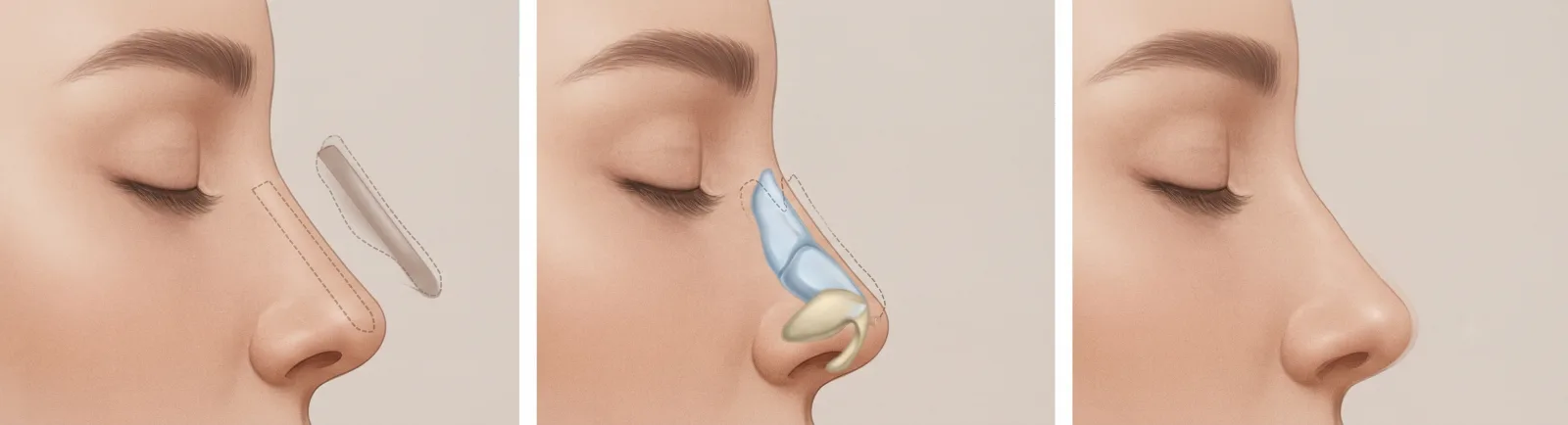
Illustration: the previous implant (outlined) is removed and the framework is rebuilt with the patient's own cartilage for support.
The right level of anaesthesia for you is a clinical decision, made with your medical history, the length of the operation and the donor site in mind, and it is confirmed before surgery. This is one of the practical reasons a thorough consultation matters: the plan for keeping you safely asleep and comfortable is built around the specific operation you need.
Whatever the chosen approach, the principle is the same: you are not aware and you do not feel the surgery. The discomfort that people ask about almost always refers to the recovery afterwards, which is what the rest of this page covers.
During surgery
What you feel during the operation
During the operation itself you feel nothing. You are not aware of the incisions, the work on the cartilage framework, or the harvesting of any graft from the septum, ear, rib or hip. A revision can take longer than a first rhinoplasty because the surgeon is working through scar tissue from the previous operation and rebuilding, which takes more time than simple refinement. A longer operation does not mean a more painful one for you, because the anaesthesia covers the whole procedure.
Working through scar tissue is one of the things that makes a revision technically demanding. Old scarring can distort the planes the surgeon normally works in, the skin envelope may be thinner or stiffer, and the original framework has already been altered. None of this changes what you experience on the table, and you will not be aware of it. It is, however, why the operation is planned carefully and why an experienced surgeon and an unhurried schedule matter for a revision.
You wake up with the nose supported by internal splints or packing and an external cast or tape, and with a sense of congestion and pressure. That is the start of recovery and a normal sign. It is exactly what a settled, rebuilt nose feels like in the first hours.
First days
What the first days actually feel like
Most people are surprised that a nose operation is not especially sharp or painful. The dominant sensations are pressure, fullness and congestion. The nose feels blocked and swollen, breathing through it is difficult while it is splinted, and there is a tight, heavy feeling across the bridge. There is usually bruising and swelling around the nose and sometimes the eyes, which looks more dramatic than it feels and peaks in the first two to three days before easing.
Garnet's revision protocol gives a useful sense of the early timeline: dressings are typically changed on day 1 and day 3, and the sutures come out over roughly 7 to 14 days depending on where the graft was taken: about 7 days for the nose, around 10 days for ear, rib or temporalis-fascia donor sites, and up to 14 days for a hip dermis donor site. Each of those touchpoints is also when the surgeon checks that everything is healing as it should, which is reassuring as well as practical.
Day-to-day discomfort is generally mild to moderate and well controlled with the medication you are given. The blocked, congested feeling lasts longer than the soreness. It eases as internal swelling settles and any packing or internal splints are removed, and most people are presentable in public, with residual swelling, within a couple of weeks. You can read how the whole recovery unfolds in the revision rhinoplasty recovery timeline.
Donor site
The part most people don't expect: the donor site
The detail patients most often overlook is that a revision frequently borrows cartilage or tissue from somewhere else, and that second site has its own recovery. At Garnet the material is chosen per case from your own septal or ear cartilage, rib (your own or donor), dermis from the hip, or temporalis fascia from the temple. Where you feel discomfort, and for how long, depends partly on where the graft came from.
A rib graft, for example, leaves a small chest incision that can feel tight or sore when you breathe deeply, laugh or twist for the first several days; an ear donor site leaves a discreet area behind or within the ear; a hip dermis site leaves a small area that can feel bruised when you sit or move; and a temporalis-fascia site is in the hairline. For many people the donor site is the most noticeable ache in the first days, sometimes more than the nose itself. It is still a normal, expected and manageable part of a revision.
Knowing this in advance changes the experience. When you understand why there is a second tender spot and how long it typically lasts, it feels like part of the plan. Your surgeon should tell you at consultation which donor site is likely for your case, so you can picture recovery realistically. That is also why material choice is discussed openly in the revision rhinoplasty overview.
Managing it
How discomfort is managed
Discomfort after a revision is controlled with prescribed pain medication, and most people step down from it within the first several days as the soreness fades. Keeping your head elevated, resting in the first days, using cold compresses as advised, and avoiding bending, heavy lifting and strenuous activity all reduce swelling and the pressure feeling that drives most of the discomfort. Simple, consistent care does more for comfort than any single remedy.
The congested, blocked sensation eases in stages as internal swelling subsides and the splints or packing are removed at the scheduled dressing changes. It is normal for this to take longer than the soreness, and for the nose to feel stuffy for a while even once the outside looks settled. Following the after-care instructions closely, and reporting anything that feels wrong straight away, is the most reliable way to stay comfortable and protect the result.
You should never feel alone with discomfort. Clear guidance on what is normal, what is not, and who to contact removes most of the anxiety that makes pain feel worse. This is one of the quiet advantages of being looked after by the surgeon who actually operated on you, without being passed between staff.
At Garnet
How Garnet keeps a revision comfortable
Garnet is a single-surgeon clinic in Apgujeong, Seoul. Dr. In-Soo Baek is a board-certified plastic surgeon (Korean medical licence no. 77407) and the only operating doctor. He consults, performs the revision himself and reviews every dressing change and follow-up. Because the surgeon who chose your graft and rebuilt your framework is the same person checking your recovery, the assessment of what is normal for your specific operation is consistent throughout.
The clinic caps the day at two surgeries, so a complex revision is given unhurried time and is never squeezed into a busy list. Dressings are reviewed on day 1 and day 3, sutures are removed on schedule by donor site, and discomfort is managed with prescribed medication and clear after-care. Structured follow-ups at 1, 3 and 6 months mean both the nose and the donor site are reviewed as they settle, and Garnet is registered with Korea's foreign-patient programme.
If you are weighing a revision and worried about pain, the most reassuring step is to ask your specific questions before committing, including which donor site is likely for you and what recovery will feel like. You can do this in a no-obligation online consultation before you plan any travel.
Prices
Price at Garnet
Revision rhinoplasty
From₩4,000,000 + VATExcluding VAT (10% VAT is added at payment)Book now
Same price as Korean patients. Prices shown exclude 10% VAT; your written quote, issued after the in-person consultation, shows the full amount payable.
Dr. In-Soo Baek
Director & sole operating surgeon
Korean medical licence no. 77407
Operate on what you came for. Trained at Korea University Medical Center. Every case planned, performed and reviewed by the same hands.
1Operating surgeon
~2Surgeries per day
7Registered techniques
Board-certified plastic surgeon
Plastic surgery training at Korea University College of Medicine & graduate school
Korean Society of Plastic and Reconstructive Surgeons member, in its facial-contour, eye & rhinoplasty groups
Consults, operates and follows up each case himself
Peer-reviewed papers behind the facts on this page. Each describes findings in its own study group — not results at Garnet — and none predicts your own outcome.
Kim DY et al. Treatment Strategy for Revision Rhinoplasty in Asians. Facial Plastic Surgery. 2016. doi:10.1055/s-0036-1594254
Cochran CS. Harvesting Rib Cartilage in Primary and Secondary Rhinoplasty. Clinics in Plastic Surgery. 2016. doi:10.1016/j.cps.2015.09.018
Shomorony A et al. Endonasal Secondary Rhinoplasty Techniques. Facial Plastic Surgery Clinics of North America. 2026. doi:10.1016/j.fsc.2026.01.004
FAQ
Common questions
Is revision rhinoplasty painful?
You feel nothing during the operation because it is done under anaesthesia. Afterwards, most people describe pressure, congestion and a blocked, swollen feeling more than sharp pain, and it is generally well controlled with prescribed medication. If cartilage is taken from a donor site like the rib or hip, that second area is often the more noticeable ache in the first days.
What anaesthesia is used for revision rhinoplasty?
Revision rhinoplasty is performed under anaesthesia so you feel nothing during surgery, with the depth and type matched to how complex the rebuild is and whether a graft is being harvested from a donor site. The right approach is a clinical decision made with your medical history and the operation length in mind, and the plan is agreed with you before surgery.
How much discomfort is there after revision rhinoplasty?
Generally mild to moderate and well controlled. The strongest sensations are pressure, fullness and congestion, with bruising and swelling that peak in the first two to three days and then ease. The blocked, stuffy feeling tends to last longer than the soreness, easing as internal swelling settles and splints or packing are removed.
Why does the donor site hurt more than my nose?
Because a revision often borrows cartilage or tissue from the rib, ear, hip or temple, and that second site has its own healing. A rib site can feel tight when you breathe deeply, a hip site bruised when you move, and so on. For many people this is the most noticeable ache in the early days. It is a normal, expected part of a revision.
How long does the pain last after revision rhinoplasty?
Most people step down from stronger pain medication within the first several days as soreness fades. Pressure and congestion ease over the following weeks as swelling settles and splints or packing are removed. A donor site such as the rib can feel tender for several days to a couple of weeks. Residual swelling can linger much longer but is not painful.
Does working through scar tissue make recovery more painful?
Working through scar tissue from the previous operation makes a revision more technically demanding and can make it longer, but it does not make what you feel during surgery painful, because anaesthesia covers the whole operation. Recovery sensations are similar to a first rhinoplasty (pressure and congestion), with the addition of any donor-site tenderness.
How is pain controlled after the operation?
With prescribed pain medication, plus simple measures that reduce swelling and pressure: keeping your head elevated, resting in the first days, cold compresses as advised, and avoiding bending, lifting and strenuous activity. Following the after-care instructions closely and reporting anything that feels wrong are the most reliable ways to stay comfortable.
When do the dressings and stitches come out?
At Garnet, dressings are typically changed on day 1 and day 3, and sutures come out over roughly 7 to 14 days depending on the donor site: about 7 days for the nose, around 10 days for ear, rib or temporalis-fascia sites, and up to 14 days for a hip dermis site. Each visit is also a check that healing is on track.
Will I be awake during the surgery?
No. Revision rhinoplasty is performed under anaesthesia, and you are not aware of the operation, the incisions or the harvesting of any graft. The exact anaesthetic plan is matched to the complexity of your rebuild and confirmed before surgery as part of your consultation.
Can I ask about pain before travelling to Korea?
Yes. You can ask exactly what recovery will feel like, which donor site is likely for your case and how discomfort is managed in an online consultation before you commit to travel, so you can plan your recovery realistically.
My mom recently had a brow lift and lower blepharoplasty with Dr. Baek, and our experience has been wonderful so far. The Garnet team was incredibly kind and welcoming, with Kelly assisting us as our English consultant—she made everything…
I’m so happy I chose this clinic for my lower blepharoplasty. I was traveling from abroad by myself, so I was a little nervous, but from the beginning I felt comfortable and truly cared for. Everyone was kind, patient, and professional…
Came in for an in-person consult and ended up choosing Garnet and Dr.Baek for my non-incisional DES and tiplasty/alarplasty. I communicated with Kelly (English consultant) from the start till now (3 weeks post-op). She really help me feel…
My under-eyes have been sagging and folding for years... I tried to cover it up with makeup, but it actually got stuck in the wrinkles and made it stand out even more. While going for consultations, I noticed that the bigger the hospital…
Send photos and your question before you travel. An English-speaking coordinator reviews every enquiry and replies with guidance on whether surgery is appropriate, the likely plan and timing.
✓ Reviewed by the clinic coordinator, not a bot
✓ Photo-based pre-assessment before you fly
✓ Foreign-patient scheduling & after-care
✓ One surgeon for consultation, surgery and follow-up
Prefer to chat now? Reach the coordinator directly:









 T S7 months ago



