Revision rhinoplasty is for people who are unhappy with a previous nose operation, or who have developed breathing or shape problems after it. But wanting a different result is not the same as being a good candidate. A second operation works in scarred, altered tissue, and the real question is whether more surgery will genuinely improve things for you.
The short answer
Good candidates have a clear, specific problem after a previous rhinoplasty: a shape they dislike, a deformity that appeared as swelling settled, or a functional issue like blocked breathing.
What matters most is what you have left to rebuild with: scarred tissue, thinned skin and how much of your own cartilage remains all shape what is realistically possible.
Timing matters. It is usually wiser to wait until the previous nose has fully settled, often about a year, before operating again.
A careful assessment can conclude that waiting, or not operating at all, is the right answer; that is a sign of a careful surgeon.
A first rhinoplasty works in tissue that has never been operated on. A revision does not. By the time you are considering a second operation there is internal scarring, the skin may be thinner or stiffer, the original cartilage framework has been altered or partly removed, and any implant or graft from the first surgery is already in place. This is why revision rhinoplasty is widely regarded as more demanding than the first operation, and why being a good candidate is about more than simply disliking your current nose.
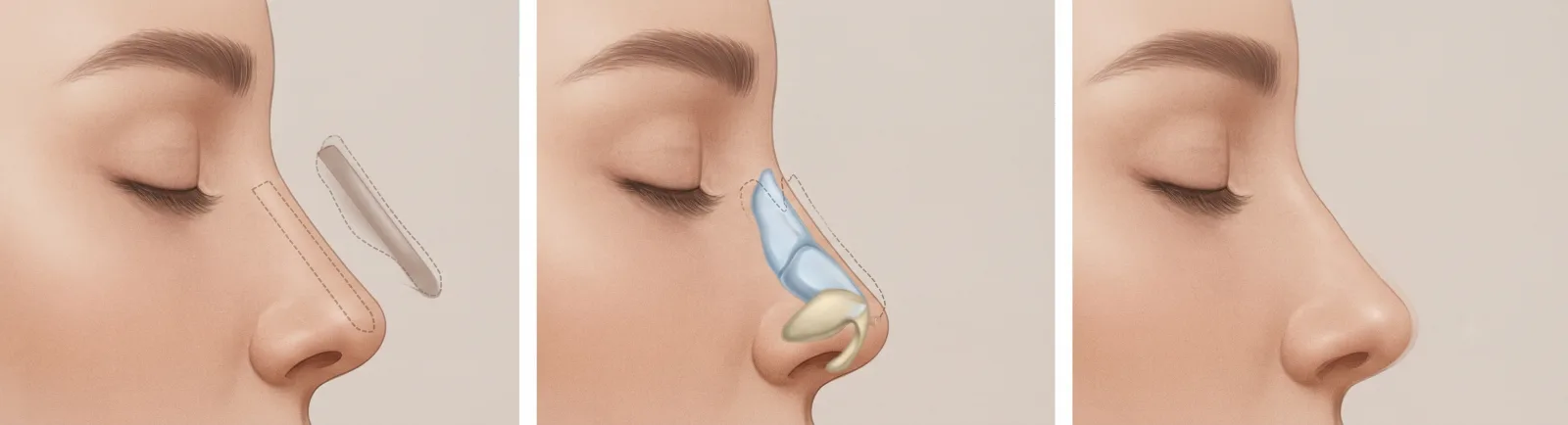
Illustration: the previous implant (outlined) is removed and the framework is rebuilt with the patient's own cartilage for support.
At Garnet the technique reflects this. Revision is performed through an open approach, which lets the surgeon see the altered framework directly instead of working blind through the nostrils. The rebuilding material is chosen case by case from your own septal or ear cartilage, rib (your own or donor), dermis from the hip, or temporalis fascia, depending on what the previous surgery left behind and what your nose now needs.
Understanding this difference is the first step in deciding if a revision suits your nose. This page will not talk you into a revision. It is here to help you judge whether a second operation is likely to give you the result you want, or whether patience or a non-surgical route would suit you better.
Good candidate
Who tends to be a good candidate
The clearest candidates have a specific, nameable problem. A vague sense that something is off is harder to act on. That might be a tip that has drooped or become pinched, a bridge that is too high, too low or visibly crooked, asymmetry that emerged as the swelling from the first operation settled, an implant that has shifted, become visible under the skin or is causing redness, or a result that simply looks more operated-on than you hoped. When you can point to what you want changed, a surgeon can tell you whether it is realistically correctable.
Realistic expectations matter as much as the anatomy. A revision aims to improve a defined problem. It cannot deliver a perfectly symmetrical nose; no nose is perfectly symmetrical, and a previously operated nose has less margin than an untouched one. Candidates who do well understand they are trading a known problem for a likely improvement, accept that a small further refinement is sometimes needed, and are in good general health and not smoking, since healing in scarred tissue is less forgiving.
Emotional readiness counts too. A second operation can feel loaded after a disappointing first one. Good candidates have processed the first result, can describe what they want calmly, and are choosing a revision as a considered next step, without an anxious rush. If you are still in the early, raw weeks after a primary operation, a careful surgeon will usually ask you to wait before deciding.
Function
Functional and breathing problems as well as looks
Not every reason for a revision is cosmetic. A previous rhinoplasty can leave you breathing worse than before, through a deviated or over-resected septum, collapse of the nasal valve when you inhale, scar tissue narrowing the airway, or a framework weakened by how much cartilage was taken in the first operation. If you notice you now sleep, exercise or simply breathe through your nose less easily than you used to, that functional problem is a legitimate and often a strong reason to consider revision.
Function and appearance are usually intertwined in a revision. The same structural weakness that makes the nose look pinched or collapsed can be what is obstructing the airflow, so rebuilding the framework with cartilage grafts can address both at once. This is part of why material choice matters so much: a structural revision often needs more graft material than was available in the first operation, which is when donor sites such as the rib, ear or septum come into the plan.
If breathing is your main concern, say so clearly at consultation. A surgeon assessing you for revision should examine the inside of the nose as well as the outside shape, and should tell you plainly if your symptoms are likely surgical, partly allergic or related to other causes. Operating will not fix a problem that is not structural.
Tissue
How much cartilage and healthy tissue you have left
The single biggest factor in whether a revision will go well is what the first operation left behind. The septum is the usual first source of cartilage, but if it was already harvested or deviated, there may not be enough left. The ear can provide curved cartilage suited to the tip; the rib (your own or carefully prepared donor rib) provides the strongest, straightest material for rebuilding a bridge or a collapsed framework; the hip can provide dermis, and the temple provides fascia for softening contours and wrapping grafts. A good candidate is, in part, someone who still has a workable source for what their nose now needs.
Skin quality matters too. Thin skin shows every underlying irregularity, so it demands a smoother, more precise framework; thick or scarred skin resists redraping and can blunt fine detail. Repeated operations also tend to thin and stiffen the skin envelope, which is one reason surgeons are cautious about doing multiple revisions in quick succession. None of this can be judged from a single photograph alone, which is why an in-person or detailed photo-based assessment is so important before anyone promises a particular result.
This is also where candour separates a good plan from a risky one. If the tissue and cartilage available cannot support the change you are hoping for, the responsible answer is to say so and to discuss what is realistically achievable. Proceeding and hoping is not a plan. You can read more about how the rebuilding works in the revision rhinoplasty overview and how it compares with a first operation in revision vs primary rhinoplasty.
Timing
When to wait, and when not to operate at all
Timing is part of candidacy. After a rhinoplasty the nose continues to change as swelling resolves and scar tissue matures, and the final shape often is not clear for many months, frequently around a year. Operating too early risks revising a nose that would have settled acceptably on its own, or working in tissue that is still inflamed and unpredictable. Unless there is an urgent functional or implant problem, most surgeons will ask you to wait until the previous result has fully matured before planning a revision.
There are also cases where the right answer is not to operate. If your concern is minor and within the normal range of a settled result, if the tissue cannot support the change you want, or if expectations cannot realistically be met, more surgery may leave you no happier and with a thinner, more scarred nose. Sometimes a non-surgical refinement, or simply more time, is the better path. A surgeon who is willing to tell you this is protecting your result.
If you are unsure where you stand, a pre-assessment is the sensible first step. It costs you nothing to find out whether a revision is the right move, the wrong move, or simply a question of waiting a few more months. Many international patients begin exactly here, with an online consultation before committing to anything.
At Garnet
How Garnet assesses whether a revision is right for you
Garnet is a single-surgeon clinic in Apgujeong, Seoul. Dr. In-Soo Baek is a board-certified plastic surgeon (Korean medical licence no. 77407) and the only operating doctor. He sees you at consultation, carries out the surgery in person and checks each follow-up himself. For a revision this continuity matters: the surgeon who examines your scarred tissue and decides what material to use is the same person carrying out the rebuild, so nothing is lost in handover.
The assessment is unhurried and direct. It looks at what you dislike or struggle with, what the first operation did, what cartilage and skin you have to work with, and whether the change you want is realistically achievable. It is comfortable concluding that waiting, or not operating, is the right answer. Garnet does not over-recommend; only the concern you came with is addressed, and structured follow-ups at 1, 3 and 6 months mean a revision result is reviewed properly as it settles. Garnet is registered with Korea's foreign-patient programme.
If you are weighing a revision, the most useful next step is a clear, no-obligation read on your candidacy. You can send photos and a description of your previous surgery for a pre-assessment, and ask your questions, through an online assessment before you plan any travel.
Prices
Price at Garnet
Revision rhinoplasty
From₩4,000,000 + VATExcluding VAT (10% VAT is added at payment)Book now
Same price as Korean patients. Prices shown exclude 10% VAT; your written quote, issued after the in-person consultation, shows the full amount payable.
Dr. In-Soo Baek
Director & sole operating surgeon
Korean medical licence no. 77407
Operate on what you came for. Trained at Korea University Medical Center. Every case planned, performed and reviewed by the same hands.
1Operating surgeon
~2Surgeries per day
7Registered techniques
Board-certified plastic surgeon
Plastic surgery training at Korea University College of Medicine & graduate school
Korean Society of Plastic and Reconstructive Surgeons member, in its facial-contour, eye & rhinoplasty groups
Consults, operates and follows up each case himself
Peer-reviewed papers behind the facts on this page. Each describes findings in its own study group — not results at Garnet — and none predicts your own outcome.
Longino ES et al. Revision Rhinoplasty. Facial Plastic Surgery Clinics of North America. 2026. doi:10.1016/j.fsc.2026.01.009
Wei J et al. Revision Rhinoplasty in Asians. Clinics in Plastic Surgery. 2023. doi:10.1016/j.cps.2022.08.004
Jiang A et al. Revision Rhinoplasty: With Introduction of a Novel Preoperative Assessment Classification System. Seminars in Plastic Surgery. 2021. doi:10.1055/s-0041-1727271
FAQ
Common questions
Who is a good candidate for revision rhinoplasty?
Someone with a clear, specific problem after a previous nose operation (a shape they dislike, asymmetry or a deformity that appeared as swelling settled, a shifted or visible implant, or a functional problem like blocked breathing) who has realistic expectations and enough healthy tissue and cartilage left to rebuild with. Wanting a different result is not enough on its own; the anatomy has to support the change.
Am I suitable for revision rhinoplasty if I just don't like my nose?
Possibly, but it depends on whether your concern is something a second operation can realistically improve. A vague dissatisfaction is harder to act on than a specific, nameable problem. The assessment looks at what you dislike, what the first operation did and what tissue remains, and may conclude that a revision will help, that waiting is wiser, or that the result is already within a normal range.
When is revision rhinoplasty not recommended?
When the concern is minor and within the normal range of a settled nose, when the skin and cartilage cannot support the change you want, when expectations cannot realistically be met, or when the previous nose has not yet fully healed. In these cases more surgery can leave you no happier and with thinner, more scarred tissue, so waiting or a non-surgical option may be the better path.
How long should I wait before a revision?
Usually until the previous result has fully settled, which is often around a year, because the nose keeps changing as swelling resolves and scar tissue matures. Operating earlier risks revising a nose that would have settled on its own. The main exceptions are urgent functional or implant problems, which may need attention sooner.
Does it matter how much cartilage I have left?
Very much. The septum, ear, rib and other donor sites each provide different material, and a revision often needs more graft than the first operation. If the septum was already used or there is little workable cartilage left, the plan changes. That is why an individual assessment is essential before deciding what is achievable.
Can revision rhinoplasty fix breathing problems?
Often, if the breathing problem is structural: a deviated or over-resected septum, valve collapse or scar tissue narrowing the airway. Rebuilding the framework with cartilage grafts can improve both the airway and the shape together. It will not help breathing problems that are mainly allergic or unrelated to structure, so the cause should be examined first.
Is a previously operated nose harder to revise?
Yes. A revision works in scarred tissue, with a skin envelope that may be thinner or stiffer and a cartilage framework already altered by the first operation. This makes the surgery more demanding and the margins smaller, which is why surgeon experience, careful material choice and realistic goals matter even more than in a first rhinoplasty.
Will I need more than one revision?
Most people do not, but a previously operated nose has less margin, so a small further refinement is occasionally needed. Realistic candidates understand this in advance. Repeated operations in quick succession are generally discouraged because they progressively thin and scar the tissue, so each revision should be planned carefully and never rushed.
Can I find out if I'm a candidate before travelling to Korea?
Yes. You can send photos and a clear description of your previous surgery and current concern for a pre-assessment in an online consultation, and get a candid read on whether a revision is likely to help, before you commit to any travel.
Does Garnet treat international patients for revision rhinoplasty?
Yes. Garnet is registered with Korea's foreign-patient programme and coordinates consultation, scheduling and after-care for visitors from abroad, with the same board-certified surgeon assessing, operating and following you up at 1, 3 and 6 months.
My mom recently had a brow lift and lower blepharoplasty with Dr. Baek, and our experience has been wonderful so far. The Garnet team was incredibly kind and welcoming, with Kelly assisting us as our English consultant—she made everything…
I’m so happy I chose this clinic for my lower blepharoplasty. I was traveling from abroad by myself, so I was a little nervous, but from the beginning I felt comfortable and truly cared for. Everyone was kind, patient, and professional…
Came in for an in-person consult and ended up choosing Garnet and Dr.Baek for my non-incisional DES and tiplasty/alarplasty. I communicated with Kelly (English consultant) from the start till now (3 weeks post-op). She really help me feel…
My under-eyes have been sagging and folding for years... I tried to cover it up with makeup, but it actually got stuck in the wrinkles and made it stand out even more. While going for consultations, I noticed that the bigger the hospital…
Not sure whether a revision is right for you? Send photos and a description of your previous surgery for a no-obligation pre-assessment before you plan a trip.
Send photos and your question before you travel. An English-speaking coordinator reviews every enquiry and replies with guidance on whether surgery is appropriate, the likely plan and timing.
✓ Reviewed by the clinic coordinator, not a bot
✓ Photo-based pre-assessment before you fly
✓ Foreign-patient scheduling & after-care
✓ One surgeon for consultation, surgery and follow-up
Prefer to chat now? Reach the coordinator directly:









 T S7 months ago



