Revision rhinoplasty on the nose leaves a few small, predictable scars, and scarring is a fair worry when you already have one result you were not happy with. Those scars sit in places that are easy to overlook once they settle, and the most visible of them is a single fine line under the nose that usually becomes hard to see over the months that follow.
The short answer
Revision rhinoplasty is almost always performed open, through a small incision across the columella (the strip of skin between the nostrils). That leaves one fine external scar that typically fades to a faint line.
If cartilage or tissue has to be borrowed from elsewhere, a donor site adds a second small scar: most often the ear, sometimes the rib or hip, hidden in a natural crease.
Most of the work is reached through incisions inside the nostrils, which leave no scar you can see at all.
Healing is gradual: redness and firmness in the scar are normal early on and soften over months, and the same surgeon reviews them at structured 1-, 3- and 6-month follow-ups.
A first-time nose operation can sometimes be done entirely through the nostrils, with no external incision. That is a closed approach. Revision rhinoplasty is different. The surgeon is working inside a nose that has already been operated on, where scar tissue, a previous implant and altered cartilage make the anatomy harder to read. To correct it precisely and safely, the surgeon needs to see the framework directly, so revision rhinoplasty is almost always performed open.
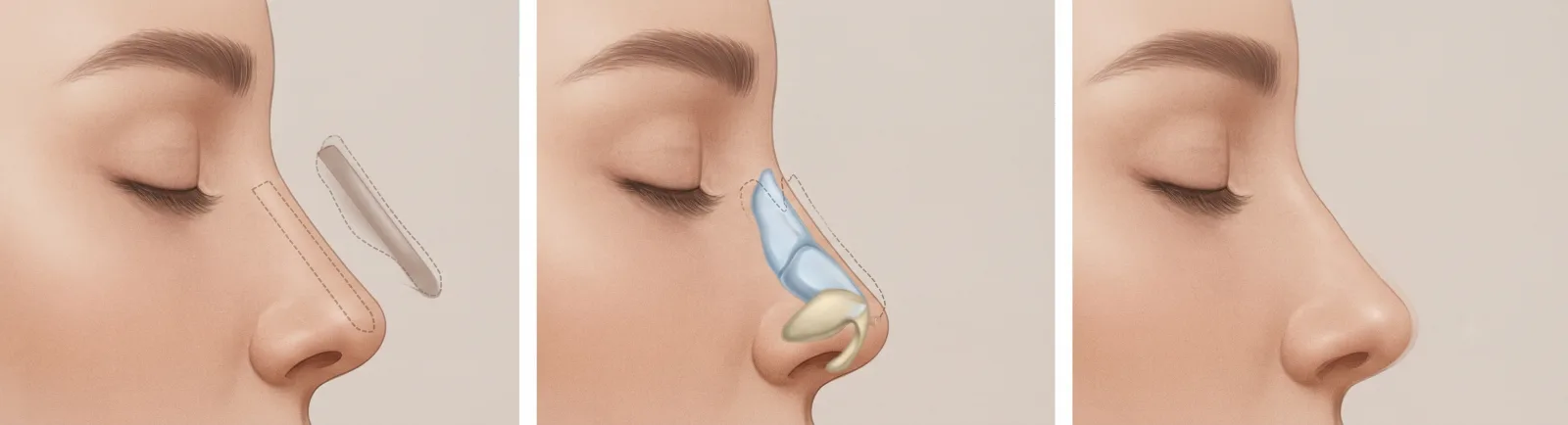
Illustration: the previous implant (outlined) is removed and the framework is rebuilt with the patient's own cartilage for support.
The open approach uses one small incision across the columella, the narrow bridge of skin between your nostrils, which lets the skin be lifted gently off the cartilage and bone. That single external incision is the trade-off for accuracy. It is also why scarring after revision is a slightly different conversation than after a first operation: there is one visible scar to discuss, in a spot most people never look at, plus whatever the donor site adds if grafting is needed.
This matters for the result as well as the scar. Working open lets the surgeon rebuild support, reposition cartilage and place grafts under direct vision, so nothing has to be guessed. Many patients decide the single fine columellar line is a fair exchange for a more reliable correction the second time around.
Columellar scar
The columellar incision — the one external scar
The external scar from open revision rhinoplasty sits across the columella, on the underside of the nose between the nostrils. It is usually only a few millimetres long and is placed in a zig-zag or stepped pattern, because a broken line catches the eye far less than a straight one as it heals. Because it sits tucked under the tip, facing downward, it is not in your eye-line or anyone else's during normal conversation.
In the first weeks the line can look pink or slightly raised, and that is expected. Over the months that follow it typically settles into a faint, pale line that most people have to be told is there to find it. Skin type, your individual healing and how the tissue was handled all influence the final appearance, which is one reason a careful surgeon will not promise an invisible scar. No surgeon can guarantee that, but a well-placed, carefully closed columellar incision usually becomes inconspicuous.
All the other work (separating tissue, adjusting the bridge, shaping cartilage) is reached through incisions inside the nostrils. Those internal incisions heal within the lining of the nose and leave nothing visible from the outside, so the columellar line is the only external scar the open approach itself creates.
Donor sites
Donor-site scars when grafting is needed
Revision rhinoplasty often needs new material to rebuild or reinforce the nose, because the original cartilage may have been used, removed or weakened. At Garnet the material is chosen case by case, with no fixed recipe. It may be cartilage from the nasal septum or the ear, or, when more structural support is needed, autologous or donor rib, a small graft of dermis from the hip, or temporalis fascia from above the ear. Where that material comes from determines whether there is a second, separate scar, and where it sits.
Ear cartilage is taken through an incision hidden behind or inside the fold of the ear, leaving a scar that is very hard to see. A rib graft is taken through a short incision low on the chest, placed where a bra line or natural fold conceals it. A dermis graft from the hip leaves a small line within the bikini area. Temporalis fascia is reached through a short incision in the hair above the ear, so the scar is covered by hair. Septal cartilage, taken from inside the nose, adds no external scar at all.
Which of these applies to you depends entirely on what your nose needs, and the surgeon will explain it before you decide. Because Garnet is a single-surgeon clinic, the same surgeon who plans the donor site is the one who takes the graft and later reviews how that scar is healing. There is no hand-off.
Healing
How revision rhinoplasty scars heal over time
Scars do not reach their final look quickly. They go through a long, fairly predictable settling process. For the first week or two the columellar line and any donor-site incision are held by sutures and may look red, firm or slightly lumpy. The nose sutures generally come out around 7 days; sutures at a donor site stay in a little longer depending on where they are: roughly 10 days for ear, rib or temporalis fascia, and up to about two weeks for a hip dermis graft, because those tissues are under more tension.
Over the following weeks the redness fades and the firmness softens, though a scar can stay slightly pink and feel a little hard for a couple of months before it relaxes. From there it continues to mature quietly for many months, gradually flattening and paling. This is the same slow timeline that governs how the shape of the nose itself settles, which is why scar appearance and final result are best judged together over the long run. The first month is too early.
Garnet builds this into structured follow-ups at one, three and six months, so the same surgeon who operated checks each scar as it matures and can advise on care at the right moments. For international patients those reviews continue remotely after you fly home, with photos shared so the surgeon can keep an eye on healing from a distance.
Helping healing
What helps scars heal well
A scar's final appearance depends partly on how it is treated while it matures, and there are sensible, evidence-aligned habits that help. Keeping the incision clean and following the surgeon's wound-care instructions in the first weeks matters most, because an incision that heals without infection or excess tension generally leaves a finer line. Avoid picking at crusts and resist the urge to test how the scar feels.
Sun protection is the single most useful long-term habit: a fresh scar exposed to ultraviolet light can darken and stay discoloured, so shielding the columella and any donor site from direct sun for several months helps them fade evenly. Not smoking, staying hydrated and giving your body time also support healthy healing, since nicotine in particular narrows the small blood vessels that a healing scar depends on.
If a scar looks like it is thickening or staying red longer than expected, the right move is to raise it at a follow-up instead of self-treating. A surgeon who is reviewing you at 1, 3 and 6 months can step in early with simple measures. You can ask exactly how scar care will be handled, including after you return home, in an online consultation before you travel.
At Garnet
How Garnet handles revision scarring
For revision rhinoplasty scarring, the surgeon who decides where the columellar incision and any donor site will go is the same person who closes them and watches them heal at 1, 3 and 6 months. Dr. In-Soo Baek, a board-certified plastic surgeon (Korean medical licence no. 77407), runs Garnet as a single-surgeon clinic in Apgujeong, Seoul, and consults, operates and reviews every follow-up himself.
The clinic caps the day at two surgeries, so each revision case has unhurried time for the careful tissue handling and meticulous closure that give a fine scar the ideal chance to fade well. Material for the rebuild is chosen for your nose specifically, so donor-site scars are only created when they add value to your result.
For a second nose operation planned from abroad, Garnet's registration with Korea's foreign-patient programme means consultation, scheduling and after-care are coordinated for you. If you want a frank view of what scarring would look like in your case, start with a no-obligation online assessment and send photos for a pre-assessment before you plan a trip.
Prices
Price at Garnet
Revision rhinoplasty
From₩4,000,000 + VATExcluding VAT (10% VAT is added at payment)Book now
Same price as Korean patients. Prices shown exclude 10% VAT; your written quote, issued after the in-person consultation, shows the full amount payable.
Dr. In-Soo Baek
Director & sole operating surgeon
Korean medical licence no. 77407
Operate on what you came for. Trained at Korea University Medical Center. Every case planned, performed and reviewed by the same hands.
1Operating surgeon
~2Surgeries per day
7Registered techniques
Board-certified plastic surgeon
Plastic surgery training at Korea University College of Medicine & graduate school
Korean Society of Plastic and Reconstructive Surgeons member, in its facial-contour, eye & rhinoplasty groups
Consults, operates and follows up each case himself
Peer-reviewed papers behind the facts on this page. Each describes findings in its own study group — not results at Garnet — and none predicts your own outcome.
Hacker S et al. Differences between Primary and Revision Rhinoplasty: Indications, Techniques, Grafts, and Outcomes. Plastic & Reconstructive Surgery. 2021. doi:10.1097/prs.0000000000008216
Wong BJF et al. Grafting Techniques in Primary and Revision Rhinoplasty. Facial Plastic Surgery Clinics of North America. 2018. doi:10.1016/j.fsc.2017.12.006
Sazgar AA et al. Use of Bone-Cartilaginous Unit in Revision Rhinoplasty. Aesthetic Surgery Journal. 2018. doi:10.1093/asj/sjy319
FAQ
Common questions
Where are the scars after revision rhinoplasty?
The main external scar is a small line across the columella (the skin between the nostrils), because revision is almost always done open. The rest of the work is reached through incisions inside the nostrils, which leave no visible scar. If cartilage or tissue is borrowed from elsewhere, the donor site adds a second small scar, usually well hidden in the ear, a chest fold, the hairline or the bikini area.
Will revision rhinoplasty scars be visible?
The columellar scar sits on the underside of the nose, out of your eye-line, and is usually only a few millimetres long. In the first weeks it can look pink or slightly raised; over the months that follow it typically fades to a faint pale line most people have to be shown to find. No surgeon can guarantee an invisible scar, but a well-placed, carefully closed incision usually becomes inconspicuous.
Why is revision rhinoplasty done open instead of closed?
A revised nose has scar tissue, a previous implant and altered cartilage that make the anatomy hard to read. The open approach, through a small columellar incision, lets the surgeon see and rebuild the framework directly under vision, which is safer and more precise. The single fine external scar is the trade-off for that accuracy.
How long does the columellar scar take to fade?
It matures slowly. The nose sutures usually come out around seven days, after which the line may stay pink and slightly firm for a couple of months. From there it continues to flatten and pale quietly for many months. Final scar appearance is best judged over the long run alongside how the nose shape itself settles.
Will I have an extra scar from a cartilage graft?
Only if your nose needs material from elsewhere. Septal cartilage is taken from inside the nose and adds no external scar. Ear cartilage leaves a scar hidden in the ear fold; a rib graft leaves a short line low on the chest; a hip dermis graft sits within the bikini area; temporalis fascia is reached through an incision hidden in the hair. The surgeon chooses the material for your nose and explains any donor scar before you decide.
Do donor-site stitches come out at the same time as the nose?
Not always. Nose sutures generally come out around 7 days. Donor-site sutures stay in a little longer depending on the area: roughly 10 days for ear, rib or temporalis fascia, and up to about two weeks for a hip dermis graft, since that tissue is under more tension.
What can I do to help my scars heal well?
Keep the incisions clean and follow the wound-care instructions, avoid picking at crusts, and protect any healing scar from direct sun for several months, since ultraviolet light can darken a fresh scar. Not smoking and giving your body time also help. If a scar looks like it is thickening, raise it at a follow-up before trying any treatment yourself.
Can the same surgeon check my scars after I go home?
Yes. At a single-surgeon clinic the operating surgeon manages your recovery, and Garnet's structured follow-ups at one, three and six months continue remotely after you fly home, with photos shared so the surgeon can review how each scar is maturing from a distance.
Does the surgeon who plans my donor site also take the graft?
Yes. Garnet is a single-surgeon clinic, so the same board-certified surgeon who decides where any graft will be taken from is the one who takes it and later reviews how that scar is healing. There is no hand-off between doctors.
Can I ask about scarring before I travel to Korea?
Yes. You can send photos and discuss what the columellar scar and any donor-site scar would look like in your case, and how scar care will be handled after you return home, in an online consultation before you commit to travel.
My mom recently had a brow lift and lower blepharoplasty with Dr. Baek, and our experience has been wonderful so far. The Garnet team was incredibly kind and welcoming, with Kelly assisting us as our English consultant—she made everything…
I’m so happy I chose this clinic for my lower blepharoplasty. I was traveling from abroad by myself, so I was a little nervous, but from the beginning I felt comfortable and truly cared for. Everyone was kind, patient, and professional…
Came in for an in-person consult and ended up choosing Garnet and Dr.Baek for my non-incisional DES and tiplasty/alarplasty. I communicated with Kelly (English consultant) from the start till now (3 weeks post-op). She really help me feel…
My under-eyes have been sagging and folding for years... I tried to cover it up with makeup, but it actually got stuck in the wrinkles and made it stand out even more. While going for consultations, I noticed that the bigger the hospital…
Worried about scarring from a second nose operation? Send photos for an honest, no-obligation pre-assessment of what the scars would look like in your case before you plan a trip.
Send photos and your question before you travel. An English-speaking coordinator reviews every enquiry and replies with guidance on whether surgery is appropriate, the likely plan and timing.
✓ Reviewed by the clinic coordinator, not a bot
✓ Photo-based pre-assessment before you fly
✓ Foreign-patient scheduling & after-care
✓ One surgeon for consultation, surgery and follow-up
Prefer to chat now? Reach the coordinator directly:









 T S7 months ago



