After a second nose operation, the question everyone asks is when it will actually look like the result they came for. You will see a recognisable improvement within weeks once the splint is off, but the true, settled shape of a revised nose takes the better part of a year, and sometimes a little longer, to emerge, with the tip the very last part to refine.
The short answer
You see an early version of the result within a week or two, once the splint comes off, but it is still a swollen version of the shape.
Most of the obvious swelling lifts over the first one to two months, and by around three months the nose looks natural enough for everyday life.
Revised noses settle more slowly than first-time noses, because previous scar tissue and grafting make the skin take longer to shrink down onto the new framework.
The final, refined result — especially the tip — typically takes around 12 months and can keep maturing toward 18 months in thicker-skinned or heavily revised cases.
A nose changes shape after surgery mainly as swelling resolves, and that happens far more gradually than people expect. The skin and soft tissue have to shrink down and re-drape onto the new framework underneath, and until they do, what you see is the new structure wearing a layer of swelling. This is true of any nose operation, but it is more pronounced after revision rhinoplasty, which is why a revised nose is a patience game.
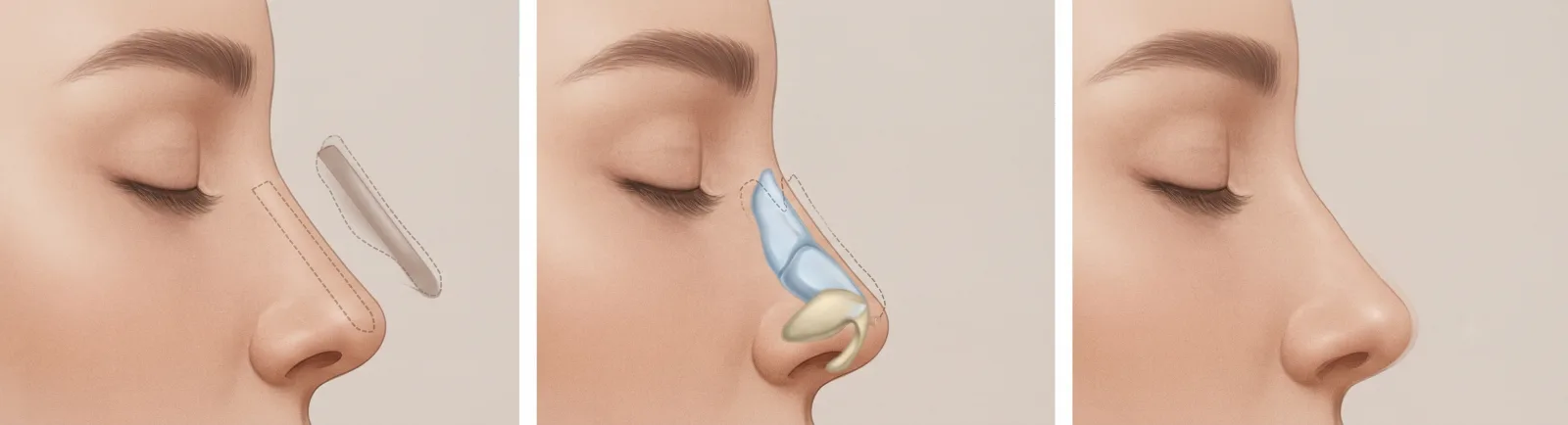
Illustration: the previous implant (outlined) is removed and the framework is rebuilt with the patient's own cartilage for support.
There are two reasons revision is slower than a first operation. First, a previously operated nose contains scar tissue from the earlier surgery, and scarred skin is stiffer and slower to settle than untouched skin. Second, revision often rebuilds the framework with grafted cartilage or tissue, and the overlying skin needs longer to relax onto a reconstructed structure than onto a lightly altered one. Both effects stretch the timeline; neither changes its shape.
None of this means anything is going wrong while you wait. Slow settling is the normal, expected course, and your surgeon should tell you up front that judging a revised nose at 1 month is judging it too early. The useful mindset is to expect a good everyday appearance within a few months and the genuinely final shape much later. It also helps to separate the look of the result from the practical healing milestones covered in the revision rhinoplasty recovery timeline.
Splint off
The first look at a revised nose, when the splint comes off
Your first real look at the new nose comes when the external splint or cast is removed, which is generally around a week after surgery, close to when the nose sutures come out. This is an exciting moment and an important one to put in context: the nose underneath is the new structure, but it is at its most swollen, so it will look fuller, less defined and often slightly upturned compared with where it will end up.
Bruising around the eyes, if any, is usually fading by this point, and the dressing changes on days one and three are already behind you. Many patients feel the bridge already looks straighter or better supported than before, since the structural change is visible early, while the refinement of the tip and the final narrowness are still hidden under swelling.
It is best not to draw conclusions from this stage, and not to compare your day-seven nose against someone else's final-result photo. The same caution applies to before-and-after timelines online: an image labelled as a result is usually months down the line. Treat the splint-off look as the starting line.
1–3 months
Weeks 1 to 3 months: the visible improvement in the revised nose
Over the first month the most obvious swelling subsides noticeably, and the nose starts to look more like itself. By around the one-month mark most patients are comfortable in public and in photos taken from a distance, even though close inspection still shows some fullness, especially at the tip. This is the phase where the result becomes encouraging and the early-stage anxiety usually eases.
Between one and three months the change is steadier but still meaningful: the bridge looks cleaner, the swelling on the sides of the nose continues to recede, and the overall shape reads as natural in everyday settings. By about three months many people feel the nose looks essentially normal to anyone who is not studying it, which is why this is a reasonable checkpoint to feel reassured even though refinement continues.
Recovery during this window is mostly invisible to others, because the work is happening inside the tissues. The shape you have at 3 months is a good preview of the final result, though it is still changing, particularly at the tip, which has its own slower clock.
Tip last
Why the tip is the last part to refine
The tip of the nose is consistently the slowest area to reach its final shape, and this is even more true after revision. The tip has thicker, more mobile soft tissue than the bridge, and that soft tissue holds onto swelling longer. After a revision in particular, the tip is often the area that was rebuilt or reinforced with grafts, so it carries both more surgery and more scar tissue, and therefore more residual fullness for longer.
Practically, this means the bridge may look settled and refined while the tip still feels firm, slightly full or a little numb for months. That mismatch is normal and not a sign the surgery missed; it is simply the tip running on a slower timetable than the rest of the nose. Firmness and reduced sensation in the tip also gradually resolve as the swelling clears and the nerves recover.
Because of this, the final assessment of a revised nose is really an assessment of the tip, and it is the reason surgeons ask you not to judge the outcome until the tip has had time to define. The clearest, fairest comparison is the one-year photo against your pre-operative photo.
One year
The final revision rhinoplasty result, around a year
For most people the revised nose reaches its genuinely final, refined shape at around twelve months. By then the tip swelling has resolved, the skin has fully re-draped onto the new framework, and the contour you see is the contour you keep. This one-year mark is the point at which it is fair to make a final judgement and a true before-and-after comparison.
Some cases run a little longer. A nose with thicker skin, or one that needed extensive rebuilding with rib or multiple grafts, can keep refining quietly toward roughly 18 months as the last deep swelling settles. This is normal and does not indicate a problem. It simply reflects how much the skin had to recover and re-drape. Your surgeon can tell you, based on your skin and what your operation involved, which timeline is more likely for you.
The wait is long, but it is also why patience is part of the result: the nose you see at a year is stable and lasting. Knowing the timeline in advance is the ideal protection against the early-recovery worry of comparing a swollen nose against a finished one.
At Garnet
How Garnet follows your result over time
Garnet is a single-surgeon clinic in Apgujeong, Seoul, where Dr. In-Soo Baek, a board-certified plastic surgeon (Korean medical licence no. 77407), consults, performs the operation himself and reviews every follow-up. Because settling takes the better part of a year, that continuity at a single-surgeon clinic matters: the same surgeon who knows exactly what was rebuilt is the one assessing your result at structured follow-ups at 1, 3 and 6 months, when each stage of the timeline can be judged in context.
The clinic caps the day at two surgeries, so the planning that shapes your eventual result is unhurried, and the assessment along the way is straightforward. That includes telling you when the nose simply needs more time, with no over-promising of an early outcome. For international patients those reviews continue remotely after you fly home, with photos shared so the surgeon can track how the shape and the tip are maturing from a distance.
Garnet is registered with Korea's foreign-patient programme and coordinates consultation, scheduling and after-care for international visitors. If you want a realistic sense of how long your own result is likely to take, you can start with a no-obligation online assessment and send photos before you plan a trip.
Prices
Price at Garnet
Revision rhinoplasty
From₩4,000,000 + VATExcluding VAT (10% VAT is added at payment)Book now
Same price as Korean patients. Prices shown exclude 10% VAT; your written quote, issued after the in-person consultation, shows the full amount payable.
Dr. In-Soo Baek
Director & sole operating surgeon
Korean medical licence no. 77407
Operate on what you came for. Trained at Korea University Medical Center. Every case planned, performed and reviewed by the same hands.
1Operating surgeon
~2Surgeries per day
7Registered techniques
Board-certified plastic surgeon
Plastic surgery training at Korea University College of Medicine & graduate school
Korean Society of Plastic and Reconstructive Surgeons member, in its facial-contour, eye & rhinoplasty groups
Consults, operates and follows up each case himself
Peer-reviewed papers behind the facts on this page. Each describes findings in its own study group — not results at Garnet — and none predicts your own outcome.
Cochran CS. Harvesting Rib Cartilage in Primary and Secondary Rhinoplasty. Clinics in Plastic Surgery. 2016. doi:10.1016/j.cps.2015.09.018
Shomorony A et al. Endonasal Secondary Rhinoplasty Techniques. Facial Plastic Surgery Clinics of North America. 2026. doi:10.1016/j.fsc.2026.01.004
Tasman AJ. Camouflage Techniques in Secondary Rhinoplasty. Facial Plastic Surgery Clinics of North America. 2026. doi:10.1016/j.fsc.2026.01.007
FAQ
Common questions
When will I see the final results of revision rhinoplasty?
You see an early, swollen version within a week or two once the splint comes off, a natural everyday appearance by around three months, and the genuinely final, refined shape at about twelve months. Thicker-skinned or heavily rebuilt noses can keep refining toward roughly eighteen months. The tip is always the last part to settle.
Why does a revised nose take longer to settle than a first nose?
A previously operated nose contains scar tissue, which is stiffer and slower to settle than untouched skin, and revision often rebuilds the framework with grafts that the overlying skin needs longer to relax onto. Both effects stretch the timeline, so judging a revised nose at one month is judging it too early.
When is the swelling gone after revision rhinoplasty?
Most of the obvious swelling lifts over the first one to two months, and by around three months the nose looks natural to anyone not studying it closely. Deeper swelling, especially in the tip, resolves much more slowly over the following months toward the one-year mark.
Why does the tip take so long to refine?
The tip has thicker, more mobile soft tissue that holds onto swelling longer than the bridge, and in revision it is often the area that was rebuilt with grafts, so it carries more surgery and more scar tissue. That is why the bridge can look settled while the tip stays firm and full for months.
What will my nose look like when the splint comes off?
It will look like the new structure at its most swollen: fuller, less defined and sometimes slightly upturned compared with the final result. The bridge often already looks straighter, while the tip refinement is still hidden. That first look is where the settling starts.
Is it normal for the tip to feel firm or numb for months?
Yes. Firmness, fullness and reduced sensation in the tip are normal after revision and resolve gradually as swelling clears and the nerves recover. It is a sign of a slower-settling tip, with nothing going wrong, and it eases over the months toward the final result.
When can I make a fair before-and-after comparison?
At around twelve months, against your pre-operative photo. That is when the swelling has resolved and the contour is stable. Comparing a day-seven or one-month nose against someone else's finished result is the most common reason patients worry unnecessarily during recovery.
Could my result keep changing after a year?
In most people the nose is essentially final by twelve months. In thicker-skinned cases or those that needed extensive rebuilding with rib or multiple grafts, the last deep swelling can keep settling toward about eighteen months. Your surgeon can tell you which timeline is more likely based on your skin and operation.
Can the same surgeon track my result after I return home?
Yes. At a single-surgeon clinic the operating surgeon manages your recovery, and Garnet's structured follow-ups at one, three and six months continue remotely after you fly home, with photos shared so the surgeon can assess how the shape and tip are maturing from a distance.
Can I get a realistic timeline before I travel?
Yes. You can send photos and discuss how long your own result is likely to take, given your skin and what your operation would involve, in an online consultation before you commit to travel.
My mom recently had a brow lift and lower blepharoplasty with Dr. Baek, and our experience has been wonderful so far. The Garnet team was incredibly kind and welcoming, with Kelly assisting us as our English consultant—she made everything…
I’m so happy I chose this clinic for my lower blepharoplasty. I was traveling from abroad by myself, so I was a little nervous, but from the beginning I felt comfortable and truly cared for. Everyone was kind, patient, and professional…
Came in for an in-person consult and ended up choosing Garnet and Dr.Baek for my non-incisional DES and tiplasty/alarplasty. I communicated with Kelly (English consultant) from the start till now (3 weeks post-op). She really help me feel…
My under-eyes have been sagging and folding for years... I tried to cover it up with makeup, but it actually got stuck in the wrinkles and made it stand out even more. While going for consultations, I noticed that the bigger the hospital…
Send photos and your question before you travel. An English-speaking coordinator reviews every enquiry and replies with guidance on whether surgery is appropriate, the likely plan and timing.
✓ Reviewed by the clinic coordinator, not a bot
✓ Photo-based pre-assessment before you fly
✓ Foreign-patient scheduling & after-care
✓ One surgeon for consultation, surgery and follow-up
Prefer to chat now? Reach the coordinator directly:









 T S7 months ago



