Revision rhinoplasty corrects a nose that has already been operated on, often rebuilding support with rib, ear or septal cartilage, and it is one of the most demanding and most over-rushed operations in facial surgery. This guide is candid about when a previous nose job genuinely needs correcting, why most surgeons advise waiting around a year before revising, how scar tissue and used-up cartilage change what is possible, and what rebuilding support actually involves.
The short answer
Revision is for a previous rhinoplasty that did not heal as hoped: a deviation, a problem with the implant or tip, breathing trouble or a result that looks unnatural. Normal early swelling that is still settling is a different matter.
Timing matters: most surgeons advise waiting roughly a year after the previous surgery so tissue has fully healed and the result has declared itself before any correction is planned.
Cartilage availability shapes the plan. When septal and ear cartilage have already been used, support may need to come from rib cartilage, donor tissue or fascia, which makes revision more complex than a first operation.
At Garnet the same board-certified surgeon assesses revision candidly, including saying when to wait or when no further surgery is needed, performs an open revision himself and reviews recovery at 1, 3 and 6 months.
Revision is appropriate when a previous rhinoplasty has healed and the result is genuinely not what it should be. A recent nose that is simply still swollen does not qualify. The reasons people seek correction include a nose that has deviated or looks crooked, a dorsal implant that has shifted, become visible or is too high or low, a tip that is under-projected, pinched or asymmetric, an overly operated or unnatural appearance, or breathing difficulty that has developed since the first surgery. Any of these can be a sound reason to consider revision.
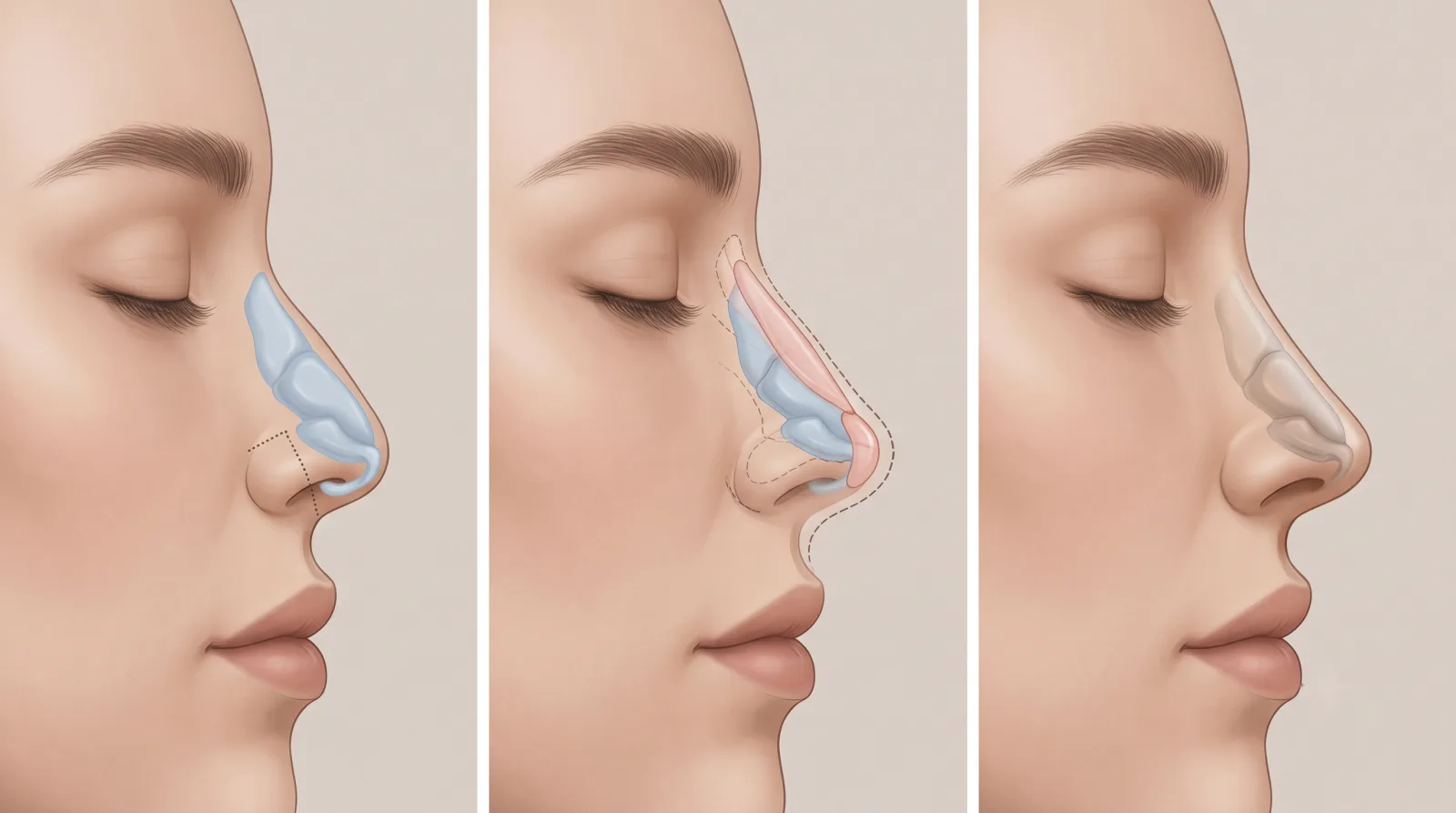
Illustration: the nasal framework (blue) is reshaped to raise the bridge and refine the tip. The dashed outline shows the original contour.
What is not a reason for revision is the normal, unfinished healing of a recent nose. A nose that still feels stuffy, looks a little swollen at the tip or is settling in the months after a first operation has not failed. It is mid-healing, and the original rhinoplasty result has not yet declared itself. Separating a genuine shortfall from a result that is simply still settling is the first and most important judgement, and it is exactly what timing is about.
Not every concern is best solved by more surgery. A careful assessment sometimes concludes that waiting is wiser, that a concern is minor and will improve, or that the realistic gain from revising does not justify a demanding second operation. The right starting point is a frank read of what was done before, how it healed and whether the issue is truly correctable. Another operation is not automatically the answer.
Waiting
Why waiting around a year usually matters
With a previously operated nose, the timing of a revision is easy to overlook and matters a great deal. After a rhinoplasty the nose swells, the tip in particular stays firm and slightly swollen for many months, scar tissue forms internally and the result keeps refining well into the first year. Judging a nose as a failure too early risks correcting something that was simply still settling, which is why most surgeons advise waiting roughly a year before planning a revision in all but specific urgent situations.
Waiting serves two purposes. First, it lets the result declare itself: a tip that looks bulky or a bridge that seems uneven at a few months often looks markedly better at a year, and many early concerns resolve on their own. Second, it lets the tissue heal and soften — operating through fresh, inflamed scar tissue is harder and less predictable than working once the area has matured and stabilised. Both the diagnosis and the surgery are better when the nose has been given time.
There are exceptions a surgeon will discuss with you, for example a clear functional problem, an exposed or infected implant, or an issue that will not improve with time. But the general principle holds: revision is a considered decision made at the right moment, after the early result has settled. The normal settling and what counts as expected swelling are part of the conversation at consultation, and you can begin that conversation remotely in an online consultation from abroad.
Scar & cartilage
Why scar tissue and cartilage supply change everything
Revision rhinoplasty is more demanding than a first operation for two main reasons, and both come down to what the previous surgery left behind. The first is scar tissue: once a nose has been operated on, the natural tissue planes are altered, scarring is present and the surgeon works with a changed, less predictable starting point. This makes the dissection more delicate and the planning more involved.
The second, and often decisive, factor is cartilage availability. A first-time rhinoplasty at Garnet typically uses the patient's own septal and ear cartilage to build and define the structure. When a previous surgery has already used that cartilage, or weakened the septum, there may be little local material left to rebuild with. A revision frequently has to bring in support from elsewhere, so it is planned around what donor tissue is realistically available and is never treated as a simple redo.
These two factors together explain why a realistic revision plan can look different from what a patient expects. The surgeon is not only correcting the visible problem but also rebuilding sound structure within previously operated tissue, with whatever cartilage can be sourced. It is meticulous, individualised work, which is why an experienced hand, unhurried time and realistic expectations matter so much for a second nose operation.
Materials
Rebuilding support: where the cartilage comes from
Because local cartilage is often depleted, revision is planned around the right material for each case. At Garnet the dedicated revision rhinoplasty approach chooses the source per patient: the patient's own rib cartilage when strong structural support is needed and septal or ear cartilage is no longer sufficient, donor rib as an alternative source of framework material, dermis taken from the hip, temporalis fascia from the scalp area for soft cover and camouflage, or any remaining septal and ear cartilage where some is still usable. The choice depends entirely on what the nose needs and what was used before.
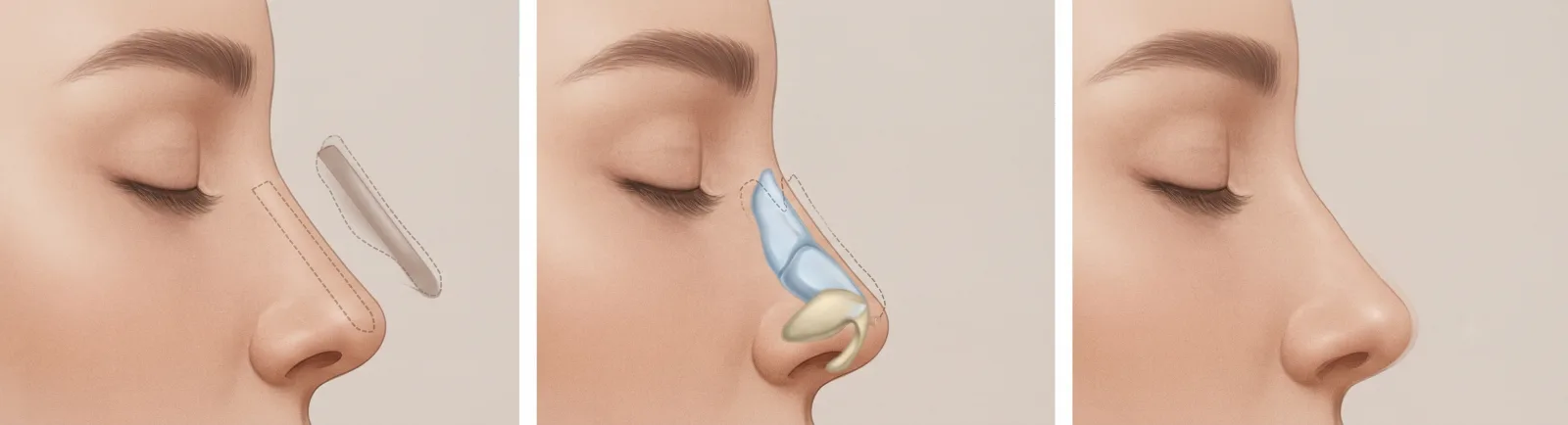
Illustration: the previous implant (outlined) is removed and the framework is rebuilt with the patient's own cartilage for support.
Each source has its own role and its own small donor consideration. Rib cartilage provides robust framework strength for a structurally compromised nose, with a small rib donor site; ear and septal cartilage suit finer tip and definition work; fascia and dermis are used more for softening, cover and contour than for primary support. Suture removal differs by donor site too: the nose sutures come out at about a week, while ear, rib, fascia and hip dermis donor sites heal over roughly ten to fourteen days depending on the area.
What matters for you as a patient is that the plan is built around your specific nose. A frank assessment establishes what structure has been lost, what support is needed and which donor source achieves it with the least added burden. That plan is explained to you clearly before any decision, including the trade-offs of using a rib or other distant donor site.
What's involved
What a revision rhinoplasty actually involves
A revision is generally performed through an open approach, which gives the surgeon full, direct access to assess what was done previously, release scar tissue, reposition or replace an implant, and rebuild support with grafted cartilage. Working openly is part of what makes a careful correction possible in altered tissue. The surgeon can see and address the underlying structure directly.
Recovery follows a broadly similar shape to a first rhinoplasty but accounts for the donor sites involved. There are early dressing checks (at Garnet on around day 1 and day 3), an external splint, and nose sutures removed at about 7 days. Where a donor site such as the ear, rib, scalp fascia or hip is used, those stitches come out a little later, generally around ten to fourteen days, and that area has its own mild, separate soreness. As with any nose surgery, congestion and pressure tend to outweigh sharp pain in the early days.
Because revision is meticulous, individualised work in previously operated tissue, expectations should be realistic and the timeline patient. A good revision can meaningfully improve a deviated, over-operated or structurally weak result, but it works within the constraints of what earlier surgery left behind. The best plans are candid about what can be improved, what is better left alone, and what the recovery genuinely involves. That is why the assessment matters as much as the operation.
At Garnet
How Garnet approaches revision and correction
At Garnet, a single-surgeon clinic in Apgujeong, Seoul, the only operating doctor is Dr. In-Soo Baek, a board-certified plastic surgeon (Korean medical licence no. 77407). For a procedure as demanding as revision, this continuity matters: he examines what was done to your nose before, chooses the donor cartilage or tissue, performs the open revision himself and reviews how it settles. No rotating team is involved. The clinic caps the day at two surgeries, so a meticulous revision is given unhurried time.
The assessment is deliberately frank. Because revision is harder than a first procedure, because cartilage may be depleted, and because many early concerns resolve with healing, you may be advised to wait until roughly a year has passed, told that a concern will improve on its own, or guided toward a realistic correction with no promise to erase every issue. The aim is to do what reliably helps within the constraints of previously operated tissue. Recovery is then followed with structured check-ups at 1, 3 and 6 months.
If you are an international patient, whether your first rhinoplasty was done elsewhere or you are planning ahead, you can begin before you travel. Garnet is registered with Korea's foreign-patient programme, and you can send photos and a description of your earlier surgery for a pre-assessment in an online consultation, including a candid view of whether revision is the right step, and when.
Prices
Price at Garnet
Revision rhinoplasty
From₩4,000,000 + VATExcluding VAT (10% VAT is added at payment)Book now
Same price as Korean patients. Prices shown exclude 10% VAT; your written quote, issued after the in-person consultation, shows the full amount payable.
Dr. In-Soo Baek
Director & sole operating surgeon
Korean medical licence no. 77407
Operate on what you came for. Trained at Korea University Medical Center. Every case planned, performed and reviewed by the same hands.
1Operating surgeon
~2Surgeries per day
7Registered techniques
Board-certified plastic surgeon
Plastic surgery training at Korea University College of Medicine & graduate school
Korean Society of Plastic and Reconstructive Surgeons member, in its facial-contour, eye & rhinoplasty groups
Consults, operates and follows up each case himself
Peer-reviewed papers behind the facts on this page. Each describes findings in its own study group — not results at Garnet — and none predicts your own outcome.
Li D et al. An Overview of Asian Rhinoplasty. Annals of Plastic Surgery. 2016. doi:10.1097/sap.0000000000000841
Jang YJ et al. Rhinoplasty in the Asian Nose. Facial Plastic Surgery Clinics of North America. 2014. doi:10.1016/j.fsc.2014.04.001
Nassif PS et al. Asian Rhinoplasty. Facial Plastic Surgery Clinics of North America. 2010. doi:10.1016/j.fsc.2009.11.018
FAQ
Common questions
Can a previous rhinoplasty be corrected?
Often, yes. Revision can address a deviated or crooked nose, a shifted or visible implant, an under-projected or asymmetric tip, an over-operated look or breathing difficulty that developed since the first surgery. It is more demanding than a first operation because of scar tissue and possibly depleted cartilage, so a careful, candid assessment of what is realistically correctable comes first.
What does rhinoplasty revision involve?
It is generally performed through an open approach so the surgeon can assess the previous work, release scar tissue, reposition or replace an implant and rebuild support with grafted cartilage. Because local cartilage is often used up, support may come from rib, donor rib, ear or septal cartilage, scalp fascia or hip dermis, chosen per case based on what the nose needs.
When should I consider rhinoplasty revision?
Once the previous nose has fully healed and the result has declared itself (most surgeons advise waiting roughly a year), and the issue is a genuine shortfall beyond normal settling. Urgent functional problems or an exposed implant are exceptions a surgeon will discuss. Revision is a considered decision, made once the early result has settled.
Why should I wait about a year before revision?
Because a nose keeps refining for many months: the tip stays firm and slightly swollen, scar tissue matures and the result settles well into the first year. Waiting lets the result declare itself, so you do not correct something that was still healing, and it lets tissue soften, which makes the revision itself more predictable. Both diagnosis and surgery are better with time.
Why is revision rhinoplasty harder than the first operation?
Two reasons: the tissue planes have been operated on before, with scar tissue and an altered, less predictable starting point; and the septal and ear cartilage used to build the nose may already be depleted. The surgeon often has to rebuild structure with cartilage sourced from elsewhere, which makes revision meticulous, individualised work.
What if my cartilage was already used in the first surgery?
That is common in revision and it shapes the plan. When septal and ear cartilage are no longer sufficient, support is brought in from elsewhere, typically the patient's own rib cartilage for strong framework, or donor rib, with fascia or dermis used for soft cover and camouflage. The assessment establishes what structure was lost and which source rebuilds it with the least added burden.
Will revision rhinoplasty fix my breathing problem?
Sometimes. Breathing difficulty that developed after a previous rhinoplasty can be a sound reason for revision, and an open approach lets the surgeon assess and address the underlying structure. Whether it can be improved depends on the specific cause, which is established at a thorough assessment. The plan is candid about what is realistically correctable and promises no guaranteed outcome.
Is revision rhinoplasty more painful than a first nose job?
Not dramatically. As with a first rhinoplasty, congestion and pressure tend to outweigh sharp pain in the early days, and discomfort responds to prescribed pain relief. Where a donor site such as the rib, ear, scalp or hip is used, that area has its own mild, separate soreness and its sutures come out a little later, generally around ten to fourteen days.
Can Garnet revise a rhinoplasty done at another clinic?
You can be assessed for it. You can send photos and a description of your earlier surgery for a pre-assessment before you travel. The same board-certified surgeon then plans the donor material, performs the open revision himself and reviews recovery, and will tell you candidly if waiting, a different plan, or no further surgery is the better answer.
Will I definitely need a revision after rhinoplasty?
No. Many patients never need a second procedure. Revision is an option for correcting a genuine shortfall once a nose has fully healed, and it is never an inevitable step. A result that is still settling in the first year has not failed. Whether revision is worthwhile, and when, is an individual judgement made on your nose and how it has healed.
My mom recently had a brow lift and lower blepharoplasty with Dr. Baek, and our experience has been wonderful so far. The Garnet team was incredibly kind and welcoming, with Kelly assisting us as our English consultant—she made everything…
I’m so happy I chose this clinic for my lower blepharoplasty. I was traveling from abroad by myself, so I was a little nervous, but from the beginning I felt comfortable and truly cared for. Everyone was kind, patient, and professional…
Came in for an in-person consult and ended up choosing Garnet and Dr.Baek for my non-incisional DES and tiplasty/alarplasty. I communicated with Kelly (English consultant) from the start till now (3 weeks post-op). She really help me feel…
My under-eyes have been sagging and folding for years... I tried to cover it up with makeup, but it actually got stuck in the wrinkles and made it stand out even more. While going for consultations, I noticed that the bigger the hospital…
Considering correcting an earlier rhinoplasty? Send photos and a note on what was done for a no-obligation pre-assessment, including whether revision is the right step, and the right time for it.
Send photos and your question before you travel. An English-speaking coordinator reviews every enquiry and replies with guidance on whether surgery is appropriate, the likely plan and timing.
✓ Reviewed by the clinic coordinator, not a bot
✓ Photo-based pre-assessment before you fly
✓ Foreign-patient scheduling & after-care
✓ One surgeon for consultation, surgery and follow-up
Prefer to chat now? Reach the coordinator directly:








 T S7 months ago



