For an international rhinoplasty patient, the nose splint and sutures come off at about 7 days, and that one date sets how long you should stay in Korea. This guide walks through the whole journey: the online consultation first, planning the stay, the days around surgery, flying home and how follow-up continues remotely.
The short answer
Plan your stay around the splint and nose sutures coming off at about a week. Most international patients allow roughly 7 to 10 days in Korea so removal is done before they fly home.
Start with an online consultation before you travel: send photos and your goals for a pre-assessment, so surgery is planned in advance instead of being decided on arrival.
Flying is generally avoided until the splint and sutures are out and early swelling has settled, which is one reason removal timing drives the trip length.
At Garnet a dedicated coordinator handles scheduling and after-care, the same board-certified surgeon operates and reviews you, and follow-up continues remotely once you return home.
Start with an online consultation, before you book a flight
The sensible first step for any international patient is an online consultation from abroad; the flight comes later. You send clear photos of your nose and a description of what you would like to change, and you receive a pre-assessment: whether rhinoplasty is suitable for you, what approach would be considered, and a realistic view of the result and recovery. Your trip is then planned around a genuine assessment, with no decision rushed on the day you arrive.
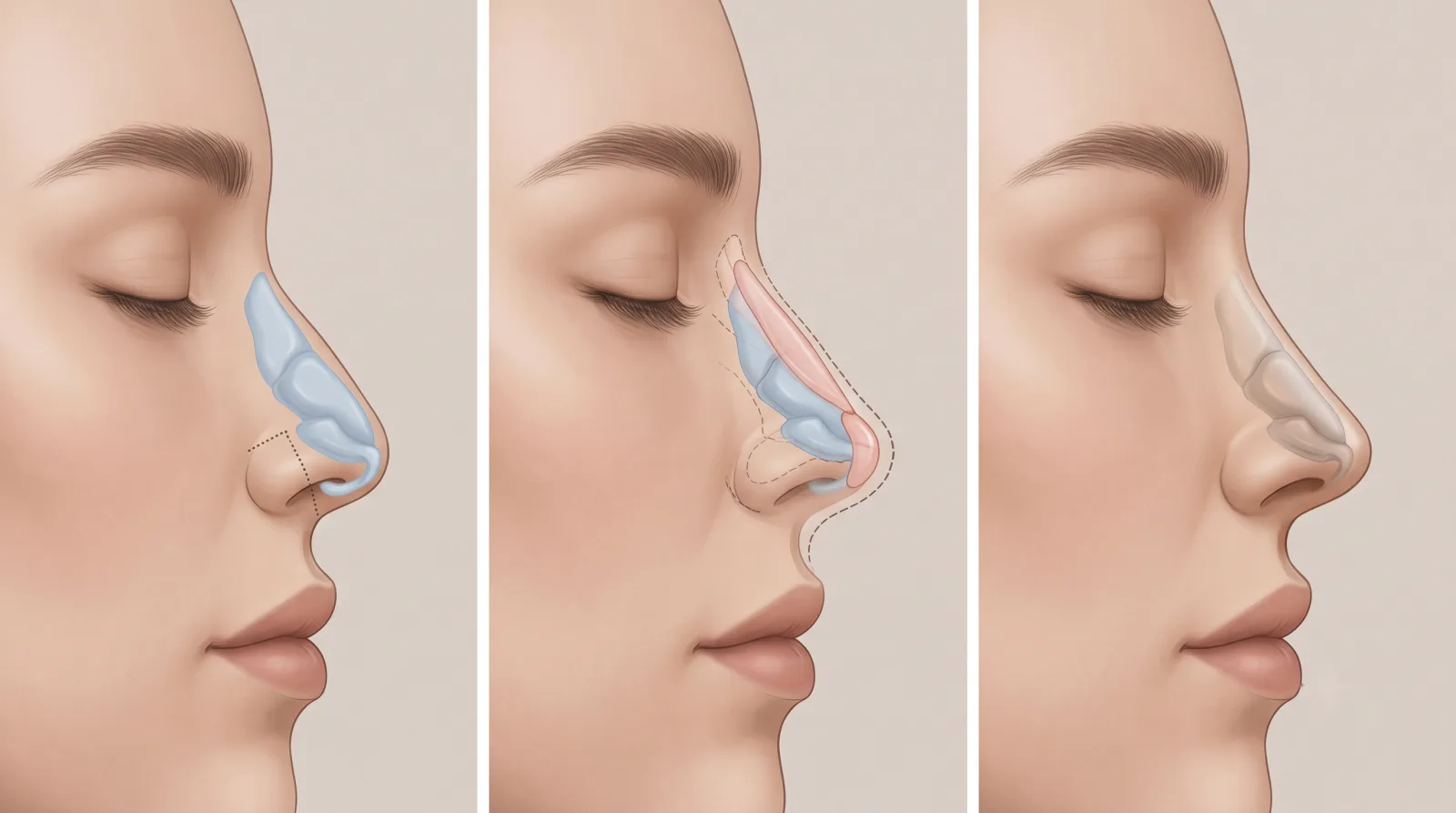
Illustration: the nasal framework (blue) is reshaped to raise the bridge and refine the tip. The dashed outline shows the original contour.
An online consultation also lets you ask the questions that matter most before committing to travel: who will perform the surgery, what technique and cartilage would be used, how long you should stay and how follow-up works once you are home. Getting clear answers in advance is what turns a daunting overseas procedure into a planned, predictable trip. It costs you nothing but a few photos and a conversation.
Crucially, a good pre-assessment includes being told if surgery is not the right answer for you, or if a more limited or different approach suits your nose better. A candid online consultation protects you from flying across the world for an operation that was never going to deliver what you hoped. That is exactly why it should come first, before any flight or accommodation is booked.
How long
How long should you stay in Korea for rhinoplasty?
The single fact that determines your trip length is suture and splint removal at about a week. After a rhinoplasty there are early dressing checks (at Garnet on around day 1 and day 3), and then the external splint together with the nose sutures comes off at roughly 7 days. You want to be in Korea for that milestone, so most international patients plan a stay of around 7 to 10 days.
The extra days beyond the splint removal give a small buffer for early swelling to settle and for the surgeon to confirm you are healing well before you travel. If your plan involves a donor site such as the ear (common when the tip is built from your own cartilage), those stitches usually come out a little later, around 10 days, which is worth factoring into the timing for some cases. Your exact stay depends on which cartilage source your plan uses.
It helps to think of the stay in two parts: a short pre-surgery window for your in-person consultation and any checks, then the recovery window up to splint and suture removal. You do not need to stay until every trace of swelling is gone, since residual swelling settles over weeks and months at home; you only need to stay until the splint and sutures are out and the surgeon is satisfied with early healing. General guidance on planning the length of a surgical trip is covered in how long to stay in Korea for surgery.
The trip
A rhinoplasty trip, day by day
A typical rhinoplasty trip starts with an in-person consultation and the surgery itself early in the stay, so that as much of the recovery window as possible happens while you are still in Korea. After surgery the first 2 to 3 days are the most congested. You breathe mainly through your mouth and feel blocked and pressured, though sharp pain is uncommon, so plan a quiet, restful stay for that period and leave sightseeing for later.
Across the stay there are scheduled checks: dressing reviews around day one and day three, then splint and nose suture removal at about 7 days. That removal appointment is the turning point most patients describe: the nose feels lighter, breathing begins to open up and the most congested phase is behind them. Where an ear donor site is involved, its stitches come out a little later. Knowing these fixed points lets you plan your accommodation and any gentle activity around them.
Practical considerations make the trip smoother: a place to stay within easy reach of the clinic in Apgujeong, sleeping propped up to ease congestion, and keeping the early days low-key. General advice on recovering comfortably during the stay is covered in recovering in Seoul after surgery. The clinic's coordinator helps you map the fixed appointments so the rest of your stay can be planned around them.
Flying home
Flying home and how follow-up continues
Flying is generally avoided until the splint and nose sutures are out and early swelling has settled, which is precisely why removal timing drives how long you stay. Travelling home after that milestone, with the surgeon satisfied that early healing is on track, is the usual plan. At your final in-person check the surgeon looks at your nose and tells you if you are ready to fly.
Recovery does not stop when you board the plane. Residual swelling continues to settle over the following weeks and months, with the fine refinement of the tip taking longest. In this later phase the appearance improves gradually and discomfort is minor. You return home with clear guidance on what is normal, what to watch for and how to care for your nose during this settling period.
Follow-up then continues remotely. At a single-surgeon clinic the operating surgeon, who knows your case, reviews your progress after you have flown home, so questions and check-ins are handled by the person who performed your surgery. Garnet's structured follow-ups at 1, 3 and 6 months are designed to work for international patients, with the later reviews done remotely once you are back home.
Coordination
Coordination, language and the foreign-patient programme
For an international patient, the logistics around the surgery matter almost as much as the surgery itself, and this is where coordination makes the difference. Garnet is registered with Korea's foreign-patient programme, which sets expectations for coordinating and keeping records for visitors from abroad, and a dedicated coordinator stays with you from the first consultation through to recovery, helping with scheduling, the sequence of appointments and after-care so you are not navigating it alone in an unfamiliar city.
Communicating clearly before and during the trip removes much of the anxiety of having surgery abroad. The online consultation establishes your plan and answers your questions in advance, and the coordinator helps keep everything on track once you arrive. Because the clinic is a single-surgeon practice, the surgeon you spoke with is the one you meet and the one who operates, so there is no uncertainty about who is responsible for your care.
If language is a concern, raising it at the online consultation stage is the right move, so the coordination can be arranged to suit you. The broader point is that an overseas rhinoplasty works most reliably when the assessment, scheduling and follow-up are joined up under one clinic and one surgeon, the model Garnet is built around for foreign patients.
At Garnet
How Garnet supports rhinoplasty patients from abroad
At Garnet, a one-surgeon clinic in Apgujeong, Seoul, every nose is operated on by Dr. In-Soo Baek, a board-certified plastic surgeon (Korean medical licence no. 77407). For an international patient that continuity is reassuring: the surgeon who assesses you online and in person is the one who performs your rhinoplasty and reviews your recovery, including remotely after you fly home. The clinic caps the day at two surgeries, so your case is given unhurried time.
The journey is designed end to end for visitors from abroad. It begins with an online pre-assessment from photos, continues with a stay planned around splint and suture removal at about a week, and is supported throughout by a dedicated coordinator who handles scheduling and after-care. Garnet is registered with Korea's foreign-patient programme, and structured follow-ups at 1, 3 and 6 months continue remotely once you are home.
The approach is candid at every step, including telling you if rhinoplasty is not the right answer, or if a different plan suits your nose better, before you ever book a flight. You can start with a no-obligation online consultation: send photos and a note on your goals, and get a candid pre-assessment and a realistic plan for the trip before you commit to travel.
Real Results
Before & After
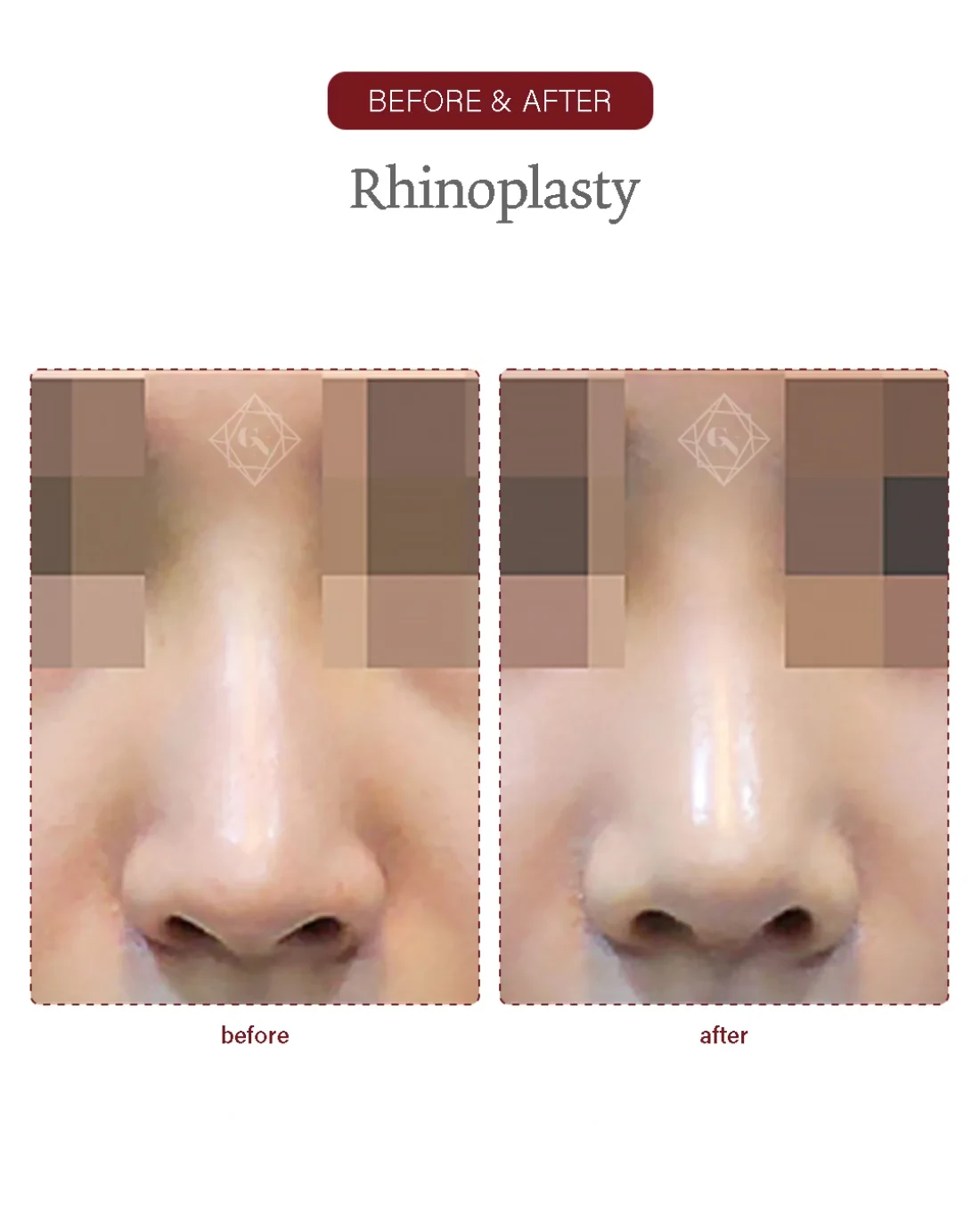
Rhinoplasty result of an actual Garnet patient (published with consent). Date, procedure and clinic (Garnet Plastic Surgery, Apgujeong) are labelled on the image, with the usual same-condition disclaimer. Results, recovery and suitability vary by individual and are not guaranteed.
Dr. In-Soo Baek
Director & sole operating surgeon
Korean medical licence no. 77407
Operate on what you came for. Trained at Korea University Medical Center. Every case planned, performed and reviewed by the same hands.
1Operating surgeon
~2Surgeries per day
7Registered techniques
Board-certified plastic surgeon
Plastic surgery training at Korea University College of Medicine & graduate school
Korean Society of Plastic and Reconstructive Surgeons member, in its facial-contour, eye & rhinoplasty groups
Consults, operates and follows up each case himself
Peer-reviewed papers behind the facts on this page. Each describes findings in its own study group — not results at Garnet — and none predicts your own outcome.
Li D et al. An Overview of Asian Rhinoplasty. Annals of Plastic Surgery. 2016. doi:10.1097/sap.0000000000000841
Jeevan R et al. Travelling abroad for aesthetic surgery: Informing healthcare practitioners and providers while improving patient safety. Journal of Plastic, Reconstructive & Aesthetic Surgery. 2011. doi:10.1016/j.bjps.2010.04.022
Jang YJ et al. Rhinoplasty in the Asian Nose. Facial Plastic Surgery Clinics of North America. 2014. doi:10.1016/j.fsc.2014.04.001
Ramírez B et al. Aesthetic Surgical Tourism: Physiological Changes During Flight That May Affect Patient Safety and Outcomes. Plastic and Reconstructive Surgery - Global Open. 2026. doi:10.1097/gox.0000000000007568
FAQ
Common questions
How do international patients get rhinoplasty in Korea?
Usually by starting with an online consultation from abroad (sending photos and goals for a pre-assessment), then planning a stay of around 7 to 10 days for the surgery and recovery. The trip is built around splint and suture removal at about a week, and follow-up continues remotely once you fly home. A coordinator helps with scheduling and after-care throughout.
How long should I stay in Korea for rhinoplasty?
Most international patients plan around 7 to 10 days. The key milestone is the external splint and nose sutures coming off at about 7 days, and you want to be in Korea for that. A few extra days give a buffer for early swelling to settle. Where an ear donor site is used, its stitches come out a little later, around ten days.
Can I start with an online consultation for rhinoplasty?
Yes, and you should. You send clear photos and a description of what you would like to change, and receive a pre-assessment of whether rhinoplasty suits you, what approach would be considered and what to expect. It lets you plan the trip around a genuine assessment, and it costs nothing but a few photos and a conversation.
When can I fly home after rhinoplasty?
Generally once the splint and nose sutures are out and early swelling has settled, which is why removal timing drives how long you stay. The surgeon makes the call at your final in-person check, based on your actual healing. Residual swelling then continues to settle gradually at home over the following weeks and months.
Does Garnet treat international patients for rhinoplasty?
Yes. Through its foreign-patient programme registration, Garnet arranges the nose consultation, scheduling and after-care for people travelling in. A dedicated coordinator stays with you from consult to recovery, the same board-certified surgeon operates and reviews you, and structured follow-ups at 1, 3 and 6 months continue remotely once you return home.
How does follow-up work after I return home?
Remotely. At a single-surgeon clinic the operating surgeon, the doctor who performed your rhinoplasty, reviews your progress after you fly home, so check-ins are handled by the person who knows your case. Garnet's structured follow-ups at 1, 3 and 6 months are designed for international patients, with the later reviews done remotely. You also leave with clear guidance on what is normal.
What does the trip look like day by day?
Typically an in-person consultation and surgery early in the stay, so most of the recovery window happens in Korea. The first two to three days are the most congested, so a quiet, restful stay suits them. Then dressing checks around day 1 and day 3, and splint and suture removal at about 7 days, the turning point most patients describe before flying home.
Is it safe to fly long-haul after rhinoplasty?
Flying is generally avoided until the splint and sutures are out and early swelling has settled, which is one reason the stay is planned the way it is. The surgeon confirms you are healing well and ready to travel at your final check. Following that guidance, and not flying home with the splint still on, is part of a sensible plan.
What if I have a complication after I fly home?
You are given clear guidance before you leave on what is normal, what to watch for and when to seek local care. Because the operating surgeon reviews you remotely after you return home, concerns are assessed by the doctor who performed your surgery, who can advise on next steps, including arranging local care where appropriate, so you are not left without support.
Will language be a problem for my rhinoplasty trip?
Raise it at the online consultation stage so coordination can be arranged to suit you. A dedicated coordinator stays with you from the first consultation through recovery, helping with scheduling and after-care, and the online consultation establishes your plan and answers your questions in advance, so the trip is joined up under one clinic and one surgeon.
My mom recently had a brow lift and lower blepharoplasty with Dr. Baek, and our experience has been wonderful so far. The Garnet team was incredibly kind and welcoming, with Kelly assisting us as our English consultant—she made everything…
I’m so happy I chose this clinic for my lower blepharoplasty. I was traveling from abroad by myself, so I was a little nervous, but from the beginning I felt comfortable and truly cared for. Everyone was kind, patient, and professional…
Came in for an in-person consult and ended up choosing Garnet and Dr.Baek for my non-incisional DES and tiplasty/alarplasty. I communicated with Kelly (English consultant) from the start till now (3 weeks post-op). She really help me feel…
My under-eyes have been sagging and folding for years... I tried to cover it up with makeup, but it actually got stuck in the wrinkles and made it stand out even more. While going for consultations, I noticed that the bigger the hospital…
Planning a rhinoplasty trip to Korea from abroad? Send photos and a note on your goals for a no-obligation pre-assessment and a realistic plan for how long to stay before you book a flight.
Send photos and your question before you travel. An English-speaking coordinator reviews every enquiry and replies with guidance on whether surgery is appropriate, the likely plan and timing.
✓ Reviewed by the clinic coordinator, not a bot
✓ Photo-based pre-assessment before you fly
✓ Foreign-patient scheduling & after-care
✓ One surgeon for consultation, surgery and follow-up
Prefer to chat now? Reach the coordinator directly:









 T S7 months ago



