"How long will it last?" is a fair question for a rib cartilage rhinoplasty, because rib is chosen precisely when a nose needs strong, lasting structure. Costal cartilage gives the most robust structural rebuild available and integrates as your own tissue, but rib has one well-known behaviour, warping, that careful surgery is designed to manage.
The short answer
Rib (costal) cartilage provides the strongest structural framework available in rhinoplasty, which is why it is used for major augmentation and complex reconstruction that needs durable support.
As autologous tissue (your own rib, or donor rib) it integrates and is meant to remain permanently; there is no implant to exchange.
The trade-off is that rib cartilage can warp over time, so it must be carved from balanced sections and stabilised carefully; a well-executed rib graft manages this and holds well.
No rhinoplasty stops ageing, but a properly built rib framework gives an especially durable structural foundation for the long term.
Why rib cartilage gives the most durable structure
A rib cartilage rhinoplasty uses costal cartilage, either your own rib or processed donor rib, to build the nasal framework. Rib is chosen for a specific reason: it provides a large volume of strong, rigid cartilage, far more than the septal or ear cartilage available in a standard nose surgery. That makes it the material of choice when a nose needs substantial augmentation or a genuine structural rebuild, and it is a common workhorse in complex reconstruction and revision.
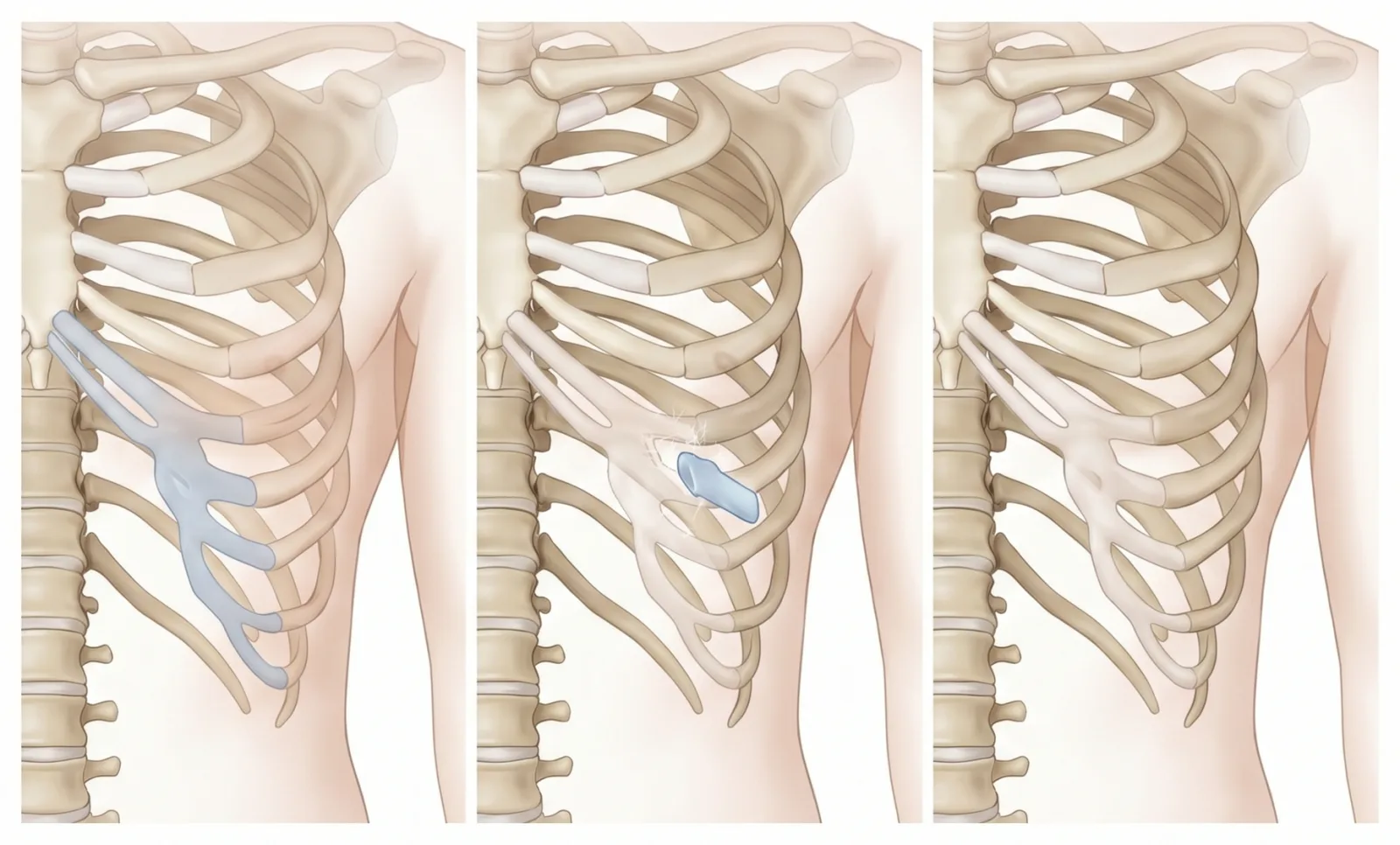
Illustration: where rib cartilage (blue) sits on the chest wall, and the small segment taken to build a stronger nasal framework.
Because rib supplies robust structural support, the framework it builds is inherently sturdy. Where softer grafts might not hold significant projection over the long term, a well-constructed rib framework carries the load. This is the core of its longevity: the result rests on a strong, purpose-built foundation. No material is asked to do more than it can.
So when a nose truly needs its structure rebuilt (for major dorsal augmentation, strong tip support, or a reconstruction after previous surgery), rib is frequently the most durable answer. Its strength is exactly why it is reserved for cases that need it and is not the default for every nose. Understanding that context is the starting point for realistic longevity expectations.
Integrates
How rib cartilage integrates as your own tissue
Rib cartilage is autologous when it is your own, and even processed donor rib is a biological graft that the body incorporates. Once placed and healed, it integrates and becomes a living part of your nasal framework, meant to remain permanently. There is no artificial implant involved, so the long-term concerns that can attach to a silicone implant, such as eventual exchange, shifting or skin thinning, do not apply in the same way.
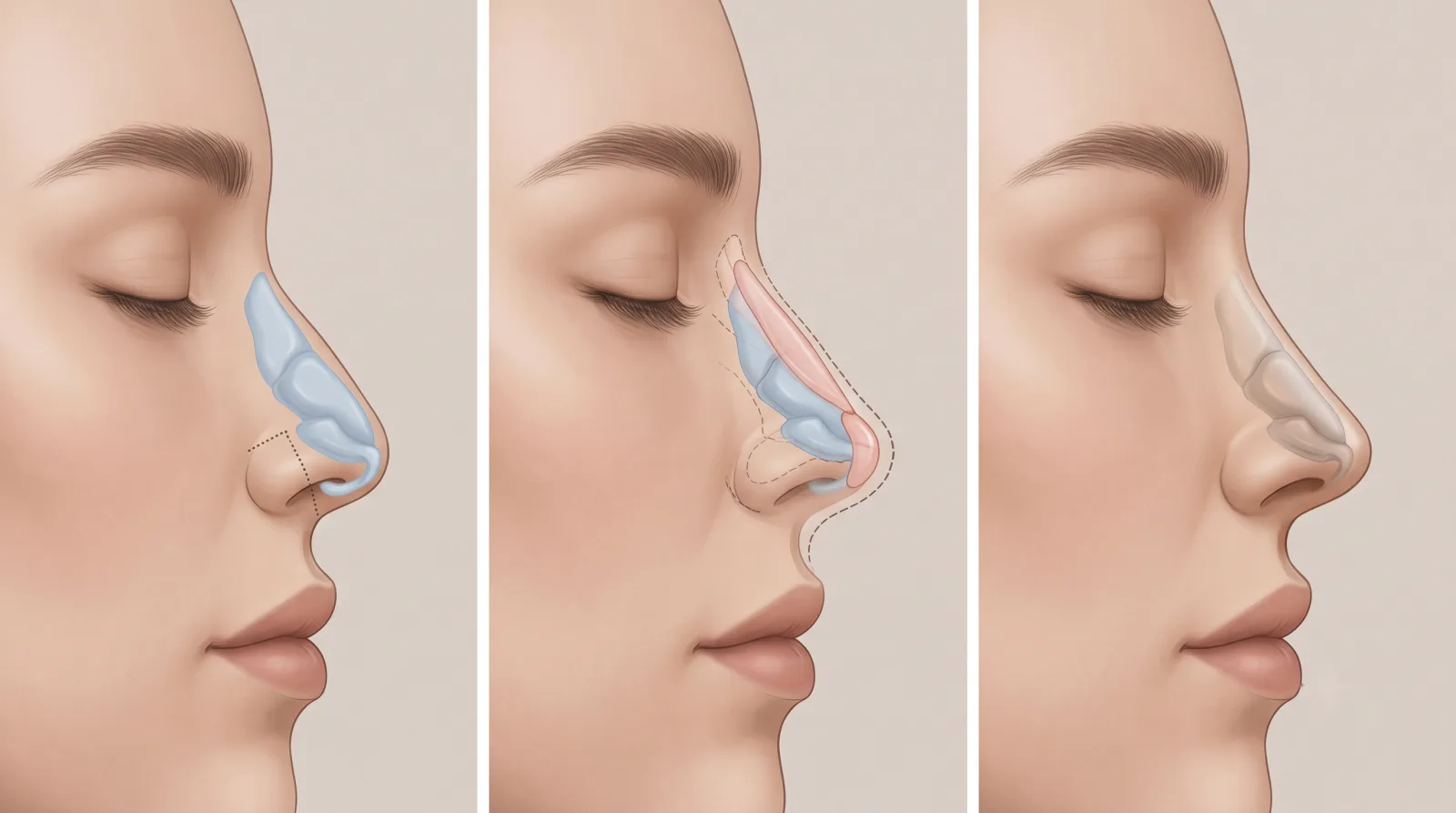
Illustration: the nasal framework (blue) is reshaped to raise the bridge and refine the tip. The dashed outline shows the original contour.
This integration is a real strength for longevity. You are living with a framework built from robust cartilage that belongs to, or is incorporated by, your body. No foreign material has to be managed over time. For patients who want the most durable structure without an implant, that combination of strength and integration is the appeal of the rib approach, and it distinguishes it from an implant-based standard rhinoplasty.
That said, integration takes time and depends on healthy healing, which is why the recovery is a little more involved than a cartilage-only nose: there is a rib donor site to heal as well as the nose. The reward for that is a foundation designed to last. Rib cartilage does have one specific behaviour that needs addressing head-on, its tendency to warp.
Warping
The issue of rib cartilage warping
The best-known trade-off of rib cartilage is that it can warp, meaning curve or twist slightly, as it heals and over time, because costal cartilage retains internal stresses that can express themselves once it is carved. This is a genuine, well-documented behaviour, and any fair discussion of rib rhinoplasty has to acknowledge it. It is a property of the material and no flaw in the patient.
The good news is that surgical technique is specifically designed to manage warping. Carving grafts from balanced, central sections of the rib, allowing the cartilage to declare any tendency to bend before final shaping, and stabilising grafts, sometimes with internal support, all reduce the risk substantially. A well-executed rib framework, built by an experienced surgeon who respects this behaviour, holds its shape well; a rushed one is more prone to distortion.
This is precisely why rib work rewards meticulous, unhurried surgery. The durability of a rib nose depends on the strength of the material and also on how carefully warping is anticipated and controlled during the operation. Managed properly, rib gives a strong, lasting framework; managed carelessly, its warping can undermine the result. The surgery itself is therefore central to how long it lasts.
How it ages
How the nose still ages after rib rhinoplasty
As with every nose surgery, a rib rhinoplasty does not stop the nose ageing. The sturdy framework holds, but the living tissue around it keeps changing: skin can thin over the years, the soft tissue of the face shifts, and the nose evolves gently. A strong rib framework resets and reinforces the structure; it does not switch off the passage of time.
What the rib approach gives you is an especially durable structural starting point from which the nose ages slowly. Years later your nose will reflect the reconstructed framework, looking like an older version of that result with its structure kept. Because rib provides such robust support, the framework itself is well placed to endure even as the surrounding tissue ages naturally.
What a rib rhinoplasty offers is a lasting reshape that then ages gently. A rib framework is among the most durable foundations available, but the skin and soft tissue over it still age, so subtle changes over the years are normal and expected. They are no sign anything has gone wrong.
Later on
If your nose ever needs attention later
For a well-built rib rhinoplasty, most people enjoy the durable framework for the long term without needing further surgery, because the strength of the reconstruction is the point. Because there is no implant, one of the common long-term prompts for revisiting a nose does not apply, and integrated rib cartilage is meant to remain permanently.
Illustration: the previous implant (outlined) is removed and the framework is rebuilt with the patient's own cartilage for support.
If attention is ever wanted years later, it is more likely to relate to fine refinement, or, uncommonly, to addressing a graft that warped despite careful technique. Where a nose needs more substantial correction, that overlaps with revision rhinoplasty, in which rib cartilage is itself often the chosen structural material, so the same durable logic applies.
There is no schedule you are obliged to follow and no assumption of further surgery. A properly executed rib framework is one of the most durable structural rebuilds available, ages gently, and, carrying no implant, removes a major long-term reason for revisiting a nose. If anything is ever needed, it is best discussed with the surgeon who built the framework.
At Garnet
Garnet's approach to a durable rib framework
Garnet is a single-surgeon clinic in Apgujeong, Seoul. Dr. In-Soo Baek is a board-certified plastic surgeon (Korean medical licence no. 77407) and the only operating doctor. He plans the reconstruction, carves and stabilises the rib cartilage, performs the surgery himself and reviews every follow-up, and the clinic keeps to two surgeries a day so a demanding rib case has the unhurried time that careful carving and warp control require. With over ten years focused on nose surgery, the emphasis is on building a strong framework that holds its shape over the long term.
Because a rib framework's durability depends on how warping is anticipated and controlled, that unhurried single-surgeon model is directly relevant to how long the result lasts: the same surgeon carves the grafts from balanced sections, stabilises them and secures the rebuild, then follows your healing (nose sutures out around 7 days and the rib donor site around 10) with structured reviews at 1, 3 and 6 months, and by messenger after you fly home. For visitors travelling for rib rhinoplasty, Garnet holds registration with Korea's foreign-patient programme.
If you would like a realistic view of how a rib cartilage rhinoplasty could last for your nose specifically, including a frank discussion of warping and how it is managed, the ideal first step is a no-obligation online assessment. Send photos of your nose and hear how your rib framework would be built and how long it is likely to hold, before you plan any travel.
Prices
Price at Garnet
Revision rhinoplasty
From₩4,000,000 + VATExcluding VAT (10% VAT is added at payment)Book now
Same price as Korean patients. Prices shown exclude 10% VAT; your written quote, issued after the in-person consultation, shows the full amount payable.
Dr. In-Soo Baek
Director & sole operating surgeon
Korean medical licence no. 77407
Operate on what you came for. Trained at Korea University Medical Center. Every case planned, performed and reviewed by the same hands.
1Operating surgeon
~2Surgeries per day
7Registered techniques
Board-certified plastic surgeon
Plastic surgery training at Korea University College of Medicine & graduate school
Korean Society of Plastic and Reconstructive Surgeons member, in its facial-contour, eye & rhinoplasty groups
Consults, operates and follows up each case himself
Peer-reviewed papers behind the facts on this page. Each describes findings in its own study group — not results at Garnet — and none predicts your own outcome.
Fedok FG. Costal Cartilage Grafts in Rhinoplasty. Clinics in Plastic Surgery. 2016. doi:10.1016/j.cps.2015.08.002
Lee Peng G et al. Safe and Simple Costal Cartilage Harvest. Facial Plastic Surgery Clinics of North America. 2026. doi:10.1016/j.fsc.2026.02.001
Fedok FG et al. The Use of Costal Cartilage in Rhinoplasty. Facial Plastic Surgery Clinics of North America. 2024. doi:10.1016/j.fsc.2024.06.009
FAQ
Common questions
How long does rib cartilage rhinoplasty last?
Rib cartilage gives the strongest, most durable structural framework available in rhinoplasty, and as autologous tissue it integrates and is meant to remain permanently, with no implant to exchange. The main caveat is that rib can warp, so careful carving and stabilisation matter. A well-executed rib framework holds its shape well and provides an especially durable foundation for the long term.
Is rib cartilage rhinoplasty permanent?
The rib framework is a lasting structural change, and the cartilage integrates as your own tissue meant to remain, so the reconstruction endures without any implant to manage. But nothing stops the nose ageing, and rib can warp if not carved and stabilised carefully. It is fair to call it one of the most durable rebuilds available; nobody can promise it is unchanging forever.
Why is rib cartilage used instead of other cartilage?
Rib supplies a large volume of strong, rigid cartilage (far more than septal or ear cartilage), so it is chosen when a nose needs substantial augmentation, strong tip support or a genuine structural rebuild, including in complex revisions. Its strength is exactly why it is reserved for cases that need it.
Can rib cartilage warp over time?
Yes, it can. Costal cartilage retains internal stresses that can cause it to curve or twist as it heals, which is its best-known trade-off. Surgical technique is designed to manage this: carving from balanced sections, letting the cartilage declare any bend before final shaping, and stabilising the grafts. A well-executed rib framework by an experienced surgeon substantially reduces this risk.
Does rib cartilage rhinoplasty change with age?
Yes, gently. The sturdy framework holds, but the living tissue keeps ageing: skin can thin and facial soft tissue shifts over the years. Because rib provides such robust support, the framework itself is well placed to endure while the surrounding tissue ages naturally. Your nose ages slowly from a reinforced starting point and keeps its structure.
Does having no implant make it last longer?
It changes the long-term picture, beyond simply making it last longer. With no implant, the concerns that can attach to a silicone implant (eventual exchange, shifting, skin thinning) do not apply, and integrated rib is meant to remain permanently. In exchange, rib carries its own consideration in the form of possible warping, which careful surgery manages.
Will I need further surgery after rib rhinoplasty?
Most people with a well-built rib framework enjoy the durable result for the long term without further surgery, and the absence of an implant removes a common long-term prompt. If attention is ever needed, it is more likely fine refinement or, uncommonly, addressing a graft that warped despite careful technique. That is best discussed with the surgeon who built the framework.
Does having the same surgeon help with long-term results?
It helps considerably. When the same board-certified surgeon carves the rib, controls for warping, secures the rebuild and follows your healing at 1, 3 and 6 months, the framework is built and monitored as intended, which is central to how well it holds its shape. Continuity also makes any future step easier, because the surgeon knows exactly how your nose was constructed.
Can I get a longevity estimate for a rib rhinoplasty before travelling?
Yes. In an online consultation from abroad you can send photos, and the surgeon can give a clear view of both the likely result and how it may last for your nose specifically, including a frank discussion of rib warping and how it is managed, before you commit to any travel.
My mom recently had a brow lift and lower blepharoplasty with Dr. Baek, and our experience has been wonderful so far. The Garnet team was incredibly kind and welcoming, with Kelly assisting us as our English consultant—she made everything…
I’m so happy I chose this clinic for my lower blepharoplasty. I was traveling from abroad by myself, so I was a little nervous, but from the beginning I felt comfortable and truly cared for. Everyone was kind, patient, and professional…
Came in for an in-person consult and ended up choosing Garnet and Dr.Baek for my non-incisional DES and tiplasty/alarplasty. I communicated with Kelly (English consultant) from the start till now (3 weeks post-op). She really help me feel…
My under-eyes have been sagging and folding for years... I tried to cover it up with makeup, but it actually got stuck in the wrinkles and made it stand out even more. While going for consultations, I noticed that the bigger the hospital…
For a clear view of how long a rib cartilage rhinoplasty could last for your nose, send photos for a no-obligation pre-assessment, including how warping is managed, before you plan a trip.
Send photos and your question before you travel. An English-speaking coordinator reviews every enquiry and replies with guidance on whether surgery is appropriate, the likely plan and timing.
✓ Reviewed by the clinic coordinator, not a bot
✓ Photo-based pre-assessment before you fly
✓ Foreign-patient scheduling & after-care
✓ One surgeon for consultation, surgery and follow-up
Prefer to chat now? Reach the coordinator directly:








 T S7 months ago



