Rib cartilage rhinoplasty rebuilds the nose with your own costal (rib) cartilage, which means recovery involves a second site most nose surgeries don't have: the chest, where the rib graft is harvested. This timeline walks through both, the nose and the rib donor area, week by week, so you can plan your stay and your return home realistically.
The short answer
Recovery happens at two sites: the nose, where sutures typically come out at around seven days, and the chest rib donor area, where sutures come out at around ten days.
The nose follows the usual rhinoplasty arc: cast, then visible swelling and bruising that settle over the first weeks. The chest adds tightness and tenderness on deep breathing or twisting that eases over a couple of weeks.
Most patients return to desk work in roughly two weeks once both sites are comfortable, with strenuous exercise and chest-loading activity held back longer.
Because both sites and the nose's shape keep settling for months, the same surgeon reviews you at 1, 3 and 6 months, which matters for an international patient timing a return trip.
Why rib cartilage rhinoplasty has two recovery sites
Most rhinoplasty recovery focuses on one place: the nose. Rib cartilage rhinoplasty adds a second, because the structural cartilage used to rebuild the nose is harvested from a rib, either your own (autologous) or processed donor costal cartilage. Rib gives a large, strong supply of cartilage, which is why it is chosen for noses that need substantial structural support, such as complex or revision cases. The cost of that strength is a small incision at the lower chest and a donor site that heals on its own schedule.
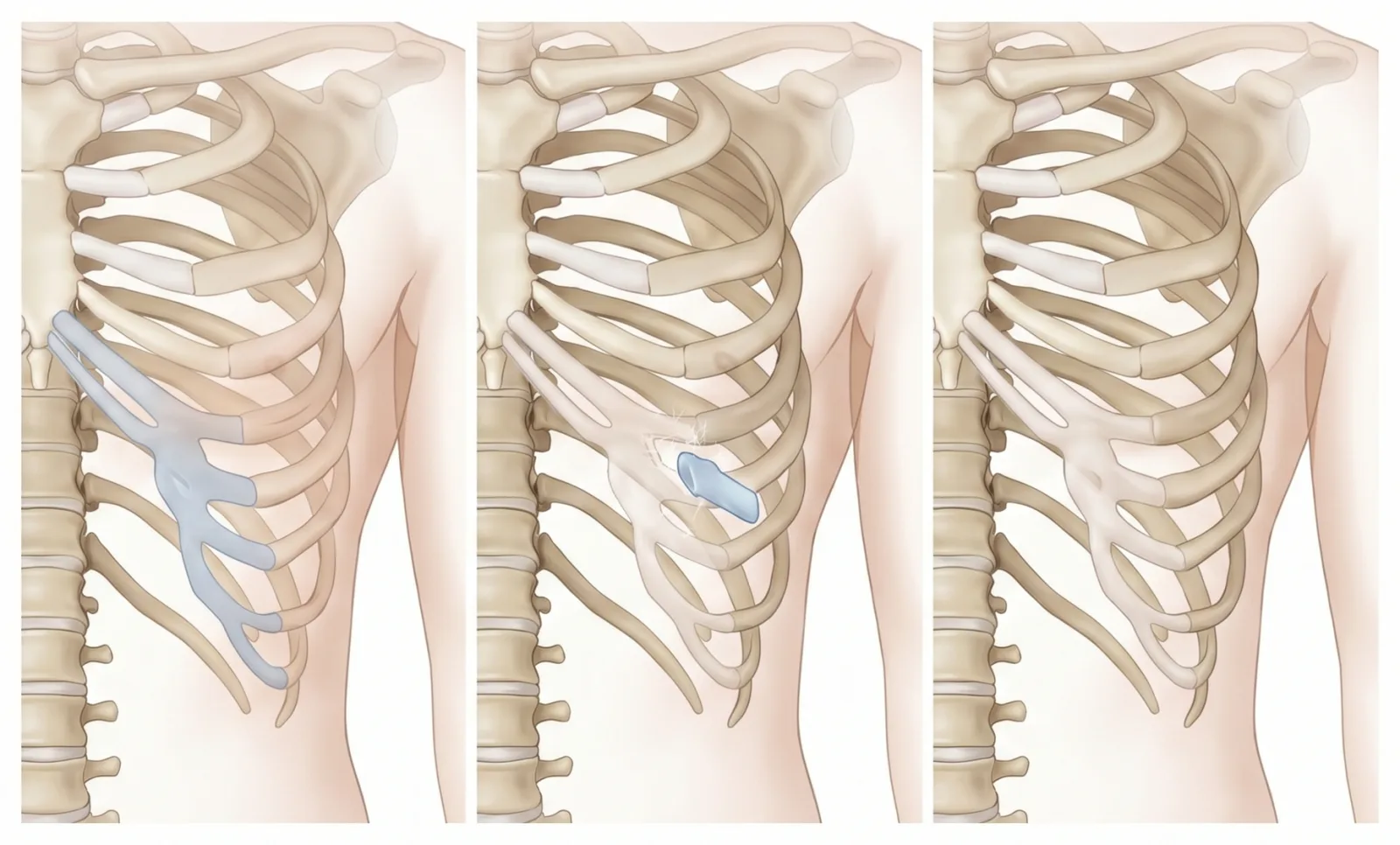
Illustration: where rib cartilage (blue) sits on the chest wall, and the small segment taken to build a stronger nasal framework.
So your timeline runs on two tracks at once. The nose follows the familiar rhinoplasty pattern: a cast or splint, then swelling and bruising that fade over weeks while the deeper shape keeps refining for months. The chest donor site has its own arc: an incision that needs about ten days before sutures come out, and a period of tightness or tenderness when you breathe deeply, laugh, cough or twist, which settles over a couple of weeks. Neither track is dramatic, but knowing both exist lets you plan properly.
This page goes deep on the recovery specifically; for who rib cartilage suits and how the framework is built, the parent rib cartilage rhinoplasty cell is the place to start. If you are still choosing your cartilage source, the related rib vs ear-cartilage rhinoplasty page weighs the donor sites against each other.
Days 1 to 7
Days 1 to 7: the first week
The first day or two are the most managed. Your nose will have an external cast or splint and likely internal support, and the chest donor site will be dressed. Expect the nose to feel blocked (you'll breathe through your mouth) and to see swelling around the nose and under the eyes, often with bruising that can be more noticeable in the first 48 to 72 hours before it begins to settle. The chest feels tight and sore, most obvious when you take a deep breath, cough, laugh or sit up; this is the donor site, and it is the part rib-cartilage patients most underestimate.
Through this week, rest with your head elevated to ease nose swelling, avoid bending and heavy lifting, and move gently and often without straining your chest. Sneezing and nose-blowing are off the table while the internal work settles. Pain at both sites is managed with prescribed medication and is usually described as manageable tightness more than sharp pain; many patients find the chest the more attention-grabbing of the two in these first days simply because every breath uses it.
By the end of the first week the worst of the swelling peak has passed and bruising is fading from purple toward yellow-green. The nose is still casted and you won't yet see your result. That is entirely normal at this stage. For how the nose-only side of this compares across nose surgery generally, the rhinoplasty recovery timeline covers the shape-settling arc in more detail.
Week two
Around day 7 to 10: casts off, sutures out
This is the milestone stretch. At around 7 days the nose cast or splint comes off and the nose sutures are removed; Garnet records nose suture removal at about day seven. Seeing the nose for the first time is a relief, but it is important to expect it to look swollen and a little firm; the tip especially stays puffy for some time. This is only the first preview of the new structure.
The chest donor site runs a few days behind. Garnet records the rib donor sutures coming out at around ten days, because the chest moves with every breath and the surgeon prefers to give the incision extra support before removing stitches. Once those are out, the chest is usually noticeably more comfortable, though some tightness on deep movement can linger a little longer. For an international patient, this is the practical reason a stay in Korea is planned to cover roughly the 10-day window, so both the nose and the chest sutures can be removed and checked before you fly.
By the end of this period most people look presentable enough for low-key public outings, with residual swelling and perhaps faint bruising that make-up can help with, and a chest that is sore only with bigger movements. Travel logistics around exactly this window are covered in the how long to stay in Korea guide.
Weeks to months
Weeks two to twelve and beyond
From the second week onward the trajectory is steady improvement at both sites. The obvious swelling and bruising of the nose continue to fade through the first two to four weeks, after which most of the change is subtle: the tip slowly de-puffs and the refined shape emerges over months. As with all rhinoplasty, the deepest tip swelling is the slowest to go, and final definition can take up to a year. Rib cases are no exception, and the slow pace is normal.
The chest donor site keeps fading into the background. After the sutures are out the tightness on breathing and twisting eases over the following weeks, and the incision line begins maturing the way any scar does: pink and firm at first, then paler and flatter over the following months. It sits low on the chest where it is easy to keep covered. Numbness or odd sensation around the incision can occur and usually settles over weeks to months as small nerves recover.
Because both the nose's shape and the two healing sites keep changing for months, this whole window is what Garnet's structured 1-, 3- and 6-month reviews are built to cover. For an international patient those reviews are partly in person and partly by messenger after you go home. The slower months of nose refinement don't require you to stay in Korea, only to stay in contact. The related rib vs ear-cartilage comparison explains why rib's longer donor recovery buys its structural strength.
Work and flying
Returning to work, exercise and flying
Most people doing desk-based work feel ready to return at roughly two weeks, once the nose cast is off and the chest is comfortable enough for normal sitting, talking and light movement. Jobs that are physical, involve heavy lifting, or load the chest and core need longer. Here the rib donor site sets the pace more than the nose, and pushing it too early risks pain and strained healing. Gentle walking is fine early; structured exercise, especially anything that engages the chest or raises blood pressure to the face, is generally held back for several weeks and reintroduced gradually on your surgeon's advice.
Flying is usually comfortable once the acute swelling has settled and both suture sites have been removed and checked, which lines up naturally with the planned stay. The cabin environment itself is not the main issue; the bigger considerations are being far from your surgeon if anything needs attention and avoiding strain. Because the nose continues to settle for months afterward, flying home is not the end of recovery, just the end of the in-person phase. General timing for air travel after surgery is covered in the when can I fly after surgery guide.
These are general patterns. Individual recovery varies with the extent of surgery and your own healing. The reliable way to get a timeline for your case is to ask the surgeon who would operate. You can do that, and plan your stay and return around both the nose and chest, in an online consultation before you book travel.
At Garnet
Aftercare at Garnet
Garnet is a single-surgeon clinic in Apgujeong, Seoul. Dr. In-Soo Baek, a board-certified plastic surgeon (Korean medical licence no. 77407), performs rib cartilage rhinoplasty himself and personally reviews each follow-up, so the surgeon who built your nasal framework and harvested the rib graft is the same one tracking how both sites heal. The clinic caps the day at two surgeries, which keeps the operation and your after-care unhurried.
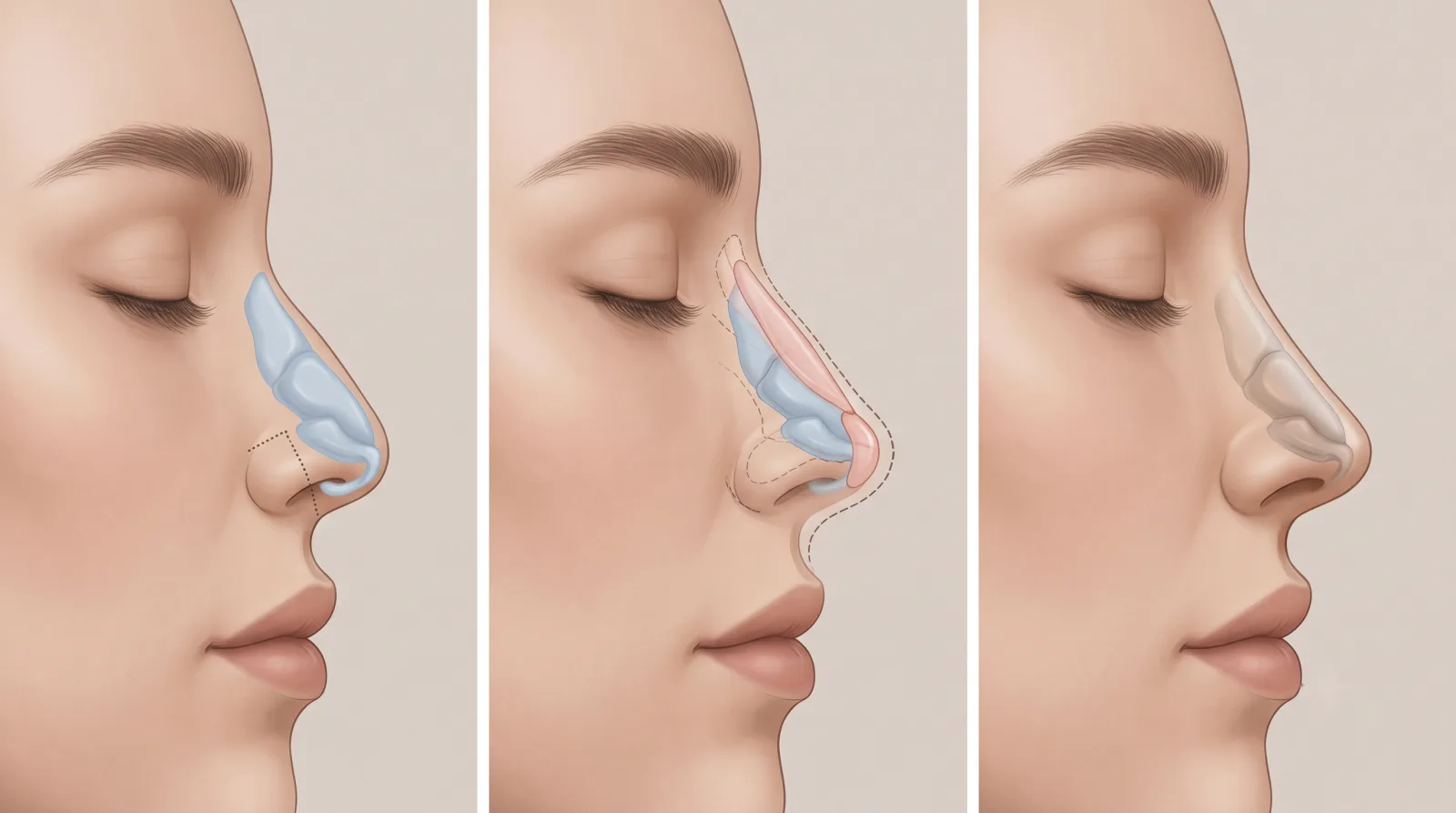
Illustration: the nasal framework (blue) is reshaped to raise the bridge and refine the tip. The dashed outline shows the original contour.
Follow-ups are structured at 1, 3 and 6 months, the right cadence for a procedure whose nose shape and chest donor site both keep settling well past the point you go home. For international patients, the early in-person reviews cover suture removal and the first weeks, and the same surgeon continues to check progress by messenger once you've travelled, with clear guidance on what's normal at the nose and the chest at each stage. A dedicated coordinator stays with you from consultation through recovery.
If you're planning rib cartilage rhinoplasty from abroad and want a realistic timeline for your own case, including how long to stay and when you could fly, the ideal next step is a pre-assessment. You can send photos and ask your questions in a no-obligation online assessment, or read the full procedure overview on the rhinoplasty cell.
Dr. In-Soo Baek
Director & sole operating surgeon
Korean medical licence no. 77407
Operate on what you came for. Trained at Korea University Medical Center. Every case planned, performed and reviewed by the same hands.
1Operating surgeon
~2Surgeries per day
7Registered techniques
Board-certified plastic surgeon
Plastic surgery training at Korea University College of Medicine & graduate school
Korean Society of Plastic and Reconstructive Surgeons member, in its facial-contour, eye & rhinoplasty groups
Consults, operates and follows up each case himself
Peer-reviewed papers behind the facts on this page. Each describes findings in its own study group — not results at Garnet — and none predicts your own outcome.
Yoo SH et al. Rib cartilage in Asian rhinoplasty: new trends. Current Opinion in Otolaryngology & Head & Neck Surgery. 2019. doi:10.1097/moo.0000000000000547
Fedok FG. Costal Cartilage Grafts in Rhinoplasty. Clinics in Plastic Surgery. 2016. doi:10.1016/j.cps.2015.08.002
Lee Peng G et al. Safe and Simple Costal Cartilage Harvest. Facial Plastic Surgery Clinics of North America. 2026. doi:10.1016/j.fsc.2026.02.001
FAQ
Common questions
How long does rib cartilage rhinoplasty recovery take?
The visible early recovery is broadly the first two weeks: the nose cast comes off and sutures are removed around day seven, and the chest rib donor sutures come out around day ten. Most desk-based patients return to work near two weeks. The nose's deeper swelling and final shape keep refining over months, up to about a year.
What is rib cartilage rhinoplasty recovery like day by day?
Days 1 to 7: nose cast on, swelling and bruising peak then begin to fade, and the chest feels tight on deep breathing. Around day 7: nose cast off and nose sutures out. Around day 10: chest rib donor sutures out and the chest eases. Weeks to months: swelling settles and the refined shape gradually emerges, reviewed at one, three and six months.
Why does rib cartilage rhinoplasty have a chest recovery too?
Because the structural cartilage is harvested from a rib at the lower chest, there is a small donor incision there. It needs about ten days before sutures come out and brings tightness on deep breathing, coughing or twisting that eases over a couple of weeks. Ear- or septal-cartilage noses don't have this second healing site.
When can I return to work after rib cartilage rhinoplasty?
Most people in desk-based jobs feel ready at roughly two weeks, once the nose cast is off and the chest is comfortable for normal sitting and movement. Physical work or anything that loads the chest and core needs longer, because the rib donor site sets the pace more than the nose.
When can I fly home after rib cartilage rhinoplasty?
Flying is usually comfortable once the acute swelling has settled and both the nose and chest sutures have been removed and checked, which lines up with the planned stay of around ten days or a little more. The nose keeps settling for months afterward, so flying home ends only the in-person phase of recovery.
Does the chest rib donor site hurt a lot?
Most patients describe it as tightness and soreness more than sharp pain, most noticeable on deep breaths, coughing, laughing or twisting in the first days. It is managed with prescribed medication and eases markedly once the sutures come out at around ten days. It is the part rib-cartilage patients most often underestimate.
How long until I see my final nose shape?
You'll get a first swollen preview when the cast comes off around day seven, but that is not the result. Obvious swelling fades over the first two to four weeks, while the tip de-puffs slowly and final definition can take up to a year. Patience through the slow months is normal.
What aftercare follows rib cartilage rhinoplasty?
Rest with the head elevated early, avoid bending, lifting and chest strain, don't blow or knock the nose, and follow wound-care for both the nose and chest. Reintroduce exercise gradually on your surgeon's advice. At Garnet, structured reviews at one, three and six months track both sites, continuing by messenger after you fly home.
Will the chest donor scar be visible?
The incision sits low on the chest where it is easy to keep covered. Like any scar it is pink and firm at first, then pales and flattens over the following months. Final appearance depends partly on individual healing, so no clinic can promise an identical result for everyone.
How is recovery tracked if I live abroad?
The early in-person reviews at Garnet cover suture removal and the first weeks. After you fly home, the same board-certified surgeon who operated continues to check your progress by messenger through the one-, three- and six-month follow-up points, with guidance on what's normal at the nose and chest at each stage.
My mom recently had a brow lift and lower blepharoplasty with Dr. Baek, and our experience has been wonderful so far. The Garnet team was incredibly kind and welcoming, with Kelly assisting us as our English consultant—she made everything…
I’m so happy I chose this clinic for my lower blepharoplasty. I was traveling from abroad by myself, so I was a little nervous, but from the beginning I felt comfortable and truly cared for. Everyone was kind, patient, and professional…
Came in for an in-person consult and ended up choosing Garnet and Dr.Baek for my non-incisional DES and tiplasty/alarplasty. I communicated with Kelly (English consultant) from the start till now (3 weeks post-op). She really help me feel…
My under-eyes have been sagging and folding for years... I tried to cover it up with makeup, but it actually got stuck in the wrinkles and made it stand out even more. While going for consultations, I noticed that the bigger the hospital…
If you are planning rib cartilage rhinoplasty from abroad, send photos for a no-obligation pre-assessment and get a realistic timeline for both the nose and the chest before you book travel.
Send photos and your question before you travel. An English-speaking coordinator reviews every enquiry and replies with guidance on whether rib cartilage rhinoplasty is appropriate for you, the likely plan and timing.
✓ Reviewed by the clinic coordinator, not a bot
✓ Photo-based pre-assessment before you fly
✓ Foreign-patient scheduling & after-care
✓ One surgeon for consultation, surgery and follow-up
Prefer to chat now? Reach the coordinator directly:








 T S7 months ago



