When rhinoplasty rebuilds your nose with your own cartilage instead of an implant, the next question is which cartilage. Rib and ear are the two most discussed sources, and they are not interchangeable: they differ in strength, how much they yield, how they behave once shaped, and where the donor site sits. This page compares them side by side so you can understand which is suited to your nose. The decision itself belongs to the surgeon assessing you.
The short answer
Rib (costal) cartilage is strong and plentiful, suited to noses needing major structural rebuilding such as complex or revision cases, but it adds a chest donor site and longer recovery.
Ear (conchal) cartilage is softer and curved, ideal for adding volume to the bridge and softening the tip, with a small, well-hidden donor site behind or inside the ear.
Rib can warp as it heals if not handled carefully, which is one reason it needs an experienced surgeon; ear cartilage's natural curve makes it less suited to long, straight structural support.
There is no single 'better' option. The right cartilage depends on what your nose needs, which a proper assessment of the nose decides.
Both rib cartilage rhinoplasty and ear-cartilage rhinoplasty avoid a synthetic implant by rebuilding the nose with your own tissue. The appeal is shared: living cartilage integrates with your body, ages like your own tissue, and avoids the long-term concerns that can come with an implant: migration, becoming visible through thin skin, or needing removal years later. Where they part ways is the source of that cartilage, and the source changes almost everything about what the surgery can do and how you recover.
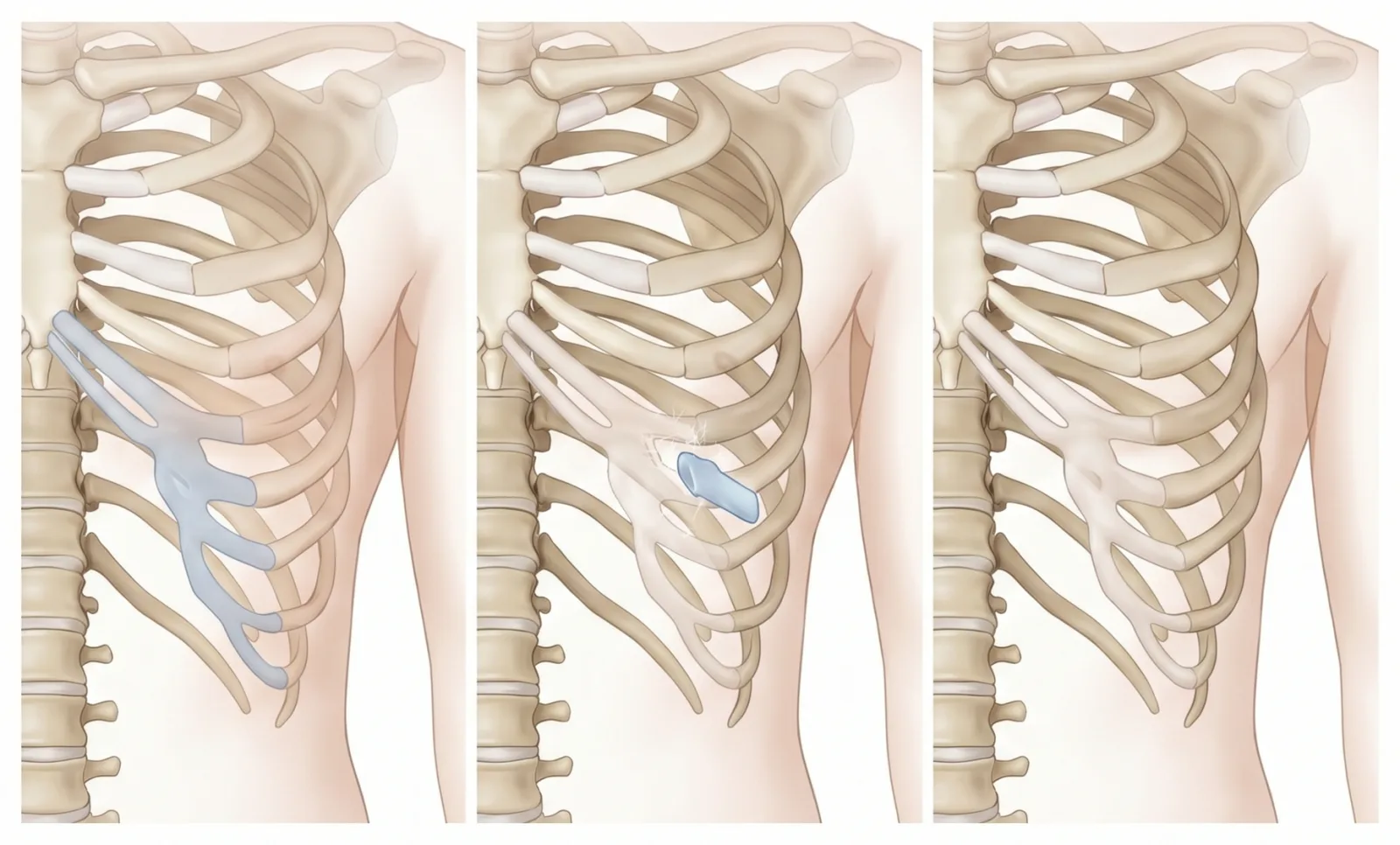
Illustration: where rib cartilage (blue) sits on the chest wall, and the small segment taken to build a stronger nasal framework.
It helps to think of the two materials as having different jobs. Some noses need a strong internal scaffold rebuilt from scratch; others need volume added to the bridge and a softening of the tip. The cartilage best suited to one of those jobs is not the ideal for the other. Choosing well means finding which material matches what your particular nose actually requires; 'stronger' in the abstract does not settle it.
This page focuses on the comparison; for the full picture of either procedure on its own, see the parent rib cartilage rhinoplasty cell and the implant-free rhinoplasty page, which at Garnet uses ear cartilage for the bridge and septal cartilage for the tip. If you're deciding between cartilage and an implant in the first place, the implant vs implant-free comparison is the better starting point.
Rib cartilage
Rib (costal) cartilage — strength and supply
Rib cartilage is harvested from the lower chest, and its defining qualities are strength and quantity. A rib provides a large block of firm cartilage — enough to carve into long, straight structural pieces that rebuild the bridge, support the tip, and lengthen or reinforce a nose that lacks its own framework. This is why rib is the material of choice for major structural work: severely under-projected noses, complex shapes, and many revision cases where earlier surgery used up the available septal cartilage. The source can be your own (autologous) rib or processed donor costal cartilage.
The strength that makes rib so useful is also why it asks more of the patient and the surgeon. Harvesting it means a small incision at the chest and a donor site that heals on its own timeline. Rib cartilage can also have a tendency to warp (to bend slightly as it heals) if it is not carved and balanced carefully, which is one of the main reasons rib rhinoplasty is regarded as technically demanding and best done by an experienced surgeon who plans for that behaviour.
In short, rib is the option you reach for when the nose needs substantial rebuilding and there isn't enough softer cartilage elsewhere to do the job. The day-by-day picture of healing both the nose and the chest is covered on the rib cartilage rhinoplasty recovery timeline.
Ear cartilage
Ear (conchal) cartilage — soft and well-hidden
Ear cartilage is taken from the bowl of the ear (the conchal cartilage). It is softer and naturally curved, which makes it well suited to adding gentle volume to the bridge and to softening or refining the tip. It is not used as a long, rigid support beam. At Garnet, ear-cartilage work is part of implant-free rhinoplasty, where ear cartilage builds up the dorsum and septal cartilage from inside the nose refines the tip. That combination suits noses wanting natural augmentation without an implant and without major skeletal rebuilding.
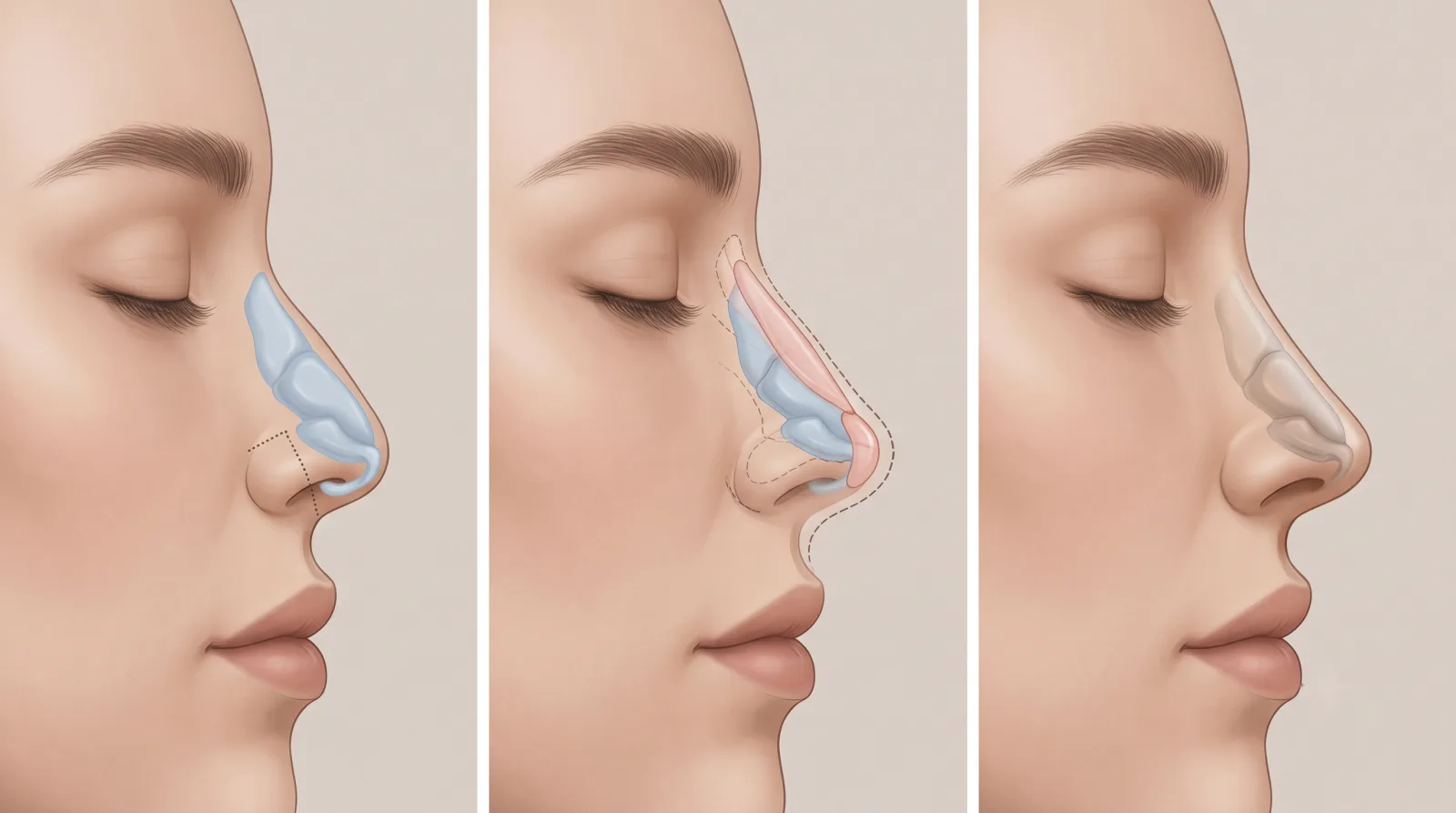
Illustration: instead of an implant, the bridge and tip are built from the patient's own tissue, shaped into the nasal framework (blue). The dashed line shows the original contour.
Its great practical advantage is the donor site. The incision to reach ear cartilage sits in a natural crease behind or inside the ear, where it is hard to see once healed, and only a flat reserve of cartilage is borrowed so the ear keeps its shape. Recovery at the donor site is gentle compared with the chest, since there's no incision that moves with every breath. For many patients, that smaller, quieter donor site is a meaningful point in ear cartilage's favour.
The limit of ear cartilage is the flip side of its softness and its modest supply: there is only so much available, and its curve makes it less suited to the long, straight structural pieces a heavily rebuilt nose needs. When the job is bigger than ear cartilage can do, that is precisely where rib comes in. How the ear donor scar itself heals is covered on the implant-free rhinoplasty scars and healing page.
Strength and supply
Strength, supply and warping compared
On strength, rib clearly leads: it provides firm cartilage that can be shaped into rigid, load-bearing pieces, while ear cartilage is softer and better at adding volume and refinement than at structural support. On supply, rib again provides much more: a single rib yields a generous block, whereas ear cartilage is limited to what the conchal bowl can spare. These two differences alone explain why rib dominates major rebuilds and revision cases, and ear suits gentler augmentation.
Warping is where the detail matters. Rib cartilage can warp as it heals if not carved and balanced with care, so it depends heavily on technique and an experienced surgeon to manage; ear cartilage's natural curve is part of why it isn't used for long straight grafts, but it isn't prone to the same straight-graft warping problem because it isn't asked to do that job. Neither material is 'unstable' in good hands. They simply behave differently and are suited to different tasks.
Put plainly: rib trades a more involved harvest and careful handling for strength and quantity; ear trades limited supply and softness for a small, hidden donor site and a gentler recovery. Calling either one 'better' misses the point, because they answer different needs. The comparison of donor sites continues in the next section.
Donor and recovery
Donor sites and recovery compared
The donor site is often the deciding practical factor. Ear cartilage leaves a small incision tucked in a fold of the ear; at Garnet the donor sutures come out at around ten days, the ear is tender briefly, and the line fades in a hidden crease. Rib cartilage leaves a small incision low on the chest, with sutures also coming out at around ten days, but it brings tightness and soreness on deep breathing, coughing or twisting in the first days because the chest moves constantly. For the nose itself, both follow the usual rhinoplasty arc with sutures out around day seven.
So the difference in recovery comes mostly from the donor site; the nose heals in a similar way. Ear's donor site is genuinely minor, a quiet, hidden line. Rib's is more noticeable early on and is the part rib patients most underestimate, though it settles over a couple of weeks. For an international patient, both still centre the stay around the roughly 10-day window for suture removal, but rib asks for a little more caution with chest-loading activity afterward, while ear lets you move more freely sooner.
Set against the surgical benefit, each donor site is a reasonable trade for what its cartilage delivers. Whether the gentler ear donor or the stronger rib graft is right for you depends entirely on what your nose needs. That is exactly why this is a decision to make with the surgeon; a table cannot make it. The recovery detail for rib is on the rib cartilage rhinoplasty recovery timeline.
Making the choice
How the choice is made at Garnet
For 'rib or ear?', your nose decides, with the surgeon. A nose that needs major structural rebuilding, significant lengthening, or revision after earlier surgery is likely pointing toward rib, because that is where the strength and supply are. A nose that wants natural bridge augmentation and tip refinement without an implant is well served by ear cartilage, with its small hidden donor site. The realistic comparison only becomes a recommendation once a surgeon has examined your nose, skin and existing structure.
Illustration: the nasal framework (blue) is reshaped to raise the bridge and refine the tip. The dashed outline shows the original contour.
Garnet is a single-surgeon clinic in Apgujeong, Seoul, where Dr. In-Soo Baek, a board-certified plastic surgeon (Korean medical licence no. 77407), performs the assessment, the operation and every follow-up himself. That continuity matters for this decision: the surgeon who weighs rib against ear for your case is the same one who carries it out and reviews how it heals, and Garnet's stated approach is to address only what you came for, without over-recommending more surgery than your nose needs.
If you're trying to decide between rib and ear cartilage from abroad, the most useful step is a pre-assessment for your specific nose. You can send photos and ask which source would suit you and why in a no-obligation online assessment, or read the overview of nose surgery options on the rhinoplasty cell first.
Dr. In-Soo Baek
Director & sole operating surgeon
Korean medical licence no. 77407
Operate on what you came for. Trained at Korea University Medical Center. Every case planned, performed and reviewed by the same hands.
1Operating surgeon
~2Surgeries per day
7Registered techniques
Board-certified plastic surgeon
Plastic surgery training at Korea University College of Medicine & graduate school
Korean Society of Plastic and Reconstructive Surgeons member, in its facial-contour, eye & rhinoplasty groups
Consults, operates and follows up each case himself
Peer-reviewed papers behind the facts on this page. Each describes findings in its own study group — not results at Garnet — and none predicts your own outcome.
Lee Peng G et al. Safe and Simple Costal Cartilage Harvest. Facial Plastic Surgery Clinics of North America. 2026. doi:10.1016/j.fsc.2026.02.001
Uzunoğlu E et al. Polypropylene vs. Polydioxanone: How to Fix Septal Extension Graft?. Plastic & Reconstructive Surgery. 2025. doi:10.1097/prs.0000000000012697
Fedok FG et al. The Use of Costal Cartilage in Rhinoplasty. Facial Plastic Surgery Clinics of North America. 2024. doi:10.1016/j.fsc.2024.06.009
Cobo R et al. Septal Extension Graft Versus Columellar Strut. Facial Plastic Surgery Clinics of North America. 2024. doi:10.1016/j.fsc.2024.06.005
FAQ
Common questions
What is the difference between rib cartilage and ear-cartilage rhinoplasty?
Rib (costal) cartilage is strong and plentiful, suited to major structural rebuilding such as complex or revision noses, but adds a chest donor site. Ear (conchal) cartilage is softer and curved, suited to adding volume to the bridge and softening the tip, with a small hidden donor site at the ear. They do different jobs and are not interchangeable.
Which is stronger, rib or ear cartilage?
Rib cartilage is the stronger and firmer of the two, which is why it is used for rigid, load-bearing structural support and longer grafts. Ear cartilage is softer and better at adding gentle volume and refinement than at providing rigid structure.
Why is rib cartilage used for revision rhinoplasty?
Revision noses often need significant rebuilding, and earlier surgery may have already used up the available septal cartilage. Rib provides a large, strong supply that can be carved into the structural pieces a complex rebuild needs, which ear cartilage's limited, softer supply usually cannot match.
Does rib cartilage warp?
Rib cartilage can warp (bend slightly as it heals) if it is not carved and balanced carefully, which is one reason rib rhinoplasty is technically demanding and best done by an experienced surgeon who plans for that behaviour. Ear cartilage isn't used for long straight grafts, so it isn't asked to resist that particular problem.
Which has the smaller donor site?
Ear cartilage. Its incision sits in a natural crease behind or inside the ear, is small and well hidden, and recovery there is gentle. Rib cartilage leaves a small chest incision that brings tightness on deep breathing for the first days. That is more noticeable than the ear, though it settles over a couple of weeks.
Is recovery longer for rib or ear cartilage rhinoplasty?
The nose recovers on a similar arc for both, with sutures out around day seven. The difference is the donor site: ear is quiet and hidden with sutures out around day ten, while rib's chest donor site is more noticeable early and asks for more caution with chest-loading activity afterward, also with sutures out around day ten.
Is rib or ear cartilage rhinoplasty better for me?
Neither is universally better; it depends on what your nose needs. Major structural rebuilding or revision usually points toward rib; natural bridge augmentation and tip refinement without an implant suit ear cartilage. The right choice comes from a proper assessment of your nose.
Can ear cartilage be used for a major nose rebuild?
Usually not on its own. Ear cartilage is limited in supply and its natural curve makes it less suited to the long, straight structural pieces a heavily rebuilt nose needs. When the job is bigger than ear cartilage can do, rib is typically the more appropriate source.
How do I choose between rib and ear cartilage rhinoplasty?
Start with what your nose needs structurally, then discuss it with a surgeon who examines you. You can send photos and ask which source would suit your nose and why in an online consultation before travelling, so you understand the recommendation and its trade-offs in advance.
Who decides which cartilage is used at Garnet?
The same board-certified surgeon who would operate, Dr. In-Soo Baek, assesses your nose and recommends the source. Because Garnet is a single-surgeon clinic, the surgeon who weighs rib against ear for your case is the one who carries it out and reviews how it heals at one, three and six months.
My mom recently had a brow lift and lower blepharoplasty with Dr. Baek, and our experience has been wonderful so far. The Garnet team was incredibly kind and welcoming, with Kelly assisting us as our English consultant—she made everything…
I’m so happy I chose this clinic for my lower blepharoplasty. I was traveling from abroad by myself, so I was a little nervous, but from the beginning I felt comfortable and truly cared for. Everyone was kind, patient, and professional…
Came in for an in-person consult and ended up choosing Garnet and Dr.Baek for my non-incisional DES and tiplasty/alarplasty. I communicated with Kelly (English consultant) from the start till now (3 weeks post-op). She really help me feel…
My under-eyes have been sagging and folding for years... I tried to cover it up with makeup, but it actually got stuck in the wrinkles and made it stand out even more. While going for consultations, I noticed that the bigger the hospital…
Not sure whether rib or ear cartilage suits your nose? Send photos for a no-obligation pre-assessment and ask which source the surgeon would recommend for your case before you plan a trip.
Send photos and your question before you travel. An English-speaking coordinator reviews every enquiry and replies with guidance on whether surgery is appropriate, the likely plan and timing.
✓ Reviewed by the clinic coordinator, not a bot
✓ Photo-based pre-assessment before you fly
✓ Foreign-patient scheduling & after-care
✓ One surgeon for consultation, surgery and follow-up
Prefer to chat now? Reach the coordinator directly:








 T S7 months ago



