Implant-free rhinoplasty rebuilds the nose with your own cartilage (ear cartilage for the bridge, septal cartilage for the tip) in place of a synthetic implant. Patients fairly ask whether taking cartilage from the ear leaves a visible scar. This page looks closely at exactly where the incisions are placed, why the nose scar is usually invisible, and how the small ear donor site heals over time.
The short answer
Implant-free rhinoplasty uses your own tissue, ear cartilage for the bridge and septal cartilage for the tip, so there is a small ear donor site as well as the nose incisions.
A closed (endonasal) approach hides the nose incisions entirely inside the nostrils; an open approach adds one tiny scar across the columella that typically fades to a faint line.
The ear donor incision sits in a natural crease behind or inside the ear, where it is hard to see once healed.
Final scar appearance settles over months. Most maturing happens in the first 3 to 6 months, which is exactly when the same surgeon reviews you.
Why implant-free rhinoplasty involves more than one site
In a conventional bridge augmentation, a synthetic implant is slid through the nostril, so the only incisions are inside the nose. Implant-free rhinoplasty takes a different route: instead of a foreign material, it rebuilds the nose using your own cartilage. At Garnet the bridge is built up with ear cartilage and the tip is refined with cartilage from the septum, the wall inside your own nose. Because the body provides the material, the result feels and ages like your own tissue. It does mean a small amount of cartilage has to be borrowed from the ear.
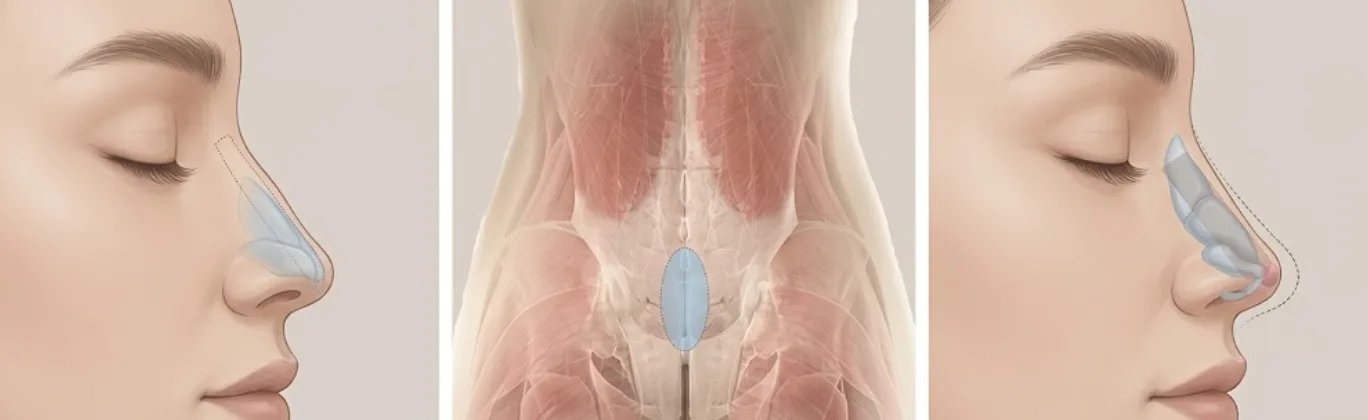
Illustration: instead of an implant, the bridge and tip are built from the patient's own tissue, shaped into the nasal framework (blue). The dashed line shows the original contour.
That trade-off is the heart of the scar question. There are two areas to think about: the incisions on the nose itself, and the small donor site at the ear. The septal cartilage for the tip is taken from inside the nose, so it adds no external scar at all. Understanding where each incision sits, and how visible it really is, removes most of the worry that the word "donor site" tends to create.
Every surgery leaves some mark, and no operation is scar-free. The realistic goal is incisions placed where the eye does not look, which fade to the point of being difficult to find. That is achievable in implant-free rhinoplasty, and the rest of this page explains why. For the bigger picture of how the procedure works, the parent implant-free rhinoplasty page covers technique and candidacy.
Nose incisions
Where the nose incisions are: closed vs open
The nose can be approached two ways, and the choice decides whether there is any external nose scar at all. In a closed (endonasal) approach, every incision is made inside the nostrils. Once healed, there is nothing visible on the outside of the nose. The scars are tucked up inside the nasal lining where no one, including you in the mirror, will see them. Many implant-free cases that focus on the bridge can be done this way.
An open approach adds one small incision across the columella, the thin strip of skin between the nostrils, so the surgeon can lift the skin and place cartilage with direct vision. This is often chosen when the tip needs precise reshaping with septal cartilage. The columella scar is genuinely small, a few millimetres, and sits underneath the nose where light does not fall on it. In most patients it matures into a faint line that is hard to spot at conversational distance. The incision used is decided case by case; the parent cell explains why Garnet records the nose sutures as coming out at around seven days.
Whichever approach is used, the nose incisions are not the part most patients end up worrying about. They are either fully hidden or reduced to a faint columellar line. The donor site at the ear is the one that surprises people, so it deserves its own section. You can see how this fits the wider recovery arc on the implant-free rhinoplasty recovery timeline.
Ear donor
The ear donor scar is smaller than people expect
To build the bridge, a small piece of cartilage is taken from the bowl of the ear (the conchal cartilage). The incision to reach it is placed in a natural crease, either tucked behind the ear where it meets the head or inside the bowl of the ear itself. Both locations are chosen precisely because they fall in shadow and folds, where a healed line is very difficult to see. Importantly, only cartilage is borrowed; the shape and projection of your ear are not changed, because cartilage is removed from a flat reserve area that does not support the ear's outline.
The donor incision is closed with sutures that, in Garnet's records, come out at around 10 days, a little longer than the nose, because the ear is a mobile area and the surgeon prefers to give it extra support before the stitches are removed. In the first couple of weeks the ear may feel tender, slightly swollen or numb around the incision; this is normal and settles. The numbness, where it occurs, usually fades over weeks to months as small nerves recover.
Set against the benefit, the donor scar is a modest cost: a hidden few-centimetre line in exchange for a bridge made of living tissue with no implant to migrate, become visible through thin skin, or need removal years later. For a fuller comparison of materials, the related rib vs ear-cartilage rhinoplasty page weighs ear, septal and rib cartilage side by side, including their donor sites.
Healing timeline
How implant-free rhinoplasty scars heal over time
Scars do not look finished the moment the stitches come out — they mature over months. In the first weeks the lines can look slightly pink, firm or raised; this is the body laying down collagen and is a normal, temporary stage. It does not mean the scar will stay that way. Over the following months the pinkness fades, the firmness softens, and the line flattens and pales toward your own skin tone. Most of this maturing happens in the first 3 to 6 months, with subtle further improvement out to a year.
The nose incisions and the ear donor site follow the same biology but on slightly different visible timelines. Internal nose incisions are hidden from the start, so there is little to watch. A columella scar, if you had an open approach, is at its most noticeable in the early weeks and then quietly fades. The ear donor line, sitting in a crease, is usually the quickest to disappear from view simply because of where it is. None of this can be rushed, but it is predictable, and knowing the stages stops the early pink phase from causing alarm.
Because the visible result and the scar both keep changing for months, this is exactly the window Garnet's structured follow-ups are built around. Reviews at 1, 3 and 6 months let the same surgeon track how each line is settling and reassure you at the stages where worry is most common. For how the swelling and shape evolve alongside the scars, see the rhinoplasty recovery timeline.
Helping them fade
What helps the scars fade well
Most of scar quality is set by where and how the incision is made, but aftercare in the months that follow makes a real difference at the margins. Keeping the incisions clean and protected early, not picking at scabs, and following the clinic's wound-care instructions all help the lines settle smoothly. Once incisions are fully closed, sun protection matters: ultraviolet light can darken a maturing scar, so shielding the nose and ear from strong sun, or using protection, through the first several months is worth the habit.
Avoiding tension on the healing tissue helps too. For the ear that means being gentle with glasses arms, earphones and sleeping position in the first weeks; for the nose it means following the guidance on glasses, blowing your nose and contact during the early healing period. If a scar looks like it is thickening, raising or staying red longer than expected, that is a reason to tell your surgeon without waiting. Early, simple measures handle most of these, and a single-surgeon clinic makes that conversation straightforward.
No clinic can promise a guaranteed, invisible result for every skin type. Individual healing varies, including a tendency toward firmer scars in some people. The realistic aim is incisions placed to be hidden or faint, supported by good aftercare and reviewed by the surgeon who made them. You can raise your own skin's healing tendencies before you travel in an online consultation.
At Garnet
How Garnet approaches scars and healing
Garnet is a single-surgeon clinic in Apgujeong, Seoul, where Dr. In-Soo Baek, a board-certified plastic surgeon (Korean medical licence no. 77407), performs the operation himself and reviews every follow-up. For implant-free rhinoplasty that means the same surgeon who decides exactly where each nose incision and the ear donor line will sit is also the one who checks, months later, how those lines have matured. Nothing about your scars is handed off between people.
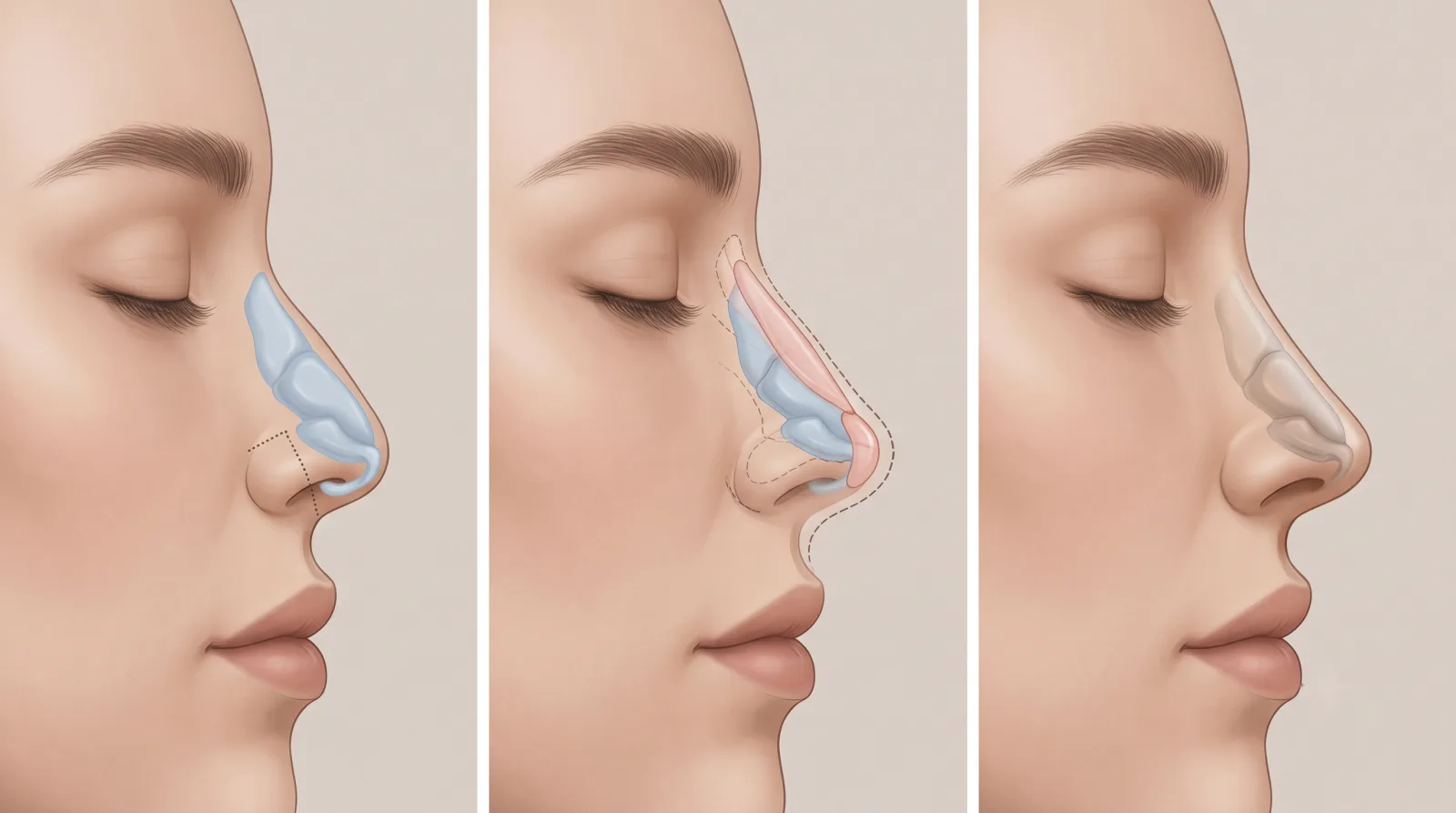
Illustration: the nasal framework (blue) is reshaped to raise the bridge and refine the tip. The dashed outline shows the original contour.
The clinic caps the day at two surgeries, so each case has unhurried time, the kind that careful, well-placed incisions and meticulous closure actually need. Structured reviews at 1, 3 and 6 months mean the scar-maturing window is covered by appointments, and for international patients the same surgeon can continue to check progress by messenger after you fly home, with clear guidance on what is normal at each stage.
If you are weighing implant-free rhinoplasty and the donor-site question is on your mind, the most useful next step is a pre-assessment. You can send photos and ask about incision placement, your skin's likely healing and what your particular case would involve in a no-obligation online assessment, or read the overview on the rhinoplasty cell first.
Dr. In-Soo Baek
Director & sole operating surgeon
Korean medical licence no. 77407
Operate on what you came for. Trained at Korea University Medical Center. Every case planned, performed and reviewed by the same hands.
1Operating surgeon
~2Surgeries per day
7Registered techniques
Board-certified plastic surgeon
Plastic surgery training at Korea University College of Medicine & graduate school
Korean Society of Plastic and Reconstructive Surgeons member, in its facial-contour, eye & rhinoplasty groups
Consults, operates and follows up each case himself
Peer-reviewed papers behind the facts on this page. Each describes findings in its own study group — not results at Garnet — and none predicts your own outcome.
Liang X et al. A systematic review and meta-analysis of comparison between autologous costal cartilage and alloplastic materials in rhinoplasty. Journal of Plastic, Reconstructive & Aesthetic Surgery. 2018. doi:10.1016/j.bjps.2018.03.017
Wee JH et al. Complications Associated With Autologous Rib Cartilage Use in Rhinoplasty. JAMA Facial Plastic Surgery. 2015. doi:10.1001/jamafacial.2014.914
Sajjadian A et al. Current Status of Grafts and Implants in Rhinoplasty: Part I. Autologous Grafts. Plastic and Reconstructive Surgery. 2010. doi:10.1097/prs.0b013e3181c82f12
FAQ
Common questions
Where are the scars after implant-free rhinoplasty?
There are two areas. The nose incisions are either entirely inside the nostrils (closed approach) or include one small line across the columella under the nose (open approach). The cartilage for the bridge is taken from the ear, leaving a small donor incision hidden in a crease behind or inside the ear. Cartilage for the tip comes from inside the nose and leaves no external scar.
Will implant-free rhinoplasty scars be visible?
In most patients they are not noticeable once healed. Internal nose incisions cannot be seen at all; a columella scar, if used, is a few millimetres under the nose and usually fades to a faint line; the ear donor scar sits in a natural fold where it is hard to see. Because healing differs from person to person, no clinic can promise the same nose and ear-crease scars for everyone.
Does taking cartilage from the ear change the shape of my ear?
No. Only a flat reserve of cartilage from the bowl of the ear is borrowed, from an area that does not support the ear's outline, so the ear keeps its shape and projection. There is a small hidden incision to reach the cartilage, but the ear's appearance is not altered.
How long until the ear donor scar heals?
The donor sutures typically come out at around 10 days at Garnet, slightly later than the nose, because the ear is a mobile area. The skin closes in those first weeks, and the line then matures and fades over the following months, helped by it sitting in a natural crease.
When do the nose stitches come out?
Nose sutures are usually removed at around seven days. Internal incisions are hidden from the start; if an open approach was used, the small columella line is most visible in the early weeks and then quietly fades over the following months.
How do implant-free rhinoplasty scars heal over time?
Scars are not finished at suture removal; they mature. They may look slightly pink, firm or raised in the first weeks, then pale, soften and flatten over the following months. Most of this happens in the first 3 to 6 months, with subtle further improvement out to about a year.
What can I do to help the scars fade?
Keep incisions clean and protected, don't pick at scabs, follow the clinic's wound-care guidance, and protect the healed lines from strong sun for the first several months. Being gentle around the ear with glasses and earphones early on also helps. If a scar reddens or thickens longer than expected, tell your surgeon early.
Is the ear donor scar worth it compared to an implant?
That is a personal judgement, but the trade is a small hidden incision in exchange for a bridge built from your own living tissue, with no synthetic implant to migrate, show through thin skin or need removal later. Whether ear cartilage or another material suits you is best decided with the surgeon for your specific nose.
Can I discuss scarring before I travel to Korea?
Yes. You can send photos and ask about incision placement, the donor site and your own skin's healing tendencies in an online consultation before committing to travel, so you understand what your particular case would involve in advance.
Who reviews my scars after I go home?
At Garnet the same board-certified surgeon who performed your operation reviews you at one, three and six months and can continue to check progress by messenger after you return home, with guidance on what is normal at each healing stage.
My mom recently had a brow lift and lower blepharoplasty with Dr. Baek, and our experience has been wonderful so far. The Garnet team was incredibly kind and welcoming, with Kelly assisting us as our English consultant—she made everything…
I’m so happy I chose this clinic for my lower blepharoplasty. I was traveling from abroad by myself, so I was a little nervous, but from the beginning I felt comfortable and truly cared for. Everyone was kind, patient, and professional…
Came in for an in-person consult and ended up choosing Garnet and Dr.Baek for my non-incisional DES and tiplasty/alarplasty. I communicated with Kelly (English consultant) from the start till now (3 weeks post-op). She really help me feel…
My under-eyes have been sagging and folding for years... I tried to cover it up with makeup, but it actually got stuck in the wrinkles and made it stand out even more. While going for consultations, I noticed that the bigger the hospital…
Worried about the donor-site scar in implant-free rhinoplasty? Send photos for a no-obligation pre-assessment and ask exactly where the incisions would sit before you plan a trip.
Send photos and your question before you travel. An English-speaking coordinator reviews every enquiry and replies with plain guidance on whether implant-free rhinoplasty is appropriate for you, the likely plan and timing.
✓ Reviewed by the clinic coordinator, not a bot
✓ Photo-based pre-assessment before you fly
✓ Foreign-patient scheduling & after-care
✓ One surgeon for consultation, surgery and follow-up
Prefer to chat now? Reach the coordinator directly:








 T S7 months ago



