Recovery from an implant-free rhinoplasty has a feature most nose-job timelines miss: because the nose is rebuilt with your own cartilage, there are two areas healing at once: the nose itself and the ear, where donor cartilage is taken. This page walks through both, day by day and then week by week, so you know what is normal, when the sutures come out, when you can work, and how long the final shape takes to arrive.
The short answer
Implant-free rhinoplasty uses your own cartilage (ear cartilage for the dorsum and septal cartilage for the tip), so there are two healing sites, the nose and the ear donor.
At Garnet the nose sutures come out at around day 7 and the ear-donor sutures at around day 10, which shapes the early timeline and any travel plans.
Most visible swelling and bruising eases over the first week to two, but the tip and overall shape keep refining over months.
The same board-certified surgeon who operates reviews your recovery, with structured follow-up at 1, 3 and 6 months, done remotely for international patients.
Most rhinoplasty timelines only describe the nose. An implant-free rhinoplasty is different because it rebuilds the nose with your own tissue and uses no synthetic implant: at Garnet the dorsum (bridge) is built up with ear cartilage and the tip is refined with septal cartilage, so no implant is placed. That approach means a small donor site at the ear in addition to the nose, and a recovery timeline that has to account for both.
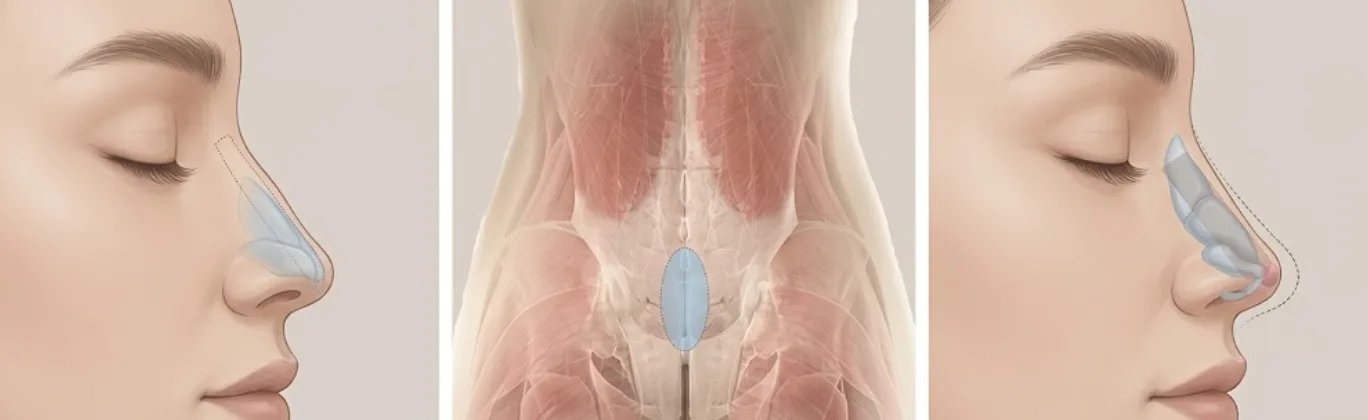
Illustration: instead of an implant, the bridge and tip are built from the patient's own tissue, shaped into the nasal framework (blue). The dashed line shows the original contour.
Practically, the two sites heal on slightly different schedules. The nose sutures are removed at around day 7, while the ear-donor sutures come out at around day 10. The ear site is usually the more straightforward of the two to recover from, a small, well-hidden donor area behind or within the contour of the ear. It does add a second thing to look after in the first week and a half, and it is worth planning your time around the later, day-10 suture removal.
Choosing an implant-free approach is a real decision with trade-offs that go beyond recovery; the comparison of implant-free versus implant rhinoplasty covers why someone chooses cartilage over an implant in the first place.
The first week
Day by day: the first week
Days 1–2: expect the most swelling and a blocked, congested nose, with bruising that often shows around the eyes and settles over the following days. You may have a splint or cast on the nose and dressings at the ear donor site. This is the heaviest stretch. Rest with your head elevated, avoid bending and straining, and follow the cold-compress and care guidance you are given. Discomfort is typically mild, seldom severe, and is managed with the medication provided.
Days 3–6: the worst of the swelling and bruising usually begins to ease, breathing through the nose remains stuffy because of internal swelling, and the ear donor site settles steadily. You will be keeping both areas clean per your instructions and avoiding anything that raises blood pressure in the face. Many people start to feel more themselves by the end of this stretch even though the nose still looks swollen.
Day 7: the nose sutures (and any splint, depending on your case) typically come out around now, which is usually a turning point. The nose feels less encumbered even though significant swelling remains. The ear-donor sutures are not out yet; those come at around day 10. For the broader context of how the procedure itself is performed, see the parent implant-free rhinoplasty page.
Weeks 2–6
Weeks two to six
Around day 10: the ear-donor sutures come out, and with both suture sites resolved the most active early phase is largely behind you. Residual swelling, especially across the bridge and tip, and any lingering faint bruising continue to fade. The ear donor area, being small and concealed, usually quietens quickly once its sutures are out.
Weeks two to four: most people look presentable enough to return to ordinary social life within this window, even though the nose is still subtly swollen, particularly the tip. Nasal breathing keeps improving as internal swelling resolves, though it can remain variable for a while. You can gradually return to light activity on the surgeon's guidance, while still avoiding contact, heavy lifting, straining and anything that risks a knock to the nose.
Weeks four to six: by now the nose is clearly settling toward its new shape, the donor ear is typically well healed, and many normal activities have resumed. The tip, however, is the slowest area to finish. It stays firmer and a little swollen for considerably longer, which is normal and expected with cartilage work. If you want the fuller week-by-week picture for nose surgery generally, the rhinoplasty recovery timeline is a useful companion.
Over months
Months: how the final shape settles
Rhinoplasty is a months-long settling process, not a days-long one, and this is the single most important expectation to set. Over the first few months the bulk of the visible swelling resolves and the shape becomes much more like the final result. But the tip continues to refine for a good deal longer. Final tip definition and the last of the subtle swelling can take many months to a year to fully mature, especially with the patient's own cartilage shaping it.
Because the nose is built from your own ear and septal cartilage, with no implant, the result tends to settle in a natural way as the tissue integrates. The flip side is patience: judging the final result too early, while the tip is still firm and slightly swollen, gives a misleading picture. The structured follow-up reviews exist partly to track exactly this gradual settling.
The ear donor site, by contrast, has essentially finished healing within the first weeks for most people. Once healed, it is small and concealed, and it plays no part in the long settling of the nose tip.
Work and flights
Returning to work and flying
Work: many people with desk-based jobs return within roughly one to two weeks, often after the nose sutures and splint are out and the worst bruising has faded. You may still be visibly swollen, and a fair amount depends on how public-facing your role is and how comfortable you are being seen mid-recovery. Physically demanding or contact-risk work needs longer; do not rush back to anything that could knock the nose or spike facial pressure. Your surgeon will give you a timeline matched to your job and your healing.
Flying: for international patients the practical anchor is suture removal (nose sutures at around day 7 and ear-donor sutures at around day 10), with the surgeon checking your healing in person before you fly. Having both suture sites reviewed before a long flight is the most careful sequence, which is why the stay is usually planned around the later, day-10 point. Our guide on when you can fly after plastic surgery explains the general principles, and the implant-free rhinoplasty for international patients page covers the full travel and remote-follow-up pathway.
As with any face surgery, the surgeon's in-person clearance is the signal that matters more than a fixed calendar date, and a small buffer at the end of the trip is wise so a delayed review does not collide with a booked flight.
Follow-up
Aftercare and follow-up that sees you through
Good aftercare in the early phase protects the result: keep both the nose and the ear donor site clean as instructed, sleep with your head elevated early on, avoid bending, straining and heavy exercise until cleared, keep glasses off the bridge if you are advised to, and protect healing skin from strong sun. Do not poke, press or test the new tip; the cartilage framework needs time to settle undisturbed. Your coordinator gives you specific written instructions for both sites.
At Garnet the same board-certified surgeon who performed your operation reviews your recovery, with structured follow-up at 1, 3 and 6 months, the points at which a rhinoplasty's settling is most usefully tracked. Because the operating surgeon is the one assessing you, the advice comes straight from the person who did the surgery, with no one relaying it second-hand. For international patients these reviews continue remotely by messenger and photos after you return home.
If anything concerns you between reviews (a change in swelling, a question about the donor ear, or how breathing is recovering), you have a clear route to ask. That matters because so much of rhinoplasty recovery unfolds over months at home, long after the days at the clinic.
Dr. In-Soo Baek
Director & sole operating surgeon
Korean medical licence no. 77407
Operate on what you came for. Trained at Korea University Medical Center. Every case planned, performed and reviewed by the same hands.
1Operating surgeon
~2Surgeries per day
7Registered techniques
Board-certified plastic surgeon
Plastic surgery training at Korea University College of Medicine & graduate school
Korean Society of Plastic and Reconstructive Surgeons member, in its facial-contour, eye & rhinoplasty groups
Consults, operates and follows up each case himself
Peer-reviewed papers behind the facts on this page. Each describes findings in its own study group — not results at Garnet — and none predicts your own outcome.
Xiang X et al. The Treatment of Alar Base Depression in Rhinoplasty with Diced Autologous Cartilage or Mass Cartilage: A Systematic Review. Aesthetic Plastic Surgery. 2024. doi:10.1007/s00266-024-04008-y
Liyanage D et al. A Systematic Review and Meta-Analysis of Autologous vs Irradiated Homologous Costal Cartilage Grafts for Dorsal Augmentation Rhinoplasty. Aesthetic Surgery Journal Open Forum. 2024. doi:10.1093/asjof/ojae122
Drake VE et al. Outcomes of Autologous Versus Irradiated Homologous Costal Cartilage Graft in Rhinoplasty. Facial Plastic Surgery & Aesthetic Medicine. 2024. doi:10.1089/fpsam.2023.0334
FAQ
Common questions
How long does implant-free rhinoplasty recovery take?
The early, most visible phase runs about one to two weeks: nose sutures come out around day 7 and the ear-donor sutures around day 10, with most swelling and bruising easing over that window. But full recovery is much longer: the nose keeps refining over months, and final tip definition can take many months to a year as the cartilage settles.
What is implant-free rhinoplasty recovery like day by day?
Days 1–2 are the heaviest, with swelling, congestion and bruising around the eyes. Days 3–6 the worst eases. Around day 7 the nose sutures (and splint) typically come out, which is a turning point. Around day 10 the ear-donor sutures come out. Weeks two to six bring steady settling, though the tip stays firm and slightly swollen far longer than the rest of the nose.
Why are there two healing sites?
Because implant-free rhinoplasty rebuilds the nose with your own cartilage and places no implant. At Garnet the bridge is built with ear cartilage and the tip refined with septal cartilage, so there is a small donor site at the ear in addition to the nose. The two sites heal on slightly different schedules: nose sutures around day 7, ear-donor sutures around day 10.
When can I return to work after implant-free rhinoplasty?
Many people with desk jobs return within roughly one to two weeks, often after the nose sutures and splint are out and the worst bruising has faded, though you may still be visibly swollen. Physically demanding or contact-risk work needs longer, since a knock to the nose or a spike in facial pressure must be avoided. Your surgeon will set a timeline matched to your job and healing.
When do the sutures come out?
At Garnet the nose sutures come out at around day 7 and the ear-donor sutures at around day 10. These two points shape the early timeline and, for international patients, the length of stay. The trip is usually planned so both suture sites can be checked in person before a long flight home.
How long until I see the final result?
Expect a months-long settling process. The bulk of visible swelling resolves over the first few months and the shape becomes much closer to the final result, but the tip is the slowest area. Final tip definition and the last subtle swelling can take many months to a year to fully mature, especially with your own cartilage shaping it. Judging it too early gives a misleading picture.
What aftercare follows implant-free rhinoplasty?
Keep both the nose and ear donor site clean as instructed, sleep with your head elevated early on, avoid bending, straining and heavy exercise until cleared, keep glasses off the bridge if advised, protect healing skin from strong sun, and do not press or test the new tip. Your coordinator provides specific written instructions for both sites, and the surgeon reviews you at 1, 3 and 6 months.
How does the ear donor site recover?
The ear donor area is usually the more straightforward of the two sites: a small, well-concealed area whose sutures come out at around day 10. For most people it quietens quickly once healed and is essentially a closed chapter within the first weeks, unlike the nose tip, which keeps settling over months.
When can I fly home after implant-free rhinoplasty?
The practical anchor is suture removal, with nose sutures around day 7 and ear-donor sutures around day 10, and the surgeon checking your healing in person before a long flight. Having both sites reviewed first is the most careful sequence, so the stay is usually planned around the later, day-10 point, with a small buffer so a delayed review does not collide with a booked flight.
Will the same surgeon follow my recovery?
At Garnet, yes. It is a single-surgeon clinic where the same board-certified surgeon who performs your operation reviews your recovery at 1, 3 and 6 months, so the advice comes directly from the surgeon who operated. For international patients, these reviews continue remotely by messenger and photos after you return home.
My mom recently had a brow lift and lower blepharoplasty with Dr. Baek, and our experience has been wonderful so far. The Garnet team was incredibly kind and welcoming, with Kelly assisting us as our English consultant—she made everything…
I’m so happy I chose this clinic for my lower blepharoplasty. I was traveling from abroad by myself, so I was a little nervous, but from the beginning I felt comfortable and truly cared for. Everyone was kind, patient, and professional…
Came in for an in-person consult and ended up choosing Garnet and Dr.Baek for my non-incisional DES and tiplasty/alarplasty. I communicated with Kelly (English consultant) from the start till now (3 weeks post-op). She really help me feel…
My under-eyes have been sagging and folding for years... I tried to cover it up with makeup, but it actually got stuck in the wrinkles and made it stand out even more. While going for consultations, I noticed that the bigger the hospital…
Planning an implant-free rhinoplasty and wondering how recovery would fit your schedule? Send nose photos for a no-obligation assessment, and we'll map out the timeline, including the ear donor site and follow-up, before you plan anything.
Send photos and your question before you travel. An English-speaking coordinator reviews every enquiry and replies with guidance on whether surgery is appropriate, the likely plan and timing.
✓ Reviewed by the clinic coordinator, not a bot
✓ Photo-based pre-assessment before you fly
✓ Foreign-patient scheduling & after-care
✓ One surgeon for consultation, surgery and follow-up
Prefer to chat now? Reach the coordinator directly:









 T S7 months ago



