An implant-free rhinoplasty rebuilds the nose bridge from your own ear cartilage, so a trip to Korea for it means 2 areas to heal: the nose and a small ear donor site. That second site shapes how long you stay and how you plan the trip safely from abroad. The rest is logistics, and good logistics start with an online consultation before you book a flight.
The short answer
Most international patients plan for roughly a 10-day stay, so both the nose sutures (~day 7) and the ear donor site (~day 10) can be removed before you fly home.
An online consultation lets you send photos and discuss the plan in detail from abroad, before you commit to travelling.
Because the bridge is rebuilt from your own ear cartilage, there is a small donor site behind the ear to look after as well as the nose.
After you return home, the same surgeon can review your recovery remotely, with structured follow-up at 1, 3 and 6 months.
The sensible first step is an online consultation, before any flight. You send clear photos of your nose (and, ideally, any records from a previous surgery), describe what you would like to change, and get a realistic view of what an implant-free approach can do for you before you spend anything on travel. For this procedure that includes confirming you are a candidate for a bridge rebuilt from your own ear cartilage and a septal-cartilage tip, with no implant.
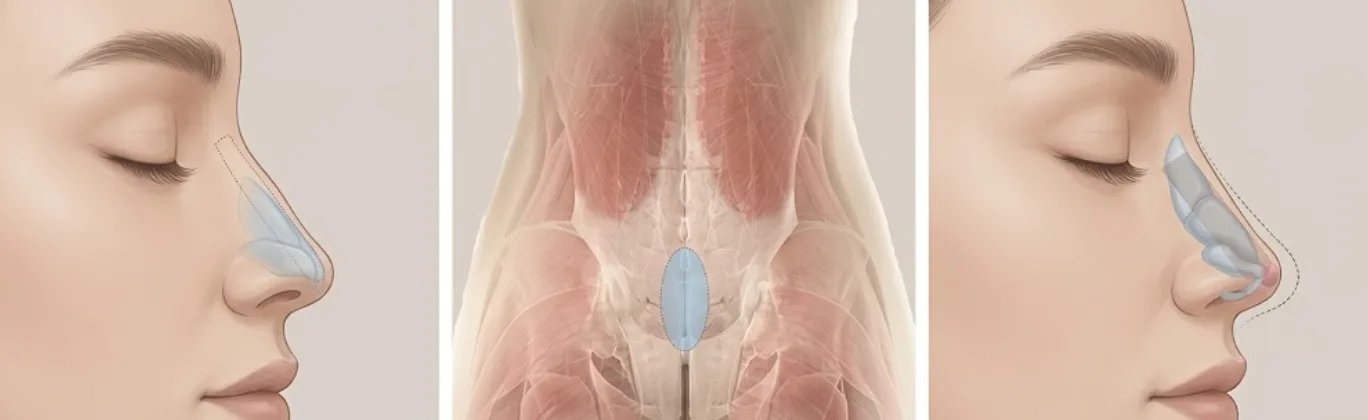
Illustration: instead of an implant, the bridge and tip are built from the patient's own tissue, shaped into the nasal framework (blue). The dashed line shows the original contour.
A good online assessment is candid and free of sales pressure. It should tell you what is achievable, what the recovery involves (including the ear donor site) and how long you would need to stay, so you can plan with real numbers. The mechanics of how this works from abroad are covered at online consultation from abroad; the key point is that you can resolve the big questions before committing to a trip.
Doing this first also lets you confirm the things that matter most for safety from a distance: that the surgeon is a board-certified plastic surgeon, that the same surgeon will perform your whole operation, and how follow-up works once you return home. If a clinic cannot answer those clearly online, that is useful information before you book anything.
How long to stay
How long to stay in Korea for an implant-free rhinoplasty
The length of stay for an implant-free rhinoplasty is driven by suture removal, and this is where it differs from some other nose surgery. There are two areas to heal: the nose, whose sutures are typically removed around day 7, and the ear donor site where cartilage is taken, whose sutures come out around day 10. Because the ear is the later of the two, planning your stay around the ear donor site is what keeps you from flying home with sutures still in.
In practice, most international patients plan for roughly a 10-day stay: arrive a day or two before surgery for the in-person consultation and any checks, have the operation, recover locally through the early swelling, return for nose suture removal around day 7, and then have the ear sutures removed around day 10 before flying home. Building in a small buffer for rest and any review appointments is wiser than booking the tightest possible window.
If you are comparing this to other procedures or want the general logic of trip length, the guide at how long to stay in Korea for surgery is a useful companion. For an implant-free nose, the trip is planned around the ear donor site as well as the nose.
In Seoul
What your time in Seoul looks like
Your trip begins with an in-person consultation, even if you have already done an online one. This is where the surgeon examines your nose directly, confirms the plan and the use of your own ear and septal cartilage, and answers any remaining questions before surgery. Garnet does not charge a consultation or CT fee and does not pressure you to book the same day, so there is room to ask everything you need.
The surgery itself is done under sedation or general anaesthesia, so you are unaware of it. Afterwards you recover at your accommodation through the first days of swelling and congestion. Most patients describe pressure more than sharp pain. You return to the clinic for nose suture removal around day 7 and the ear donor site around day 10. Between appointments, gentle rest, keeping your head elevated and avoiding heat and exertion all help. The practicalities of recovering in the city, from where to stay to what to expect, are covered at recovering in Seoul after surgery.
Garnet is in Apgujeong, a five-minute walk from Apgujeong Station, which makes the back-and-forth for suture removal straightforward. A dedicated coordinator stays with you from consultation through recovery, which removes a lot of the friction of navigating appointments and aftercare in a country you do not live in.
Follow-up
Follow-up after you fly home
Recovery does not end when you board the plane, and a good clinic plans for that. After both sets of sutures are out and you have flown home, the deeper swelling, especially around the bridge and tip, continues to settle over weeks and months. This is the part international patients most need reassurance about, because they are no longer in the room with their surgeon.
At a single-surgeon clinic the operating surgeon can continue to review your recovery remotely. You can send photos and updates and get answers from the person who actually did your surgery and knows how your ear cartilage graft was placed. Garnet structures this as follow-up at 1, 3 and 6 months, with the same surgeon throughout, so the milestones of healing are tracked properly even from abroad.
Before you travel, it is worth confirming exactly how this remote follow-up works and who manages any concern after you are home. This is one of the most important questions for any international nose patient, and it is best settled during your online consultation before you travel.
Planning
Planning the trip with confidence
Beyond the medical plan, a smooth implant-free rhinoplasty trip comes down to a few practical decisions: booking a stay long enough to clear the ear donor site, choosing accommodation near the clinic to make suture-removal visits easy, and timing your flight home for after day 10. Avoiding tight connections and very long-haul return flights in the first days is sensible, and the guide at when can I fly after plastic surgery covers the timing in more detail.
It also helps to sort the boring-but-important things early: how payment works as a foreign patient, what documents you may want, and who your point of contact is throughout. A clinic registered with Korea's foreign-patient programme is set up to coordinate exactly these details, which is one less thing to improvise once you arrive.
The single best way to plan with confidence is to front-load the questions. Resolve candidacy, stay length, recovery and follow-up in an online consultation, and the trip itself becomes logistics. You are then travelling to confirm a plan you already understand, with candidacy for the ear-cartilage bridge already settled.
At Garnet
How Garnet supports international patients
At Garnet, a single-surgeon clinic in Apgujeong, Seoul, the implant-free nose is operated by Dr. In-Soo Baek, a board-certified plastic surgeon (Korean medical licence no. 77407) and the only operating doctor. He consults, performs the operation himself and reviews every follow-up, so an international patient deals with one surgeon from the first online photo of the nose to the six-month review. The clinic caps the day at 2 surgeries, one patient at a time, which leaves time for an unhurried assessment.
For an implant-free rhinoplasty specifically, that continuity covers both healing areas: the same surgeon who harvests and shapes your ear cartilage is the one checking how the nose and the ear donor site settle. A dedicated coordinator stays with you from consultation through recovery, and there is no consultation or CT fee and no pressure to book same day. That matters when you have travelled a long way to be there.
Garnet is registered with Korea's foreign-patient programme and supports the whole journey: an online assessment first, an in-person plan, surgery, suture removal around day 7 for the nose and day 10 for the ear, and structured remote follow-up at 1, 3 and 6 months. The procedure itself is explained in full at implant-free rhinoplasty, and you can begin with a no-obligation online assessment whenever you are ready.
Dr. In-Soo Baek
Director & sole operating surgeon
Korean medical licence no. 77407
Operate on what you came for. Trained at Korea University Medical Center. Every case planned, performed and reviewed by the same hands.
1Operating surgeon
~2Surgeries per day
7Registered techniques
Board-certified plastic surgeon
Plastic surgery training at Korea University College of Medicine & graduate school
Korean Society of Plastic and Reconstructive Surgeons member, in its facial-contour, eye & rhinoplasty groups
Consults, operates and follows up each case himself
Peer-reviewed papers behind the facts on this page. Each describes findings in its own study group — not results at Garnet — and none predicts your own outcome.
McGuire C et al. Prevention of Autologous Costal Cartilage Graft Warping in Secondary Rhinoplasty. Journal of Craniofacial Surgery. 2020. doi:10.1097/scs.0000000000006429
Alkaelani MT et al. Complications of Medical Tourism in Aesthetic Surgery. Annals of Plastic Surgery. 2023. doi:10.1097/sap.0000000000003683
Vila PM et al. Comparison of Autologous vs Homologous Costal Cartilage Grafts in Dorsal Augmentation Rhinoplasty. JAMA Otolaryngology–Head & Neck Surgery. 2020. doi:10.1001/jamaoto.2019.4787
Vaccari S et al. Literature Review: Venous Thromboembolism Prophylaxis in Plastic Surgery. Aesthetic Plastic Surgery. 2023. doi:10.1007/s00266-023-03508-7
FAQ
Common questions
How do international patients get an implant-free rhinoplasty in Korea?
Usually by starting with an online consultation: you send photos and your history, get a realistic view of candidacy and stay length, then travel for an in-person plan and surgery. Afterwards you stay long enough for suture removal and fly home, with the same surgeon reviewing your recovery remotely at set intervals.
How long should I stay in Korea for an implant-free rhinoplasty?
Most patients plan for roughly a 10-day stay. Because the bridge is rebuilt from your own ear cartilage, there are two areas to heal: the nose sutures come out around day 7 and the ear donor site around day 10. Planning your stay around the later ear site keeps you from flying home with sutures still in.
Why is the stay longer than just the nose suture date?
Because an implant-free nose has a second healing site. Cartilage is taken from behind the ear to rebuild the bridge, and that ear donor site has its own sutures, removed around day 10, a few days after the nose at around day 7. The ear is the later of the two, so it sets the minimum stay.
Can I start with an online consultation from abroad?
Yes, and it is the recommended first step. You can send photos and any previous records, discuss what an implant-free approach can realistically achieve, and confirm candidacy, recovery and stay length before booking travel. It also lets you confirm the surgeon is board-certified and will perform your whole operation.
What does my time in Seoul involve?
An in-person consultation to confirm the plan, the surgery under sedation or general anaesthesia, local recovery through the early swelling, then return visits for nose suture removal around day 7 and ear suture removal around day 10. A dedicated coordinator stays with you throughout, and the clinic is a short walk from Apgujeong Station.
How does follow-up work after I fly home?
At a single-surgeon clinic the operating surgeon can review your recovery remotely: you send photos and updates and get answers from the person who did your surgery. Garnet structures this as follow-up at 1, 3 and 6 months with the same surgeon, so deeper swelling and healing are tracked properly even from abroad.
When can I fly home after the surgery?
After both sets of sutures are out, which is why the stay is planned around the ear donor site at roughly day 10. Flying earlier risks travelling with sutures still in and through the period of most swelling. Timing your return flight for after day 10, and avoiding very tight connections, is the sensible approach.
Does Garnet treat international patients for this procedure?
Yes. Garnet is registered with Korea's foreign-patient programme and coordinates the whole journey (online assessment, in-person plan, surgery, suture removal and remote follow-up) with the same board-certified surgeon throughout and a dedicated coordinator supporting you from consultation to recovery.
Is there a fee just to be assessed before I commit?
Not at Garnet. There is no consultation or CT fee and no pressure to book the same day. You can begin with a no-obligation online assessment from abroad and only travel once you understand the plan, the stay length and how follow-up will work after you return home.
My mom recently had a brow lift and lower blepharoplasty with Dr. Baek, and our experience has been wonderful so far. The Garnet team was incredibly kind and welcoming, with Kelly assisting us as our English consultant—she made everything…
I’m so happy I chose this clinic for my lower blepharoplasty. I was traveling from abroad by myself, so I was a little nervous, but from the beginning I felt comfortable and truly cared for. Everyone was kind, patient, and professional…
Came in for an in-person consult and ended up choosing Garnet and Dr.Baek for my non-incisional DES and tiplasty/alarplasty. I communicated with Kelly (English consultant) from the start till now (3 weeks post-op). She really help me feel…
My under-eyes have been sagging and folding for years... I tried to cover it up with makeup, but it actually got stuck in the wrinkles and made it stand out even more. While going for consultations, I noticed that the bigger the hospital…
Planning an implant-free rhinoplasty trip to Korea? Send photos for a no-obligation online assessment, and we'll map out candidacy, stay length and follow-up before you book a flight.
Send photos and your question before you travel. An English-speaking coordinator reviews every enquiry and replies with guidance on whether surgery is appropriate, the likely plan and timing.
✓ Reviewed by the clinic coordinator, not a bot
✓ Photo-based pre-assessment before you fly
✓ Foreign-patient scheduling & after-care
✓ One surgeon for consultation, surgery and follow-up
Prefer to chat now? Reach the coordinator directly:









 T S7 months ago



