Round eye correction is delicate work on the eyelids and the eye opening, so many patients worry about pain, and most find it far more comfortable than they feared. The eye area is numbed thoroughly, so the procedure itself is not painful, and the discomfort afterwards is usually mild and short-lived. This page explains the anaesthesia typically used, what you feel at each stage, and how comfort is managed, so you can plan with realistic expectations.
The short answer
Round eye correction is typically performed under local anaesthesia, often with light sedation, so the area is fully numbed and the procedure itself is not painful.
What patients mainly feel during surgery is pressure or movement once the eye area is numb; sharp pain is not expected.
Afterwards, discomfort is usually mild (tightness, a gritty or swollen feeling and tenderness), seldom severe pain, and is managed with simple measures.
An unhurried single-surgeon clinic, where the same surgeon operates and follows up, keeps the experience calm and the aftercare consistent.
Round eye correction is, like most eyelid surgery, typically performed under local anaesthesia, often combined with light sedation. The eye area is numbed with local anaesthetic so the tissue the surgeon works on has no sensation, while sedation, where used, keeps you relaxed and drowsy without being fully asleep. This combination is well suited to delicate eyelid work, because it lets the surgeon assess the eye's position and symmetry during the procedure.
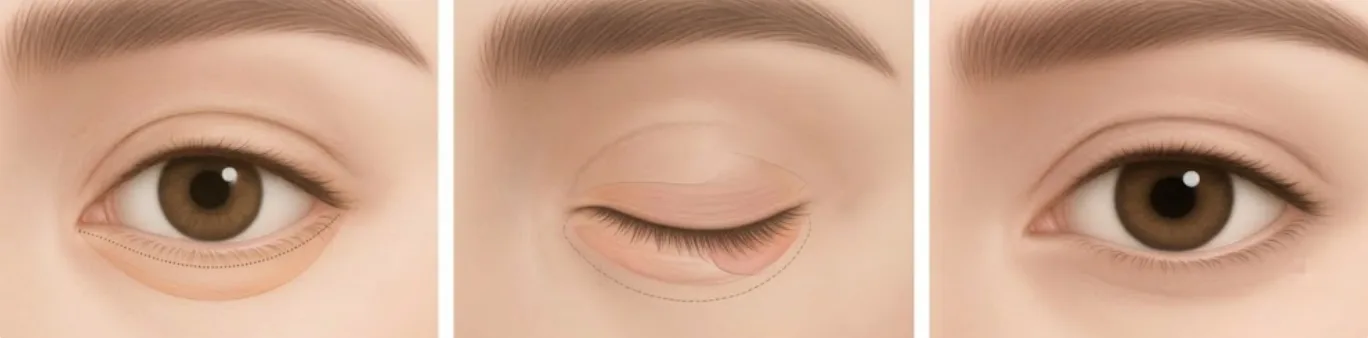
Illustration: the rounded, open lower-lid line is outlined and gently brought back toward a calmer, more natural eye shape.
The exact approach depends on the scope of your case and your own preferences and health. A more involved lower-lid repositioning may be planned slightly differently from a gentle reshaping of the eye opening, and your surgeon explains what is recommended for you. Because the precise plan is individual, this page describes what is typical. The specifics are confirmed in person.
The key point for a nervous patient is that the area is thoroughly numbed before any work begins. You are not expected to feel the surgery. The most common pre-operative worry, that you will feel cutting or stitching around your eye, is exactly what the anaesthesia is there to prevent, and it does so reliably. The candidacy guide covers how your case and health are assessed beforehand.
During surgery
What you feel during round eye correction
The part patients dread most, the procedure itself, is usually the least uncomfortable, because the eye area is numb. The one moment you may notice is the local anaesthetic going in at the start, a brief stinging or pinching sensation as the area is numbed, lasting seconds. Many people describe it as the only genuinely uncomfortable moment of the whole experience, and it passes quickly.
Once the area is numb, what you feel is pressure, touch or movement, without pain. You may sense the surgeon working, or a feeling of the lid being adjusted, but without the sharpness you might imagine. With light sedation, even this awareness is softened and time tends to pass quickly. If at any point you felt discomfort, the team can add more numbing. You are not expected to endure anything.
Because the surgeon is reshaping the eye opening and, in many cases, repositioning the lower-lid margin, being comfortable and still helps the precise, unhurried work this area needs. That is one reason an environment that is calm and not rushed matters as much as the anaesthetic itself, which the section on a single-surgeon clinic below picks up.
Afterwards
How much discomfort there is afterwards
Once the anaesthetic wears off, most patients are surprised by how manageable the discomfort is. Severe pain is unusual; the typical experience is mild tightness, a gritty or swollen feeling, tenderness around the lower lid, and some bruising and swelling. The eye may feel tight or slightly dry as it settles, and watering or sensitivity to light for a short while is normal. For most people this is discomfort more than pain, and it eases over the first several days.
The first day or two tend to be the peak, after which swelling and tenderness steadily subside. Sutures around the eye are typically removed within about a week, and many patients find the sensation improves noticeably once they are out. Because the lower-lid position settles over the following weeks, you may feel mild tightness for longer than you have actual pain. This is a normal part of healing.
Everyone heals at a slightly different pace, and a more involved lower-lid case may feel tighter for a little longer than a gentle reshaping. What matters is knowing what is normal and what is not: pain that is getting worse, or any change in vision, is not expected and should prompt contact with the clinic. The cost guide explains why follow-up that covers this settling period is part of proper care.
Managing comfort
How discomfort after round eye correction is managed
Comfort after round eye correction is managed with simple, effective measures. Cold compresses in the early days reduce swelling and soothe the area, keeping the head elevated helps swelling drain, and any prescribed medication manages discomfort; most patients need only mild pain relief, if any. Resting the eyes, avoiding strain and following the aftercare instructions you are given do most of the work.
Equally important is knowing whom to ask. Clear aftercare guidance (what to expect each day, what is normal, and when to make contact) turns uncertainty into reassurance, which is a large part of how comfortable recovery feels. At Garnet the same surgeon who operated reviews your recovery, with structured follow-ups at 1, 3 and 6 months, so questions go to the person who knows your case. There is no rotating team.
For international patients, that continuity does not end at the airport: those follow-up reviews can continue by messenger after you fly home, so you are not left guessing about a gritty feeling or lingering tightness once you have travelled. Planning the trip so you are still in Seoul for suture removal and the first review is covered in the guide on how long to stay in Korea.
Why people worry
Why people worry more than they need to
A lot of pre-operative fear comes from imagining surgery around the eyes without anaesthetic, picturing the sensation of being awake while delicate work happens on such a sensitive area. In reality the area is fully numbed, light sedation softens awareness, and the procedure itself is not the painful part. The anticipation is almost always worse than the experience.
It also helps to separate discomfort from pain. The tightness, grittiness, swelling and tenderness of the first days are real but mild, and they are signs of normal healing. Knowing in advance that this is expected, and temporary, removes much of the anxiety, because you are no longer interpreting every normal sensation as a warning.
Finally, an unhurried consultation does a great deal to settle nerves. When a board-certified plastic surgeon explains what you will feel at each stage, what is normal afterwards, and how anything will be handled, the unknowns shrink. You can have exactly this conversation before you travel through an online consultation, which is often when the worry eases most.
At Garnet
Comfort at a single-surgeon clinic
How a clinic is run affects how comfortable the whole experience feels, not just the anaesthetic. Garnet is a single-surgeon clinic in Apgujeong, Seoul, where Dr. In-Soo Baek, a board-certified plastic surgeon (Korean medical licence no. 77407), personally handles consultation, surgery and follow-up. The day is deliberately capped at two surgeries, with one patient per hour, so your case is unhurried and the delicate, precise work the eye area needs is never rushed.
That continuity matters for comfort because the same surgeon who numbs and operates is the one who reviews your healing and answers your questions afterwards. There is no handoff between the person who did the surgery and the person managing your recovery, which removes a common source of anxiety. A dedicated coordinator also stays with you from consultation through recovery, so practical worries are handled too.
None of this is a promise that you will feel nothing; that would be misleading. The experience is built to be calm, thoroughly numbed and well supported: the area is numbed properly, the work is unhurried, and the discomfort afterwards is mild and looked after by the surgeon who knows your case. You can begin with a no-obligation online assessment to talk through exactly what to expect.
Dr. In-Soo Baek
Director & sole operating surgeon
Korean medical licence no. 77407
Operate on what you came for. Trained at Korea University Medical Center. Every case planned, performed and reviewed by the same hands.
1Operating surgeon
~2Surgeries per day
7Registered techniques
Board-certified plastic surgeon
Plastic surgery training at Korea University College of Medicine & graduate school
Korean Society of Plastic and Reconstructive Surgeons member, in its facial-contour, eye & rhinoplasty groups
Consults, operates and follows up each case himself
Peer-reviewed papers behind the facts on this page. Each describes findings in its own study group — not results at Garnet — and none predicts your own outcome.
Yapa S et al. Lower Eyelid Transcutaneous Blepharoplasty, Minimizing Complications and Correction of Lower Eyelid Malposition. Facial Plastic Surgery. 2022. doi:10.1055/a-1973-7656
Rohrich RJ et al. Preventing Lateral Canthal Malposition in Modern Blepharoplasty. Plastic & Reconstructive Surgery. 2020. doi:10.1097/prs.0000000000006468
Hahn S et al. Lower Lid Malposition. Facial Plastic Surgery Clinics of North America. 2016. doi:10.1016/j.fsc.2015.12.006
FAQ
Common questions
Is round eye correction painful?
For most patients, no; it is far more comfortable than feared. The eye area is fully numbed with local anaesthesia, often with light sedation, so the procedure itself is not painful; you feel pressure or movement without sharp pain. Afterwards the discomfort is usually mild (tightness, a gritty feeling, swelling and tenderness), seldom severe pain, and it eases over the first several days.
What anaesthesia is used for round eye correction?
It is typically performed under local anaesthesia, often combined with light sedation, so the eye area is numbed while you stay relaxed and drowsy but not fully asleep. This suits delicate eyelid work because the surgeon can assess the eye's position and symmetry during the procedure. The exact approach is decided at consultation based on the scope of your case, your health and your preferences.
Will I feel the surgery?
You are not expected to feel the surgery itself, because the area is thoroughly numbed before any work begins. The one sensation you may notice is the local anaesthetic going in at the start, a brief stinging or pinching that lasts seconds. After that you feel pressure, touch or movement without pain, and with light sedation even that awareness is softened. More numbing can be added if needed.
How much does it hurt afterwards?
Usually much less than people expect. The typical experience is mild tightness, a gritty or swollen feeling, tenderness around the lower lid, and some bruising and swelling; severe pain is unusual. The first day or two are the peak, then it steadily settles. Most patients need only mild pain relief, if any, and find things improve noticeably once the sutures are removed within about a week.
How is the discomfort managed?
With simple measures: cold compresses in the early days, keeping the head elevated to help swelling drain, resting the eyes, and any prescribed medication for discomfort. Clear aftercare guidance about what is normal and when to make contact is just as important. At Garnet the same surgeon who operated reviews your recovery at 1, 3 and 6 months, so questions go to the person who knows your case.
How long does the discomfort last?
The mild discomfort is usually concentrated in the first several days, peaking around the first day or two and then steadily easing. Sutures are typically removed within about a week, which often improves the sensation. You may notice mild tightness for a few weeks as the lower-lid position settles, but this is a normal part of healing and not pain. Everyone's pace differs slightly.
Is a lower-lid repositioning more uncomfortable than a simple reshaping?
A more involved lower-lid case can feel a little tighter and take slightly longer to settle than a gentle reshaping of the eye opening, but for most patients it is still discomfort and not severe pain, and it is managed the same way. The surgeon explains what to expect for your specific case, since the scope of the lower-lid work, and therefore the recovery feel, is individual.
When should discomfort prompt me to contact the clinic?
Healing discomfort should steadily decrease. Pain that keeps worsening, spreading redness, or any change in your vision is not expected and should prompt contact with the clinic. At a single-surgeon clinic the operating surgeon manages this, and for international patients those reviews can continue by messenger after you fly home, so you always have someone who knows your case to ask.
Can I ask about round eye correction pain and anaesthesia before I travel?
Yes. You can discuss the anaesthesia plan, what you will feel at each stage, and how discomfort is managed in an online consultation before committing to travel. A frank conversation about exactly what to expect is often when pre-operative worry eases most. At Garnet there is no consultation or CT fee and no pressure to book the same day.
My mom recently had a brow lift and lower blepharoplasty with Dr. Baek, and our experience has been wonderful so far. The Garnet team was incredibly kind and welcoming, with Kelly assisting us as our English consultant—she made everything…
I’m so happy I chose this clinic for my lower blepharoplasty. I was traveling from abroad by myself, so I was a little nervous, but from the beginning I felt comfortable and truly cared for. Everyone was kind, patient, and professional…
Came in for an in-person consult and ended up choosing Garnet and Dr.Baek for my non-incisional DES and tiplasty/alarplasty. I communicated with Kelly (English consultant) from the start till now (3 weeks post-op). She really help me feel…
My under-eyes have been sagging and folding for years... I tried to cover it up with makeup, but it actually got stuck in the wrinkles and made it stand out even more. While going for consultations, I noticed that the bigger the hospital…
Worried about pain or anaesthesia? Send photos for a no-obligation pre-assessment and talk through exactly what to expect. There is no consultation or CT fee, and no pressure to book the same day.
Send photos and your question before you travel. An English-speaking coordinator reviews every enquiry and replies with plain guidance on whether round eye correction is appropriate for your eyes, the likely plan and timing.
✓ Reviewed by the clinic coordinator, not a bot
✓ Photo-based pre-assessment before you fly
✓ Foreign-patient scheduling & after-care
✓ One surgeon for consultation, surgery and follow-up
Prefer to chat now? Reach the coordinator directly:









 T S7 months ago



