It is natural to want to know when your eyes will look their finest after round eye correction. You will see a meaningful change quite early, but the final, settled outer-corner shape takes months to emerge as swelling resolves and the tissues relax into their new position. This page sets out a realistic timeline of the first days, weeks and months, so you judge your result at the right time and not at its most swollen, least representative moment.
The short answer
Early swelling and bruising around the eyes are most noticeable in the first days, then subside markedly over the first couple of weeks. This is not your final result.
Round eye correction reshapes the outer corner and lower lid, and that shape keeps refining for months as swelling fully resolves and tissues settle.
Most people consider the look broadly settled by several months, with subtle final refinement continuing toward around the one-year mark.
A structured review at one, three and six months with the same surgeon lets you track settling at each stage, beyond the swollen early weeks.
The first days: swelling, bruising and an early glimpse
In the first few days after round eye correction, your eyes will be swollen and likely bruised, and this is the least representative your result will ever look. The lower lid and outer corner are delicate areas with a generous blood supply, so visible swelling early on is expected. Cold compresses, head-elevated rest and following your aftercare keep this phase as comfortable and short as possible, as covered in more detail in our recovery timeline.
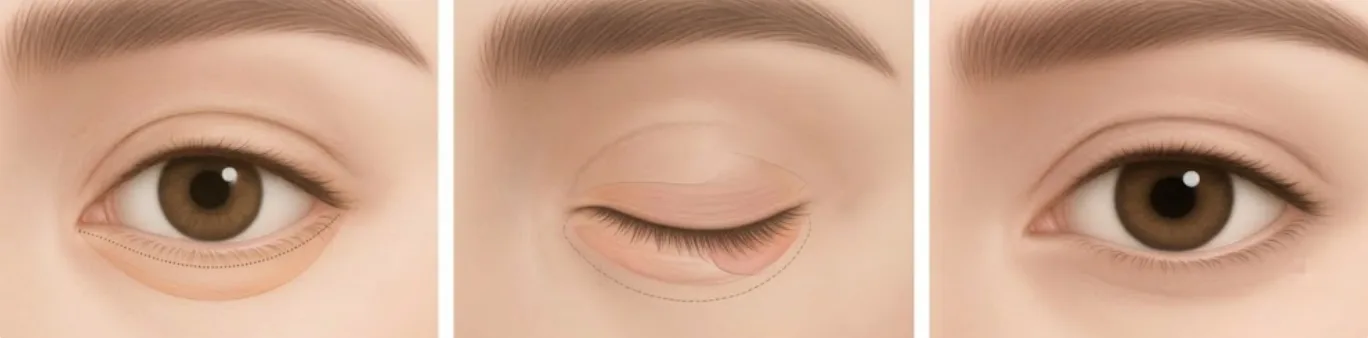
Illustration: the rounded, open lower-lid line is outlined and gently brought back toward a calmer, more natural eye shape.
Through the first week you will usually see the most dramatic day-to-day improvement, as the early swelling begins to come down and bruising starts to fade. For the eye area, external sutures are commonly removed within roughly this first week, which itself makes the eyes look tidier. Many patients catch an encouraging early glimpse of the new outer-corner shape at this point, though it is still sitting on a foundation of residual swelling.
The most useful mindset for this stage is to expect change. The eye you see in the mirror in week 1 is a swollen, healing eye that is improving fast, and the settled shape comes later. Treating early appearance as the final outcome is the most common reason patients worry unnecessarily.
Weeks 2-6
Weeks two to six: the swelling that you can see goes down
Across the second to sixth weeks, the swelling that other people would notice continues to subside, and you start to look like yourself again in everyday situations. For many patients this is the window in which they feel comfortable returning to normal social life and, for international patients, when they have usually already flown home with the more visible swelling behind them. Our page for international patients explains how this maps onto a typical trip.
What is important to understand is that 'most of the obvious swelling has gone' is not the same as 'fully settled'. A degree of deeper, subtler swelling persists well beyond this point, particularly around the lower lid and outer corner, and it is exactly this residual swelling that keeps the final shape from being fully visible yet. The outer corner can still look a little tighter or higher than it eventually will.
Any healing incision lines are also still maturing during this window, typically looking their pinkest before they begin to fade, as described in our guide to scars and healing. So while you will look good enough for normal life, this is not yet the moment to make a final judgement on the shape or the scars.
Months 1-6
Months one to six: the shape refines
From roughly one to six months, the changes become more subtle but they are real. The remaining deep swelling continues to resolve, the lower-lid support relaxes and settles, and the outer-corner shape gradually refines toward its final form. Round eye correction and lower-lid retraction correction are specifically about that shape and support, so this slower settling phase is where the considered result genuinely emerges.
Because the change in this period is gradual, patients sometimes feel their eyes look 'the same' from week to week, then notice on comparing photos a month or two apart that the shape has clearly refined. This is why a clinic that reviews you at set intervals, with earlier photos to compare against, is so useful for judging progress. Structured reviews at one, three and six months are designed around exactly this timescale.
Most people consider the result broadly settled somewhere in this window, with the eyes looking natural and balanced, even though the very last refinement is still to come. The overall result also depends on your starting anatomy and the surgical plan, which is why a careful assessment at the outset, ideally via an online consultation, sets realistic expectations for what your particular outcome will look like.
Truly settled
When round eye correction is truly final
As a general guide, the result of round eye correction is usually considered close to final by around the six-month mark, with the last, very subtle settling and the full fading of any incision lines continuing toward roughly a year. By then the deep swelling has fully resolved, the lower lid and outer corner have settled into their lasting position, and what you see is the considered, finished outcome.
This long horizon is also why a sensible surgeon will advise patience before considering any revision. Most concerns that feel pressing at a few weeks (slight asymmetry, an outer corner that looks a touch tight, a firm or pink line) resolve on their own as healing completes. Judging too early risks reacting to swelling instead of the real result.
If a revision genuinely is appropriate, it is best assessed once everything has settled and by the original surgeon, who has your records and remembers your anatomy. Our companion page on the recovery timeline covers the practical milestones along the way; this page is about how the appearance of the outer corner and lower lid settles.
Judging fairly
How to judge your result fairly
The single most helpful habit is to compare like with like over time; a mirror on a swollen morning misleads. Standardised photos (same lighting, same angle, eyes relaxed and looking straight ahead) taken at intervals give you a reliable record of how the shape is refining, far more reliably than day-to-day impressions, which are coloured by tiredness, lighting and fluid shifts.
It also helps to remember what round eye correction is designed to achieve: a natural, balanced eye shape that still looks like you. Garnet's own concept, 'younger, but still yourself', reflects that aesthetic, and a result judged against that goal at the right time is far more satisfying than one judged against an unrealistic early hope.
Finally, lean on your surgeon for reassurance about your specific healing; the internet does not know your eyes. The reviews at one, three and six months exist precisely so that the person who knows your case can tell you whether what you are seeing is normal settling, which it usually is. How that continuing relationship works is described in our guide to single-surgeon care.
At Garnet
How Garnet tracks your round eye correction result
At Garnet, round eye correction, including lower-lid retraction correction, is performed by Dr. In-Soo Baek, a board-certified plastic surgeon (Korean medical licence no. 77407) and the clinic's only operating doctor. Because the same surgeon consults, operates and reviews every follow-up, the person tracking how your result settles is the person who planned and performed it, so the assessment of your progress stays consistent.
Garnet's structured follow-up at one, three and six months is built around exactly the timescale on which an eye result settles, letting you and the surgeon judge the refining shape at each stage. For international patients these reviews continue by messenger after you fly home, so you are never left guessing about your own healing. Round eye and lower-lid retraction correction are among the surgical methods Garnet has registered as trademarks with the Korean IP Office.
If you want a realistic sense of what your result might look like and how long it will take to settle, the place to start is an assessment of your eyes. You can begin with an online consultation: send photos and get a measured, no-obligation view of what is achievable for your anatomy before committing to anything.
Dr. In-Soo Baek
Director & sole operating surgeon
Korean medical licence no. 77407
Operate on what you came for. Trained at Korea University Medical Center. Every case planned, performed and reviewed by the same hands.
1Operating surgeon
~2Surgeries per day
7Registered techniques
Board-certified plastic surgeon
Plastic surgery training at Korea University College of Medicine & graduate school
Korean Society of Plastic and Reconstructive Surgeons member, in its facial-contour, eye & rhinoplasty groups
Consults, operates and follows up each case himself
Peer-reviewed papers behind the facts on this page. Each describes findings in its own study group — not results at Garnet — and none predicts your own outcome.
Taban M et al. Aesthetic Lateral Canthoplasty. Ophthalmic Plastic & Reconstructive Surgery. 2010. doi:10.1097/iop.0b013e3181baa23f
Glat PM et al. Evolution of the Lateral Canthoplasty: Techniques and Indications. Plastic & Reconstructive Surgery. 1997. doi:10.1097/00006534-199711000-00003
Lassus C. An easy canthoplasty. Aesthetic Plastic Surgery. 1996. doi:10.1007/bf02275533
FAQ
Common questions
When will I see the final results of round eye correction?
You see a meaningful early change within the first weeks, but the final outer-corner shape settles over months. As a general guide the result is usually considered close to final by around six months, with very subtle refinement and full fading of incision lines continuing toward roughly a year.
How does the result of round eye correction change over time?
Early on, obvious swelling and bruising dominate and then subside over the first weeks. From about one to six months, deeper swelling resolves and the lower lid and outer corner refine toward their settled shape. The change becomes more subtle over time but continues, which is why early appearance is not the finished result.
When is swelling gone after round eye correction?
The swelling other people would notice mostly subsides over the first few weeks, but subtler deep swelling around the lower lid and outer corner persists for longer and keeps the final shape from being fully visible. It generally continues to resolve over several months until the result settles.
Why does my outer corner look tight or high early on?
Residual swelling and the freshly adjusted tissues can make the outer corner look tighter or higher than it eventually will. This commonly relaxes and settles as deep swelling resolves over the months that follow, which is why surgeons advise judging the shape after the early weeks.
When can I judge whether I need a revision?
Not in the early weeks. Most concerns that feel pressing early, such as slight asymmetry or a tight-looking corner, resolve as healing completes over months. A revision, if it is ever appropriate, is best assessed once everything has settled, generally around six months or later, and by the original surgeon.
How can I track my round eye correction results reliably?
Take standardised photos (same lighting, angle, and eyes relaxed looking straight ahead) at intervals, and compare like with like; day-to-day mirror impressions are unreliable. Structured reviews at 1, 3 and 6 months with your surgeon give a clear read on how the shape is refining.
Will both eyes settle at the same rate?
Not always exactly. Mild differences in swelling and settling between the two sides are common in the early weeks and usually even out as healing completes. Persistent, clear asymmetry once everything has settled is worth raising with your surgeon, but early differences are typically just timing.
Does the result look natural or dramatic?
Round eye correction aims for a natural, balanced eye shape that still looks like you, without a dramatic overnight change. Garnet's own concept is 'younger, but still yourself', and judging your result against that realistic goal at the right time is far more satisfying than expecting an immediate transformation.
When can international patients fly home relative to seeing results?
Most international patients fly home after their early in-person review, with the more visible swelling subsiding but the result still settling for months afterward. You will not see the final shape on the plane, and that is normal; follow-up then continues remotely. See our page for international patients for how this fits a trip.
Who reviews how my result settles at Garnet?
Dr. In-Soo Baek, the board-certified plastic surgeon who performs your round eye correction, reviews your result himself at 1, 3 and 6 months, continuing by messenger after you return home. The person tracking your settling is the person who planned and performed the surgery.
My mom recently had a brow lift and lower blepharoplasty with Dr. Baek, and our experience has been wonderful so far. The Garnet team was incredibly kind and welcoming, with Kelly assisting us as our English consultant—she made everything…
I’m so happy I chose this clinic for my lower blepharoplasty. I was traveling from abroad by myself, so I was a little nervous, but from the beginning I felt comfortable and truly cared for. Everyone was kind, patient, and professional…
Came in for an in-person consult and ended up choosing Garnet and Dr.Baek for my non-incisional DES and tiplasty/alarplasty. I communicated with Kelly (English consultant) from the start till now (3 weeks post-op). She really help me feel…
My under-eyes have been sagging and folding for years... I tried to cover it up with makeup, but it actually got stuck in the wrinkles and made it stand out even more. While going for consultations, I noticed that the bigger the hospital…
Want a realistic sense of your result and how long it will take to settle? Send photos for a no-obligation pre-assessment of what's achievable for your eyes.
Send photos and your question before you travel. An English-speaking coordinator reviews every enquiry and replies with guidance on whether surgery is appropriate, the likely plan and timing.
✓ Reviewed by the clinic coordinator, not a bot
✓ Photo-based pre-assessment before you fly
✓ Foreign-patient scheduling & after-care
✓ One surgeon for consultation, surgery and follow-up
Prefer to chat now? Reach the coordinator directly:









 T S7 months ago



