Pain is the question almost every patient asks first, and it is a fair one, because this operation works on two places at once: the nose and the ear, where a small piece of cartilage is taken. You do not feel the surgery itself, and the days afterwards are more about pressure and tightness than sharp pain. The nose and the ear behave differently, though, and it helps to know what each feels like.
The short answer
Ear cartilage rhinoplasty uses cartilage from the bowl of your ear (the conchal area) to shape the nasal tip, so there are two areas to consider: the nose and the ear.
The operation is done under anaesthesia so you feel nothing during it; the real question is comfort in the days afterwards.
Most patients describe the nose as blocked and tight more than painful, and the ear donor site as a tenderness that fades over the first week to 10 days.
At a single-surgeon clinic, the surgeon who plans your anaesthesia and harvest is the one who sees you through recovery, so discomfort is reviewed by the person who knows your case.
What anaesthesia is used for ear cartilage rhinoplasty
Septal and ear-cartilage rhinoplasty is a tip-refining operation that borrows cartilage from your own nasal septum and from the conchal bowl of the ear to build projection and definition. Because two sites are involved, the anaesthesia plan is chosen so that both the nose and the ear are fully numb and you are comfortable throughout. In practice this usually means either deep sedation combined with local anaesthesia, or general anaesthesia, depending on the extent of the work and your own health and preference. The point of either approach is the same: you do not feel the surgery, and you are not aware of the harvest from the ear.
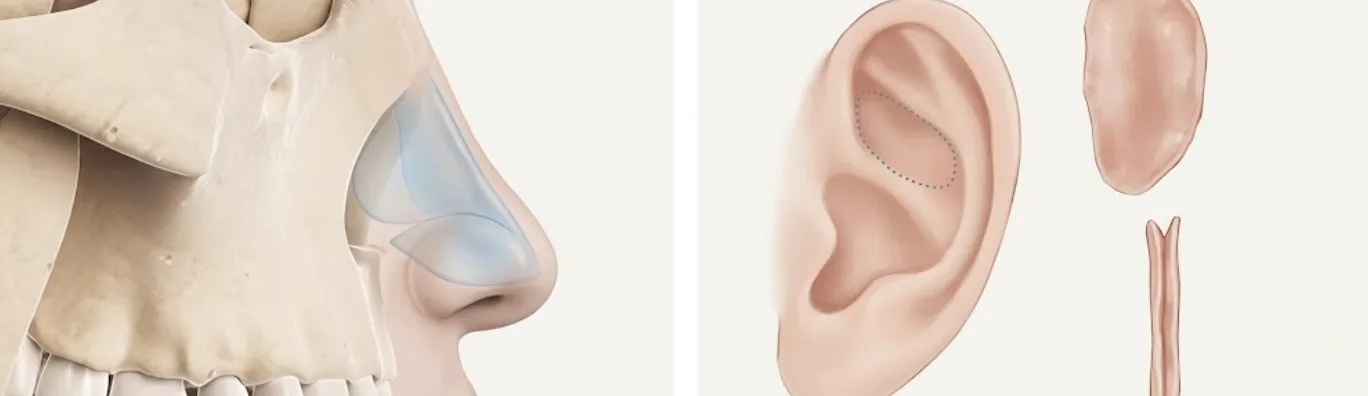
Illustration: two common sources of the patient's own cartilage: the septum inside the nose (blue) and the curved cartilage of the ear.
The choice is a medical one, and it is made together with you. Factors include how much cartilage is needed, whether the septum alone would suffice or the ear is required for the tip, your medical history, and how anxious you feel about being awake. This is exactly the kind of thing worth settling before you travel. You can raise it in an online consultation and have the plan explained in plain terms. For the full overview of the operation itself, see the parent guide on septal and ear-cartilage rhinoplasty.
Whatever is chosen, local anaesthetic is also infiltrated into the nose and around the ear so that the immediate area stays numb into the early recovery period. That is why many patients are surprised by how little they feel in the first hours after waking. The discomfort tends to arrive gradually as the local wears off.
During surgery
What you actually feel during the operation
During the surgery itself you feel nothing. Under sedation you are in a sleep-like state and unaware of time passing; under general anaesthesia you are fully asleep. The cartilage harvest from the ear, taken from the hidden bowl behind the rim so any small scar sits in a natural crease, happens while you are anaesthetised, as does the shaping of the tip. Patients often expect the ear to be the dramatic part and are reassured to learn it is one of the quieter steps of the operation.
What patients describe waking up to is not pain so much as awareness: a packed, blocked nose, a snug splint or cast over the bridge, and a dressing on the ear. There may be a dull, heavy sensation, but rarely anything sharp. Because the same surgeon plans and performs the whole operation at a single-surgeon clinic, the anaesthetic and harvest are tailored to your case, and the surgeon knows precisely what was done to each site when they review you afterwards.
It is worth separating the two ideas of 'awake' and 'in pain'. Modern anaesthesia means you can be comfortably unaware for a procedure that, decades ago, sounded daunting. Put simply, the operation is not the painful part. Recovery is where comfort is managed, and that is very manageable.
Nose afterwards
What the nose feels like afterwards
For most patients the nose is more uncomfortable than painful. The dominant sensations are blockage and pressure: with internal support in place and swelling inside the nasal passages, you breathe through your mouth for the first several days and the bridge feels tight under its splint. There can be a throbbing quality in the first day or two, especially when you bend forward or lie flat, which is why sleeping propped up on pillows helps considerably.
Tenderness concentrates around the tip and bridge, the areas that were reshaped. Touching, smiling widely or wrinkling the nose can feel odd and tender, though not agonising. Bruising and swelling around the eyes and cheeks are common and look worse than they feel. The external splint usually stays on for about a week, and the stitches in the nose are typically removed around 7 days. By the time the splint comes off, the sharp phase is well behind most people.
Numbness of the nasal tip is normal and can last weeks to a few months as the small nerves recover. This is sensation changing and is not nerve damage; it gradually returns. If you want to understand how the whole recovery unfolds beyond comfort alone, the main procedure guide sets out the overall timeline.
Ear donor site
The ear cartilage donor site: the part patients ask about
Because cartilage is taken from the ear, the donor site has its own short recovery, and this is the part that distinguishes ear-cartilage rhinoplasty from work that uses the septum alone. The ear is dressed after surgery and feels tender, slightly swollen and warm for the first few days. Most patients describe it as a soreness when they touch the ear, rest the side of their head on a pillow, or wear glasses or earphones, and not as a constant pain. The conchal bowl loses a small amount of cartilage but keeps its shape, so the ear does not visibly change.
Stitches at the ear are usually removed a little later than the nose, around 10 days, because the donor site benefits from a slightly longer settling period. Until then, it is sensible to sleep on the opposite side, keep the dressing clean and dry, and be gentle when washing your hair. A feeling of tightness or mild numbness around the ear can linger briefly and then resolves.
The reassuring point is that the donor-site discomfort is usually milder than patients fear and shorter than the nose's recovery in terms of sharp sensation. It is a localised tenderness that fades over the first week to 10 days. Your surgeon will tell you exactly how to care for the ear, and at a single-surgeon clinic that same surgeon checks the harvest site at each follow-up.
Managing comfort
Managing comfort, day by day
Comfort is managed with simple, well-established measures. Prescribed pain relief covers the first few days, when discomfort peaks, and most patients step down to milder medication quickly. Keeping your head elevated, applying cool compresses around the eyes and cheeks as advised (never directly on the splint or fresh wounds), staying hydrated and resting all reduce swelling, which in turn reduces the pressure feeling.
The first 48 to 72 hours are the most noticeable, after which comfort improves steadily. The nose's tightness eases as internal swelling settles; the ear's tenderness fades over the first week. Avoiding bending, heavy lifting, alcohol and strenuous activity in the early days keeps blood pressure steady and limits throbbing. Sleeping slightly upright and on the side away from the harvested ear makes the nights easier.
If you are travelling for surgery, plan a calm recovery window and keep the itinerary light, since the comfort plan works most smoothly with rest. For how to structure your stay around both the nose and the ear, see ear cartilage rhinoplasty for international patients, and for the broader picture of healing in the city, recovering in Seoul after surgery.
Red flags
When discomfort isn't part of normal recovery
Most discomfort follows a predictable downward curve, so it helps to know what does not fit that pattern. Pain that suddenly increases after it had been settling is worth reporting. So is pain at the nose or ear accompanied by spreading redness, increasing warmth, swelling that worsens after the first few days, a discharge with odour, or fever. These can suggest the wound needs a review and not just more time.
At the ear specifically, a tense, increasingly swollen and very tender area can occasionally indicate fluid collecting under the skin and should be assessed promptly, as early attention keeps the donor site settling smoothly. None of this is common, but knowing the signals means you can act early without waiting and worrying.
Because the same surgeon who operated reviews your recovery, you have a direct line back to the person who knows exactly what was done. International patients can continue to send photos and questions remotely and be seen again at the structured follow-ups, so concerns about the nose or the ear are answered by your own surgeon. You can also ask all of this upfront in an online consultation before you travel.
Real Results
Before & After
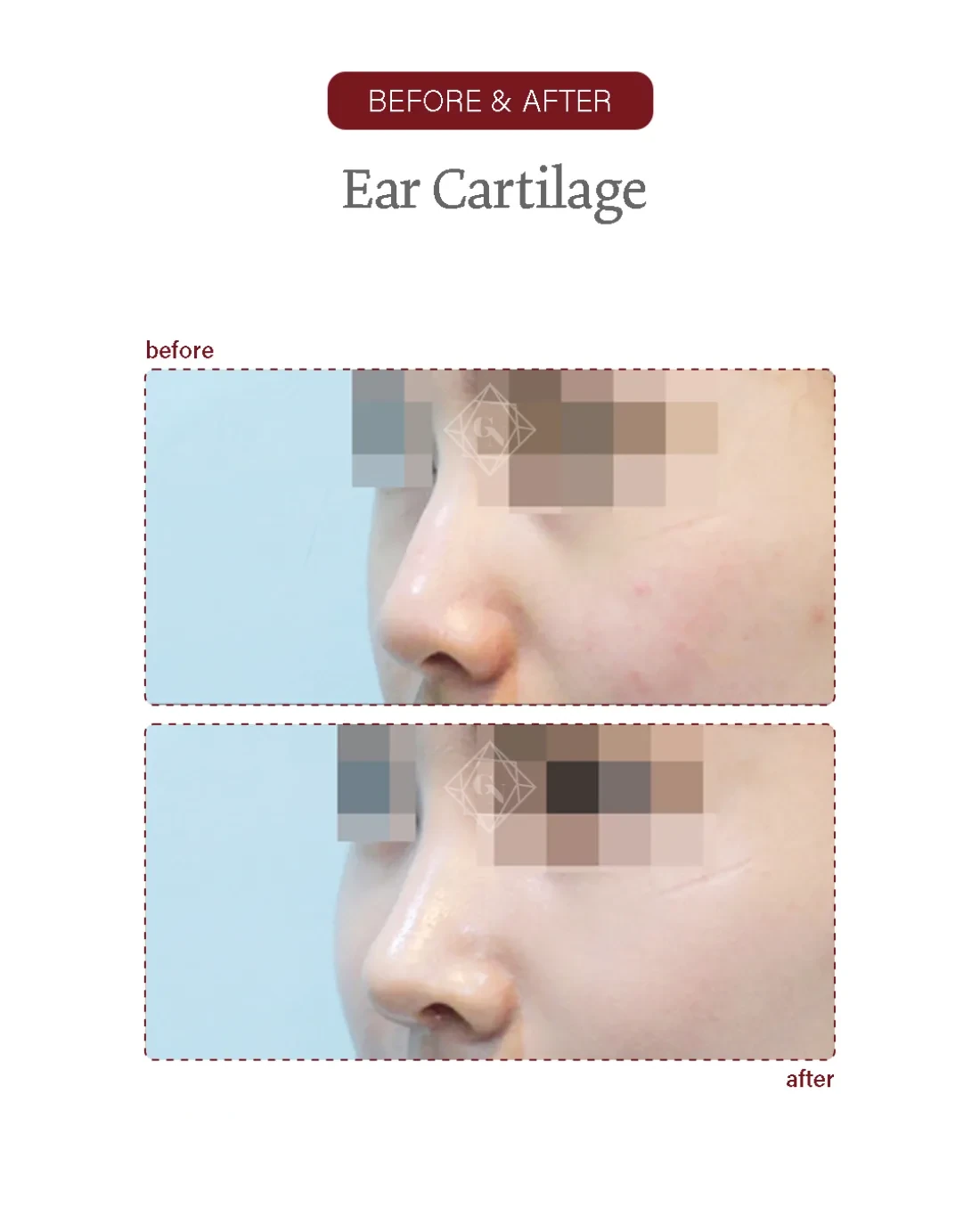
Ear-cartilage rhinoplasty result of an actual Garnet patient, Apgujeong (published with consent; same lighting and angle before and after). Results, recovery and suitability vary by individual and are not guaranteed; further sets are reviewed privately at consultation.
Dr. In-Soo Baek
Director & sole operating surgeon
Korean medical licence no. 77407
Operate on what you came for. Trained at Korea University Medical Center. Every case planned, performed and reviewed by the same hands.
1Operating surgeon
~2Surgeries per day
7Registered techniques
Board-certified plastic surgeon
Plastic surgery training at Korea University College of Medicine & graduate school
Korean Society of Plastic and Reconstructive Surgeons member, in its facial-contour, eye & rhinoplasty groups
Consults, operates and follows up each case himself
Peer-reviewed papers behind the facts on this page. Each describes findings in its own study group — not results at Garnet — and none predicts your own outcome.
Kridel RWH et al. Tip Grafts in Revision Rhinoplasty. Facial Plastic Surgery Clinics of North America. 2006. doi:10.1016/j.fsc.2006.06.014
Muenker R. The bilateral conchal cartilage graft: A new technique in augmentation rhinoplasty. Aesthetic Plastic Surgery. 1984. doi:10.1007/bf01572783
Uzunoğlu E et al. Polypropylene vs. Polydioxanone: How to Fix Septal Extension Graft?. Plastic & Reconstructive Surgery. 2025. doi:10.1097/prs.0000000000012697
FAQ
Common questions
Is ear cartilage rhinoplasty painful?
The operation itself is not something you feel, because it is done under sedation or general anaesthesia. Afterwards, most patients describe the nose as blocked and tight more than sharply painful, and the ear donor site as a tenderness. Discomfort peaks in the first two to three days and is managed well with prescribed pain relief.
What anaesthesia is used for ear cartilage rhinoplasty?
Depending on the extent of the work and your health and preference, it is usually performed under deep sedation with local anaesthesia, or under general anaesthesia. Local anaesthetic is also infiltrated into the nose and around the ear so the area stays numb into early recovery. The plan is decided with you at consultation.
Does taking cartilage from my ear hurt afterwards?
The ear donor site is tender, mildly swollen and warm for the first few days, more a soreness when touched, lying on it or wearing glasses than a constant pain. It is usually milder than patients expect and fades over the first week to 10 days, when the ear stitches are typically removed.
How long does the discomfort last?
The most noticeable phase is the first 48 to 72 hours for both the nose and the ear, after which comfort improves steadily. The nose's tightness eases as internal swelling settles over the first week or two; the ear's tenderness fades over the first week to 10 days. Mild numbness of the tip or around the ear can linger longer and then resolves.
Will I be awake during the surgery?
No. Whether you have sedation or general anaesthesia, you are in a sleep-like state or fully asleep and unaware of the operation, including the cartilage harvest from the ear. Being 'awake' and being 'in pain' are different things; modern anaesthesia means you are comfortably unaware throughout.
How do I manage pain after I get home?
Prescribed pain relief covers the first few days when discomfort peaks, and most patients step down to milder medication quickly. Keeping your head elevated, resting, using cool compresses as advised, sleeping on the side away from the harvested ear, and avoiding bending, alcohol and strenuous activity all reduce swelling and the pressure feeling.
Is the nose or the ear more uncomfortable?
They feel different. The nose is mostly pressure, blockage and tightness because of internal support and swelling; the ear is a localised tenderness at the donor site. Many patients find the ear milder and shorter-lived than they feared, while the nose's blocked feeling is the more persistent sensation over the first week.
When should I be concerned about pain?
Pain that suddenly worsens after settling, or pain with spreading redness, increasing warmth, worsening swelling after the first days, foul discharge or fever, should be reported. At the ear, a tense, increasingly swollen, very tender area should be assessed promptly. These are uncommon, but early review is better than waiting.
Will the numbness in my nose go away?
Numbness of the nasal tip after rhinoplasty is normal and reflects small nerves recovering. It does not mean they are damaged. Sensation typically returns gradually over weeks to a few months. Mild numbness around the ear donor site can also linger briefly and then resolves.
Can I ask about anaesthesia before I travel to Korea?
Yes. You can discuss the anaesthesia plan, the harvest from the ear and the comfort plan in an online consultation before booking, and send photos of your nose for a pre-assessment. Because the same surgeon consults, operates and follows up, the person answering your questions is the one who will care for you.
My mom recently had a brow lift and lower blepharoplasty with Dr. Baek, and our experience has been wonderful so far. The Garnet team was incredibly kind and welcoming, with Kelly assisting us as our English consultant—she made everything…
I’m so happy I chose this clinic for my lower blepharoplasty. I was traveling from abroad by myself, so I was a little nervous, but from the beginning I felt comfortable and truly cared for. Everyone was kind, patient, and professional…
Came in for an in-person consult and ended up choosing Garnet and Dr.Baek for my non-incisional DES and tiplasty/alarplasty. I communicated with Kelly (English consultant) from the start till now (3 weeks post-op). She really help me feel…
My under-eyes have been sagging and folding for years... I tried to cover it up with makeup, but it actually got stuck in the wrinkles and made it stand out even more. While going for consultations, I noticed that the bigger the hospital…
Worried about pain or anaesthesia for ear cartilage rhinoplasty? Send photos for a no-obligation pre-assessment and have the comfort plan explained before you plan a trip.
Send photos and your question before you travel. An English-speaking coordinator reviews every enquiry and replies with guidance on whether surgery is appropriate, the likely plan and timing.
✓ Reviewed by the clinic coordinator, not a bot
✓ Photo-based pre-assessment before you fly
✓ Foreign-patient scheduling & after-care
✓ One surgeon for consultation, surgery and follow-up
Prefer to chat now? Reach the coordinator directly:









 T S7 months ago



