A revision of the nasal tip with septal and ear (conchal) cartilage is a different kind of operation from a first rhinoplasty, because the tissue has healed, scarred and sometimes thinned, and the aim is to correct what is already there. This cartilage is often the material of choice for a tip that has dropped, become poorly defined or lost support. Revision is only worth doing when the assessment is clear about what can, and cannot, be improved.
The short answer
Revision corrects a previous result; it works on healed, sometimes scarred tissue, so it is planned differently from a first operation.
Septal and ear (conchal) cartilage is a common, well-tolerated material for rebuilding or refining the nasal tip in a revision.
Not everyone needs revision, and not every concern is suited to a surgical answer; a careful assessment may advise waiting or against operating.
A single-surgeon clinic means the surgeon who assesses your previous nose is the one who operates and follows you up, with no uncertainty about who is in the room.
When to consider an ear cartilage rhinoplasty revision
Patients seek revision for a range of reasons after an earlier nose operation: a tip that has dropped or lost projection over time, a tip that looks poorly defined or rounded, asymmetry that became apparent as swelling settled, an over-rotated or pinched tip, or a sense that the result simply does not suit the face. Some of these concerns are structural and benefit from added cartilage support; others are subtle and may not warrant surgery at all.
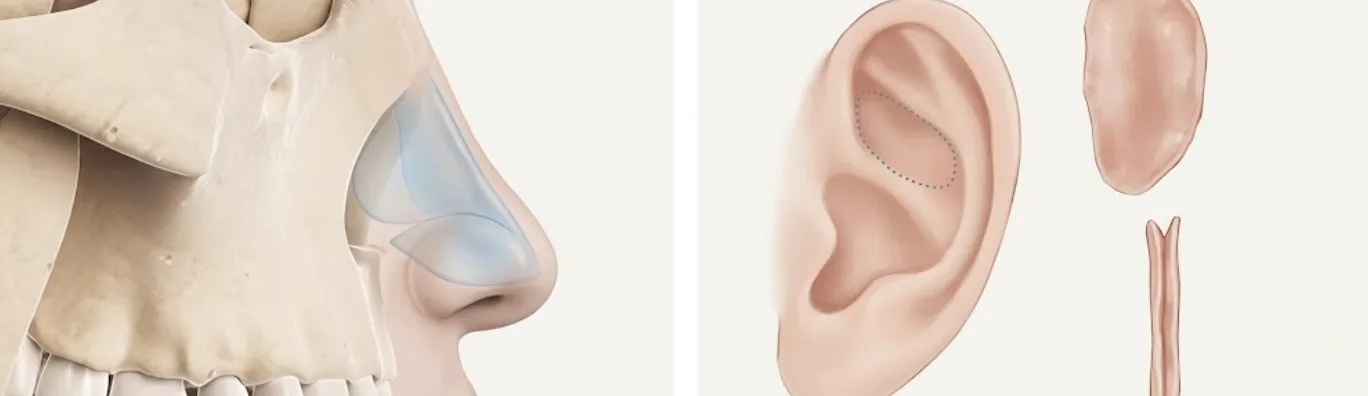
Illustration: two common sources of the patient's own cartilage: the septum inside the nose (blue) and the curved cartilage of the ear.
Timing matters more in revision than in a first operation. A nose continues to settle for many months, and what looks unfinished early can refine on its own, so it is usually wise to wait until the tissues have fully healed, often around a year from the previous surgery, before deciding. Operating too soon, on tissue that is still swollen and inflamed, makes a careful correction harder. For the overview of the operation that supplies the cartilage, see the parent guide on septal and ear-cartilage rhinoplasty.
If your original concern was the bridge or a previous implant and the tip is fine, the right path may be a broader revision rhinoplasty in place of a tip-focused cartilage correction. Part of a good assessment is matching the right operation to the actual problem.
Why cartilage
Why septal and ear cartilage is used for correction
In a revision, the surgeon needs reliable material to rebuild support, add definition or reshape a tip, and your own cartilage is generally preferred because it integrates well and avoids the concerns of synthetic implants in already-operated tissue. The nasal septum is the first source, but in a revision the septum may have been partly used or weakened in the first surgery, so the ear's conchal cartilage becomes valuable. Its gentle natural curve is well suited to shaping and supporting the tip.
Ear cartilage is harvested from the hidden bowl of the ear, leaving the ear's shape intact and any small scar tucked into a natural crease. Combining septal and ear cartilage lets the surgeon tailor the correction: septal cartilage for straighter structural support, conchal cartilage for the contoured tip. This is the same tip-refining logic as a primary septal and ear-cartilage rhinoplasty, applied to a nose that has already been operated on.
Because a revised nose has scar tissue and altered anatomy, having more than one cartilage source available gives the surgeon flexibility to respond to what they find during the operation, without depending on a single, possibly depleted, supply.
Candidacy
Who is, and isn't, a good candidate for cartilage tip revision
Good candidates are people whose previous result has fully healed, who have a specific, describable concern, and who hold realistic expectations about what a second operation can change. Revision can meaningfully improve tip definition, support and symmetry when there is a clear structural reason behind the concern. It tends to disappoint when the goal is perfection, when the concern is very minor, or when the tissue has not yet settled.
Some people are better advised to wait, and some are better advised not to operate at all. Thin or heavily scarred skin, multiple previous operations, or unrealistic goals all raise the bar for proceeding. A careful surgeon will sometimes recommend against surgery, and that conversation reflects good judgement. Garnet's stated approach is to address only the area you came for, without over-recommending additional work.
Your general health, the quality of remaining cartilage, and what was done previously all feed into candidacy. You can begin to establish whether revision is realistic for you in an online consultation, sending photos and a description of your previous surgery before committing to travel.
The procedure
What an ear cartilage revision actually involves
A tip revision using septal and ear cartilage typically involves accessing the tip, releasing and adjusting scar tissue from the previous operation, and placing precisely shaped cartilage grafts to restore projection, definition or symmetry. The ear donor site adds a short, separate part to the recovery. Whether the approach is closed or open is decided per case, depending on what the correction requires and what was done before.
Recovery mirrors a primary cartilage rhinoplasty, with two sites to heal. An external splint protects the nose for about a week, the nasal stitches are usually removed around seven days, and the ear donor-site stitches a little later, around ten days. Swelling in a revised nose can take longer to settle than in a first operation because the tissue has been worked on before, so patience with the final result is important. For how comfort feels across both sites, see pain and anaesthesia.
Because revision works on altered, scarred anatomy, it asks for meticulous, unhurried surgery. At a single-surgeon clinic the day is deliberately capped so each case has time, and the surgeon who plans the correction is the one who carries it out and reviews it.
Expectations
Setting realistic expectations for a second tip operation
Revision is, by its nature, more complex than a first operation. The tissue is scarred, the blood supply is altered, and the margins for adjustment are narrower. A realistic goal is meaningful improvement (better tip definition, restored support, improved symmetry); an entirely new nose or a flawless ideal is not. Setting that expectation clearly at the outset is part of a result you will be satisfied with.
Swelling resolves more slowly in a revised nose, and the tip in particular can take many months to show its settled shape, so judging the outcome too early is misleading. Your surgeon should explain what is realistically achievable for your specific nose, and what trade-offs are involved, before you decide. This is precisely why an unhurried, candid consultation matters more in revision than almost anywhere else.
Structured follow-up helps here: being reviewed at 1, 3 and 6 months means changes are tracked over the period when a revised nose is genuinely settling, and questions are answered by the surgeon who knows your case. International patients can continue this remotely; see ear cartilage rhinoplasty for international patients.
Assessment
Why the assessment comes before the operation
More than any first procedure, a revision lives or dies on the assessment. Before any operation is considered, the surgeon needs to understand what was done previously, examine how the tissue has healed, gauge the remaining cartilage, and listen to what specifically bothers you. Only then can they say plainly whether a cartilage correction will help, whether a different operation fits better, or whether waiting, or doing nothing, is the wiser course.
At Garnet the same board-certified plastic surgeon, Dr. In-Soo Baek (Korean medical licence no. 77407), consults, operates and follows up, so the person assessing your previous nose is the person who will perform any correction and review your recovery. There is no consultation or CT fee and no pressure to book on the day, which is the right environment for a decision that should not be rushed.
If you are abroad, you do not need to fly in just to find out whether revision is sensible. Start with an online consultation: share photos and the details of your previous surgery, get a clear read on what is realistic, and only then plan a trip if it makes sense for you.
Prices
Price at Garnet
Revision rhinoplasty
From₩4,000,000 + VATExcluding VAT (10% VAT is added at payment)Book now
Same price as Korean patients. Prices shown exclude 10% VAT; your written quote, issued after the in-person consultation, shows the full amount payable.
Dr. In-Soo Baek
Director & sole operating surgeon
Korean medical licence no. 77407
Operate on what you came for. Trained at Korea University Medical Center. Every case planned, performed and reviewed by the same hands.
1Operating surgeon
~2Surgeries per day
7Registered techniques
Board-certified plastic surgeon
Plastic surgery training at Korea University College of Medicine & graduate school
Korean Society of Plastic and Reconstructive Surgeons member, in its facial-contour, eye & rhinoplasty groups
Consults, operates and follows up each case himself
Peer-reviewed papers behind the facts on this page. Each describes findings in its own study group — not results at Garnet — and none predicts your own outcome.
Brandstetter M et al. Comparative Analysis and Long-Term Results of Various Septal Extension Graft Types. Facial Plastic Surgery. 2020. doi:10.1055/s-0040-1712468
Gode S et al. The Joint Tip Graft: A Joint Support for Rim, Facet and Infratip Lobule in Rhinoplasty. Aesthetic Plastic Surgery. 2019. doi:10.1007/s00266-019-01329-1
Jang YJ et al. Tip Grafting for the Asian Nose. Facial Plastic Surgery Clinics of North America. 2018. doi:10.1016/j.fsc.2018.03.008
FAQ
Common questions
Can a previous rhinoplasty be corrected with ear cartilage?
Often, yes. Septal and ear (conchal) cartilage is a common, well-tolerated material for refining a tip that has dropped, lost definition or lost support after a previous operation. Whether it is the right correction for your nose depends on what was done before and how the tissue has healed, which an assessment determines.
When should I consider an ear cartilage rhinoplasty revision?
Usually only after the previous result has fully healed, often around a year from the first surgery, and when you have a specific, describable concern such as a dropped, poorly defined or asymmetric tip. Operating too soon, on still-swollen tissue, makes a careful correction harder.
Why is ear cartilage used instead of the septum alone?
In a revision the septum may have been partly used or weakened in the first operation, so the ear's conchal cartilage becomes valuable. Its natural curve suits the tip, and having both sources gives the surgeon flexibility to respond to the scarred, altered anatomy of a revised nose.
Is revision more difficult than a first rhinoplasty?
Yes. Revision works on healed, scarred tissue with an altered blood supply and narrower margins for adjustment, so it asks for meticulous, unhurried surgery and careful planning. This is why a careful assessment and an experienced, board-certified plastic surgeon matter so much.
Does the ear donor site add to the recovery?
It adds a short, separate part. The nasal stitches are usually removed around seven days and the ear donor-site stitches a little later, around ten days. The ear is tender for the first few days and settles over the first week to ten days, alongside the nose's own recovery.
How long until I see the final revision result?
Longer than a first operation. Swelling resolves more slowly in a revised nose, and the tip in particular can take many months to show its settled shape, so judging the result too early is misleading. Structured follow-up over 1, 3 and 6 months tracks the change.
Might I be advised not to have revision?
Yes, and that is a good sign. If the concern is very minor, the tissue has not settled, the skin is thin or heavily scarred, or expectations are unrealistic, a careful surgeon may recommend waiting or not operating. Garnet's approach is to address only the area you came for, without over-recommending.
What results can I realistically expect?
Meaningful improvement: better tip definition, restored support and improved symmetry. An entirely new nose or a flawless ideal is not a realistic aim. A realistic goal, set clearly at the outset, is part of a result you will be satisfied with. Your surgeon should explain what is achievable for your specific nose.
Can I get assessed for revision from abroad?
Yes. You can start with an online consultation, sending photos and the details of your previous surgery to learn whether a cartilage correction is realistic, before deciding whether to travel. Only plan a trip if the assessment supports it.
Who will perform my revision at Garnet?
The same board-certified plastic surgeon, Dr. In-Soo Baek (Korean medical licence no. 77407), consults, operates and follows up. The person who assesses your previous nose is the one who performs any correction and reviews your recovery, with no uncertainty about who is in the room.
My mom recently had a brow lift and lower blepharoplasty with Dr. Baek, and our experience has been wonderful so far. The Garnet team was incredibly kind and welcoming, with Kelly assisting us as our English consultant—she made everything…
I’m so happy I chose this clinic for my lower blepharoplasty. I was traveling from abroad by myself, so I was a little nervous, but from the beginning I felt comfortable and truly cared for. Everyone was kind, patient, and professional…
Came in for an in-person consult and ended up choosing Garnet and Dr.Baek for my non-incisional DES and tiplasty/alarplasty. I communicated with Kelly (English consultant) from the start till now (3 weeks post-op). She really help me feel…
My under-eyes have been sagging and folding for years... I tried to cover it up with makeup, but it actually got stuck in the wrinkles and made it stand out even more. While going for consultations, I noticed that the bigger the hospital…
Unhappy with a previous nose result? Send photos and the details of your earlier surgery for a no-obligation assessment of whether a septal and ear-cartilage correction can help.
Send photos and your question before you travel. An English-speaking coordinator reviews every enquiry and replies with guidance on whether surgery is appropriate, the likely plan and timing.
✓ Reviewed by the clinic coordinator, not a bot
✓ Photo-based pre-assessment before you fly
✓ Foreign-patient scheduling & after-care
✓ One surgeon for consultation, surgery and follow-up
Prefer to chat now? Reach the coordinator directly:









 T S7 months ago



