Travelling abroad for a tip-refining rhinoplasty is very doable, but this particular operation has a detail worth planning around: it heals at two sites, the nose and the ear, where a small piece of cartilage is borrowed. That shapes how long you stay and how follow-up works, which an international patient needs to get right before booking a flight.
The short answer
You can begin entirely from home with an online consultation, sending photos for a pre-assessment before committing to travel.
Plan your stay around two sites: the nose has stitches removed around day 7, the ear donor site around day 10.
A realistic stay is roughly ten days so the ear stitches can be removed in Korea before you fly, though plans are tailored to your case.
After you return home, the same surgeon continues to review you remotely and at structured 1, 3 and 6-month follow-ups.
You do not need to fly to Korea to find out whether this operation is right for you. The sensible first step is an online consultation: you send clear photos of your nose from several angles, describe what you would like to change, and, if this is a correction, share the details of any previous surgery. The surgeon reviews this and gives a pre-assessment of what is realistic, whether septal and ear cartilage suits your tip, and roughly what to plan for.
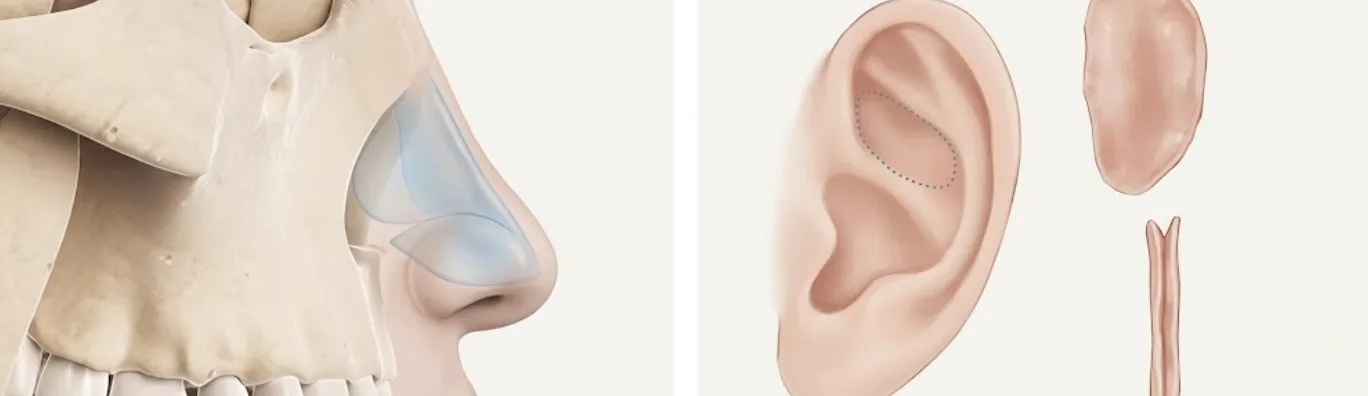
Illustration: two common sources of the patient's own cartilage: the septum inside the nose (blue) and the curved cartilage of the ear.
This remote first step does the heavy lifting before you spend money on flights. It lets you understand the operation, ask about the ear donor site, and decide whether travelling makes sense, all explained in the parent guide on septal and ear-cartilage rhinoplasty. A frank pre-assessment, including 'this may not be the right operation for you', is the point of doing it this way round.
Because the same surgeon who consults is the one who operates and follows up, the person answering your questions online is the person who will care for you in Seoul. There is no consultation or CT fee and no pressure to book on the day you arrive, so the online step is genuinely exploratory, with no sales funnel behind it.
How long to stay
How long to stay in Korea, and why the ear matters
The single most important planning point for international patients is that this operation heals at two sites with two different timelines. The nasal stitches are usually removed around seven days, but the ear donor-site stitches come out a little later, around ten days. That second number is what sets the length of a sensible stay: you generally want to be in Korea long enough to have the ear stitches removed before you fly.
For that reason, a realistic stay for ear-cartilage rhinoplasty is roughly ten days, a little longer than a tip operation that uses the septum alone. That allows for arrival and an in-person consultation, the surgery, the splint and nasal stitch removal, and the ear donor-site stitch removal, all done in Korea by the surgeon who operated. Exact timing is tailored to your case, and you can confirm it at your online consultation; the general principles are covered in how long to stay in Korea for surgery.
Building in a small buffer is wise. Swelling, weather and your own healing pace vary, and a couple of spare days mean you are not rushing the final check or flying with fresh stitches in the ear. A calm recovery window beats a packed itinerary; see recovering in Seoul after surgery.
Timeline
A typical in-Korea timeline
A representative plan looks like this, though yours is tailored to your case. On arrival you have an in-person consultation and examination to confirm the plan agreed online. Surgery follows, working on the nasal tip with septal and ear cartilage; the ear donor site is dressed. Over the following days you rest with the splint on, managing the blocked, tight feeling in the nose and the tenderness at the ear, described in detail in pain and anaesthesia.
Around day seven the splint comes off and the nasal stitches are removed, and the nose begins to look like itself, albeit still swollen. Around day ten the ear donor-site stitches are removed, which is typically the final in-person check before you fly. Throughout, the same surgeon reviews each site, so nothing is left to a rotating team.
If your case is a correction of an earlier nose rather than a first operation, the same two-site timeline applies, with the caveat that a revised nose settles more slowly (see revision and correction). Either way, the structure of the stay is built around getting both the nose and the ear safely past their stitch-removal points before departure.
Flying home
When you can fly home
Most international patients aim to fly home after the ear donor-site stitches are removed, since that is the later of the two milestones. Flying earlier is sometimes possible but means travelling with stitches still in the ear and a less-settled nose, which is why the roughly ten-day stay is the more comfortable plan. Cabin pressure and the dryness of a long flight are generally well tolerated once the early healing is past, but your surgeon gives you specific guidance for your case.
Practical flight comfort measures help: stay hydrated, avoid bending and heavy lifting with your cabin bag, keep any saline spray your surgeon recommends, and avoid alcohol around the flight. General timing principles are covered in when can I fly after plastic surgery, but the two-site nature of this operation is the reason a slightly longer stay is sensible here.
The aim is simple: leave Korea with both sites checked by the surgeon who operated, clear written aftercare, and a direct line back for anything that comes up at home. That removes the anxiety of flying off with an unanswered question about either the nose or the ear.
Remote follow-up
How follow-up works after you return home
Care does not end when you board the plane. The same surgeon who operated continues to review your recovery remotely. You can send photos and questions as your nose and ear settle, and get answers from the person who knows exactly what was done to each site. This continuity is especially valuable for international patients, who would otherwise be left to a local clinic that did not perform the surgery.
Garnet's structured follow-up at 1, 3 and 6 months gives a clear rhythm for tracking the result over the period when the tip is genuinely settling, which is slower than patients often expect, particularly in a revision. Knowing there are set check-ins, plus an open line for anything in between, makes recovering at home far less daunting than going it alone.
If a question arises that needs hands-on care, the surgeon can advise what is normal, what to watch for, and when to seek local attention. The red-flag signs are set out in pain and anaesthesia. The principle throughout is that one surgeon stays responsible for your case from the first online photo to the six-month review.
At Garnet
How Garnet supports international patients
Garnet is a single-surgeon plastic surgery clinic in Apgujeong, Seoul, a short walk from Apgujeong Station. Dr. In-Soo Baek is a board-certified plastic surgeon (Korean medical licence no. 77407) and the only operating doctor. He consults, performs the surgery himself, and reviews every follow-up. The clinic caps the day so each case has unhurried time, and is registered with Korea's foreign-patient programme (registration no. M-2023-01-08-6867).
For an international patient that means a clear, joined-up path: an online pre-assessment from home, an in-person consultation on arrival, surgery and recovery managed at both the nose and the ear by the same surgeon, and structured remote follow-up after you fly home. A dedicated coordinator stays with you from consultation through recovery, and there is no consultation or CT fee and no pressure to book same-day.
If you are weighing up a trip, the no-obligation way to start is an online consultation. For the wider practicalities of organising the visit (flights, timing and the city), see planning a plastic surgery trip to Korea.
Real Results
Before & After
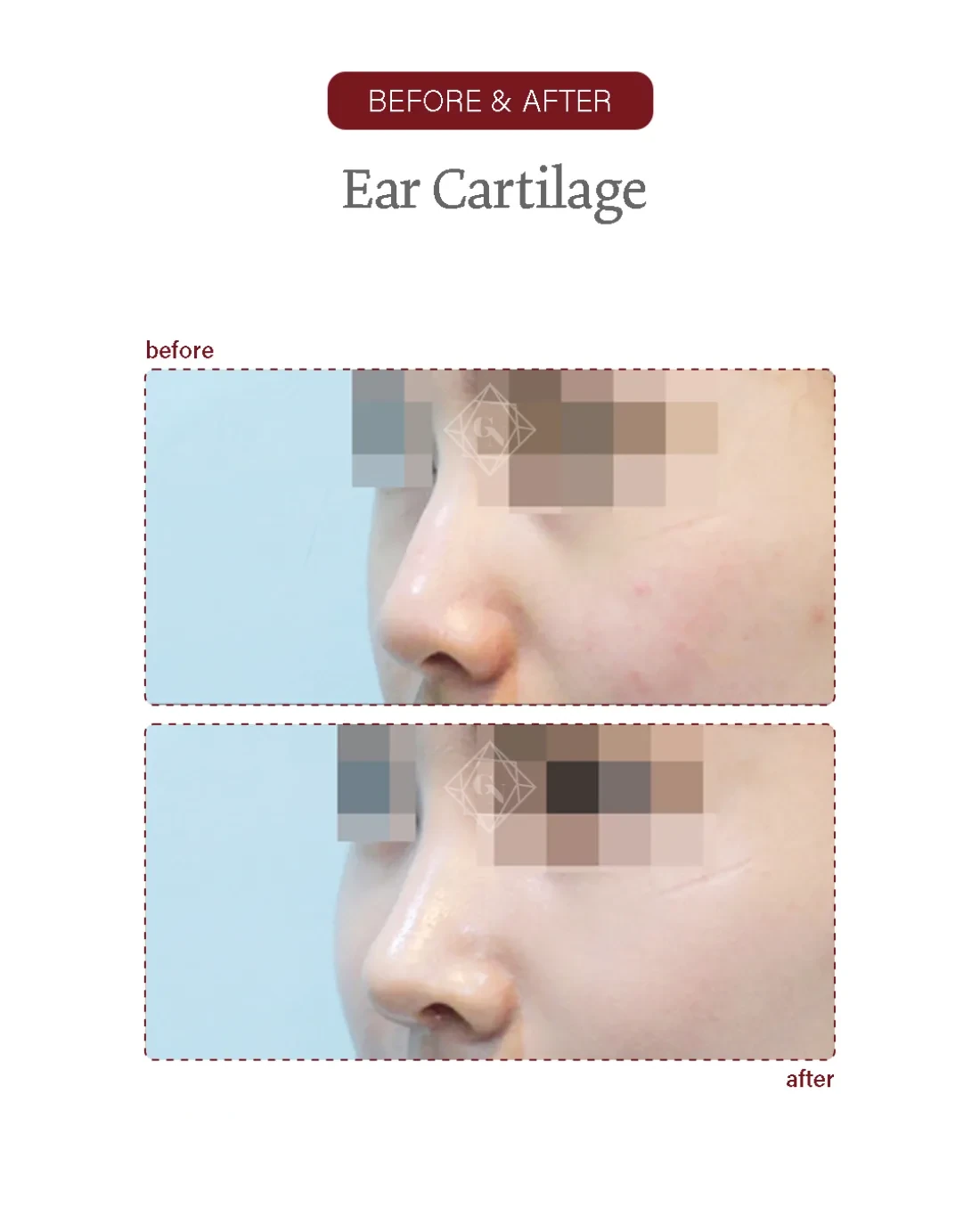
Ear-cartilage rhinoplasty result of an actual Garnet patient, Apgujeong (published with consent; same lighting and angle before and after). Results, recovery and suitability vary by individual and are not guaranteed; further sets are reviewed privately at consultation.
Dr. In-Soo Baek
Director & sole operating surgeon
Korean medical licence no. 77407
Operate on what you came for. Trained at Korea University Medical Center. Every case planned, performed and reviewed by the same hands.
1Operating surgeon
~2Surgeries per day
7Registered techniques
Board-certified plastic surgeon
Plastic surgery training at Korea University College of Medicine & graduate school
Korean Society of Plastic and Reconstructive Surgeons member, in its facial-contour, eye & rhinoplasty groups
Consults, operates and follows up each case himself
Peer-reviewed papers behind the facts on this page. Each describes findings in its own study group — not results at Garnet — and none predicts your own outcome.
Brandstetter M et al. Comparative Analysis and Long-Term Results of Various Septal Extension Graft Types. Facial Plastic Surgery. 2020. doi:10.1055/s-0040-1712468
McAuliffe PB et al. Complications of Aesthetic Surgical Tourism Treated in the USA: A Systematic Review. Aesthetic Plastic Surgery. 2022. doi:10.1007/s00266-022-03041-z
Gode S et al. The Joint Tip Graft: A Joint Support for Rim, Facet and Infratip Lobule in Rhinoplasty. Aesthetic Plastic Surgery. 2019. doi:10.1007/s00266-019-01329-1
Varma P et al. Cosmetic tourism during the COVID-19 pandemic: Dealing with the aftermath. Journal of Plastic, Reconstructive & Aesthetic Surgery. 2022. doi:10.1016/j.bjps.2021.11.013
FAQ
Common questions
How do international patients get ear cartilage rhinoplasty in Korea?
Most start with an online consultation from home, sending photos for a pre-assessment. If it is suitable and you decide to travel, you have an in-person consultation on arrival, then surgery and recovery in Seoul, with the same surgeon managing both the nose and the ear donor site, followed by remote follow-up after you fly home.
How long should I stay in Korea for ear cartilage rhinoplasty?
Roughly ten days is a realistic plan. The nasal stitches come out around day seven, but the ear donor-site stitches come out a little later, around day ten, so you generally want to stay long enough to have the ear stitches removed in Korea before flying. Exact timing is tailored to your case.
Why is the stay longer than for a septum-only nose job?
Because this operation heals at two sites. The ear donor site, where cartilage is borrowed, has its stitches removed around day 10, later than the nose at day 7. That second milestone sets the sensible stay length, slightly longer than a tip operation using the septum alone.
Can I start with an online consultation for ear cartilage rhinoplasty?
Yes. You can send clear photos from several angles and a description of what you would like to change (and, for a correction, the details of any previous surgery), and receive a pre-assessment before committing to travel. There is no consultation or CT fee and no pressure to book.
When can I fly home after the surgery?
Most patients fly home after the ear donor-site stitches are removed, around day ten, since that is the later of the two milestones. Flying earlier is sometimes possible but means travelling with ear stitches still in and a less-settled nose. Your surgeon gives specific guidance for your case.
How does follow-up work once I'm back home?
The same surgeon who operated continues to review you remotely: you send photos and questions and get answers from the person who knows exactly what was done. Garnet also runs structured follow-up at 1, 3 and 6 months, with an open line in between, so you are not left to a clinic that did not perform the surgery.
Will the same surgeon operate on me?
Yes. At Garnet the same board-certified plastic surgeon, Dr. In-Soo Baek (Korean medical licence no. 77407), consults, operates and follows up. The person who assesses you online is the one who performs the surgery and reviews both the nose and the ear at each check.
Is Garnet registered to treat foreign patients?
Yes. Garnet is registered with Korea's foreign-patient programme (registration no. M-2023-01-08-6867) and coordinates consultation, scheduling and after-care for international visitors, with a dedicated coordinator who stays with you from consultation through recovery.
What if I have a problem after I get home?
The operating surgeon can advise remotely on what is normal, what to watch for, and when to seek local care if needed. You leave Korea with both sites checked, clear written aftercare and a direct line back, so a question about either the nose or the ear is answered by your own surgeon.
Where is Garnet, and is it easy to reach?
Garnet is in Apgujeong, Gangnam-gu, Seoul, about a five-minute walk from Apgujeong Station (Subway Line 3), Exit 3. It is a central, well-connected location for international patients staying in the city during recovery.
My mom recently had a brow lift and lower blepharoplasty with Dr. Baek, and our experience has been wonderful so far. The Garnet team was incredibly kind and welcoming, with Kelly assisting us as our English consultant—she made everything…
I’m so happy I chose this clinic for my lower blepharoplasty. I was traveling from abroad by myself, so I was a little nervous, but from the beginning I felt comfortable and truly cared for. Everyone was kind, patient, and professional…
Came in for an in-person consult and ended up choosing Garnet and Dr.Baek for my non-incisional DES and tiplasty/alarplasty. I communicated with Kelly (English consultant) from the start till now (3 weeks post-op). She really help me feel…
My under-eyes have been sagging and folding for years... I tried to cover it up with makeup, but it actually got stuck in the wrinkles and made it stand out even more. While going for consultations, I noticed that the bigger the hospital…
Considering ear cartilage rhinoplasty in Seoul from abroad? Send photos for a no-obligation pre-assessment and have your stay and follow-up planned before you book a flight.
Send photos and your question before you travel. An English-speaking coordinator reviews every enquiry and replies with guidance on whether surgery is appropriate, the likely plan and timing.
✓ Reviewed by the clinic coordinator, not a bot
✓ Photo-based pre-assessment before you fly
✓ Foreign-patient scheduling & after-care
✓ One surgeon for consultation, surgery and follow-up
Prefer to chat now? Reach the coordinator directly:









 T S7 months ago



