Stem cell fat grafting suits people whose cheeks, temples or under-eyes have lost volume, and it suits others not at all. This page goes deeper than a procedure overview into candidacy: who tends to benefit from restoring lost facial volume with their own fat, what makes someone a stronger or weaker candidate, and when a different approach, or no surgery, is the better recommendation.
The short answer
The typical candidate has lost facial volume (flatter cheeks, hollow temples or under-eyes, a tired look) and would like it restored with their own tissue, without filler.
You generally need enough donor fat to harvest, realistic expectations, and good general health; heavy smoking and some medical conditions can make it less suitable.
It restores volume and does not lift; sagging skin is usually better addressed by lifting surgery, sometimes alongside grafting.
A careful assessment may conclude that filler, a different procedure, or nothing at all is the better choice for you, and that is a useful answer in itself.
Most people who consider stem cell fat grafting are noticing volume loss more than sagging. With age, and sometimes with significant weight loss, the face deflates: cheeks flatten, temples and the area under the eyes hollow, the line from cheek to mouth deepens, and the overall impression becomes tired or gaunt. The wish is usually to look rested and restored while still looking like themselves.
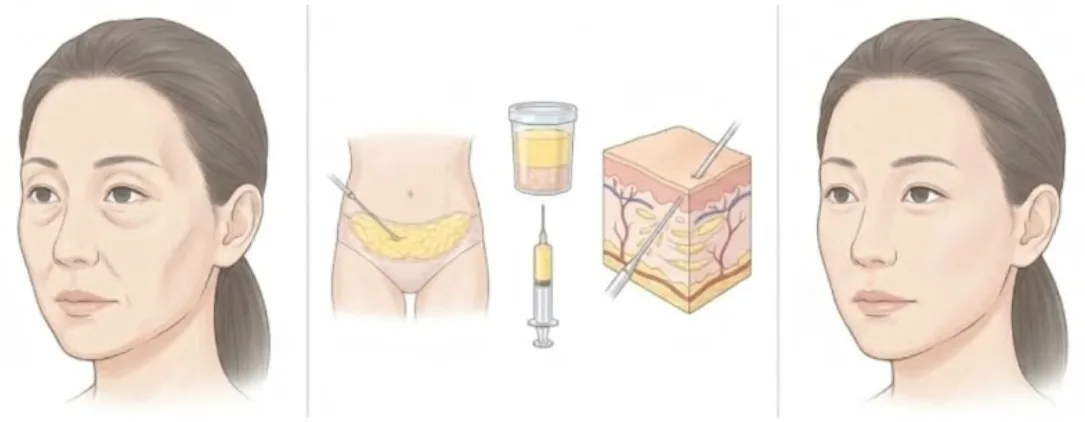
Illustration: the patient's own fat is taken, processed, and re-placed beneath the skin where volume has been lost.
The procedure addresses this by harvesting fat from your own body through cannula access and re-injecting it where volume has been lost. Stem cell fat grafting refers to that fat being supplemented with the stromal-vascular fraction concentrated from your own harvested tissue. For people who specifically want restoration using their own fat in place of a synthetic filler, and who have realistic, modest goals, it can be a good fit. If you are weighing fat against injectables, our guide on fat grafting vs filler compares the two side by side.
The procedure also has clear limits. It restores volume; it does not lift loose skin or tighten a sagging jawline. That distinction is the first step in telling a volume problem, which grafting treats, from a different problem that needs another approach.
Strong candidate
What makes someone a strong candidate
A strong candidate usually has three things. First, a volume problem that fat grafting actually solves, such as hollows and flatness without much excess skin. Second, enough donor fat to harvest from an area such as the abdomen or thigh; very lean patients sometimes have limited fat to work with, which shapes what is realistic. Third, realistic expectations: grafting refines and restores gradually, and not every transferred cell survives, so the aim is natural improvement; no particular amount of volume can be guaranteed.
General health matters too. Good candidates are in reasonable health, are not heavy smokers, and have any chronic conditions well managed, because the survival of grafted fat depends on a healthy blood supply at the recipient site. Stable weight helps as well, since significant weight changes after grafting can alter the result.
Mindset is part of candidacy. People who do well tend to want a subtle, restorative change and are comfortable with a result that settles over weeks to months. If you want an immediate, dramatic, precisely-dialled volume, a careful surgeon may steer you toward a different option, and that conversation is exactly what a consultation is for.
Not recommended
When stem cell fat grafting isn't recommended
There are situations where it is not the right choice. If your main concern is loose, sagging skin and volume loss is minor, grafting will not lift it, and adding volume to skin that needs tightening can make the face look heavier. Lifting surgery is usually the more appropriate route, sometimes combined with a modest amount of grafting.
Some medical factors make it less suitable: heavy smoking, poorly controlled diabetes or circulation problems, active infection, or conditions affecting healing, because grafted fat needs a good blood supply to survive. Very lean patients may simply lack the donor fat for the volume they want. And anyone seeking a guaranteed survival rate or a fixed final volume should know that no responsible surgeon can promise that, because fat behaves differently in every person.
Pregnancy, unstable weight, and unrealistic expectations are also reasons to wait or reconsider. A clinic that tells you this is protecting your result. You can read more about how this fits into broader decision-making in our guide on how to choose a plastic surgery clinic in Korea.
Other options
When another approach fits you better
Candidacy covers more than being able to have the procedure. It also asks if grafting is the ideal choice for your goal. If you want a quick, reversible touch of volume with no downtime, dermal filler may suit you better, and our fat grafting vs filler comparison lays out the trade-offs. If your concern is descent and sagging more than deflation, a lifting procedure is the more direct answer.
Sometimes the right plan is a combination, for example restoring volume with grafting while a separate procedure addresses laxity. Other times the conclusion is that your features do not need surgery at all, or that a less involved treatment will get you most of the way. None of these conclusions is a failure of the consultation; each is a better-informed decision.
The point of assessing candidacy carefully is to make sure the procedure you travel for is the one that actually serves you. If you would like a clear read before committing, you can describe your goals in an online consultation from abroad.
Assessment
How candidacy is actually assessed
A proper assessment looks at the pattern of your volume loss, the quality and laxity of your skin, your available donor fat, your general health and your goals, all weighed together. From there a surgeon can say whether grafting addresses your concern, roughly how much restoration is realistic, and whether anything else should be considered first or alongside.
For an international patient this can begin before you travel. Sending clear photos and a description of what bothers you lets a surgeon give an early view of your candidacy, so you are not flying in only to be told a different procedure would suit you better. If you do proceed, understanding how long the results last and the cost factors involved helps you plan with eyes open.
The ideal assessments leave room for the answer to be no. A surgeon who is willing to say that grafting is not right for you, and to explain why, is giving you more useful information than one who says yes to everything.
At Garnet
How Garnet assesses candidacy
Garnet is a single-surgeon clinic in Apgujeong, Seoul. Dr. In-Soo Baek is a board-certified plastic surgeon (Korean medical licence no. 77407) and the only operating doctor. He consults, performs the procedure himself and reviews every follow-up. Because the same surgeon does the assessment and the surgery, the candidacy conversation and the surgical plan are one and the same.
Garnet's stated approach is to address only the area you came for and not to over-recommend, which means the answer is sometimes that grafting is not your best route. The procedure is described factually, as supplemented fat grafting using your own tissue, without claims of superior graft survival, as the clinic is not designated for advanced regenerative medicine. You can start with a no-obligation online assessment to find out if your face suits grafting.
Real Results
Before & After
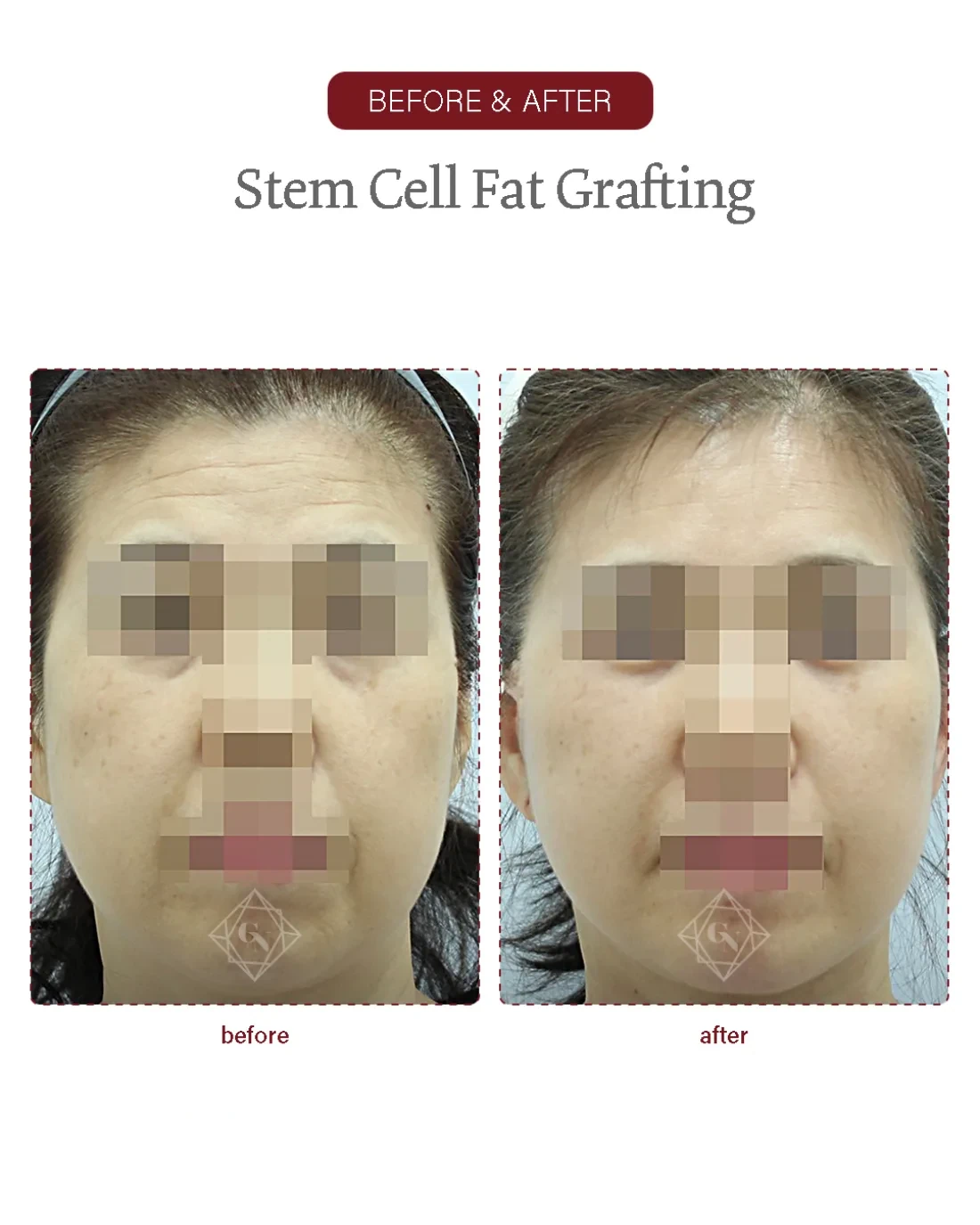
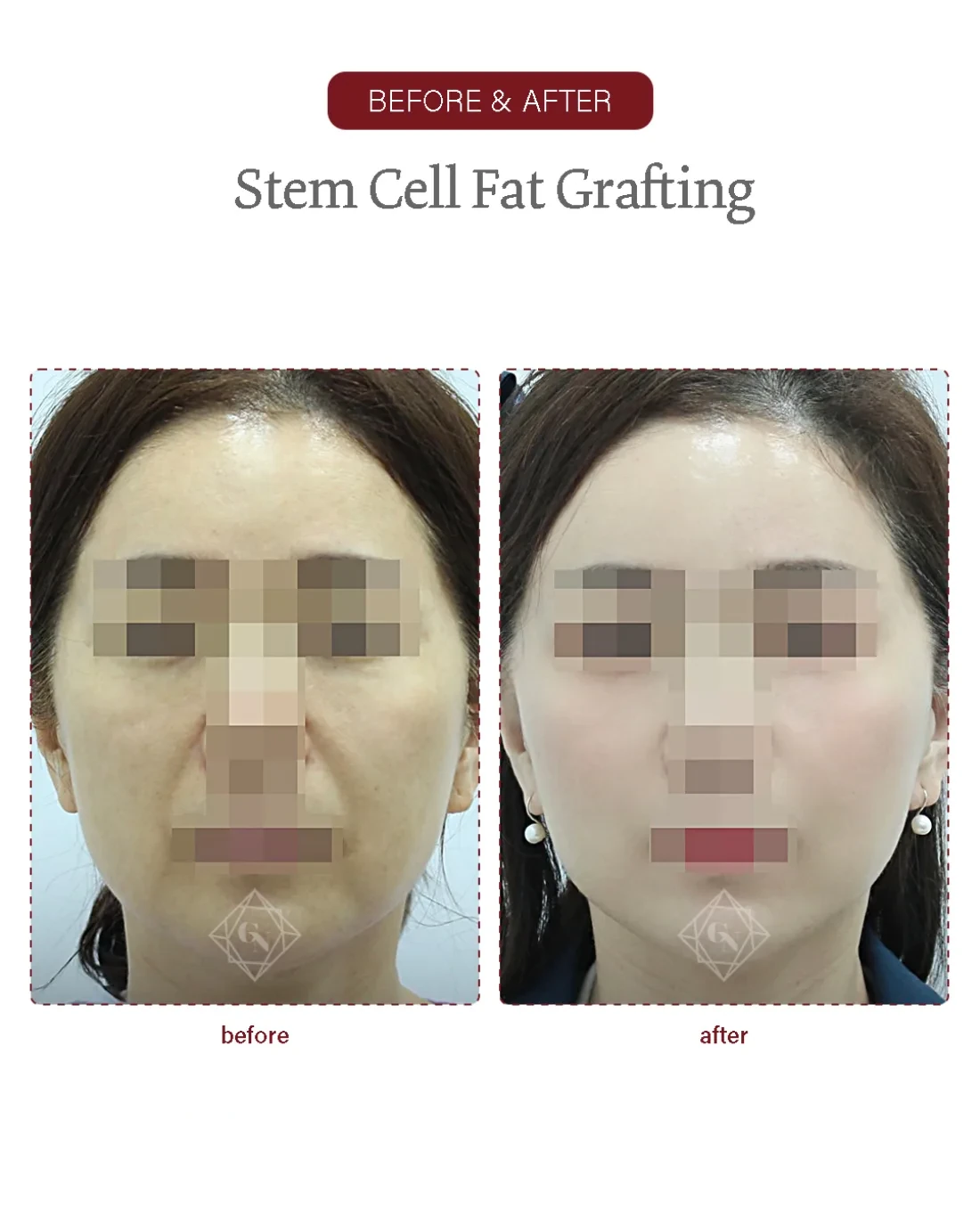
Fat-grafting and contouring results of actual Garnet patients (published with consent, with date, procedure and clinic labelled). Results, the amount of fat retained, recovery and suitability vary by individual and are not guaranteed.
Prices
Price at Garnet
Stem cell fat grafting
From₩3,500,000 + VATExcluding VAT (10% VAT is added at payment)Book now
Same price as Korean patients. Prices shown exclude 10% VAT; your written quote, issued after the in-person consultation, shows the full amount payable.
Dr. In-Soo Baek
Director & sole operating surgeon
Korean medical licence no. 77407
Operate on what you came for. Trained at Korea University Medical Center. Every case planned, performed and reviewed by the same hands.
1Operating surgeon
~2Surgeries per day
7Registered techniques
Board-certified plastic surgeon
Plastic surgery training at Korea University College of Medicine & graduate school
Korean Society of Plastic and Reconstructive Surgeons member, in its facial-contour, eye & rhinoplasty groups
Consults, operates and follows up each case himself
Peer-reviewed papers behind the facts on this page. Each describes findings in its own study group — not results at Garnet — and none predicts your own outcome.
Wufuer M et al. Improving Facial Fat Graft Survival Using Stromal Vascular Fraction–Enriched Lipotransfer: A Multicenter Randomized Controlled Study. Plastic & Reconstructive Surgery. 2023. doi:10.1097/prs.0000000000010625
Roshdy OH et al. Stromal vascular fraction improves the durability of autologous fat temple augmentation—A split-face randomized study using ultrasound biomicroscopy. Journal of Plastic, Reconstructive & Aesthetic Surgery. 2022. doi:10.1016/j.bjps.2021.12.005
Li M et al. The Efficacy of Cell-Assisted Lipotransfer Versus Conventional Lipotransfer in Breast Augmentation: A Systematic Review and Meta-Analysis. Aesthetic Plastic Surgery. 2021. doi:10.1007/s00266-020-02123-0
FAQ
Common questions
Who is a good candidate for stem cell fat grafting?
Typically someone who has lost facial volume (flatter cheeks, hollow temples or under-eyes, a tired look) and wants restoration using their own fat instead of filler. Good candidates have enough donor fat to harvest, are in reasonable health, and have realistic expectations of a gradual, natural improvement.
Am I suitable if I have sagging skin rather than volume loss?
Probably not on its own. Stem cell fat grafting restores volume; it does not lift loose skin, and adding volume to skin that needs tightening can look heavier. Sagging is usually better addressed by lifting surgery, sometimes combined with a modest amount of grafting.
When is stem cell fat grafting not recommended?
It is less suitable for heavy smokers, people with poorly controlled diabetes or circulation problems, active infection, or healing conditions, because grafted fat needs a good blood supply to survive. Very lean patients may lack donor fat, and pregnancy or unstable weight are reasons to wait.
Do I need to have a lot of body fat to be a candidate?
You need enough donor fat to harvest from an area such as the abdomen or thigh. Very lean patients sometimes have limited fat available, which shapes how much volume is realistic. An assessment will tell you what your donor sites can reasonably provide.
Is it better for me than dermal filler?
It depends on your goal. Filler is quick, reversible and needs no downtime; fat grafting uses your own tissue and suits people who prefer it to a synthetic product. Our fat grafting vs filler guide compares the two side by side, and a consultation can say which fits you.
Can stem cell fat grafting make me look younger overall?
It can restore a rested, fuller appearance where volume has been lost, which often reads as more youthful. But it is not a lift and will not change sagging or skin laxity. For some people a combination of grafting and a separate lifting procedure is the more complete plan.
What if the consultation concludes I'm not a candidate?
That is a useful outcome in itself. A careful surgeon may recommend filler, a different procedure, a combination, or no surgery at all. Knowing the most appropriate option for your goal before you travel saves you from a procedure that would not serve you.
Can my candidacy be assessed before I travel to Korea?
Yes. By sending clear photos and describing what bothers you in an online consultation, a surgeon can give an early view of whether grafting suits you and roughly what is realistic, so you can plan with confidence before flying in.
Will the same surgeon who assesses me also operate?
At a single-surgeon clinic, yes. The surgeon who assesses your candidacy is the one who performs the procedure and reviews your recovery, so the plan stays consistent from the first conversation through to follow-up.
My mom recently had a brow lift and lower blepharoplasty with Dr. Baek, and our experience has been wonderful so far. The Garnet team was incredibly kind and welcoming, with Kelly assisting us as our English consultant—she made everything…
I’m so happy I chose this clinic for my lower blepharoplasty. I was traveling from abroad by myself, so I was a little nervous, but from the beginning I felt comfortable and truly cared for. Everyone was kind, patient, and professional…
Came in for an in-person consult and ended up choosing Garnet and Dr.Baek for my non-incisional DES and tiplasty/alarplasty. I communicated with Kelly (English consultant) from the start till now (3 weeks post-op). She really help me feel…
My under-eyes have been sagging and folding for years... I tried to cover it up with makeup, but it actually got stuck in the wrinkles and made it stand out even more. While going for consultations, I noticed that the bigger the hospital…
Not sure whether stem cell fat grafting is right for you? Send photos of your cheeks, temples and under-eyes for a no-obligation pre-assessment before you plan a trip.
Send photos and your question before you travel. An English-speaking coordinator reviews every enquiry and replies with guidance on whether surgery is appropriate, the likely plan and timing.
✓ Reviewed by the clinic coordinator, not a bot
✓ Photo-based pre-assessment before you fly
✓ Foreign-patient scheduling & after-care
✓ One surgeon for consultation, surgery and follow-up
Prefer to chat now? Reach the coordinator directly:









 T S7 months ago



