By around 3 months after stem cell fat grafting, the volume you see is usually close to what will last. Whether that counts as permanent is more nuanced: a portion of the transferred fat establishes a lasting blood supply and tends to stay, while some is reabsorbed in the early months. This page explains how much typically persists, why results settle the way they do, and when a refinement might be considered.
The short answer
Not all transferred fat survives. Some is reabsorbed in the first months, and the fat that establishes a blood supply tends to remain as living tissue.
The fat that does take behaves like the rest of your body's fat: it is generally long-lasting but ages and changes with you over time.
Results settle over weeks to a few months, so the volume at 1 or 2 weeks is not the final volume, and patience is part of the process.
No responsible clinic can promise a specific survival rate or a guaranteed permanent result; realistic planning allows for the possibility of a touch-up.
When fat is transferred during stem cell fat grafting, the goal is for the injected fat cells to establish a new blood supply at the recipient site. Cells that succeed in connecting to that blood supply survive and become living tissue; cells that do not are gradually reabsorbed by the body in the early weeks. This is normal and expected. It is simply how a graft of living tissue settles in.
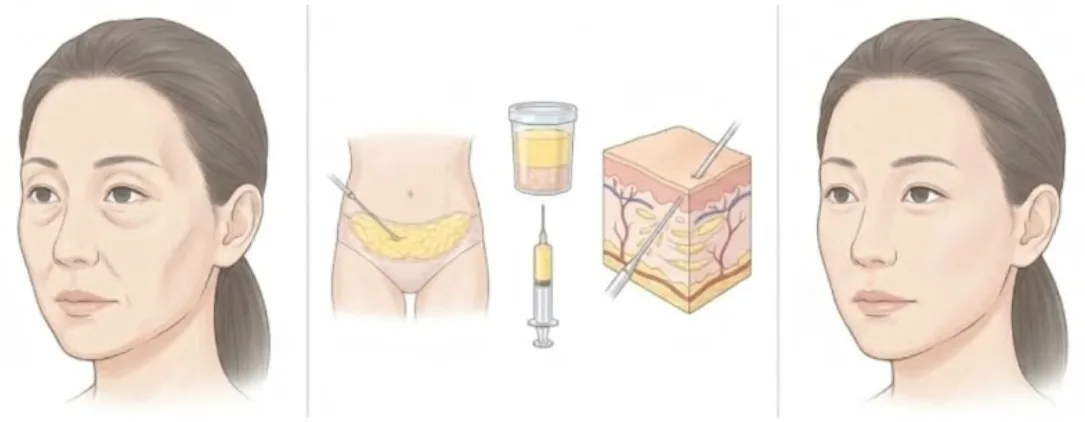
Illustration: the patient's own fat is taken, processed, and re-placed beneath the skin where volume has been lost.
Stem cell fat grafting refers to fat that is supplemented with the stromal-vascular fraction concentrated from your own harvested tissue. Put accurately, this is supplemented fat grafting using your own cells; it is not a designated advanced regenerative therapy, and no responsible clinic can promise a specific survival percentage or that it will outperform standard grafting. What can be said plainly is the biology: the fat that takes tends to stay, and the fat that does not take is reabsorbed early.
Because some reabsorption is built into the process, an experienced surgeon plans for it — by placing fat carefully in small amounts so more of it can connect to a blood supply. Understanding this from the start makes the result far easier to interpret as it settles.
Settling phase
Why the first months are a settling phase
Immediately after grafting there is swelling, and the treated area can look fuller than the final result. Over the following weeks the swelling subsides and some of the transferred fat is reabsorbed, so the volume steps down before it stabilises. This is why the appearance at one or two weeks is not a reliable preview of where you will land.
Most of the settling happens over the first few months. By around the three-month mark the result is usually close to what will remain, and many surgeons review at this point precisely because it is when the picture becomes clear. Knowing this curve in advance prevents the common worry of thinking the result has 'disappeared' when it is simply settling.
This settling pattern also shapes how you should judge success. The measure is the stable volume that remains once the process is complete; the early fullness and any single number mislead. For how the broader recovery and visible-result timeline works, our when will I see results guide for fat grafting is a useful companion.
How long it lasts
How long the results actually last
Here is the part most people are looking for. Once the settling phase is over, the fat that has survived is living tissue with its own blood supply, and it tends to be long-lasting. In that sense the retained volume is durable in a way that dissolvable filler is not. This is one reason people choose fat over injectables when they want restoration that does not need topping up every several months.
That said, 'long-lasting' differs from 'frozen in time'. The surviving fat behaves like the rest of your body's fat: it ages as you age, and it can change with significant weight gain or loss. The face also continues its natural ageing around the grafted area, so the overall impression evolves gradually even when the graft itself is stable. Careful language matters here: the clinic should describe results as durable and natural, without calling them guaranteed or permanent.
Compared with dermal filler, the retained portion of a fat graft does not dissolve on a fixed schedule, which is its main longevity advantage. A surgical lift is a different thing entirely. Grafting restores volume and does not lift, so the two are not really competing on the same timeline.
What affects it
What affects how long stem cell fat grafting results last
Several factors influence how much volume persists and how stable it stays. Surgical technique matters: placing fat in fine layers so more of it reaches a blood supply tends to improve how much survives. The recipient area matters too: well-vascularised regions generally hold a graft better than thin or highly mobile areas.
Your own physiology and habits play a part. Smoking impairs the blood supply the graft depends on, which is why surgeons advise against it around the procedure. Stable weight helps the result stay even, because the surviving fat responds to weight changes like any other fat in your body. Good general health supports healing and graft survival.
Finally, the early after-care influences the outcome: protecting the area, following aftercare instructions, and attending follow-ups so the surgeon can see how the graft has settled. If you are planning the practical side, our notes on cost factors and candidacy are worth reading alongside this page.
Touch-ups
When a touch-up might be considered
Because some reabsorption is part of the process, a second, smaller session is sometimes considered to refine the result once the first graft has fully settled. This is not a sign that anything went wrong; it is a normal way to fine-tune volume in a procedure where not every cell survives. Any such refinement is usually planned only after the result has stabilised, typically a few months on.
Whether a touch-up is needed depends on how much volume you wanted, how much survived, and your own goals. A responsible surgeon will discuss this possibility before you commit and will not imply a single session is guaranteed to deliver a fixed final volume. Knowing this upfront is part of planning realistically, and of choosing a clinic that follows up properly after the first session.
If a refinement is on the cards, the same questions as before apply: who performs it, and who reviews your recovery. Continuity from one session to the next is easiest at a clinic where the same surgeon plans, operates and follows up. You can talk through your own situation in an online consultation from abroad.
At Garnet
How Garnet follows up on results
Garnet is a single-surgeon clinic in Apgujeong, Seoul. Dr. In-Soo Baek, a board-certified plastic surgeon (Korean medical licence no. 77407), is the only operating doctor; he harvests and places the fat himself and sees each graft patient at follow-up. Garnet structures follow-up at 1, 3 and 6 months, which lines up naturally with the settling phase, so the surgeon who placed the fat is the one assessing how it has taken.
Because Garnet is not designated for advanced regenerative medicine, the procedure is described factually — supplemented fat grafting using your own tissue — without claims of superior graft survival or a guaranteed permanent result. If a refinement is appropriate, it is discussed openly and only after the first graft has settled. For international patients, the same surgeon can continue to review your progress after you travel home. You can start with a no-obligation online assessment.
Real Results
Before & After
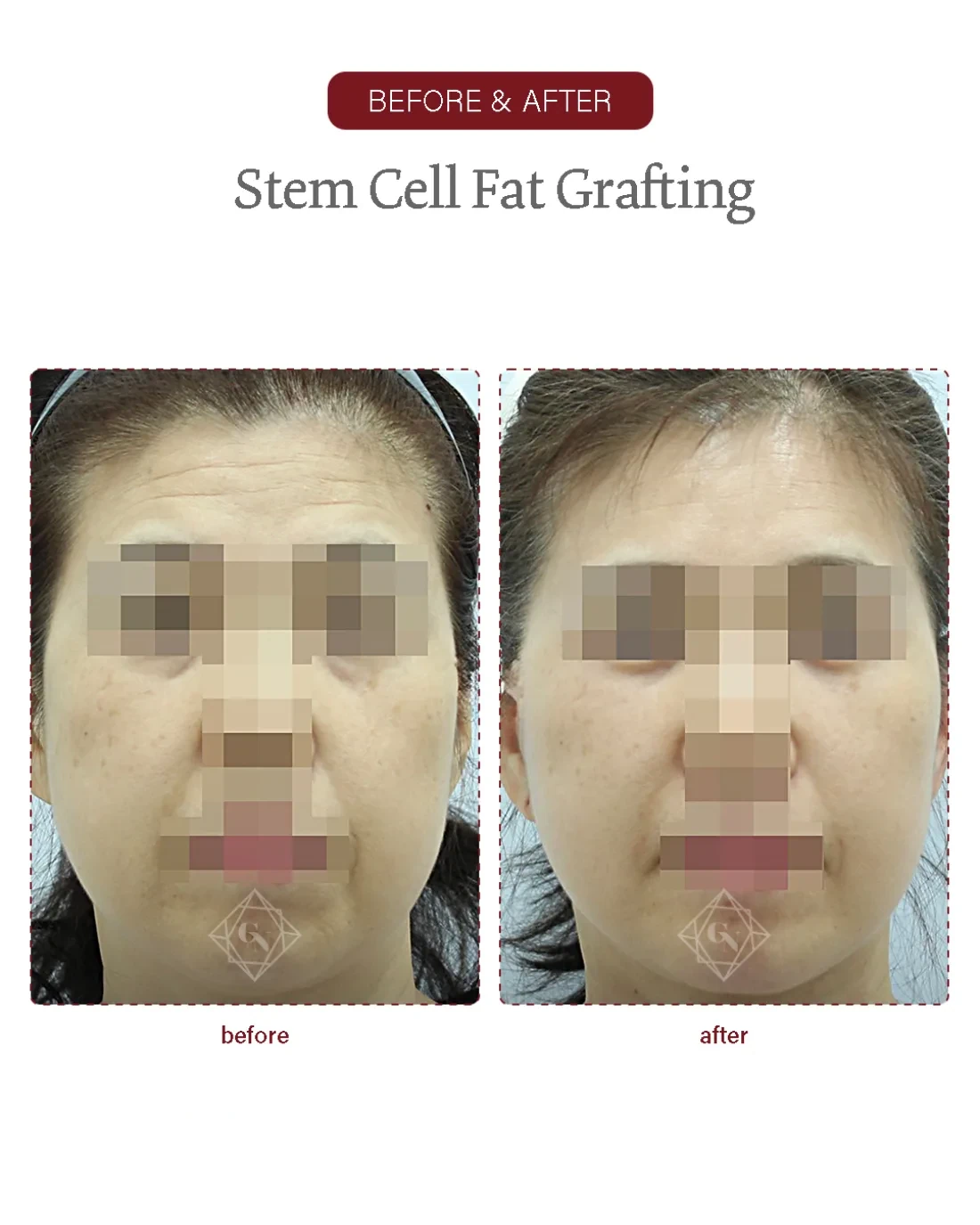
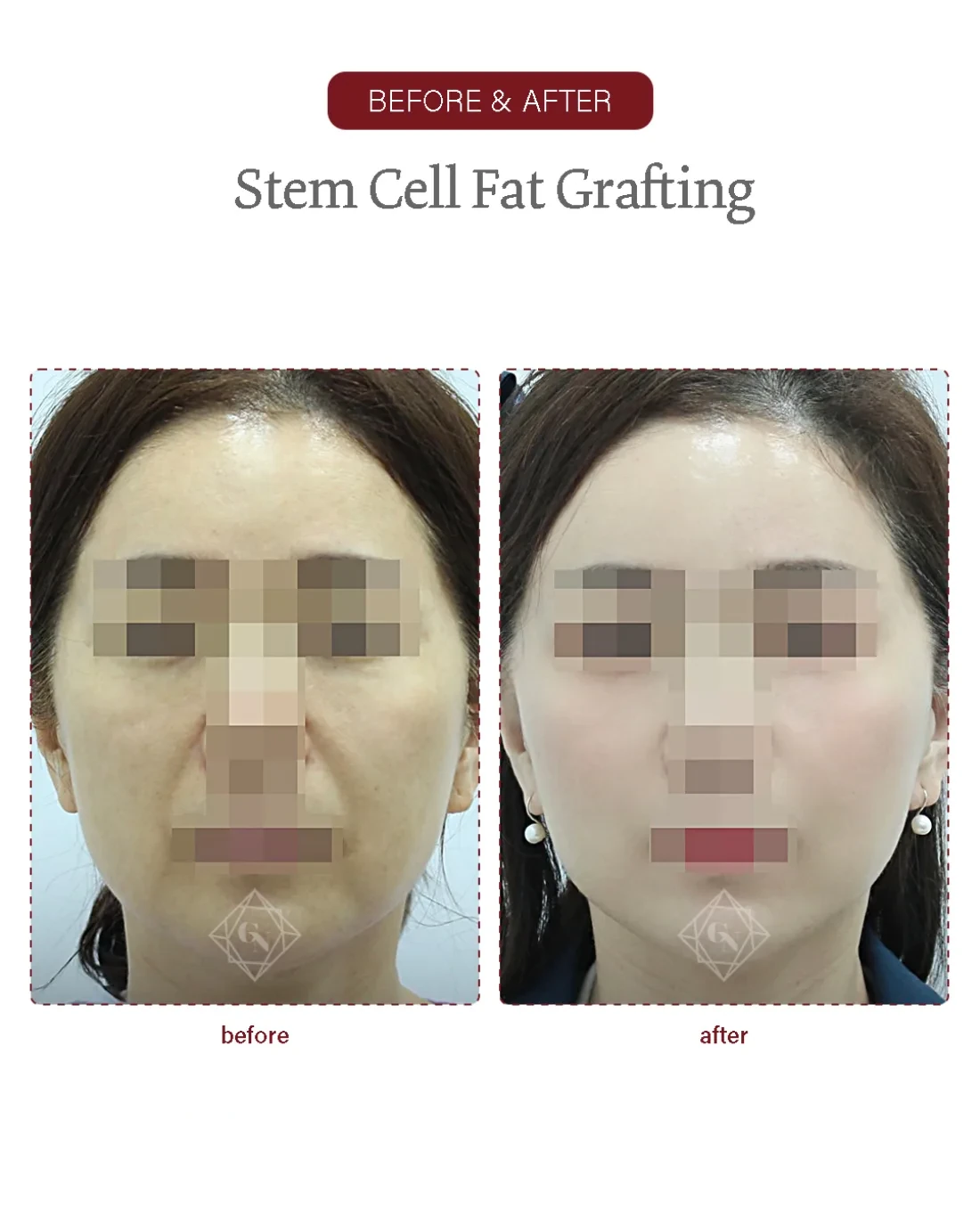
Fat-grafting and contouring results of actual Garnet patients (published with consent, with date, procedure and clinic labelled). Results, the amount of fat retained, recovery and suitability vary by individual and are not guaranteed.
Prices
Price at Garnet
Stem cell fat grafting
From₩3,500,000 + VATExcluding VAT (10% VAT is added at payment)Book now
Same price as Korean patients. Prices shown exclude 10% VAT; your written quote, issued after the in-person consultation, shows the full amount payable.
Dr. In-Soo Baek
Director & sole operating surgeon
Korean medical licence no. 77407
Operate on what you came for. Trained at Korea University Medical Center. Every case planned, performed and reviewed by the same hands.
1Operating surgeon
~2Surgeries per day
7Registered techniques
Board-certified plastic surgeon
Plastic surgery training at Korea University College of Medicine & graduate school
Korean Society of Plastic and Reconstructive Surgeons member, in its facial-contour, eye & rhinoplasty groups
Consults, operates and follows up each case himself
Peer-reviewed papers behind the facts on this page. Each describes findings in its own study group — not results at Garnet — and none predicts your own outcome.
Gontijo-de-Amorim NF et al. Fat Grafting for Facial Contouring Using Mechanically Stromal Vascular Fraction–Enriched Lipotransfer. Clinics in Plastic Surgery. 2020. doi:10.1016/j.cps.2019.08.012
Laloze J et al. Cell‐assisted lipotransfer: Friend or foe in fat grafting? Systematic review and meta‐analysis. Journal of Tissue Engineering and Regenerative Medicine. 2017. doi:10.1002/term.2524
Zhou Y et al. Efficacy and Safety of Cell-Assisted Lipotransfer. Plastic and Reconstructive Surgery. 2016. doi:10.1097/prs.0000000000001981
FAQ
Common questions
How long does stem cell fat grafting last?
The fat that survives the first months establishes its own blood supply and tends to be long-lasting, behaving like the rest of your body's fat. Some transferred fat is reabsorbed early, so the lasting result is the stable volume that remains once the settling phase is complete. It is durable, but it still ages with you.
Is stem cell fat grafting permanent?
It is more accurate to call the retained volume long-lasting than permanent. The fat that takes is living tissue and tends to stay, but it ages with you and can change with significant weight gain or loss, and the face continues to age naturally around it. No responsible clinic guarantees a permanent result.
Why does some of the grafted fat disappear?
Not every transferred fat cell connects to a new blood supply at the recipient site. Cells that do not are gradually reabsorbed in the early weeks, which is a normal part of how a living-tissue graft settles. Surgeons place fat in fine amounts to help more of it survive.
When will I know the final result?
Usually after the first few months. Swelling subsides and some fat is reabsorbed before the volume stabilises, so the appearance at 1 or 2 weeks is not the final result. By around 3 months the picture is typically close to what will remain.
How does its longevity compare to filler?
The surviving portion of a fat graft does not dissolve on a fixed schedule the way dermal filler does, which is its main longevity advantage. Filler is reversible and predictable but temporary; retained grafted fat is durable living tissue. Our fat grafting vs filler guide compares them in detail.
Can my fat grafting result change over time?
Yes. The surviving fat behaves like other body fat: it can change with significant weight gain or loss — and your face continues to age naturally around it. The graft itself is generally stable once settled, but the overall appearance evolves gradually as you age.
Will I need a touch-up?
Some people choose a second, smaller session to refine volume once the first graft has settled, because some reabsorption is part of the process. Whether it is needed depends on how much survived and your goals. A responsible surgeon discusses this possibility before you commit and does not promise one session is enough.
What can I do to help the result last?
Avoid smoking, which impairs the blood supply the graft depends on; keep your weight stable, since the fat responds to weight changes; stay in good general health; and follow after-care and attend follow-ups so the surgeon can see how the graft has settled.
Does Garnet review how the result settles?
Yes. Garnet structures follow-up at 1, 3 and 6 months, matching the settling phase, and the same board-certified surgeon who placed the fat assesses how it has taken. For international patients, the surgeon can continue to review your progress remotely after you return home.
My mom recently had a brow lift and lower blepharoplasty with Dr. Baek, and our experience has been wonderful so far. The Garnet team was incredibly kind and welcoming, with Kelly assisting us as our English consultant—she made everything…
I’m so happy I chose this clinic for my lower blepharoplasty. I was traveling from abroad by myself, so I was a little nervous, but from the beginning I felt comfortable and truly cared for. Everyone was kind, patient, and professional…
Came in for an in-person consult and ended up choosing Garnet and Dr.Baek for my non-incisional DES and tiplasty/alarplasty. I communicated with Kelly (English consultant) from the start till now (3 weeks post-op). She really help me feel…
My under-eyes have been sagging and folding for years... I tried to cover it up with makeup, but it actually got stuck in the wrinkles and made it stand out even more. While going for consultations, I noticed that the bigger the hospital…
Send photos and your question before you travel. An English-speaking coordinator reviews every enquiry and replies with guidance on whether surgery is appropriate, the likely plan and timing.
✓ Reviewed by the clinic coordinator, not a bot
✓ Photo-based pre-assessment before you fly
✓ Foreign-patient scheduling & after-care
✓ One surgeon for consultation, surgery and follow-up
Prefer to chat now? Reach the coordinator directly:









 T S7 months ago



