Fat grafting adds volume using your own fat, harvested from somewhere like the abdomen or thigh and re-injected where it is wanted. The result you see immediately after surgery is not the result you keep, and understanding why is the key to not panicking in the first weeks. The area is deliberately fuller at first, early swelling exaggerates that further, and then a portion of the transferred fat is reabsorbed while the rest establishes itself as lasting volume. This is a realistic, stage-by-stage timeline for when fat grafting results actually appear, grounded in how the procedure is performed at Garnet.
The short answer
Right after surgery the area looks fuller than the final result, partly from deliberate over-correction and partly from early swelling.
Some of the transferred fat is reabsorbed over the first three to six months; the fat that survives becomes lasting volume.
Most of the settling happens by around three months, with the result refining toward its final, stable form by about six months.
The same board-certified surgeon, Dr. In-Soo Baek, reviews how the volume settles at structured follow-ups of 1, 3 and 6 months, including remote check-ins if you have travelled home.
In the first days after fat grafting the treated area looks noticeably fuller than it eventually will, and this surprises people who were not warned. Two things are happening at once. First, the surgeon has deliberately placed more fat than the target volume, because a portion of it will not survive (more on that below). Second, fat grafting causes swelling at both the grafted area and the donor site, and that swelling adds apparent volume that has nothing to do with the fat itself.
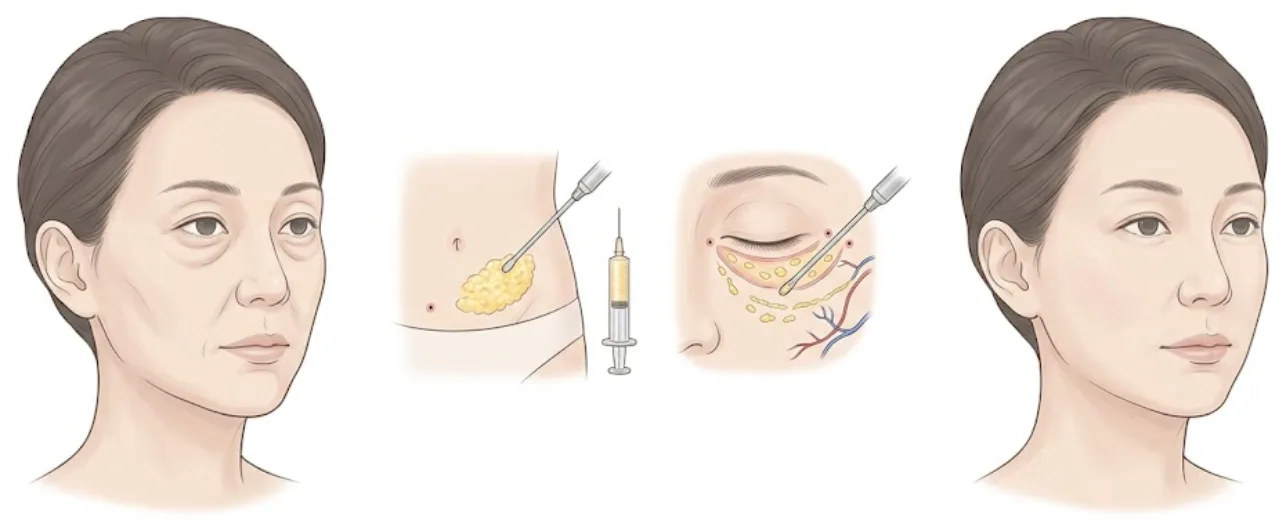
Illustration: the patient's own fat is gently taken from a donor area such as the abdomen, refined, and placed in small amounts where volume has been lost.
The practical consequence is simple: do not judge your result in the first week or two. The area can look over-full, slightly uneven, or different from side to side purely because swelling resolves at its own pace in different places. None of that tells you what the settled result will be. The overview of how the grafting is performed lives on the parent guide, fat grafting in Korea, and the day-by-day of the early phase in fat grafting recovery timeline.
Because Garnet uses PRP-supplemented micro-fat grafting placed in small amounts instead of being over-injected in bulk, the early fullness is controlled. The principle is still the same. The fat needs time to establish a blood supply and the swelling needs time to leave before the real result shows.
Over-correction
Why a surgeon over-corrects on purpose
It feels counter-intuitive that a careful surgeon would intentionally add more fat than the goal, but it is central to how fat grafting works. Not all transferred fat survives the move: a portion of the grafted cells does not establish a new blood supply and is reabsorbed by the body over the following months. To land on the right final volume, the surgeon plans for that reabsorption and places a measured amount of extra fat at the start.
This is why the immediate appearance is not a fair preview. The fullness you see on day one is the planned starting point, and the result settles down from there as the body reabsorbs what it does not keep. A surgeon who places exactly the target volume on the day would end up under-corrected once reabsorption has run its course.
How much over-correction is appropriate depends on the area, the technique and the individual. Delicate regions such as the under-eye and eyelid are treated conservatively, while areas that tolerate more volume can be planned differently. This is the kind of judgement that comes from doing the procedure often, and it is why an assessment of your specific case matters more than any general number.
First month
The first month: swelling resolves and the area looks more natural
Through the first few weeks the early swelling steadily resolves, and this is the most visible change. As it goes, the area stops looking puffy and over-full and begins to look like grafted volume. Bruising at the donor site and the grafted area fades over the same period. By around the one-month mark much of the obvious swelling has gone and the area looks considerably more natural than it did at first.
Swelling resolving and fat reabsorbing are different processes that overlap. Swelling leaving makes the area look slightly smaller, but what is leaving is fluid; the graft is still there. The fat itself is still in the early phase of settling, and the volume continues to change after the swelling has gone. This is why one month is a milestone and the volume is still changing after it.
If you have travelled home, this is the point of your first remote review, where the surgeon checks how things are settling from your photos. The general guidance on recovering away from home is in recovering in Seoul after surgery, and how the international timeline is structured in fat grafting for international patients.
Months 1–6
Months one to six: the fat settles into its final volume
Between roughly one and six months the defining process of fat grafting plays out: the portion of transferred fat that did not establish a blood supply is gradually reabsorbed, while the fat that survived stabilises as lasting volume. Most of this settling happens in the first three months or so, with the change slowing after that as the result approaches its final form. The area gradually softens from the deliberately fuller starting point to the volume you and the surgeon planned for.
This is the stretch where patience matters most, because the volume is genuinely still changing and comparing photos week to week can be misleading. The fat that survives the first few months is, in practical terms, the volume you keep. That is what makes fat grafting longer-lasting than temporary fillers. How long that retained volume holds is covered in how long fat grafting lasts.
Because some reabsorption is expected, the final volume is sometimes a little less than the immediate post-surgery fullness. That is by design. If, once everything has settled, a touch more volume is wanted, a small top-up can be considered. That is a decision made together at the later reviews, and nobody assumes it in advance.
Final volume
The final, settled fat graft volume and what you keep
By around six months the result has settled close to its final, stable form. The swelling is long gone, the reabsorption has largely run its course, and what remains is the grafted volume your body has kept and integrated. Because it is your own living tissue with its own blood supply, that volume behaves naturally. It is integrated fat that ages with you, unlike a static filler sitting in place.
Set your expectations against this settled point at around six months. A natural, softer contour that has matured over months is the goal of fat grafting, and it tends to look and feel more like your own face or body than an injected material does. For how this compares with a temporary, faster-acting option, see fat grafting vs dermal filler.
A good surgeon tells you up front that you are trading a slightly longer wait and a degree of unpredictability in survival for a result that lasts and looks like you. Knowing that at the start makes the months of settling feel like a process you expected.
Follow-up
Follow-up at 1, 3 and 6 months
Because the result of fat grafting evolves over months, structured follow-up is how that is managed well. Garnet reviews patients at 1, 3 and 6 months, which maps directly onto the settling timeline: at one month the swelling has largely resolved; at three months much of the reabsorption has happened and the volume is clearer; and at six months the result has settled close to its final form. Each review is a checkpoint against what you and the surgeon planned.
For international patients these reviews continue remotely after you fly home. You send photos so the surgeon can see how the volume is settling, raise any concerns about evenness or amount, and, once everything has settled, discuss whether a small top-up is worth considering. None of that is rushed or assumed; it is a conversation across the later reviews.
This continuity is the practical advantage of a single-surgeon clinic: the surgeon who planned and performed your grafting is the same one assessing how it settles months later. If you are weighing fat grafting from abroad, you can begin with an online consultation before you commit to any travel.
Dr. In-Soo Baek
Director & sole operating surgeon
Korean medical licence no. 77407
Operate on what you came for. Trained at Korea University Medical Center. Every case planned, performed and reviewed by the same hands.
1Operating surgeon
~2Surgeries per day
7Registered techniques
Board-certified plastic surgeon
Plastic surgery training at Korea University College of Medicine & graduate school
Korean Society of Plastic and Reconstructive Surgeons member, in its facial-contour, eye & rhinoplasty groups
Consults, operates and follows up each case himself
Peer-reviewed papers behind the facts on this page. Each describes findings in its own study group — not results at Garnet — and none predicts your own outcome.
Trepsat F. Periorbital Rejuvenation Combining Fat Grafting and Blepharoplasties. Aesthetic Plastic Surgery. 2003. doi:10.1007/s00266-003-2126-y
Hassan A et al. Autologous Fat Grafting Versus Facial Fillers in Facial Cosmesis: A Systematic review and Meta-analysis. Aesthetic Plastic Surgery. 2026. doi:10.1007/s00266-026-06132-3
Deane EC et al. Fat Grafting the Male Face. Facial Plastic Surgery Clinics of North America. 2024. doi:10.1016/j.fsc.2024.03.003
FAQ
Common questions
When will I see the final results of fat grafting?
Around six months, once the swelling has fully resolved and the reabsorption of the grafted fat has run its course. Most of the settling happens in the first three months, with the result then refining toward its final, stable form. The immediate post-surgery fullness is not the result you keep.
Why does the area look fuller right after surgery?
Two reasons. The surgeon deliberately over-corrects, placing extra fat because a portion will be reabsorbed, and early swelling adds further apparent volume. Both settle over the following weeks to months, so the area looks fuller at first than it eventually will.
How does the result of fat grafting change over time?
It settles downward from the fuller starting point. Swelling resolves over the first weeks, then between roughly one and six months a portion of the transferred fat is reabsorbed while the rest stabilises as lasting volume. The fat that survives the first few months is the volume you keep.
When is swelling gone after fat grafting?
Most of the obvious swelling resolves over the first few weeks, with the area looking considerably more natural by around one month. Some residual swelling can linger a little longer, and it is a different process from the fat reabsorbing, which continues for months afterwards.
How much of the grafted fat survives?
A portion of the transferred fat establishes a new blood supply and becomes lasting volume, while the rest is reabsorbed over the first months. This is why surgeons deliberately over-correct, and why the final volume is somewhat less than the immediate post-surgery fullness. The exact amount varies by area and individual.
Why do surgeons over-correct fat grafting?
Because not all transferred fat survives. To land on the right final volume after reabsorption, the surgeon plans for that loss and places a measured amount of extra fat at the start. Placing exactly the target volume on the day would leave the area under-corrected once settling is complete.
Might I need a top-up after fat grafting?
Sometimes. Once the result has fully settled at around six months, if a little more volume is wanted, a small top-up can be considered. That is a decision made together at the later reviews, and it depends on how your individual result settles.
Is the final fat grafting result permanent?
The fat that survives the first few months becomes lasting, integrated volume that behaves like your own tissue and ages with you, which is why fat grafting outlasts temporary fillers. How long that retained volume holds is covered in the dedicated guide on how long fat grafting lasts.
How does follow-up track the result?
Garnet reviews patients at 1, 3 and 6 months, which matches the settling timeline. For international patients these continue remotely by messenger, with the same surgeon checking how the volume is settling from your photos and discussing whether the result is where you both expected.
My mom recently had a brow lift and lower blepharoplasty with Dr. Baek, and our experience has been wonderful so far. The Garnet team was incredibly kind and welcoming, with Kelly assisting us as our English consultant—she made everything…
I’m so happy I chose this clinic for my lower blepharoplasty. I was traveling from abroad by myself, so I was a little nervous, but from the beginning I felt comfortable and truly cared for. Everyone was kind, patient, and professional…
Came in for an in-person consult and ended up choosing Garnet and Dr.Baek for my non-incisional DES and tiplasty/alarplasty. I communicated with Kelly (English consultant) from the start till now (3 weeks post-op). She really help me feel…
My under-eyes have been sagging and folding for years... I tried to cover it up with makeup, but it actually got stuck in the wrinkles and made it stand out even more. While going for consultations, I noticed that the bigger the hospital…
To see what your fat grafting result could look like once it settles, send photos for a no-obligation pre-assessment and we'll walk you through the realistic timeline for your case.
Send photos and your question before you travel. An English-speaking coordinator reviews every enquiry and replies with guidance on whether surgery is appropriate, the likely plan and timing.
✓ Reviewed by the clinic coordinator, not a bot
✓ Photo-based pre-assessment before you fly
✓ Foreign-patient scheduling & after-care
✓ One surgeon for consultation, surgery and follow-up
Prefer to chat now? Reach the coordinator directly:









 T S7 months ago



