Fat grafting is unusual because it has two recovery sites: the area where fat is taken (usually the abdomen or thigh) and the area where it is placed (the under-eye, love-band or eyelid). Both are gentle compared with major surgery, but they settle on slightly different timelines. A good part of the fullness you see in the first weeks is swelling that will come down.
The short answer
Fat grafting heals at two sites, a small harvest area on the abdomen or thigh and the grafted facial area, and there is no incision scar line, because fat is taken and placed through fine cannula access points.
Most visible swelling settles within 1–2 weeks; the grafted area looks fuller at first because it is over-corrected to allow for the fat that the body naturally reabsorbs.
There are no sutures to remove from the graft sites, which keeps after-care simple and travel-friendly for international patients.
The same surgeon who operates reviews your recovery, with structured follow-ups at 1, 3 and 6 months, when the true, settled result becomes clear.
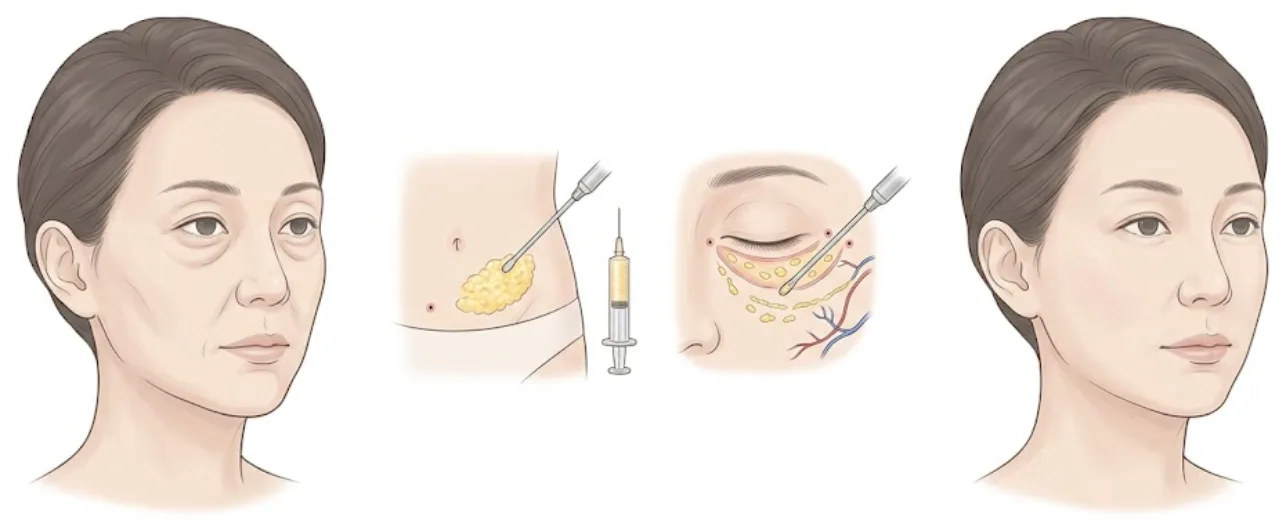
Most facial procedures have a single recovery site. Fat grafting has two, because it moves your own tissue from one place to another. At Garnet, fat is harvested from a donor area, usually the abdomen or thigh, and then, after being prepared as micro-fat and supplemented with PRP, it is placed into the target area, such as the under-eye, the love-band or the eyelid. Both steps are done through fine cannula access points with no open incisions, so there is no scar line to heal and no stitches to remove from the graft.
Illustration: the patient's own fat is gently taken from a donor area such as the abdomen, refined, and placed in small amounts where volume has been lost.
The two sites recover on slightly different rhythms. The harvest area behaves like a small liposuction site: it can feel tender, bruised and a little firm for a week or two, much like a deep gym ache. The grafted facial area swells more visibly but is rarely painful. It feels tight and full more than sore. Knowing that you are healing in two places, on two clocks, is the key to reading your own recovery calmly.
Because the technique is closed and uses your own fat, the recovery is genuinely gentler than the word "surgery" suggests for many patients. The trade-off is patience: the fat needs time to settle and establish its own blood supply, and only a portion of what is placed survives long term. That is exactly why the grafted area is deliberately over-filled at first.
Day by day
Fat grafting recovery, day by day
Day of surgery: You leave with the grafted area looking noticeably fuller than the final result. This is intentional over-correction plus early swelling. The harvest area may be wrapped or supported. You can usually walk out the same day; fat grafting is typically done under local anaesthesia with light sedation, without general anaesthesia.
Days 1–3: Swelling at the grafted area peaks. The under-eye or cheek can look puffy and the harvest site feels tender and bruised. Mild oozing or a small bruise at a cannula point is normal. Keep your head elevated, use cold compresses gently as advised, and rest. Pain is usually managed with simple medication and is most noticeable at the harvest area on the abdomen or thigh.
Days 4–7: The sharpest swelling begins to ease. Bruising changes colour (red to purple to yellow-green) as it resolves. This colour change is part of healing. Many patients feel socially presentable enough for low-key activity by the end of the first week, though the grafted area still looks fuller than it eventually will. There are no sutures to remove from the graft, so this milestone is about swelling alone.
First weeks
Weeks one to six: the fat settles
Week 2: Most of the obvious swelling has gone and the harvest area is much less tender. People who do not know you had a procedure often will not notice. This is usually when international patients feel comfortable flying home, though your surgeon will confirm this for your specific case.
Weeks 3–6: The grafted area continues to shed its early fullness as residual swelling resolves and the body reabsorbs the fat it will not keep. It is completely normal for the area to look like it is "shrinking" during this window. You are watching the over-correction come down toward the real result while the graft stays. Avoid heavy pressure, vigorous massage or aggressive heat on the grafted area while the fat establishes its blood supply.
Around 6 weeks onward: The surviving fat has largely settled into living tissue. What remains now tends to stay, because it is your own fat with its own blood supply. It is not a temporary product. The final, settled contour becomes clear over the following months, which is why the surgeon's later reviews matter as much as the early ones. You can read more about durability in our guide on how long fat grafting lasts.
What is normal
What is normal during recovery
A number of things look alarming but are an expected part of fat grafting. Over-fullness in the grafted area for the first few weeks is normal and planned: the area is intentionally over-corrected because a predictable share of the transferred fat is reabsorbed. Asymmetry during healing is also common, because the two sides do not always swell or settle at exactly the same pace; this usually evens out as the swelling resolves.
At the harvest area, expect bruising, mild firmness and a sensation like a deep ache or pulled muscle for one to two weeks. Small areas of numbness or tingling at either site can come and go as nerves recover. Slight oozing from a cannula access point in the first day or two is normal, as is the bruise's colour changing as it fades. None of this means the graft is failing.
If you are unsure whether something is normal, the simplest reassurance is direct access to the surgeon who operated on you. Because Garnet is a single-surgeon clinic, the same doctor who performed your fat grafting reviews your recovery and can advise you by messenger after you travel home, so you are not left guessing.
Red flags
Red flags worth contacting your surgeon about
Most fat grafting recoveries are uneventful, but a short list of signs is worth flagging early. Increasing (instead of decreasing) pain, redness or warmth at the grafted or harvest area after the first few days, spreading redness, or fever can suggest infection and should be reported promptly. Pus, foul-smelling discharge, or a hard, hot, expanding lump is not part of normal healing.
Sudden, marked asymmetry, a firm painful lump that grows, skin colour changes that look dusky more than bruised, or numbness that is severe and worsening when it should be mild and fading, all deserve a message to your surgeon. These are uncommon, but they are exactly the situations where having the operating surgeon contactable, with no call centre in between, makes a real difference.
Red flags are rare, but you should know who answers when you have one. Before you book, confirm who manages a complication and how after-care works once you are back home — questions we cover for international patients in our guide to recovering in Seoul after surgery.
Follow-up
Follow-up, flying home and the 1/3/6-month reviews
For many international patients the practical question is when they can fly. Fat grafting is gentle enough that short-haul travel is often comfortable within several days, and most patients are ready for a long flight home around the two-week mark once the main swelling has settled. This depends on your case, and your surgeon confirms the timing for you; no generic rule applies. General guidance on air travel after surgery is covered in our guide on when you can fly after plastic surgery.
Garnet structures after-care around reviews at 1, 3 and 6 months, performed by Dr. In-Soo Baek, the same board-certified plastic surgeon who consults and operates. The 1-month review checks early settling; by 3 months most of the reabsorption is complete; and the 6-month review is when the true, stable result is assessed. That matters for fat grafting specifically, because the final volume is only clear once the surviving fat has fully established itself.
If you have travelled home before these milestones, the reviews continue remotely, with photos and messenger guidance, so distance does not interrupt your follow-up. Because one surgeon owns the whole arc (consultation, surgery and every review), the person assessing your result is the person who created it. You can start with a no-obligation online consultation before you plan travel.
Dr. In-Soo Baek
Director & sole operating surgeon
Korean medical licence no. 77407
Operate on what you came for. Trained at Korea University Medical Center. Every case planned, performed and reviewed by the same hands.
1Operating surgeon
~2Surgeries per day
7Registered techniques
Board-certified plastic surgeon
Plastic surgery training at Korea University College of Medicine & graduate school
Korean Society of Plastic and Reconstructive Surgeons member, in its facial-contour, eye & rhinoplasty groups
Consults, operates and follows up each case himself
Peer-reviewed papers behind the facts on this page. Each describes findings in its own study group — not results at Garnet — and none predicts your own outcome.
Lin TM et al. Fat Grafting for Facial Contouring (Nose and Chin). Clinics in Plastic Surgery. 2020. doi:10.1016/j.cps.2019.08.009
Ohashi M. Fat Grafting for Facial Rejuvenation with Cryopreserved Fat Grafts. Clinics in Plastic Surgery. 2020. doi:10.1016/j.cps.2019.08.007
Trepsat F. Periorbital Rejuvenation Combining Fat Grafting and Blepharoplasties. Aesthetic Plastic Surgery. 2003. doi:10.1007/s00266-003-2126-y
FAQ
Common questions
How long does fat grafting recovery take?
Most visible swelling from facial fat grafting settles within one to two weeks, and the harvest area on the abdomen or thigh feels much better over the same period. There are no graft sutures to remove. The final, settled result becomes clear over the following months as the surviving fat establishes itself, which is why follow-ups continue at 1, 3 and 6 months.
What is fat grafting recovery like day by day?
Swelling at the grafted area peaks in the first 1 to 3 days, then eases noticeably between days 4 and 7. By week two most obvious swelling is gone. Over weeks 3 to 6 the grafted area looks like it is shrinking as planned over-correction comes down and the body reabsorbs the fat it will not keep. This is normal and does not mean the result is lost.
Why does the grafted area look too full at first?
The area is deliberately over-corrected because a predictable share of transferred fat is naturally reabsorbed in the weeks after surgery. The early fullness is a mix of that intentional over-fill and ordinary swelling. It settles toward the true result over the first one to two months, so you should not judge the outcome in the first weeks.
When can I return to work after fat grafting?
Many patients feel presentable enough for low-key, non-physical work around the end of the first week, when the sharpest swelling and bruising have eased. If your work is physically demanding or involves pressure or heat on the treated areas, you may want a little longer. Your surgeon will give guidance based on your specific job and recovery.
Are there stitches to remove after fat grafting?
No. Fat is taken and placed through fine cannula access points, with no open incisions, so there is no scar line and there are no graft sutures to remove. This keeps after-care simple and is one reason fat grafting recovery is comparatively travel-friendly for international patients.
When can I fly home after fat grafting?
Short trips are often comfortable within several days, and most international patients are ready for a long flight home around two weeks, once the main swelling has settled. This depends on your individual case, so the operating surgeon confirms it for you. See our guide on flying after surgery for general timing.
What aftercare follows fat grafting?
Keep your head elevated early on, use cold compresses gently as advised, and avoid heavy pressure, vigorous massage or aggressive heat on the grafted area while the fat establishes its blood supply. Look after the harvest area as you would a small liposuction site. Your surgeon provides specific instructions and reviews you at 1, 3 and 6 months.
Does swelling go up and down during recovery?
Yes. Some day-to-day fluctuation in swelling, and temporary asymmetry between the two sides, is normal during healing because the sides do not always settle at the same pace. This usually evens out as swelling resolves. Steadily increasing pain, redness, warmth or fever is different and should be reported to your surgeon promptly.
Who looks after my recovery if I have travelled home?
At a single-surgeon clinic the operating surgeon manages your recovery, and Garnet continues your 1, 3 and 6-month reviews remotely with photos and messenger guidance once you return home. Because the same board-certified surgeon consults, operates and follows up, the person assessing your healing is the person who performed the surgery.
When will I see the final fat grafting result?
The true, stable result is usually clear by around six months, once residual swelling has resolved and the surviving fat has fully established its blood supply. The 6-month review is specifically when this settled outcome is assessed. For more on durability, see our guide on how long fat grafting lasts.
My mom recently had a brow lift and lower blepharoplasty with Dr. Baek, and our experience has been wonderful so far. The Garnet team was incredibly kind and welcoming, with Kelly assisting us as our English consultant—she made everything…
I’m so happy I chose this clinic for my lower blepharoplasty. I was traveling from abroad by myself, so I was a little nervous, but from the beginning I felt comfortable and truly cared for. Everyone was kind, patient, and professional…
Came in for an in-person consult and ended up choosing Garnet and Dr.Baek for my non-incisional DES and tiplasty/alarplasty. I communicated with Kelly (English consultant) from the start till now (3 weeks post-op). She really help me feel…
My under-eyes have been sagging and folding for years... I tried to cover it up with makeup, but it actually got stuck in the wrinkles and made it stand out even more. While going for consultations, I noticed that the bigger the hospital…
Send photos and your question before you travel. An English-speaking coordinator reviews every enquiry and replies with guidance on whether surgery is appropriate, the likely plan and timing.
✓ Reviewed by the clinic coordinator, not a bot
✓ Photo-based pre-assessment before you fly
✓ Foreign-patient scheduling & after-care
✓ One surgeon for consultation, surgery and follow-up
Prefer to chat now? Reach the coordinator directly:









 T S7 months ago



