Fat grafting, which moves your own fat from the abdomen or thigh into the face, has an unusual answer to "how long does it last?": part of it is temporary and part of it is lasting, and the split is different for every patient. Understanding which part is which, and why no surgeon can guarantee a survival rate, is the key to having realistic expectations about your result.
The short answer
Not all grafted fat survives. A portion is naturally reabsorbed in the first few months while the rest establishes its own blood supply.
The fat that survives those first months tends to be lasting, because it becomes living tissue integrated into your face.
No surgeon can guarantee a fixed survival percentage; it varies with your tissue, technique, the area and your aftercare.
The lasting result still ages and responds to weight change, so it is a durable restoration. It does not freeze your face permanently.
Why fat grafting has a temporary phase and a lasting phase
Fat grafting is different from a filler injection, where the product simply sits and then dissolves over a known period. With grafting, your own fat is harvested through a fine cannula from the abdomen or thigh, processed into small parcels, and placed into the face. From that moment it has to survive. Transferred fat has no blood supply of its own at first, so in the early weeks it depends on the surrounding tissue while it grows new vessels. Some of the grafted fat manages this; some does not and is reabsorbed by the body.
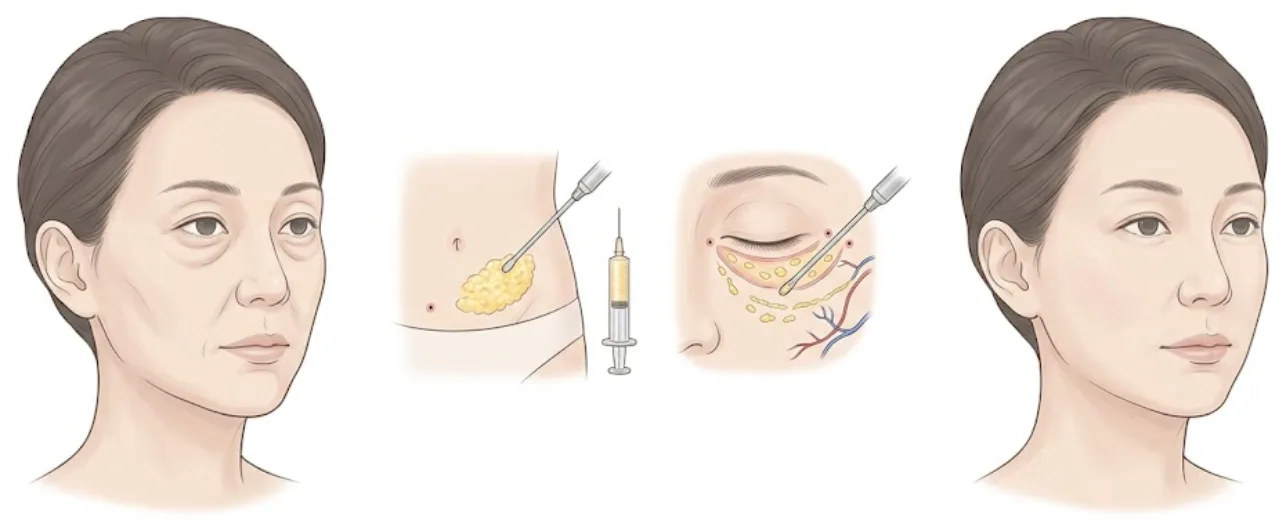
Illustration: the patient's own fat is gently taken from a donor area such as the abdomen, refined, and placed in small amounts where volume has been lost.
That is why the result you see in the first days is not the result you keep. Initial swelling makes the area look fuller than the true outcome, and over the following weeks both the swelling and the portion of fat that did not take settle down. The face then reaches a stable point, usually within a few months, where what remains is the established graft.
So the realistic way to think about longevity is in two phases: an early settling phase, where the volume reduces from its swollen peak and the non-surviving fat is cleared, and a lasting phase, where the surviving fat behaves like the rest of your facial tissue. The recovery timeline guide walks through that settling in more detail, and when you will see results covers when the picture is finally clear.
What survives
What survives, and why it then lasts
The key point is what happens to the fat that does take. Once a parcel of grafted fat establishes its own blood supply in the first months, it is living tissue integrated into your face, with nothing left to dissolve. That surviving portion is, in the ordinary sense, lasting: it does not have an expiry date the way filler does, and it is the reason patients describe fat grafting as a one-time restoration instead of a maintenance cycle.
How much of a graft survives depends on several things working together: the gentleness of the harvest, how the fat is processed, placing it in small parcels so each has access to a blood supply (large pockets are avoided), and the area treated. Well-vascularised, stable areas tend to hold fat more reliably than mobile or thin-skinned ones, which is part of why under-eye and eyelid grafting is approached so carefully. At Garnet the micro-fat is also PRP-supplemented, a technique intended to support the grafted tissue in those early weeks.
Because survival is established early, the practical takeaway is reassuring: if your result is stable at the three-to-six-month mark, that volume is the part you can expect to keep over the long term, barring the normal effects of ageing and weight change. It will not gradually melt away over a year the way a temporary filler would. You can compare this directly with the temporary model in the fat grafting versus filler guide.
No guarantee
Why no surgeon guarantees a fat survival rate
You will sometimes see specific survival percentages quoted as if they were fixed. No surgeon can guarantee exactly how much of your graft will survive, because it varies from person to person and area to area. Your own tissue quality and blood supply, the area being treated, the volume placed, whether you smoke, your aftercare and how your body responds all influence the outcome, and these cannot be fully known in advance.
This is the nature of working with living tissue. A clinic that promises a precise survival figure or a permanent result is overstating what is knowable. What a careful surgeon can do is plan for the reabsorption that always happens, judging the volume and technique to leave a good, natural result once the settling is complete. A careful surgeon will also tell you plainly that the final amount settles over the first months.
It also means realistic expectations are part of a good outcome. The aim is a natural restoration that you keep; a guaranteed number is not on offer. If a particular area takes less fat than hoped, it can usually be addressed with a conservative touch-up later, which is a normal part of how grafting is planned. It does not mean something went wrong. You can discuss what is realistic for your face in an online consultation.
Lasting result
How the lasting result behaves over the years
Once your result has settled, the surviving fat lives in your face like any other tissue, which has two consequences worth understanding. The first is durability: it is not on a dissolving clock, so the restoration genuinely lasts and many patients are happy with a single procedure for years. The second is that, because it is living fat, it still ages and still responds to your body. It restores volume durably, but it does not freeze how you look today.
Weight change is the clearest example. Grafted fat behaves like the fat it came from, so noticeable weight gain can make the treated areas fuller and significant weight loss can reduce the volume. For that reason a stable weight gives the most predictable long-term result. The natural ageing process also continues. The face will keep maturing over the years; grafting restores lost volume and does not stop the clock.
None of this undermines the value of a lasting graft; it simply frames it accurately. For most patients the surviving fat provides a soft, natural fullness that endures far beyond what a temporary option would, while still moving and ageing with them so it never looks frozen. Whether that durable restoration is the right choice for your concern is something the candidacy guide can help you judge.
Touch-up
When a touch-up or second session is considered
Because a portion of every graft is reabsorbed, some patients choose a second, smaller session to build a little more volume once the first has fully settled. This is a planned, normal part of grafting and not a failure. It is usually considered only after the result is stable, around several months in, so the surgeon can judge exactly how much extra, if any, would help. For many patients no touch-up is needed at all; for others a modest top-up refines the outcome.
Over the longer term, some people return years later for a small refresh as natural ageing continues to thin the face, much as they might have done with the original concern. This is different from filler maintenance. The graft has not "worn off"; the face has continued to age around a result that itself remains. The decision is always elective and based on what you see and want; there is no fixed schedule.
If you are travelling from abroad, it is sensible to plan the first procedure well and then assess the settled result before deciding whether anything further is worthwhile. The same surgeon who performs your grafting reviews you at one, three and six months, so the question of a touch-up is answered with your actual outcome in front of you. The international patients guide covers how that review works once you are home.
At Garnet
How Garnet plans for fat graft longevity
Garnet is a single-surgeon clinic in Apgujeong, Seoul. Dr. In-Soo Baek is a board-certified plastic surgeon (Korean medical licence no. 77407) and the only operating doctor, so he consults, harvests and places the fat himself, and reviews every follow-up. Because survival depends so much on how gently the fat is handled and placed, having one experienced surgeon carry out the whole process, with no division across staff, is central to a durable result.
The clinic uses a PRP-supplemented micro-fat technique, with fat placed in small parcels to give each the ideal access to a blood supply. The volume is planned to allow for the reabsorption that always occurs, so the settled result looks natural and not over-filled. Garnet does not promise a survival percentage or a permanent outcome; it sets a realistic expectation and reviews the settling result at 1, 3 and 6 months.
Garnet is registered with Korea's foreign-patient programme, and the same surgeon who operates continues to review international patients after they return home. You can send photos for a no-obligation pre-assessment of what fat grafting could realistically achieve and how long it could last for you, through an online consultation.
Dr. In-Soo Baek
Director & sole operating surgeon
Korean medical licence no. 77407
Operate on what you came for. Trained at Korea University Medical Center. Every case planned, performed and reviewed by the same hands.
1Operating surgeon
~2Surgeries per day
7Registered techniques
Board-certified plastic surgeon
Plastic surgery training at Korea University College of Medicine & graduate school
Korean Society of Plastic and Reconstructive Surgeons member, in its facial-contour, eye & rhinoplasty groups
Consults, operates and follows up each case himself
Peer-reviewed papers behind the facts on this page. Each describes findings in its own study group — not results at Garnet — and none predicts your own outcome.
Strong AL et al. Technical Precision with Autologous Fat Grafting for Facial Rejuvenation: A Review of the Evolving Science. Plastic & Reconstructive Surgery. 2023. doi:10.1097/prs.0000000000010643
Marten T et al. Periorbital Fat Grafting. Facial Plastic Surgery Clinics of North America. 2021. doi:10.1016/j.fsc.2021.02.003
Chen HH et al. Lipotransfer in the upper third of the face. Current Opinion in Otolaryngology & Head and Neck Surgery. 2011. doi:10.1097/moo.0b013e32834896a0
FAQ
Common questions
How long does fat grafting last?
Part of the graft is temporary and part is lasting. A portion of the transferred fat is reabsorbed in the first few months, but the fat that survives establishes its own blood supply and becomes living tissue in your face, which is durable. Once your result is stable at three to six months, that volume is the part you can expect to keep over the long term.
Is fat grafting permanent?
The surviving fat is lasting, though not strictly permanent. It does not dissolve on a clock the way filler does, so it endures for years, but because it is living tissue it still ages and responds to weight change. It is best described as a durable restoration of lost volume.
What percentage of grafted fat survives?
No surgeon can guarantee an exact percentage, because it varies with your tissue quality, blood supply, the area treated, the volume placed, whether you smoke and your aftercare. A careful surgeon plans for the reabsorption that always happens so the settled result looks natural. A fixed figure is not promised.
Why does some grafted fat disappear?
Transferred fat has no blood supply of its own at first, so in the early weeks it depends on the surrounding tissue while it grows new vessels. The fat that manages this survives; the portion that does not is reabsorbed by the body. This is why the volume reduces from its swollen early peak to a stable result over a few months.
When will I know the final result?
Usually within a few months. The early swelling makes the area look fuller than the true outcome, and over the following weeks both the swelling and the non-surviving fat settle. The picture is generally clear by around three to six months, which is when the lasting volume can be judged.
Will I need fat grafting redone?
Not always. Because a portion is reabsorbed, some patients choose a smaller second session once the first has settled to build a little more volume, while many need none at all. Years later some people have a small refresh as natural ageing continues. The decision is elective and based on your settled result.
Does weight change affect how long it lasts?
Yes. Grafted fat behaves like the fat it came from, so significant weight gain can make treated areas fuller and weight loss can reduce the volume. A stable weight gives the most predictable long-term result, so it is best to be at a steady weight before grafting.
Does fat grafting last longer than filler?
Generally, yes, for the surviving portion. Filler is gradually dissolved by the body over a known period and needs repeating, whereas the fat that takes becomes living tissue and is durable. That is why fat grafting suits patients who want a one-time restoration without ongoing top-ups, though it involves surgery and a recovery period that filler does not.
My mom recently had a brow lift and lower blepharoplasty with Dr. Baek, and our experience has been wonderful so far. The Garnet team was incredibly kind and welcoming, with Kelly assisting us as our English consultant—she made everything…
I’m so happy I chose this clinic for my lower blepharoplasty. I was traveling from abroad by myself, so I was a little nervous, but from the beginning I felt comfortable and truly cared for. Everyone was kind, patient, and professional…
Came in for an in-person consult and ended up choosing Garnet and Dr.Baek for my non-incisional DES and tiplasty/alarplasty. I communicated with Kelly (English consultant) from the start till now (3 weeks post-op). She really help me feel…
My under-eyes have been sagging and folding for years... I tried to cover it up with makeup, but it actually got stuck in the wrinkles and made it stand out even more. While going for consultations, I noticed that the bigger the hospital…
Want a realistic view of what fat grafting could achieve and how long it could last for your face? Send photos for a no-obligation pre-assessment before you plan a trip.
Send photos and your question before you travel. An English-speaking coordinator reviews every enquiry and replies with plain guidance on whether fat grafting is appropriate for you, the likely plan and timing.
✓ Reviewed by the clinic coordinator, not a bot
✓ Photo-based pre-assessment before you fly
✓ Foreign-patient scheduling & after-care
✓ One surgeon for consultation, surgery and follow-up
Prefer to chat now? Reach the coordinator directly:









 T S7 months ago



