Fat grafting takes fat from your own body, usually the abdomen or thigh, and re-injects it where you want softer volume, such as under the eyes, the temples or a hollow love-band. It is one of the more travel-friendly procedures for international patients: the in-person stay is relatively short, much of the assessment can begin online before you fly, and the part that takes time (settling and final volume) happens at home over the months that follow. This guide walks through the practicalities of getting fat grafting in Korea from abroad, grounded in how the procedure is actually performed at Garnet.
The short answer
You can begin from abroad with an online consultation and photos, so the surgeon gives a pre-assessment before you commit to travel.
Plan a relatively short stay in Seoul. The procedure itself uses cannula access with no scar line, and the in-person time centres on consultation, surgery and a short review.
Because some grafted fat is reabsorbed over the first months, the result keeps settling after you fly home, which makes remote follow-up part of the plan from the start.
The same board-certified surgeon, Dr. In-Soo Baek, consults, operates and reviews your recovery at structured follow-ups of 1, 3 and 6 months, including remote check-ins once you have travelled home.
For an international patient the sensible first step is an online consultation, well before any flight. You send clear photos of the area you want treated, describe what is bothering you and what you hope for, and the surgeon gives a genuine pre-assessment: whether fat grafting is the right approach for you, what it can realistically achieve, and what it cannot. Fat grafting is well suited to softening hollows and adding gentle volume (under the eyes, the temples, a love-band) using your own tissue, so the early conversation is about whether your concern fits that.
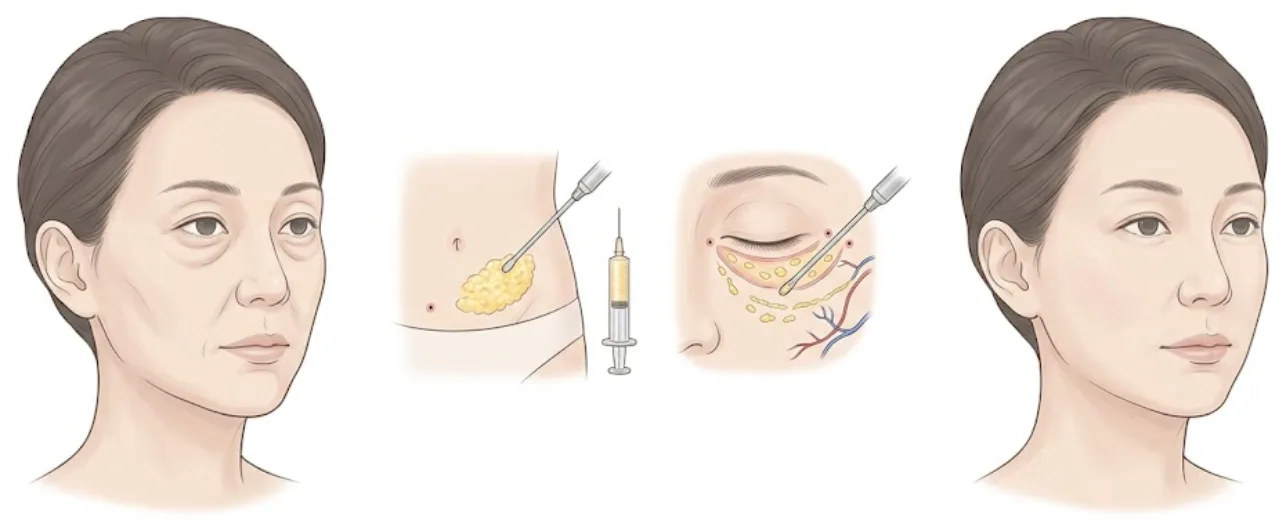
Illustration: the patient's own fat is gently taken from a donor area such as the abdomen, refined, and placed in small amounts where volume has been lost.
This matters more for fat grafting than for some procedures, because the right answer is sometimes a different one. Filler may suit a small, temporary correction; fat grafting suits someone who wants a longer-lasting, natural result and is willing to accept that a portion of the transferred fat reabsorbs. The online assessment sorts this out before you have booked a single flight. You can compare the two approaches in fat grafting vs dermal filler.
A good online consultation also tells you who you are dealing with. Ask whether the surgeon you are speaking with is the one who will operate, how the harvest and grafting are done, and how follow-up works once you are home. The full overview of the procedure itself lives on the parent guide, fat grafting in Korea; you can start the conversation through an online consultation from abroad.
How long to stay
How long should you stay in Korea?
Fat grafting is on the shorter end of the stay spectrum. The procedure uses cannula access: a fine cannula harvests fat from the abdomen or thigh and places it where it is needed. There is no long incision line to manage, and the downtime is driven mainly by swelling and bruising. No wound needs weeks of care. That keeps the necessary in-person time relatively compact compared with a major lifting operation.
A realistic plan still leaves room either side of the procedure: a day or two before for your in-person consultation and surgery, then several days afterwards for the initial swelling to ease and for a short review before you fly. The exact number depends on where you have had the grafting done, how much was transferred, and how you are healing. Your surgeon works this out for your specific case and does not promise a fixed figure in advance.
Because the timeline is individual, treat any stay length as a planning estimate to confirm at consultation, not a guarantee. The general principles of building a trip around a procedure are covered in how long to stay in Korea for surgery and planning a plastic surgery trip to Korea.
The visit
What happens at your in-person visit
When you arrive in Seoul, the in-person consultation confirms in the room what was discussed online. The surgeon examines the area, reviews the donor sites (typically the abdomen or thigh) and agrees the plan with you before anything proceeds. This is the point at which the surgeon will tell you if the plan should change, or if a smaller, staged approach makes more sense; there is no obligation to go ahead the same day.
The grafting itself harvests fat through a fine cannula, prepares it, and places it in small amounts where volume is wanted. At Garnet this is PRP-supplemented micro-fat grafting for delicate areas such as the eyelid, under-eye and love-band, with the fat layered carefully in small amounts so the area is not over-injected. You should expect some deliberate over-correction at first, because the surgeon is planning for the portion of fat that will reabsorb in the following months, so the area looks fuller immediately than it will once it settles.
Garnet runs an unhurried day: a small number of surgeries, with the director performing each operation himself. For an international patient that continuity matters: the surgeon who assessed your photos online is the one in the room and the one who reviews you afterwards, with a dedicated coordinator alongside you from consultation through recovery.
Flying home
Flying home and the first weeks of aftercare
After fat grafting the early days bring swelling and bruising at both the donor site and the grafted area. This is expected and is the main thing that shapes how soon you feel ready to travel. You keep the area gentle, follow the surgeon's aftercare instructions, and avoid pressure on the grafted region so the transferred fat can establish its blood supply undisturbed. A short review before you fly lets the surgeon check you are healing as expected and clear you for the journey.
When you can fly depends on your individual recovery after grafting, so your surgeon sets the date at the pre-flight review. The general guidance on timing a flight after a procedure is covered in when can I fly after plastic surgery, and the day-to-day of recovering away from home in recovering in Seoul after surgery.
The important thing to understand is that flying home is the start of the settling phase. The fat that survives the transfer becomes permanent volume, while the portion that does not is gradually reabsorbed over the first months. That is why the result you see at the airport is not the result you keep, and why follow-up continues remotely. How that evolves is covered in when will I see fat grafting results.
Remote follow-up
Remote follow-up at 1, 3 and 6 months
Recovery from fat grafting does not finish when you land at home. It continues over months as the grafted fat settles into its final volume. Garnet reviews patients at structured follow-ups of 1, 3 and 6 months, which maps onto how fat grafting actually evolves: by one month the early swelling has largely gone and the area looks more natural; by three months much of the reabsorption has occurred and the volume is clearer; and by six months the result has settled close to its final form.
Once you are back home, the 1-, 3- and 6-month fat grafting reviews happen by messenger. You send photos so the surgeon can check how the volume is settling, ask questions as they come up, and discuss whether the result is where you both expected. Because some grafted fat is reabsorbed, a small top-up is sometimes considered once the result has fully settled. You and the surgeon weigh that at the later reviews; it is never assumed in advance.
This continuity is the practical advantage of a single-surgeon clinic: the surgeon who assessed your photos, agreed the plan and performed the grafting is the one reviewing your progress by messenger months later. There is no handover between a consulting and an operating doctor, and no guessing about who knows your case.
At Garnet
How Garnet handles international patients
For fat grafting patients from abroad, Garnet in Apgujeong holds registration under Korea's foreign-patient programme. Dr. In-Soo Baek is a board-certified plastic surgeon (Korean medical licence no. 77407) and the only operating doctor. He handles the online assessment, the in-person consultation, the surgery itself and every follow-up, and the clinic keeps the day unhurried with a small number of operations.
For someone travelling from abroad, that model is built around the questions that matter: you know who operates, the assessment comes without a hard sell, and the same surgeon sees you through a recovery that mostly happens after you have gone home. A dedicated coordinator stays with you from the first online message through to your remote reviews. You can begin with a no-obligation online assessment and, if you decide to travel, find the clinic with how to get to Garnet in Apgujeong.
Dr. In-Soo Baek
Director & sole operating surgeon
Korean medical licence no. 77407
Operate on what you came for. Trained at Korea University Medical Center. Every case planned, performed and reviewed by the same hands.
1Operating surgeon
~2Surgeries per day
7Registered techniques
Board-certified plastic surgeon
Plastic surgery training at Korea University College of Medicine & graduate school
Korean Society of Plastic and Reconstructive Surgeons member, in its facial-contour, eye & rhinoplasty groups
Consults, operates and follows up each case himself
Peer-reviewed papers behind the facts on this page. Each describes findings in its own study group — not results at Garnet — and none predicts your own outcome.
Hassan A et al. Autologous Fat Grafting Versus Facial Fillers in Facial Cosmesis: A Systematic review and Meta-analysis. Aesthetic Plastic Surgery. 2026. doi:10.1007/s00266-026-06132-3
Pannucci CJ. Venous Thromboembolism in Aesthetic Surgery: Risk Optimization in the Preoperative, Intraoperative, and Postoperative Settings. Aesthetic Surgery Journal. 2018. doi:10.1093/asj/sjy138
Deane EC et al. Fat Grafting the Male Face. Facial Plastic Surgery Clinics of North America. 2024. doi:10.1016/j.fsc.2024.03.003
Melendez MM et al. Complications From International Surgery Tourism. Aesthetic Surgery Journal. 2011. doi:10.1177/1090820x11415977
FAQ
Common questions
How do international patients get fat grafting in Korea?
Most begin with an online consultation, sending photos for a pre-assessment before travelling. If fat grafting suits you, you plan a relatively short stay in Seoul for the in-person consultation, surgery and a short review, then fly home and continue with remote follow-up as the result settles over the following months.
Can I start fat grafting with an online consultation?
Yes. You send clear photos of the area you want treated and describe your goals, and the surgeon gives a genuine pre-assessment of whether fat grafting fits your case and what it can realistically achieve, all before you commit to any travel or booking.
How long should I stay in Korea for fat grafting?
Fat grafting is on the shorter end of the stay spectrum because it uses cannula access with no long incision line. A realistic plan allows time before for the in-person consultation and surgery and several days afterwards for the early swelling to ease and a short review. The exact length is confirmed at consultation, as it depends on your case.
Where is the fat taken from?
The fat is typically harvested from the abdomen or thigh using a fine cannula, then prepared and placed in small amounts where volume is wanted, such as under the eyes, the temples or a love-band. Using your own tissue avoids any foreign material.
Will the result change after I fly home?
Yes. Some of the transferred fat is reabsorbed over the first months while the rest becomes lasting volume, so the area looks fuller immediately after surgery than it will once it settles. The result keeps refining for months, which is why remote follow-up is part of the plan.
How does follow-up work after I return home?
Garnet reviews patients at structured follow-ups of 1, 3 and 6 months, and for international patients these continue remotely by messenger. You send photos so the same surgeon can check how the volume is settling, answer questions and discuss whether the result is where you both expected.
Might I need a second session?
Sometimes. Because a portion of grafted fat reabsorbs, a small top-up is occasionally considered once the result has fully settled. Whether a top-up is worth doing is weighed with the surgeon at the 3- and 6-month reviews, once the grafted volume has stopped changing.
Is fat grafting a good option for medical tourism in Korea?
It can be, because much of the assessment can begin online, the in-person stay is relatively short, and the settling phase happens at home with remote follow-up. Whether it is right for you depends on your goals and anatomy, which an online consultation helps establish before you travel.
Will the same surgeon operate on me?
At a single-surgeon clinic, yes. At Garnet the same board-certified surgeon handles your online assessment, in-person consultation, surgery and follow-up, so there is no handover between a consulting and an operating doctor. That is worth confirming in writing wherever you go.
My mom recently had a brow lift and lower blepharoplasty with Dr. Baek, and our experience has been wonderful so far. The Garnet team was incredibly kind and welcoming, with Kelly assisting us as our English consultant—she made everything…
I’m so happy I chose this clinic for my lower blepharoplasty. I was traveling from abroad by myself, so I was a little nervous, but from the beginning I felt comfortable and truly cared for. Everyone was kind, patient, and professional…
Came in for an in-person consult and ended up choosing Garnet and Dr.Baek for my non-incisional DES and tiplasty/alarplasty. I communicated with Kelly (English consultant) from the start till now (3 weeks post-op). She really help me feel…
My under-eyes have been sagging and folding for years... I tried to cover it up with makeup, but it actually got stuck in the wrinkles and made it stand out even more. While going for consultations, I noticed that the bigger the hospital…
Considering fat grafting in Korea from abroad? Send photos for a no-obligation online pre-assessment and we'll talk through the stay, the procedure and how remote follow-up works.
Send photos and your question before you travel. An English-speaking coordinator reviews every enquiry and replies with guidance on whether surgery is appropriate, the likely plan and timing.
✓ Reviewed by the clinic coordinator, not a bot
✓ Photo-based pre-assessment before you fly
✓ Foreign-patient scheduling & after-care
✓ One surgeon for consultation, surgery and follow-up
Prefer to chat now? Reach the coordinator directly:









 T S7 months ago



