Fat grafting and dermal filler can both add volume to areas such as the under-eye, but they are genuinely different things: one transfers your own living fat from the abdomen or thigh, the other injects a manufactured gel. Neither is simply "better". They trade off permanence, downtime, the amount of volume, and how often you return. The right choice depends on what you want to change and how you weigh those trade-offs.
The short answer
Fat grafting uses your own tissue, harvested from the abdomen or thigh and placed through fine cannula access points; dermal filler is an injectable gel product placed in-clinic with a needle.
Surviving grafted fat tends to be long-lasting because it becomes living tissue with its own blood supply; most fillers are temporary and reabsorb over months to a couple of years.
Filler is a quick, low-downtime procedure with results you can judge immediately; fat grafting is a surgical procedure with a recovery period and a result that settles over weeks to months.
Neither is universally superior. The choice depends on the area, the volume needed, your tolerance for downtime, and a candid assessment from a board-certified surgeon.
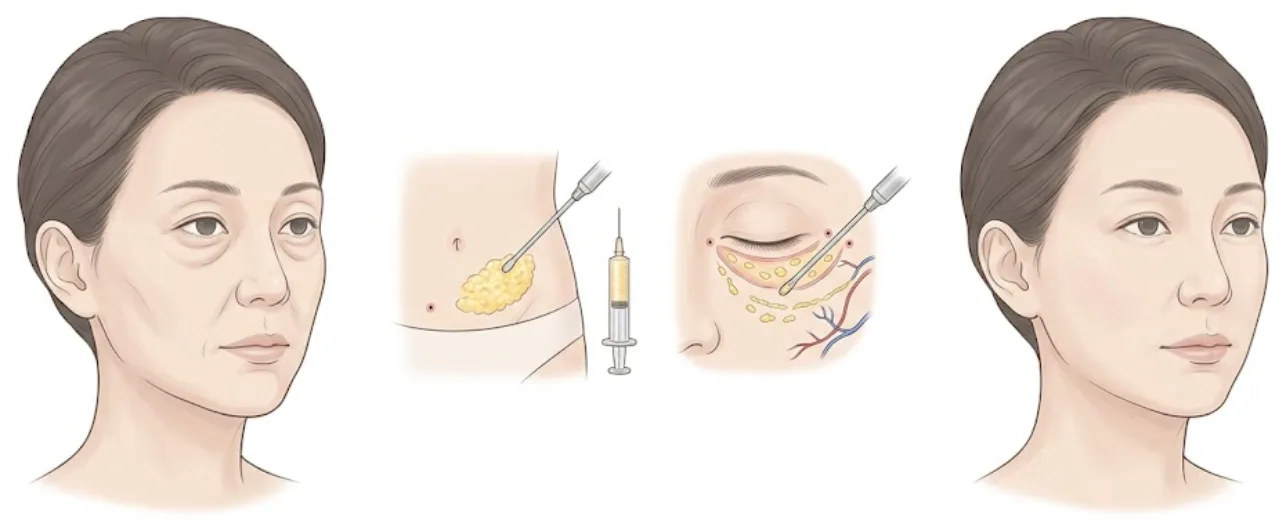
Autologous fat grafting moves your own fat from one part of your body to another. At Garnet, fat is harvested from a donor area such as the abdomen or thigh, prepared as micro-fat and supplemented with PRP, then placed into the target area (the under-eye, the love-band or the eyelid) through fine cannula access points instead of open incisions. Because it is your own tissue, there is no foreign material, and the fat that survives becomes a living, permanent part of the area.
Illustration: the patient's own fat is gently taken from a donor area such as the abdomen, refined, and placed in small amounts where volume has been lost.
Dermal filler is a manufactured gel, most commonly a hyaluronic-acid product, injected with a needle in a quick clinic visit. It adds volume immediately and is gradually broken down and reabsorbed by the body over months to a couple of years, depending on the product and area. Many hyaluronic-acid fillers can also be dissolved if needed, which gives them a reversibility that fat grafting does not have.
Surgery versus injection is only part of the core difference. The bigger part is living tissue versus a temporary product. That single distinction drives almost every other trade-off: permanence, recovery, the amount of volume that is practical, and how often you come back.
Permanence
Permanence and touch-ups
Dermal filler is, by design, temporary. It softens and reabsorbs over time, so maintaining a result means repeat sessions on a rolling basis. That can be a feature. If you are unsure about a change, or your face is still evolving, the impermanence lets you adjust or simply let it fade. It also means an ongoing series of appointments and costs over time.
Fat grafting works differently. A predictable share of the transferred fat is reabsorbed in the first weeks, which is why the area is deliberately over-corrected at first. The fat that survives that early window establishes its own blood supply and tends to stay long term, because it is living tissue with no shelf life. Sometimes a second session is planned to build volume in stages, but the goal is a lasting result without scheduled top-ups. We avoid promising a specific survival rate, since that depends on the individual, and you can read more in our guide on how long fat grafting lasts.
In short: choose filler if you value reversibility and don't mind returning; lean toward fat grafting if you prefer to invest in one recovery and keep the result, accepting that the trade-off is downtime and a less predictable exact volume.
Volume
How much volume, and which areas
Filler is excellent for precise, modest volume in defined areas, and for results you can see and shape on the spot. It is fast and controllable, which suits subtle refinements and people who want to test a change before committing. Its limits show when larger or more diffuse volume is wanted, or when repeated product over years stops being practical or natural-looking.
Fat grafting is suited to broader, softer volumising and to restoring fullness across an area in a way that blends with your own tissue. That is why it is often chosen for the under-eye and love-band region, the eyelid, and other zones where a natural, integrated result matters. Because it is your own fat, it can feel and behave like the surrounding tissue once settled. The trade-off is that the exact final volume is less predictable than a measured syringe of gel, since some fat is reabsorbed before the result stabilises.
For the specific areas Garnet treats with fat grafting and who tends to suit it, see our guide on who is a good candidate for fat grafting. The right tool genuinely depends on the area and the goal. Neither one is globally superior.
Downtime
Downtime and recovery
This is where the two diverge most. Dermal filler is essentially a lunchtime procedure: mild swelling or small bruises are possible, but most people return to normal activity quickly and can judge the result the same day. There is no harvest site and no real recovery period.
Fat grafting is a surgical procedure with a genuine, if gentle, recovery. It heals at two sites, the harvest area on the abdomen or thigh and the grafted facial area, and the visible result settles over weeks before it is final. Most obvious swelling eases within one to two weeks, and there are no graft sutures to remove. The full day-by-day picture is covered in our fat grafting recovery timeline.
If having no downtime is your priority, filler wins clearly. If you are willing to invest a recovery period in exchange for a longer-lasting, more integrated result, fat grafting earns its downtime. For many international patients, the calculus also includes that fat grafting is a single trip, whereas filler maintenance means returning, locally or to Korea, over time.
Cost
Cost and long-term value
A like-for-like price comparison is misleading, so this section explains the logic without numbers. A single filler session usually costs less up front than a fat grafting procedure. But filler is recurring: because it reabsorbs, the real comparison is one fat grafting procedure versus repeated filler sessions over years. Over a long enough horizon, a lasting result can change the value picture even when the single up-front figure is higher.
There is no universal answer, because it depends on how much product you would need, how often you would repeat it, and the area involved. Some people genuinely come out ahead with filler, for small, occasional refinements or when they want reversibility. Others find that one fat grafting procedure suits a goal that filler would only ever rent. The right frame is value over time and fit to your goal. The lowest sticker price says little.
We do not quote figures online because the responsible number depends on your assessment. For how we think about what drives surgical price and what is included, see fat grafting cost in Korea and the broader guide on what affects plastic surgery cost.
Choosing
How to choose between fat grafting and filler, and what we will tell you
The decision should start from your goal. If you want a quick, reversible, low-downtime tweak, or you are testing a change, filler is often the sensible first step. If you want a longer-lasting, natural-feeling restoration of volume and you are willing to accept a recovery period, fat grafting may suit you better. The area matters too: a soft, diffuse zone may favour fat, while a small precise correction may favour filler.
The same procedure is not right for everyone, and a responsible clinic will say so. Garnet is a single-surgeon clinic where Dr. In-Soo Baek, a board-certified plastic surgeon, assesses you personally and will tell you if filler, or simply doing nothing for now, is the better call than surgery. We do not over-recommend, and only the area you came to discuss is addressed.
Because the surgeon who consults is the surgeon who operates and who follows you up at 1, 3 and 6 months, the advice you get and the result you receive come from the same person. You can talk all of this through, with photos, in a no-obligation online consultation before deciding anything.
Dr. In-Soo Baek
Director & sole operating surgeon
Korean medical licence no. 77407
Operate on what you came for. Trained at Korea University Medical Center. Every case planned, performed and reviewed by the same hands.
1Operating surgeon
~2Surgeries per day
7Registered techniques
Board-certified plastic surgeon
Plastic surgery training at Korea University College of Medicine & graduate school
Korean Society of Plastic and Reconstructive Surgeons member, in its facial-contour, eye & rhinoplasty groups
Consults, operates and follows up each case himself
Peer-reviewed papers behind the facts on this page. Each describes findings in its own study group — not results at Garnet — and none predicts your own outcome.
Tonnard P et al. Fat Grafting for Facial Rejuvenation with Nanofat Grafts. Clinics in Plastic Surgery. 2020. doi:10.1016/j.cps.2019.08.006
Ohashi M. Fat Grafting for Facial Rejuvenation with Cryopreserved Fat Grafts. Clinics in Plastic Surgery. 2020. doi:10.1016/j.cps.2019.08.007
Schultz KP et al. Fat Grafting for Facial Rejuvenation. Seminars in Plastic Surgery. 2020. doi:10.1055/s-0039-3402767
FAQ
Common questions
What is the difference between fat grafting and dermal filler?
Fat grafting transfers your own fat, harvested from the abdomen or thigh and placed through fine cannula access points, so the surviving fat becomes living tissue. Dermal filler is a manufactured gel injected with a needle that the body gradually reabsorbs. The result is the core difference: living tissue and a lasting result versus a temporary, often reversible product.
Is fat grafting or dermal filler more permanent?
Fat grafting is the more lasting option: the share of transferred fat that survives the first weeks establishes its own blood supply and tends to stay. Most fillers are temporary, reabsorbing over months to a couple of years, so maintaining filler means repeat sessions. We avoid promising a fixed survival rate because it varies between individuals.
Which has less downtime, fat grafting or filler?
Dermal filler has far less downtime. It is essentially a quick clinic procedure with results you can judge the same day. Fat grafting is surgery with a gentle but real recovery at two sites, with most swelling settling over one to two weeks. If zero downtime is your priority, filler is the clear choice.
Is fat grafting or dermal filler cheaper?
A single filler session usually costs less up front than a fat grafting procedure, but filler is recurring because it reabsorbs. The fair comparison is one fat grafting procedure versus repeated filler over years, so value depends on how much product you would need and how long you want the result to last. The single sticker price tells you little.
Can dermal filler be reversed but not fat grafting?
Often, yes. Many hyaluronic-acid fillers can be dissolved if you are unhappy, which gives them a reversibility fat grafting does not have. Fat grafting is intended to be lasting, so it is a more committed decision. If reversibility matters a lot to you, that can be a reason to start with filler.
Which is better for under-eye hollows?
Both are used for the under-eye area, and the better choice depends on your tissue, the volume needed and how natural and lasting you want the result. Fat grafting can blend softly with surrounding tissue for a more integrated result, while filler is faster and reversible. A board-certified surgeon should assess the under-eye area and advise you on its own merits.
Will fat grafting feel more natural than filler?
It can, once settled, because grafted fat becomes living tissue similar to the surrounding area, which is why it is often chosen where a natural, integrated result matters. Well-placed filler can also look natural, but it is a product and is not your own tissue. Neither is universally superior; it depends on the area and the goal.
Can I have both fat grafting and filler?
In some plans the two are complementary, for example a lasting base of volume from fat grafting with small filler refinements over time. Whether that makes sense depends entirely on your goals and anatomy, and it should be worked out with the surgeon during an assessment instead of assumed in advance.
How do I decide between fat grafting and dermal filler?
Start from your goal: choose filler for a quick, reversible, low-downtime change, and consider fat grafting for a longer-lasting, natural-feeling result you are willing to recover from. The area and volume matter too. The most reliable way to decide is a consultation with a board-certified surgeon who will not over-recommend surgery.
My mom recently had a brow lift and lower blepharoplasty with Dr. Baek, and our experience has been wonderful so far. The Garnet team was incredibly kind and welcoming, with Kelly assisting us as our English consultant—she made everything…
I’m so happy I chose this clinic for my lower blepharoplasty. I was traveling from abroad by myself, so I was a little nervous, but from the beginning I felt comfortable and truly cared for. Everyone was kind, patient, and professional…
Came in for an in-person consult and ended up choosing Garnet and Dr.Baek for my non-incisional DES and tiplasty/alarplasty. I communicated with Kelly (English consultant) from the start till now (3 weeks post-op). She really help me feel…
My under-eyes have been sagging and folding for years... I tried to cover it up with makeup, but it actually got stuck in the wrinkles and made it stand out even more. While going for consultations, I noticed that the bigger the hospital…
If you are unsure whether fat grafting or filler fits your goal, send photos for a no-obligation assessment. We will tell you which suits you, or if neither is needed yet.
Send photos and your question before you travel. An English-speaking coordinator reviews every enquiry and replies with guidance on whether surgery is appropriate, the likely plan and timing.
✓ Reviewed by the clinic coordinator, not a bot
✓ Photo-based pre-assessment before you fly
✓ Foreign-patient scheduling & after-care
✓ One surgeon for consultation, surgery and follow-up
Prefer to chat now? Reach the coordinator directly:









 T S7 months ago



