Fat grafting moves your own fat from the abdomen or thigh to where your face has lost volume: under the eyes, the temples, the cheeks. It can look entirely natural, but it does not suit every concern. Your candidacy depends on what is actually causing the look you want to change, and on a few practical things about your own tissue.
The short answer
Fat grafting suits volume loss: flat or hollow cheeks, temples, under-eyes and the smile-line area. Loose, sagging skin needs lifting instead.
Having a modest donor area (abdomen or thigh) to harvest fat from matters; very lean patients have less fat to transfer and may see a smaller, less predictable result.
It is often a better long-term choice than filler for patients who want a one-time, natural restoration without ongoing top-ups.
A good consultation should tell you if fat grafting will not solve your concern. For some faces, lifting or a different procedure is the right call.
The clearest candidate for fat grafting is someone whose face has deflated without dropping. As we age, the deep fat pads of the face shrink and shift, so cheeks flatten, temples hollow, the under-eye area sinks into a shadow, and the lines from the nose to the mouth deepen. Where the problem is lost volume, replacing it with your own fat addresses the cause directly. Because it is living tissue, the result moves and ages with you in a way that looks natural.
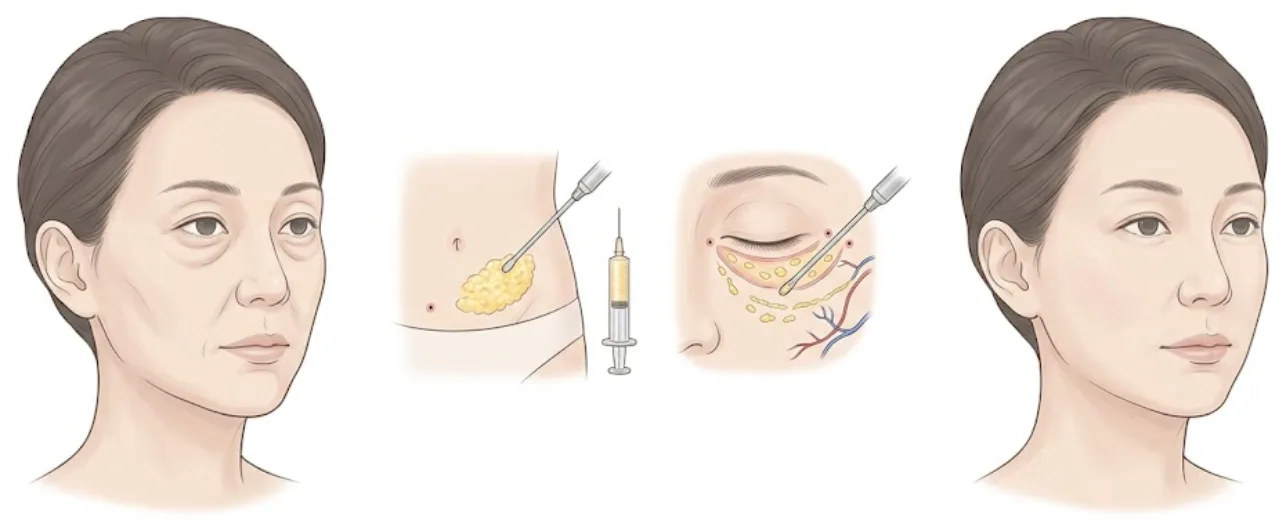
Illustration: the patient's own fat is gently taken from a donor area such as the abdomen, refined, and placed in small amounts where volume has been lost.
This is different from sagging. If the main issue is loose, descended skin and a heavy jawline, adding volume will not fix it and can even make a heavy face look fuller. That kind of change usually calls for a lifting procedure. A good candidate, then, is someone whose features are well-positioned but simply look tired, gaunt or hollow because the underlying support has thinned.
Younger patients can be candidates too. Some people are naturally hollow under the eyes or flat in the cheeks without any age-related change, and a conservative graft can soften that. The common thread is the same: the concern is a lack of fullness in the cheeks or under the eyes. You can read the broader overview on the fat grafting page and use this guide to judge whether your own concern fits.
The areas
The areas fat grafting treats well
At Garnet, fat grafting is used as a refined, micro-fat technique for specific facial zones. It is never used as a bulk filler. The fat is harvested through a fine cannula from the abdomen or thigh, processed into small parcels, and placed in carefully judged layers. The areas it suits best are the under-eye hollow and the so-called love-band (the soft roll just under the lower lash line), the upper eyelid when it has become sunken, the temples, the cheeks and the mid-face.
Under-eye and eyelid grafting is the most delicate of these, because the skin there is thin and the result has to be smooth and even. This is where micro-fat (very small, evenly distributed parcels) matters, and where the experience of the surgeon placing it counts most. A candidate for under-eye grafting has a genuine hollow or shadow. Puffiness and eye-bags are a separate problem.
Because grafting can be combined sensibly with other work, some patients have it alongside an eye or lifting procedure during the same visit. If you are weighing it against a temporary option, the fat grafting versus filler comparison sets out where each one wins. The right area-by-area plan depends on which zones have actually lost volume, which the surgeon judges in person.
Or filler?
Are you better suited to fat grafting or filler?
Many people who consider fat grafting have already tried, or thought about, dermal filler. Both add volume, but they suit different patients. Filler is quick, requires no surgery and is reversible, which makes it a sensible starting point if you are unsure or only want a small, temporary change. Fat grafting is a surgical procedure with a recovery period, but it uses your own tissue and the surviving portion is lasting. It therefore tends to suit patients who want a one-time restoration without repeated top-up appointments.
A good candidate for grafting over filler is often someone who has multiple areas to address, who dislikes the maintenance and cost cycle of repeated filler, or who wants a softer, more integrated result than filler can give in thin-skinned areas like the under-eye. Patients who have had filler complications, or who simply prefer not to have a synthetic product in their face, also lean toward grafting.
There is no universally correct choice. It depends on your priorities, your anatomy and how much downtime you can take. A good surgeon will sometimes tell a patient that filler is the more proportionate option, and that is a sign of sound advice. You can talk this through in an online consultation before you travel.
Donor fat
Donor fat, your body and what affects suitability
Fat grafting needs a source of fat to move. It is harvested gently through a cannula from a donor area, usually the abdomen or thigh, so a candidate needs at least a modest amount of fat to spare there. This is rarely a problem for most patients, but very lean people sometimes have so little donor fat that the result is smaller, and harvesting takes more effort for a smaller yield. It does not rule grafting out, but it is a real part of the assessment.
Body weight stability matters too. Grafted fat behaves like the fat it came from, so significant weight loss after the procedure can reduce the volume, and weight gain can add to it. If you are planning major weight change, it is usually better to reach a stable weight first. General health is also relevant: smoking in particular reduces the blood supply that newly grafted fat depends on to survive, so candidates are advised to stop well before and after surgery.
Realistic expectations are part of candidacy. Because a portion of any graft is naturally reabsorbed in the first months, the surgeon plans for that and the final result settles over time. It is never an instant, fixed number. A candidate who understands this, and who wants a natural restoration over a dramatic change, is the right fit. You can read more about how the result settles on the how long fat grafting lasts page.
Not suited
When fat grafting is not the right answer
Some patients are better advised against fat grafting, and a responsible clinic will say so. If the main problem is sagging skin, jowls or a heavy lower face, adding volume will not lift anything and may make the area look fuller and heavier. That is a candidate for a lifting procedure, and grafting on its own would be the wrong tool. Similarly, lower-eyelid puffiness or true eye-bags are usually caused by protruding fat. They call for a different approach, without added volume.
Active skin infection in the treatment area, uncontrolled medical conditions, certain bleeding tendencies and current smoking are all reasons to delay or reconsider. Pregnancy and breastfeeding are also reasons to wait. And anyone seeking a very large, dramatic increase in facial volume in one sitting is likely to be disappointed, because over-grafting looks unnatural and a portion is reabsorbed regardless. Conservative, staged work gives the more believable result.
Being told "this would not help you" is one of the most useful outcomes of a consultation. It is far better to hear it before surgery than to undergo a procedure that was never going to address your concern. At Garnet the same surgeon who would operate is the one who makes that judgement, so the assessment and the advice come from one person. There is more on that in the single-surgeon clinic guide.
At Garnet
How Garnet decides if you are a candidate
Garnet is a single-surgeon clinic in Apgujeong, Seoul. Dr. In-Soo Baek is a board-certified plastic surgeon (Korean medical licence no. 77407) and the only operating doctor. He consults, performs the fat grafting himself and reviews every follow-up. For fat grafting that continuity matters, because judging how much fat to harvest, how to layer it and where to place micro-fat is a matter of experience, and the person making that judgement is the person who carries it out.
The assessment is unhurried. The clinic caps the day at two surgeries and sees one patient at a time, so there is time to look properly at what is causing your concern and to tell you plainly whether grafting, lifting, filler or simply waiting is the better path. Garnet does not recommend areas you did not come about, and follow-ups are structured at one, three and six months so the settling result can be reviewed.
Garnet is registered with Korea's foreign-patient programme and can assess international patients before they travel. You can send photos for a no-obligation pre-assessment and a clear opinion on your candidacy, through an online consultation or by reading what to expect at your first consultation.
Dr. In-Soo Baek
Director & sole operating surgeon
Korean medical licence no. 77407
Operate on what you came for. Trained at Korea University Medical Center. Every case planned, performed and reviewed by the same hands.
1Operating surgeon
~2Surgeries per day
7Registered techniques
Board-certified plastic surgeon
Plastic surgery training at Korea University College of Medicine & graduate school
Korean Society of Plastic and Reconstructive Surgeons member, in its facial-contour, eye & rhinoplasty groups
Consults, operates and follows up each case himself
Peer-reviewed papers behind the facts on this page. Each describes findings in its own study group — not results at Garnet — and none predicts your own outcome.
Strong AL et al. Technical Precision with Autologous Fat Grafting for Facial Rejuvenation: A Review of the Evolving Science. Plastic & Reconstructive Surgery. 2023. doi:10.1097/prs.0000000000010643
Marten T et al. Periorbital Fat Grafting. Facial Plastic Surgery Clinics of North America. 2021. doi:10.1016/j.fsc.2021.02.003
Chen HH et al. Lipotransfer in the upper third of the face. Current Opinion in Otolaryngology & Head and Neck Surgery. 2011. doi:10.1097/moo.0b013e32834896a0
FAQ
Common questions
Who is a good candidate for fat grafting?
The ideal candidate has lost facial volume (flat or hollow cheeks, temples, under-eyes or a deepening smile line) and does not mainly have loose, sagging skin. You also need a modest donor area of fat to harvest from, stable weight, and realistic expectations, since a portion of any graft is naturally reabsorbed before the result settles.
Am I suitable for fat grafting if I am very slim?
Possibly, and it is part of the assessment. Fat grafting needs fat to move, usually from the abdomen or thigh. Very lean patients have less donor fat, which can mean a smaller and less predictable result and more effort to harvest. It rarely rules grafting out, but the surgeon should tell you what is realistically achievable for your body.
When is fat grafting not recommended?
When the real problem is sagging skin or jowls. Adding volume will not lift, and can look heavier, so lifting is the answer instead. It is also unsuitable for lower-eyelid puffiness or true eye-bags caused by protruding fat, during active skin infection, with uncontrolled medical conditions, while smoking, and during pregnancy or breastfeeding.
Should I choose fat grafting or filler?
Filler is quick, non-surgical and reversible, which suits a small or temporary change. Fat grafting is surgery with a recovery period, but it uses your own tissue and the surviving portion is lasting. It suits patients who want a one-time, natural restoration over repeated top-ups, or who have several areas to address. The right choice depends on your priorities and anatomy.
Can young patients have fat grafting?
Yes. Some people are naturally hollow under the eyes or flat in the cheeks without any age-related change, and a conservative graft can soften that. Candidacy depends on a lack of fullness more than on age, so a younger patient with genuine volume loss can be a good candidate just as an older one can.
Which areas does Garnet treat with fat grafting?
Garnet uses a refined micro-fat technique for the under-eye hollow and love-band, the upper eyelid when sunken, the temples, the cheeks and the mid-face. The fat is taken through a fine cannula from the abdomen or thigh. Under-eye grafting is the most delicate area, where even, small-parcel placement matters most.
Does smoking affect whether I can have fat grafting?
Yes. Smoking reduces the blood supply that newly grafted fat depends on to survive, which can lower how much of the graft lasts. Candidates are usually advised to stop well before and after surgery. Tell the surgeon at consultation if you smoke.
Will weight changes affect my fat grafting result?
They can. Grafted fat behaves like the fat it came from, so significant weight loss can reduce the transferred volume and weight gain can add to it. If you are planning major weight change, it is generally better to reach a stable weight before grafting.
Can I find out if I am a candidate before flying to Korea?
Yes. Garnet is registered with Korea's foreign-patient programme, and you can send photos for a no-obligation pre-assessment in an online consultation. The same surgeon who would operate reviews your case and tells you whether grafting, lifting, filler or waiting is the better option for you.
My mom recently had a brow lift and lower blepharoplasty with Dr. Baek, and our experience has been wonderful so far. The Garnet team was incredibly kind and welcoming, with Kelly assisting us as our English consultant—she made everything…
I’m so happy I chose this clinic for my lower blepharoplasty. I was traveling from abroad by myself, so I was a little nervous, but from the beginning I felt comfortable and truly cared for. Everyone was kind, patient, and professional…
Came in for an in-person consult and ended up choosing Garnet and Dr.Baek for my non-incisional DES and tiplasty/alarplasty. I communicated with Kelly (English consultant) from the start till now (3 weeks post-op). She really help me feel…
My under-eyes have been sagging and folding for years... I tried to cover it up with makeup, but it actually got stuck in the wrinkles and made it stand out even more. While going for consultations, I noticed that the bigger the hospital…
Send photos and your question before you travel. An English-speaking coordinator reviews every enquiry and replies with guidance on whether surgery is appropriate, the likely plan and timing.
✓ Reviewed by the clinic coordinator, not a bot
✓ Photo-based pre-assessment before you fly
✓ Foreign-patient scheduling & after-care
✓ One surgeon for consultation, surgery and follow-up
Prefer to chat now? Reach the coordinator directly:









 T S7 months ago



