Fat grafting involves two connected sites: fat is gently harvested from a donor area such as the abdomen or thigh, then placed in the face. That means the question "does it hurt?" has two answers. The procedure itself is done under anaesthesia so you are comfortable, and most patients describe the recovery as more of a soreness and tightness than sharp pain. It still helps to know what each part actually feels like.
The short answer
Fat grafting is carried out under anaesthesia, so you do not feel pain during the procedure itself.
There are two sites, the donor area (abdomen or thigh) and the face, and they feel different afterwards.
Most patients report soreness, tightness and tenderness without sharp pain, well managed with prescribed medication.
The fine cannula used to harvest and place the fat avoids a cut scar line, which keeps discomfort modest at both sites.
The first thing to understand about pain with fat grafting is that there are two areas involved. Fat is harvested through a fine cannula from a donor site, usually the abdomen or thigh, and then placed, again through a cannula, into the facial areas being treated, such as the under-eye, the love-band, the temples or the cheeks. Because a cannula is used and no open incision is made, there is no cut scar line at either site, which keeps the discomfort more modest than many people expect.
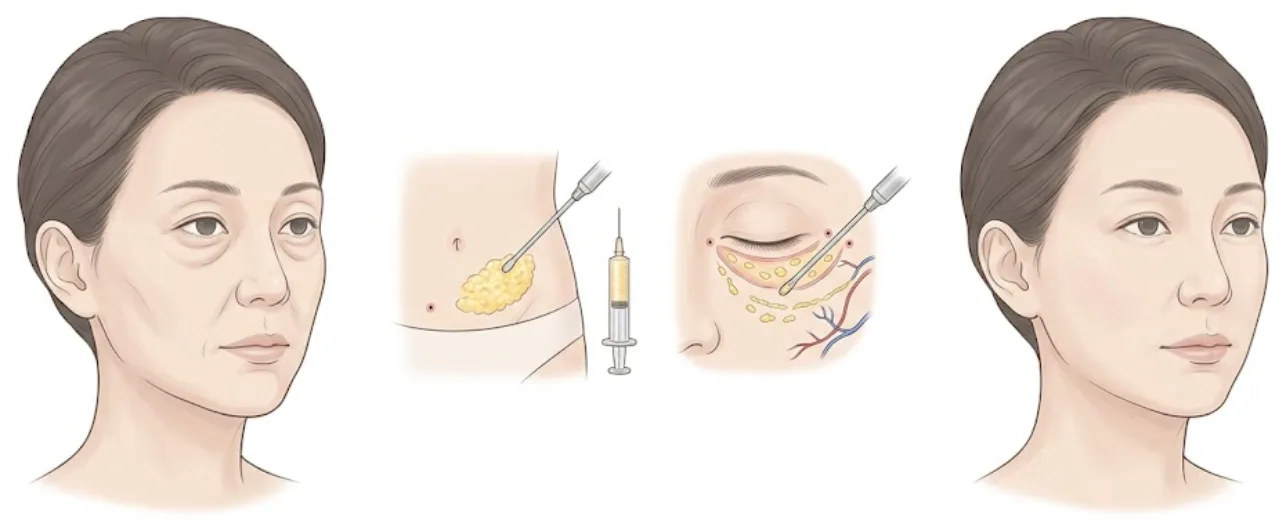
Illustration: the patient's own fat is gently taken from a donor area such as the abdomen, refined, and placed in small amounts where volume has been lost.
The two sites feel different afterwards. The donor area tends to feel like a deep bruise or like you have had a hard workout: sore and tender to the touch, sometimes a little swollen, but not sharp. The face, by contrast, feels tight and swollen more than painful, particularly in delicate areas like the under-eye where the tissue is thin. Many patients are surprised that the donor area is the part that aches most, while the face mostly feels puffy.
Neither sensation is the dramatic pain people sometimes imagine. The procedure is designed around comfort, and the cannula technique is part of that. You can see how the whole procedure fits together on the fat grafting page, and read how the swelling settles over time in the recovery timeline guide.
Anaesthesia
What anaesthesia is used for fat grafting
Fat grafting is performed under anaesthesia, so you do not feel pain during the procedure itself. The exact approach depends on how much grafting is being done, which areas, and whether it is combined with another procedure. Smaller, focused grafting can often be carried out under local anaesthesia with sedation, where the area is numbed and you are relaxed and drowsy but not fully asleep. More extensive grafting, or grafting combined with eye or lifting surgery, may be done under deeper sedation or general anaesthesia.
The donor area is also numbed before the fat is harvested, so the harvesting itself is not felt during the procedure. The right anaesthetic plan is something the surgeon decides with you based on your specific case and your own preferences and health, and it is one of the things settled clearly before surgery.
Anaesthesia is one of the safety-relevant parts of any procedure, which is why it is worth confirming who plans and monitors it. At a single-surgeon clinic the surgeon who operates is involved throughout, with no handover between teams. You can read more about why that continuity matters in the single-surgeon clinic guide, and ask about the anaesthetic approach for your case in an online consultation.
During
What you feel during the procedure
During the procedure itself you should not feel pain, because the areas are anaesthetised. Under local anaesthesia with sedation you may be aware of pressure or movement, a sensation of something being done without pain, and many patients drift in and out of a relaxed, drowsy state and remember little of it. Under general anaesthesia or deeper sedation you are asleep and aware of nothing until you wake afterwards.
The harvesting step, where fat is gently drawn from the abdomen or thigh through the cannula, is sometimes felt as a mild tugging or pressure under lighter anaesthesia, but not as sharp pain. The placement of micro-fat into the face is likewise felt as pressure, with no pain. The whole procedure is unhurried at a clinic that sees one patient at a time, so there is no rush and your comfort can be checked throughout.
Because the experience varies with the anaesthetic plan, it is worth knowing in advance which approach is intended for you and what you are likely to be aware of. That is part of a clear pre-surgery discussion, and it is also covered when you go through what to expect at your first consultation.
After
How much discomfort there is during recovery
The recovery is where most people feel something, and the accurate description is soreness and tightness, without sharp pain. As the anaesthesia wears off, the face feels swollen and tight (especially around the eyes if the under-eye or eyelids were treated), and the donor area feels bruised and tender, much like an intense workout or a deep bruise. For most patients this is very manageable with the prescribed medication.
The first two to three days are usually the most noticeable, when swelling is at its peak and the donor area aches most; it then eases steadily. Bruising at the donor site and around the treated facial areas is common and fades over the following one to two weeks. The under-eye, being thin-skinned, can swell and bruise more visibly, but this is a cosmetic appearance and does not mean significant pain. Sharp or worsening pain, as opposed to the expected dull soreness, is something to report, because the normal course is improvement day by day.
Because grafting involves two areas, sleeping and moving for the first few days takes a little planning. Keeping the head elevated helps the facial swelling, and the donor area may feel sore when you bend or stretch. None of this is usually severe, and patients are often surprised how quickly the ache settles. The full week-by-week picture, including when bruising clears, is in the recovery timeline guide.
Managing
How comfort is managed
Comfort after fat grafting is managed with a combination of prescribed pain relief, simple measures and clear guidance. You are given medication to keep the soreness manageable through the first days, when it is most noticeable, and most patients find they need it for only a short period before over-the-counter relief is enough. Keeping your head elevated, using cold compresses as advised, and resting in the first days all help reduce swelling and the tightness that comes with it.
The donor area is usually the part that benefits most from a little care: gentle movement, avoiding strenuous activity for a while, and following the advice given for that site. Because there is no cut incision, only fine cannula access points, wound care is straightforward. Clear instructions on what is normal, what helps and what to avoid make the recovery feel predictable, which itself reduces how much discomfort patients perceive.
Knowing who to ask if something does not feel right is part of comfortable recovery, especially for international patients who travel home during it. At Garnet the same surgeon reviews your recovery and can continue to advise after you return home, so questions about discomfort are answered by the person who operated. The international patients guide explains how that follow-up works from abroad.
At Garnet
How Garnet keeps fat grafting comfortable
Garnet is a single-surgeon clinic in Apgujeong, Seoul. Dr. In-Soo Baek is a board-certified plastic surgeon (Korean medical licence no. 77407) and the only operating doctor — he consults, harvests and places the fat himself, and reviews your recovery. The clinic caps the day at two surgeries and sees one patient at a time, so the procedure is unhurried and your comfort can be attended to properly, without rushing.
The fat is harvested and placed through a fine cannula, with no cut scar line at the donor area or the face, which keeps discomfort modest. The anaesthetic plan is matched to your specific case and discussed with you beforehand, and you are given clear pain-relief and aftercare guidance so the recovery feels predictable. A dedicated coordinator stays with you from consultation through recovery.
Garnet is registered with Korea's foreign-patient programme, and the same surgeon who operates continues to review international patients after they travel home, so any concerns about discomfort are answered by the person who carried out the surgery. You can ask about pain, anaesthesia and recovery for your specific case in an online consultation before you travel.
Dr. In-Soo Baek
Director & sole operating surgeon
Korean medical licence no. 77407
Operate on what you came for. Trained at Korea University Medical Center. Every case planned, performed and reviewed by the same hands.
1Operating surgeon
~2Surgeries per day
7Registered techniques
Board-certified plastic surgeon
Plastic surgery training at Korea University College of Medicine & graduate school
Korean Society of Plastic and Reconstructive Surgeons member, in its facial-contour, eye & rhinoplasty groups
Consults, operates and follows up each case himself
Peer-reviewed papers behind the facts on this page. Each describes findings in its own study group — not results at Garnet — and none predicts your own outcome.
Fiedler LS et al. Autologous fat grafting in the face and neck: Multinational trends and knowledge of the safety, applications, and indications considering oncologic risk potential. Laryngoscope Investigative Otolaryngology. 2021. doi:10.1002/lio2.649
Yang Z et al. Fat Grafting for Facial Rejuvenation in Asians. Clinics in Plastic Surgery. 2020. doi:10.1016/j.cps.2019.08.003
Tonnard P et al. Fat Grafting for Facial Rejuvenation with Nanofat Grafts. Clinics in Plastic Surgery. 2020. doi:10.1016/j.cps.2019.08.006
FAQ
Common questions
Is fat grafting painful?
The procedure itself is done under anaesthesia, so you do not feel pain during it. Afterwards, most patients describe soreness and tightness, not sharp pain. The face feels swollen and tight, and the donor area feels bruised, like an intense workout. It is generally very manageable with prescribed medication, and the worst is usually in the first two to three days.
What anaesthesia is used for fat grafting?
It depends on how much grafting is done and whether it is combined with another procedure. Smaller, focused grafting is often performed under local anaesthesia with sedation, where the area is numbed and you are relaxed but not fully asleep. More extensive grafting, or grafting with eye or lifting surgery, may use deeper sedation or general anaesthesia. The plan is decided with you beforehand.
How much discomfort is there after fat grafting?
Most patients have soreness, tightness and tenderness, with little significant pain. The face feels swollen and tight, particularly around the eyes if those areas were treated, and the donor site aches like a deep bruise. The first two to three days are most noticeable, then it eases steadily, and prescribed medication keeps it manageable.
Which hurts more, the face or the donor area?
Many patients are surprised that the donor area (the abdomen or thigh where fat is harvested) aches the most, feeling like a deep bruise or hard workout. The face tends to feel tight and swollen more than painful, even in delicate areas like the under-eye. Neither is usually severe.
Will I feel anything during the procedure?
You should not feel pain, because the areas are anaesthetised. Under local anaesthesia with sedation you may be aware of pressure or movement without pain, and many patients remember little of it. Under general anaesthesia or deeper sedation you are asleep and aware of nothing until you wake.
How long does the soreness last?
The most noticeable soreness is usually in the first two to three days, when swelling peaks and the donor area aches most, then it eases steadily. Bruising at the donor site and around the treated facial areas fades over the following one to two weeks. Most patients need stronger pain relief only briefly.
Is fat grafting more uncomfortable because of the donor area?
It does mean two areas are involved, so the donor site adds its own soreness. However, because the fat is harvested through a fine cannula with no cut incision, the donor discomfort is usually a manageable bruised ache without sharp pain, and it settles over the first one to two weeks.
Can I ask about pain and anaesthesia before I travel?
Yes. Garnet is registered with Korea's foreign-patient programme, and you can discuss the likely anaesthetic approach for your case, what recovery feels like and how comfort is managed in an online consultation. The same surgeon who would operate answers these questions and reviews your recovery, including after you return home.
My mom recently had a brow lift and lower blepharoplasty with Dr. Baek, and our experience has been wonderful so far. The Garnet team was incredibly kind and welcoming, with Kelly assisting us as our English consultant—she made everything…
I’m so happy I chose this clinic for my lower blepharoplasty. I was traveling from abroad by myself, so I was a little nervous, but from the beginning I felt comfortable and truly cared for. Everyone was kind, patient, and professional…
Came in for an in-person consult and ended up choosing Garnet and Dr.Baek for my non-incisional DES and tiplasty/alarplasty. I communicated with Kelly (English consultant) from the start till now (3 weeks post-op). She really help me feel…
My under-eyes have been sagging and folding for years... I tried to cover it up with makeup, but it actually got stuck in the wrinkles and made it stand out even more. While going for consultations, I noticed that the bigger the hospital…
Send photos and your question before you travel. An English-speaking coordinator reviews every enquiry and replies with guidance on whether surgery is appropriate, the likely plan and timing.
✓ Reviewed by the clinic coordinator, not a bot
✓ Photo-based pre-assessment before you fly
✓ Foreign-patient scheduling & after-care
✓ One surgeon for consultation, surgery and follow-up
Prefer to chat now? Reach the coordinator directly:









 T S7 months ago



