A sub-brow lift is a focused operation on the brow, done under local anaesthesia, so you are awake but the area is numb. “Will it hurt?” is one of the most common questions before any eye-area surgery. Most of what people imagine as “pain” is really the brief sting of the anaesthetic and a few days of tightness and soreness afterwards, and both are predictable and manageable.
The short answer
A sub-brow lift is typically performed under local anaesthesia, so the brow area is numbed while you stay awake and comfortable.
The sharpest sensation is the initial anaesthetic injection, a brief stinging. After that, the surgery itself should not be painful.
Post-operative discomfort is usually mild tightness and soreness around the brow, easing over the first days.
Sutures come out at about seven days; most people manage with simple measures and a short, predictable settling period.
A sub-brow lift is a localised operation, and at Garnet it is carried out with the brow area numbed by local anaesthesia. That means you are awake and aware, but the skin, the brow tissue and the deeper muscle layer being worked on are fully numb. Once the anaesthetic has taken effect, the incision below or above the eyebrow, the removal of a thin strip of tissue and the orbicularis suspension fixation that anchors the brow should not be felt as pain.
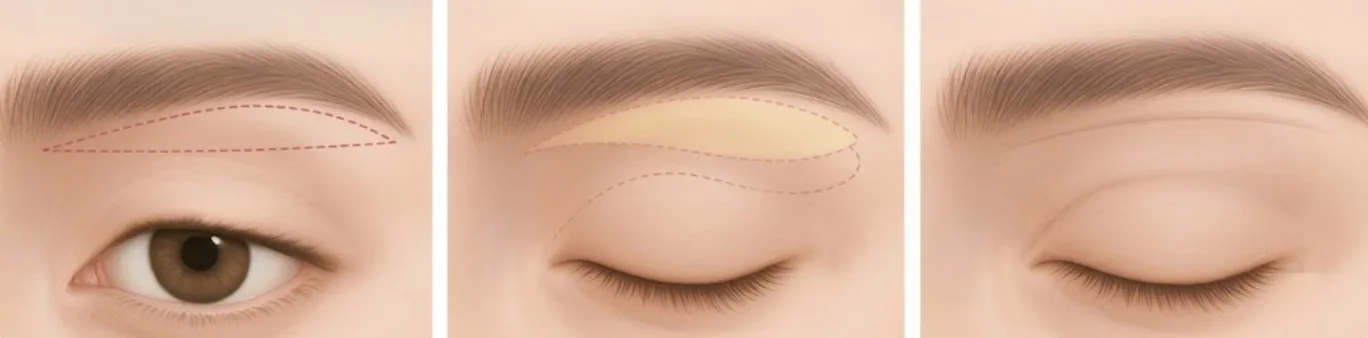
Illustration: a strip of excess skin is taken from just below the eyebrow (dotted line), so the heavy upper lid opens without touching the eyelid itself. The fine line sits along the lower brow edge.
What you may notice instead are non-painful sensations: a feeling of pressure, light tugging or movement as the surgeon works, and the sounds of the procedure. This is normal and is not the same as pain. Many patients are surprised by how little they feel once the area is numb. Because you are awake under local anaesthesia, there is no grogginess from general anaesthesia to recover from, and no separate anaesthetic wake-up.
If at any point during the operation you do feel a sharp sensation, it simply means a little more local anaesthetic is needed, which the surgeon can top up. The aim throughout is that the brow stays numb from start to finish; this page goes deeper than the short pain note on the main sub-brow lift page so you know exactly what to expect.
Anaesthesia
How the anaesthesia works
The discomfort people most associate with a sub-brow lift is really the moment the local anaesthetic is delivered. A small amount of numbing medicine is injected along the brow, and for a few seconds there is a stinging or pinching feeling as it goes in. That sensation fades quickly as the area becomes numb, and it is the most intense part of the whole experience for most patients. It is short-lived and over before the surgery proper begins.
Local anaesthesia is well suited to a focal operation like this because it numbs precisely the area being treated while you stay awake and stable. It avoids the deeper recovery and monitoring that general anaesthesia involves, which is one reason a sub-brow lift tends to feel less daunting than larger procedures. The surgeon controls the depth and spread of numbing and can add more at any point, so comfort is maintained from the first incision to the last suture.
Exactly which approach is used is confirmed at your consultation, where the surgeon explains the plan for your case. If you are weighing this operation against other eye procedures and want to understand the recovery side as well, the recovery timeline picks up where the anaesthesia leaves off.
After surgery
Discomfort after surgery, day by day
Once the local anaesthetic wears off over the first hours, the brow area feels sore and tight. Sharp pain is uncommon. Most patients describe a dull ache, a sense of tightness across the brow, and tenderness right along the incision line: discomfort that is noticeable but not severe. Some swelling and bruising around the brow and upper eye is normal and can make the area feel heavier in the first day or two.
The first two to three days are usually the peak for tightness and soreness, after which it settles steadily. By the time the sutures are removed at about seven days, the sharp tenderness has typically eased a great deal, though the area can still feel slightly tight or numb as the nerves recover. That sensation is expected and fades over the following weeks. Numbness near the incision is common early on and is not a sign of a problem.
Everyone heals at a slightly different pace, so treat this as a guide to the usual pattern. If you want the full healing picture — swelling, bruising and when the scar settles — the recovery timeline covers it in detail, and the scars and healing guide explains how the brow-line scar matures.
Managing it
How discomfort is managed
Most of the discomfort after a sub-brow lift is managed with simple, conservative measures. Keeping your head slightly elevated, applying cold as advised in the first day or two, and avoiding strenuous activity that raises blood pressure all help limit swelling and the tightness that comes with it. Your surgeon will advise on suitable pain relief; because the baseline discomfort is usually mild, many patients need very little.
Practical comfort matters too: sleeping with your head raised for the first nights, being gentle around the brow, and not rubbing or straining the area protect the fresh suspension fixation while it settles. Following the aftercare instructions closely is the single biggest factor in a smooth, low-discomfort recovery — most of what keeps people comfortable is straightforward care, with medication playing a smaller part.
Because Garnet is a single-surgeon clinic, the same surgeon who operated reviews your healing, including at suture removal around day seven, and can adjust advice to how you are actually recovering. If you are travelling from abroad and wondering how aftercare and any questions are handled once you fly home, the international-patient guide explains the remote follow-up.
Normal vs not
What is normal — and what is not
Normal after a sub-brow lift: soreness and tightness peaking in the first two to three days, swelling and bruising around the brow and upper eye, tenderness along the incision, and numbness near the brow that recovers gradually. Mild discomfort that improves a little each day is exactly the expected pattern, and a feeling of tightness as the brow sits in its new position is part of healing and not a warning sign.
What is not typical is pain that steadily worsens instead of improving, severe or one-sided swelling, increasing redness, heat or discharge at the incision, or a fever. These are uncommon, but they are the signs to report promptly. Do not wait them out. Knowing the difference in advance means you can recover calmly and only raise the things that genuinely need attention.
If anything about your recovery worries you, the right step is to contact the clinic so the question is answered by someone who knows your case. At Garnet the operating surgeon stays involved through your follow-ups, so concerns are reviewed by the person who knows your case. For international patients, that contact continues by messenger after you travel home, as set out in the consultation and follow-up guide.
At Garnet
Comfort and aftercare at Garnet
Garnet is a single-surgeon clinic in Apgujeong, Seoul, where Dr. In-Soo Baek, a board-certified plastic surgeon (Korean medical licence no. 77407), personally performs the consultation, the operation and every follow-up. For a focal procedure like a sub-brow lift, that continuity means the same surgeon manages your comfort during surgery and reviews how you heal afterwards, including suture removal at around seven days.
The clinic caps the day at two surgeries, one patient at a time, so your operation is unhurried and there is no pressure to rush. That pace matters for comfort: the anaesthesia is given carefully, the area is kept numb throughout, and your questions about discomfort and recovery are answered without a queue forming behind you. Structured follow-up at one, three and six months means soreness, numbness and scar settling are tracked by the surgeon over time.
If you are nervous about pain, the most reassuring step is to ask everything before you commit. You can do that remotely through an online consultation, or see how the in-person visit works in your first consultation at Garnet, so you arrive understanding exactly what you will and will not feel.
Prices
Price at Garnet
Sub-brow lift
From₩2,500,000 + VATExcluding VAT (10% VAT is added at payment)Book now
Same price as Korean patients. Prices shown exclude 10% VAT; your written quote, issued after the in-person consultation, shows the full amount payable.
Dr. In-Soo Baek
Director & sole operating surgeon
Korean medical licence no. 77407
Operate on what you came for. Trained at Korea University Medical Center. Every case planned, performed and reviewed by the same hands.
1Operating surgeon
~2Surgeries per day
7Registered techniques
Board-certified plastic surgeon
Plastic surgery training at Korea University College of Medicine & graduate school
Korean Society of Plastic and Reconstructive Surgeons member, in its facial-contour, eye & rhinoplasty groups
Consults, operates and follows up each case himself
Peer-reviewed papers behind the facts on this page. Each describes findings in its own study group — not results at Garnet — and none predicts your own outcome.
Parkes ML et al. Infrabrow lift. The Laryngoscope. 1976. doi:10.1002/lary.5540861213
Pascali M et al. Brows Asymmetry Correction With the Direct Approach. Journal of Craniofacial Surgery. 2016. doi:10.1097/scs.0000000000002408
Tyers AG. Brow Lift via the Direct and Trans-Blepharoplasty Approaches. Orbit. 2006. doi:10.1080/01676830600977384
FAQ
Common questions
Is a sub-brow lift painful?
The surgery itself should not be painful, because the brow area is numbed with local anaesthesia. The sharpest sensation is the brief sting of the anaesthetic injection at the start. Afterwards, most people feel mild soreness and tightness around the brow, easing over the first few days.
What anaesthesia is used for a sub-brow lift?
A sub-brow lift is typically performed under local anaesthesia, which numbs the brow area while you stay awake and stable. This avoids the deeper recovery and monitoring of general anaesthesia. The exact approach is confirmed at your consultation, where the surgeon explains the plan for your case.
Will I be awake during the procedure?
Yes, with local anaesthesia you are awake but the brow area is fully numb. You may feel non-painful sensations such as pressure or light tugging as the surgeon works, but not pain. Because you are not under general anaesthesia, there is no grogginess to recover from afterwards.
Does the anaesthetic injection hurt?
There is a brief stinging or pinching feeling for a few seconds as the local anaesthetic is injected along the brow. This fades quickly as the area numbs and is the most intense part of the experience for most patients. The surgeon can add more anaesthetic at any point if needed.
How much does it hurt after surgery?
After the anaesthetic wears off, the brow feels sore and tight, often a dull ache with tenderness along the incision. Discomfort usually peaks in the first two to three days and then settles steadily, easing further by the time sutures are removed at about seven days.
How long does the discomfort last?
The peak of soreness and tightness is generally the first two to three days, improving noticeably by suture removal at around seven days. Some tightness and numbness near the brow can linger for a few weeks as the nerves recover, but this is expected, is not painful, and fades gradually.
Why does my brow feel numb after surgery?
Numbness near the incision is common in the early weeks because small nerves in the area are recovering after surgery. It is a normal part of healing, not a sign of a problem, and sensation typically returns gradually over the following weeks. Mention it at your follow-up so the surgeon can confirm your healing.
How is the pain managed?
Discomfort is usually managed with simple measures: keeping the head elevated, applying cold as advised early on, avoiding strenuous activity, and any pain relief your surgeon recommends. Because the baseline discomfort is mild, many patients need very little medication, and good aftercare is the biggest factor in staying comfortable.
When should I be concerned about pain after a sub-brow lift?
Mild discomfort that improves each day is normal. Contact the clinic if pain steadily worsens instead of easing, or if you notice severe or one-sided swelling, increasing redness, heat, discharge at the incision, or a fever. These are uncommon but should be reported promptly.
Will the same surgeon manage my recovery?
Yes. Garnet is a single-surgeon clinic, so the surgeon who performed your sub-brow lift also reviews your healing, including at suture removal around day seven and at follow-ups. For international patients, that contact continues by messenger after you return home, so any discomfort or questions are handled by the surgeon who knows your case.
My mom recently had a brow lift and lower blepharoplasty with Dr. Baek, and our experience has been wonderful so far. The Garnet team was incredibly kind and welcoming, with Kelly assisting us as our English consultant—she made everything…
I’m so happy I chose this clinic for my lower blepharoplasty. I was traveling from abroad by myself, so I was a little nervous, but from the beginning I felt comfortable and truly cared for. Everyone was kind, patient, and professional…
Came in for an in-person consult and ended up choosing Garnet and Dr.Baek for my non-incisional DES and tiplasty/alarplasty. I communicated with Kelly (English consultant) from the start till now (3 weeks post-op). She really help me feel…
My under-eyes have been sagging and folding for years... I tried to cover it up with makeup, but it actually got stuck in the wrinkles and made it stand out even more. While going for consultations, I noticed that the bigger the hospital…
Send photos and your question before you travel. An English-speaking coordinator reviews every enquiry and replies with guidance on whether surgery is appropriate, the likely plan and timing.
✓ Reviewed by the clinic coordinator, not a bot
✓ Photo-based pre-assessment before you fly
✓ Foreign-patient scheduling & after-care
✓ One surgeon for consultation, surgery and follow-up
Prefer to chat now? Reach the coordinator directly:









 T S7 months ago



