A thread lift typically holds for roughly 12 to 18 months and is not permanent. The lift then gradually softens because the threads themselves are designed to dissolve, which makes a thread lift a refresh you can repeat; it is not a one-time, lasting change.
The short answer
A thread lift is temporary: most patients see results last roughly 12 to 18 months.
The threads are dissolvable, so the lift fades gradually as they break down; it does not fail suddenly.
How long it lasts varies with your skin, the number and type of threads, and how your face ages.
If you want a longer-lasting result, a mini or full facelift is the realistic alternative to repeated top-ups.
For most people, the lift from a thread lift holds for roughly 12 to 18 months. The result does not switch off at a fixed date. It builds in the first weeks as the threads settle and any swelling resolves, sits at its best for several months, and then softens gradually as the threads dissolve. By somewhere around a year to eighteen months, most patients notice the tissue has begun to drift back toward where it started.
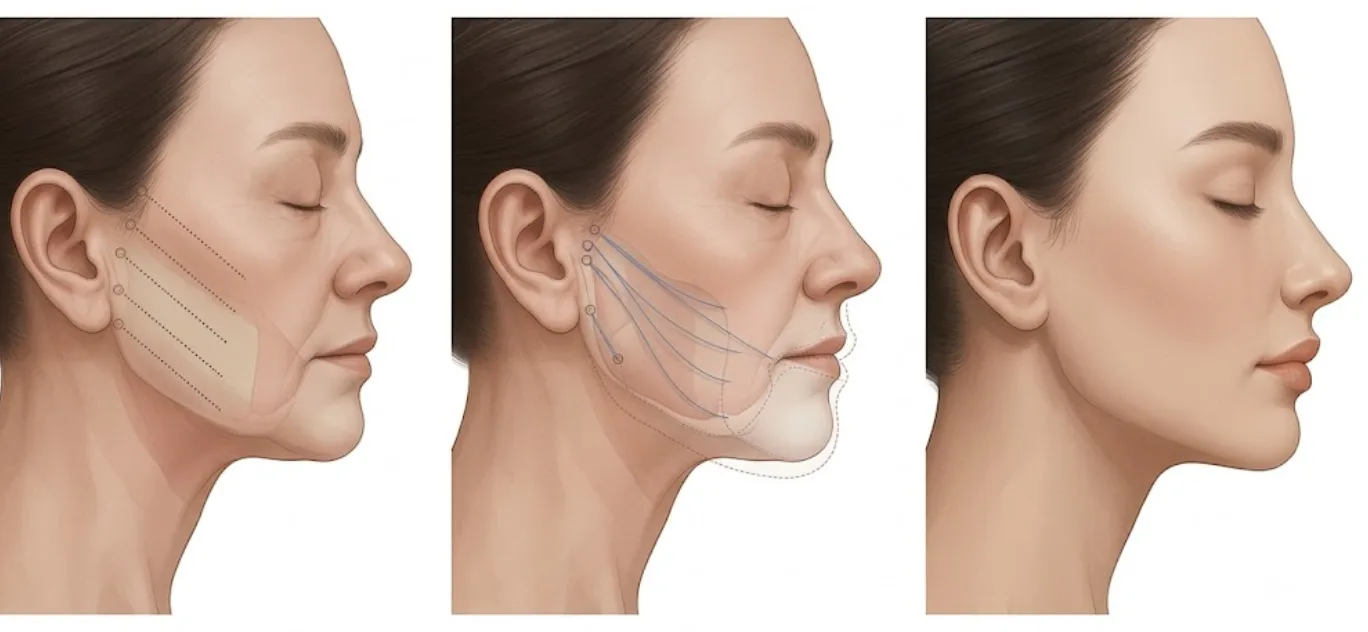
Illustration: barbed threads are placed along the paths shown and anchored at fixed points to lift early laxity of the lower face (Fixpoint Thread Lift™).
Those numbers are a realistic average and carry no promise. Some people enjoy a clear lift for closer to two years; others, particularly those who started with heavier sagging, find it fades sooner. A thread lift is a temporary refresh, a worthwhile one for the right candidate, but not a permanent change. We are careful not to claim it lasts longer than it genuinely does.
It also helps to separate the visible lift from the subtler effect. Beyond the mechanical lift, the threads prompt a little firming in the treated area as they break down, and a faint benefit of that can linger after the lift itself has faded. That effect is modest, and it is not a reason to expect the result to hold indefinitely.
Why temporary
Why a thread lift is not permanent
The reason a thread lift fades is by design: the threads used are dissolvable. They are placed under the skin through small cannula entry points and anchored to lift the tissue, and over the following months your body gradually absorbs them. As they break down, the mechanical support they provided eases off and the lift relaxes, which is why the result tapers off gradually and does not fail all at once.
This is by design. Dissolvable threads avoid leaving permanent material under the skin, which keeps the procedure minimally invasive and the recovery short, the trade-off explored in the thread lift recovery timeline. The price of that lighter approach is simply that the lift is temporary; you cannot have both a no-surgery, short-downtime lift and a permanent result from threads alone.
It is worth being clear about what the threads do and do not do. They reposition and re-drape sagging tissue, but they do not remove excess skin or reposition the deeper layers the way surgery does. So as the face continues to age, a thread lift holds the line for a while without resetting the clock, and that is the real reason it needs revisiting over time.
What affects it
What makes results last longer or shorter
Several things influence where you land in that 12-to-18-month range. The starting point matters most: someone with mild, early sagging and good skin tone tends to hold the lift longer than someone whose laxity was already advanced, because there is less downward pull working against the threads. This is the same reason candidacy and longevity are linked, as we explain in who a thread lift is for.
The plan itself plays a part. The number and type of threads, and how securely each is anchored, affect both the strength of the initial lift and how long it holds. That is one reason a careful, surgeon-placed lift behaves differently from a quick, lightly threaded one. Your own biology matters too: how quickly you metabolise the threads, your skin thickness and elasticity, and how your face naturally ages all shift the timeline.
Lifestyle has a smaller but real effect. Significant weight changes, heavy sun exposure and smoking all accelerate skin ageing and can shorten how long the lift looks its best. None of these is dramatic on its own, but together they explain why two people with the same procedure can see noticeably different longevity.
Top-up or facelift
A top-up or a longer-lasting facelift?
Because the result is temporary, you have a real choice as it fades: a top-up to refresh the lift, or a move to a procedure that lasts longer. Many people who are happy with the subtle, low-downtime nature of threads simply repeat them every year or two, treating it as ongoing maintenance.
For others, repeated top-ups start to look like the slower, costlier route to a result a single surgery would have given for longer. That is where a mini facelift becomes the fair comparison. A surgical lift tightens deeper tissue and removes a little excess skin, so it lasts considerably longer; the trade-off is a real operation and a longer recovery. We set the two side by side in thread lift vs facelift.
There is no single right answer. It depends on how your sagging is progressing, how you feel about repeating a procedure, and what value means to you over a few years. Decide with that whole picture in view, so the fading of a thread lift does not come as a surprise.
Helping it last
Helping your results last as long as possible
You cannot make dissolvable threads permanent, but you can give the lift the ideal chance of holding to the upper end of its range. Protecting your skin from sun, keeping your weight stable, not smoking, and a steady skincare routine all slow the skin ageing that works against the threads. None of this is dramatic, but it is the difference between the lower and upper end of 12 to 18 months for many people.
Following the aftercare in the first weeks matters too, because that is when the threads are settling and anchoring. Avoiding heavy facial massage, wide mouth movements and strenuous activity early on, as your surgeon advises, helps the lift set cleanly from its best position before anything disturbs it.
Finally, keep your follow-ups. Seeing the same surgeon as the result matures lets any concern be caught early and lets you plan the timing of a future top-up sensibly, before the lift has fully gone. Continuity of care, set out in what a single-surgeon clinic is, is part of getting the most from the procedure.
At Garnet
How Garnet approaches thread lift longevity
Garnet is a single-surgeon clinic in Apgujeong, Seoul, where Dr. In-Soo Baek, a board-certified plastic surgeon (Korean medical licence no. 77407), consults, performs the procedure and reviews every follow-up himself. Because the same surgeon sees the result over time, he can tell you at the outset how long your thread lift is likely to hold, and whether a longer-lasting mini facelift would actually suit you better.
When a thread lift is the right choice, Garnet uses its Fixpoint™ technique, a fixed-point barbed thread suspension placed through small cannula entry points, and supports the result with structured follow-up at 1, 3 and 6 months. Those reviews are where the lift is checked as it settles and where the timing of any future top-up can be planned without guesswork.
The starting point is an assessment of your skin and sagging, since that is what determines your realistic longevity. You can begin with a no-obligation online assessment: send photos, get a candid view of how long a thread lift would likely last for you, and a clear recommendation if a longer-lasting option fits your goals better.
Real Results
Before & After
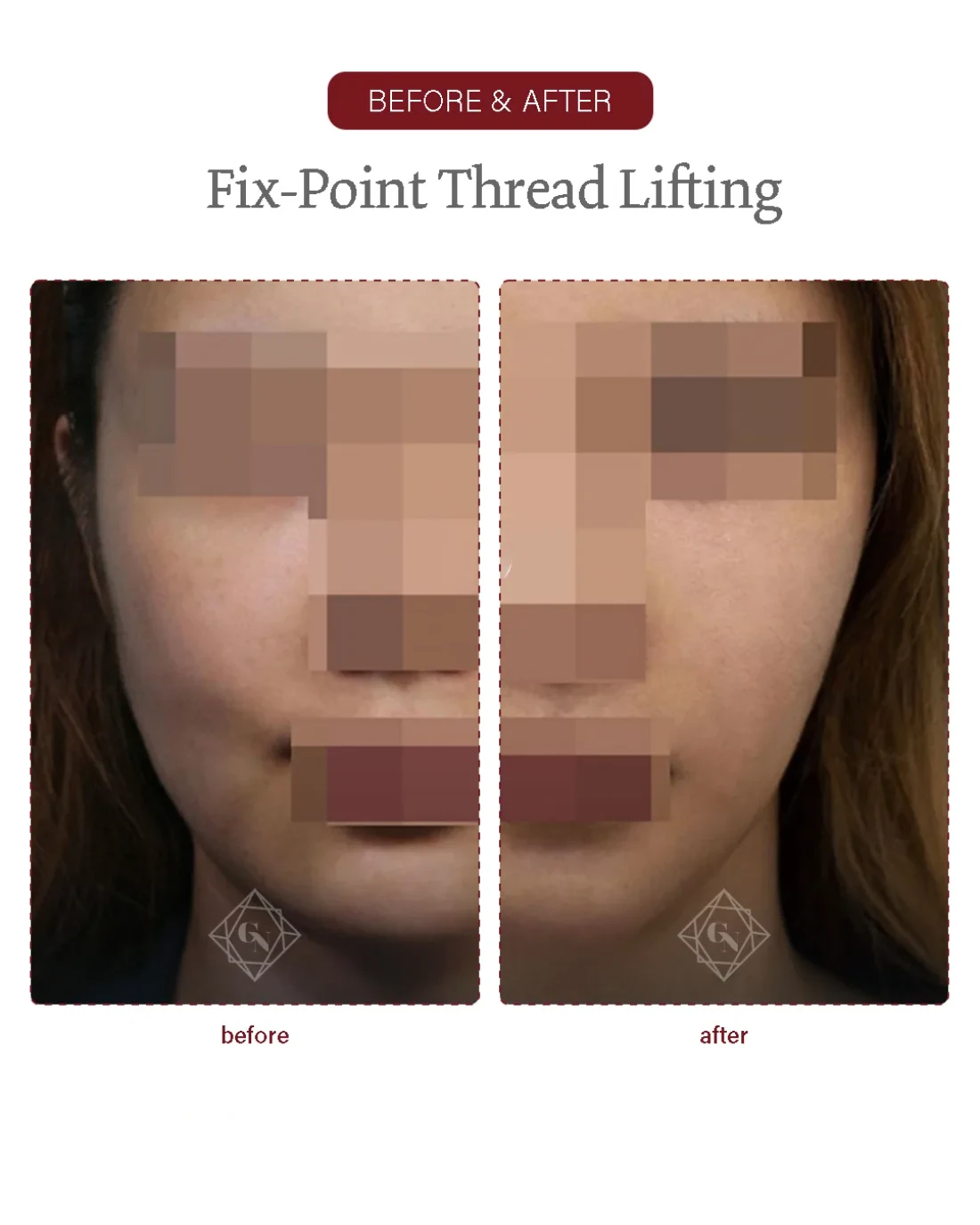
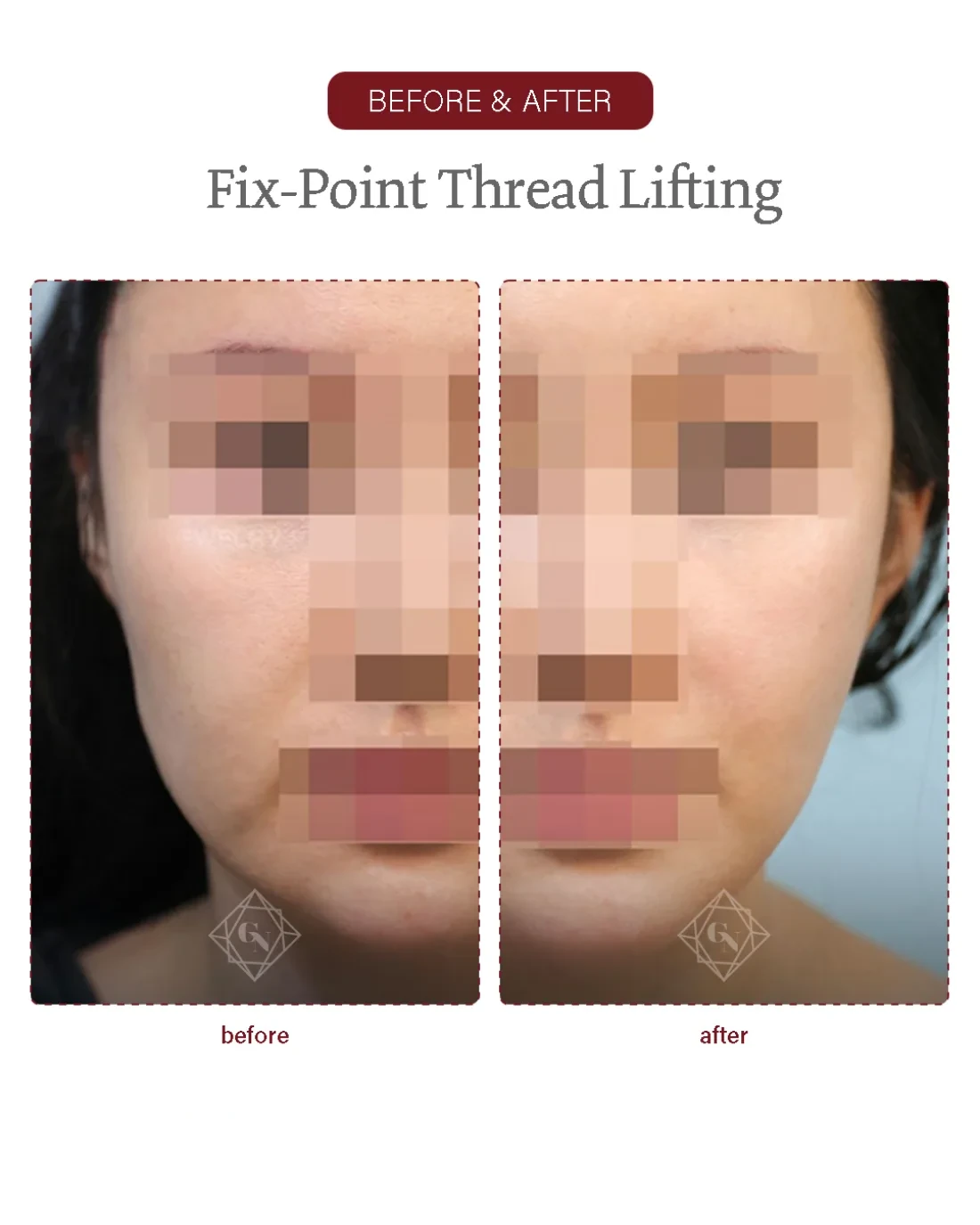
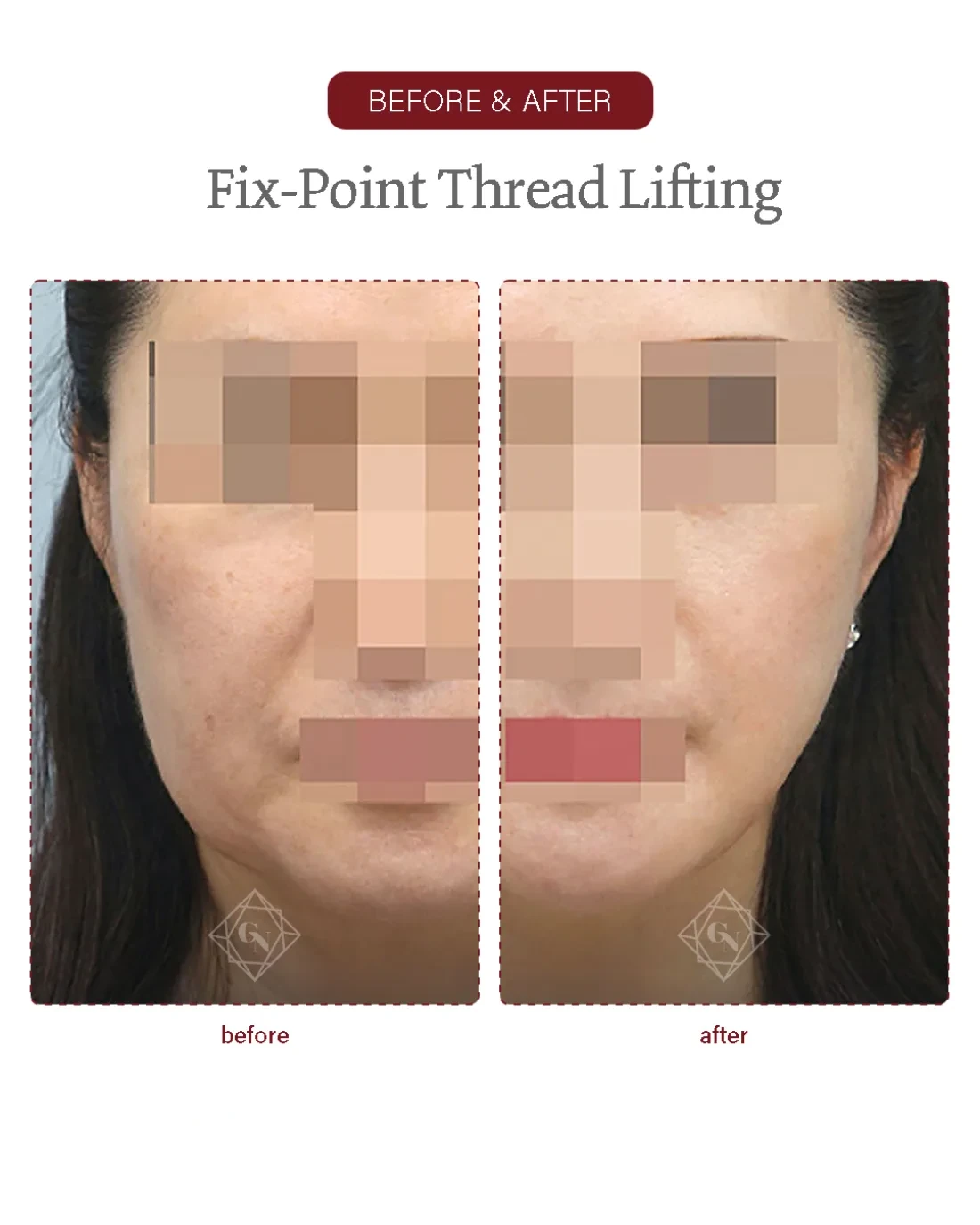
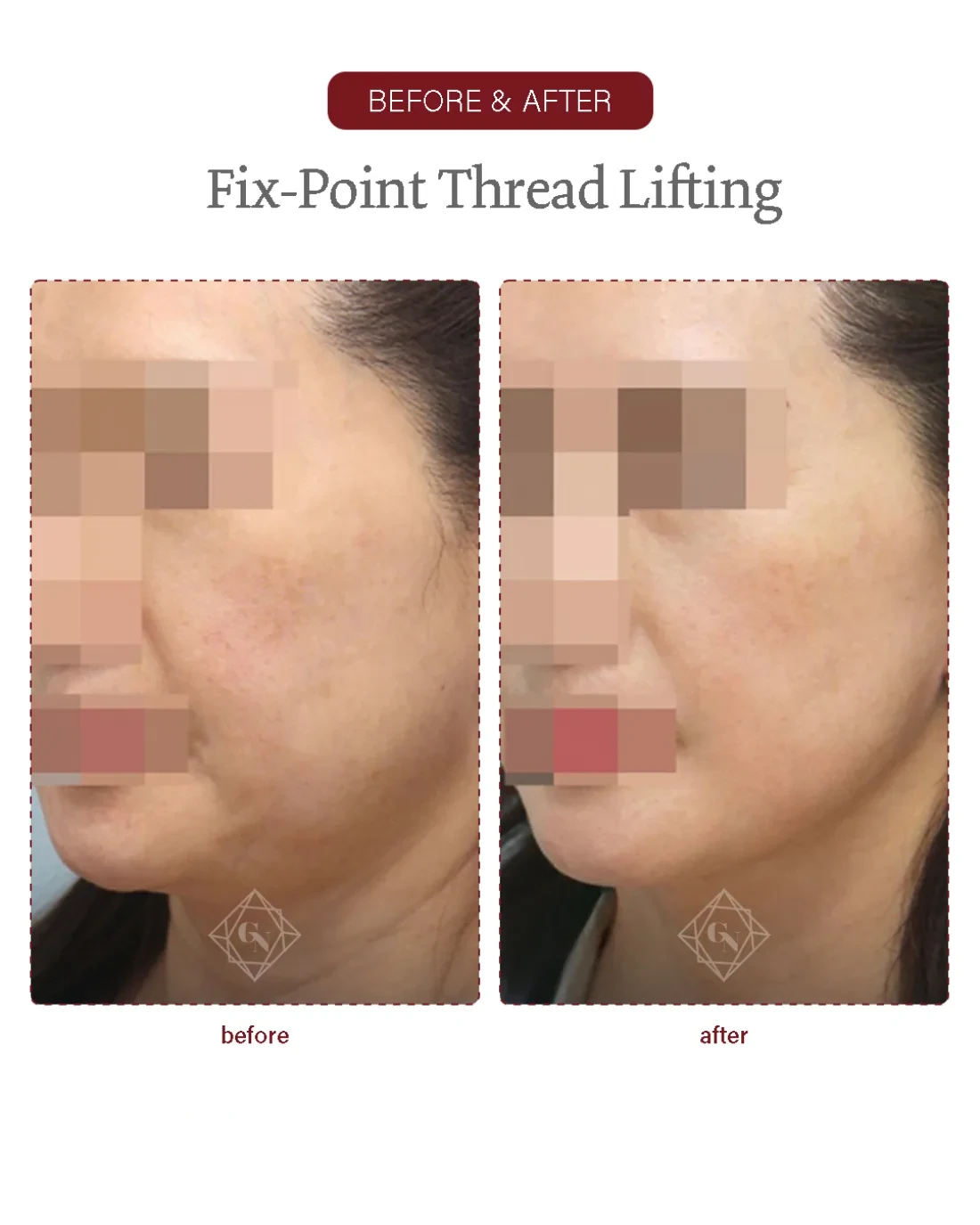
Thread-lift and contouring results of actual Garnet patients (published with consent, with date, procedure and clinic labelled). The lift is temporary and results, recovery and suitability vary by individual and are not guaranteed.
Prices
Price at Garnet
Thread lift
From₩100,000 + VAT per threadExcluding VAT (10% VAT is added at payment)Book now
Same price as Korean patients. Prices shown exclude 10% VAT; your written quote, issued after the in-person consultation, shows the full amount payable.
Dr. In-Soo Baek
Director & sole operating surgeon
Korean medical licence no. 77407
Operate on what you came for. Trained at Korea University Medical Center. Every case planned, performed and reviewed by the same hands.
1Operating surgeon
~2Surgeries per day
7Registered techniques
Board-certified plastic surgeon
Plastic surgery training at Korea University College of Medicine & graduate school
Korean Society of Plastic and Reconstructive Surgeons member, in its facial-contour, eye & rhinoplasty groups
Consults, operates and follows up each case himself
Peer-reviewed papers behind the facts on this page. Each describes findings in its own study group — not results at Garnet — and none predicts your own outcome.
Atiyeh BS et al. Percutaneous Thread Lift Facial Rejuvenation: Literature Review and Evidence-Based Analysis. Aesthetic Plastic Surgery. 2021. doi:10.1007/s00266-020-02095-1
Fundaro S et al. Expert consensus on soft-tissue repositioning using absorbable barbed suspension double-needle threads in Asian and Caucasian patients. Journal of Cutaneous and Aesthetic Surgery. 2021. doi:10.4103/jcas.jcas_138_19
Matarasso A et al. Barbed Sutures in Aesthetic Plastic Surgery: Evolution of Thought and Process. Aesthetic Surgery Journal. 2013. doi:10.1177/1090820x13499343
FAQ
Common questions
How long does a thread lift last?
For most people the lift holds for roughly 12 to 18 months. It builds in the first weeks, sits at its best for several months, then softens gradually as the dissolvable threads break down. Some enjoy closer to two years; those who started with heavier sagging often find it fades sooner.
Is a thread lift permanent?
No. The threads are dissolvable and your body gradually absorbs them over the months after the procedure, so the lift relaxes as they break down. This keeps the procedure minimally invasive with a short recovery, but it means the result is a temporary refresh and not a permanent change.
Why does a thread lift fade over time?
Because the threads are designed to dissolve. As your body absorbs them, the mechanical support they provided eases off and the lifted tissue gradually drifts back. The lift tapers off instead of failing suddenly, which is why most people notice a slow softening around a year to eighteen months.
What makes a thread lift last longer or shorter?
Your starting point matters most: mild, early sagging with good skin tone holds longer than advanced laxity. The number and type of threads, how securely they are anchored, your skin thickness and how quickly you metabolise the threads all play a part, as do sun exposure, weight changes and smoking.
When might I need a thread lift redone?
Many people repeat the procedure every one to two years as the lift fades, treating it as ongoing maintenance. The right timing depends on how your sagging is progressing; seeing the same surgeon at follow-up lets you plan a top-up sensibly before the lift has fully gone.
Is a top-up or a facelift better value?
It depends on your goals. If you like the subtle, low-downtime nature of threads, repeating them suits you. If repeated top-ups start to look like the slower route to a result a single surgery would give for longer, a mini or full facelift (a real operation with longer recovery but much longer-lasting results) may be better value over a few years.
Can I make my thread lift last longer?
You cannot make dissolvable threads permanent, but protecting your skin from sun, keeping your weight stable, not smoking and following early aftercare all help the lift reach the upper end of its range. Keeping your follow-ups lets the result be monitored and any top-up timed well.
Does the firming effect last after the lift fades?
The threads prompt a little firming in the treated area as they break down, and a faint benefit of that can linger after the mechanical lift has faded. It is modest, though, and not a reason to expect the visible lift to hold indefinitely.
How does thread lift longevity compare with a facelift?
A thread lift lasts roughly 12 to 18 months because the threads dissolve, whereas a surgical facelift tightens deeper tissue and removes a little excess skin, so it lasts considerably longer. The trade-off is that a facelift is a real operation with a longer recovery; our thread lift vs facelift guide sets them side by side.
Will Garnet tell me how long mine is likely to last?
Yes. Because Dr. In-Soo Baek, a board-certified plastic surgeon, consults, operates and follows up himself, he can give a realistic estimate of your likely longevity based on your skin and sagging, and recommend a longer-lasting option if that would genuinely suit you better.
My mom recently had a brow lift and lower blepharoplasty with Dr. Baek, and our experience has been wonderful so far. The Garnet team was incredibly kind and welcoming, with Kelly assisting us as our English consultant—she made everything…
I’m so happy I chose this clinic for my lower blepharoplasty. I was traveling from abroad by myself, so I was a little nervous, but from the beginning I felt comfortable and truly cared for. Everyone was kind, patient, and professional…
Came in for an in-person consult and ended up choosing Garnet and Dr.Baek for my non-incisional DES and tiplasty/alarplasty. I communicated with Kelly (English consultant) from the start till now (3 weeks post-op). She really help me feel…
My under-eyes have been sagging and folding for years... I tried to cover it up with makeup, but it actually got stuck in the wrinkles and made it stand out even more. While going for consultations, I noticed that the bigger the hospital…
Wondering how long a thread lift would last for you? Send photos of your jawline and cheeks for a no-obligation pre-assessment, including whether a longer-lasting option might suit your goals better.
Send photos and your question before you travel. An English-speaking coordinator reviews every enquiry and replies with guidance on whether surgery is appropriate, the likely plan and timing.
✓ Reviewed by the clinic coordinator, not a bot
✓ Photo-based pre-assessment before you fly
✓ Foreign-patient scheduling & after-care
✓ One surgeon for consultation, surgery and follow-up
Prefer to chat now? Reach the coordinator directly:









 T S7 months ago



