Under-eye fat repositioning moves herniated fat down over the orbital rim to fill the tear-trough instead of removing it, done through the inside of the lid so there is no external scar. Because it is a redistribution of a small amount of fat over an unforgiving contour, results can fall slightly short or slightly over: a bag can remain or return, a new hollow can appear, or the surface can look lumpy or uneven. Revision here is its own decision, and often the first advice is simply to let a still-swollen lower lid settle. This page sets out what under-eye fat repositioning revision really involves and when to wait, add, or redistribute.
The short answer
The most common reasons to revise are a residual or returning bag (too little fat moved or released), or a new hollow or over-flattened look under the eye (too much moved, or the trough emptied too far).
Others include a lumpy, ridged or uneven contour, a persistent dark or shadowed trough line, or asymmetry between the two eyes once the swelling has gone.
The fix is matched to the fault: releasing or repositioning more fat for a residual bag, adding volume such as a small fat graft for a hollow, and smoothing or evening an irregular contour. A full repeat of the same operation is rarely needed.
A careful assessment often concludes that the lower lid simply needs longer to settle, that a small touch of volume is enough, or that a shadow comes from skin colour and surgery would not change it.
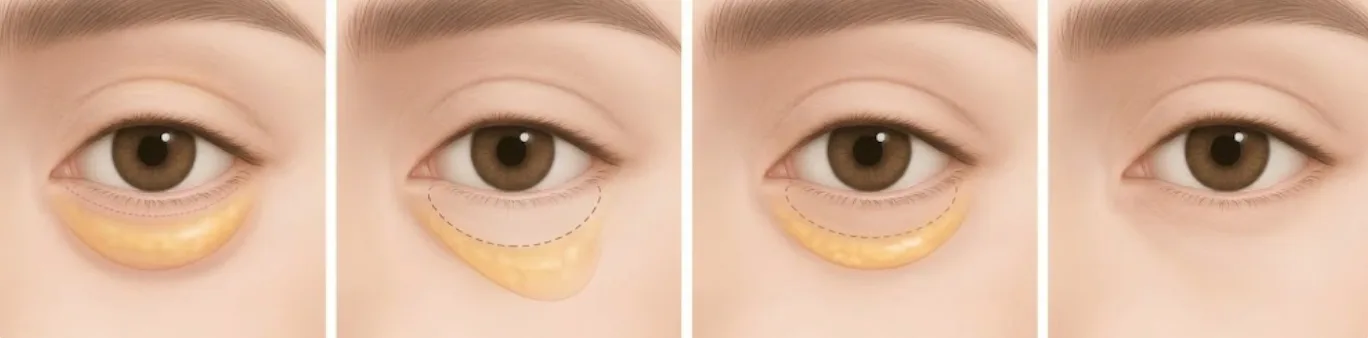
Under-eye fat repositioning treats an eye bag not by cutting fat away but by releasing the herniated pockets and moving them down over the orbital rim, fixing them to fill the tear-trough hollow beneath. It is done transconjunctivally, through the inside of the lower lid, so there is no external scar, and it aims to smooth the transition from lid to cheek. That is a delicate rebalancing of a small amount of tissue over a contour where a millimetre shows, which is why results occasionally need refining.
Illustration: working from inside the lower lid, the under-eye fat (yellow) is moved down into the hollow instead of being removed; the dashed line shows where it sat.
The concerns divide neatly into too little and too much. On the 'too little' side, a bag can remain because not enough fat was released or repositioned, or a bag can return over time as ageing continues; either way the bulge people wanted gone is still there. On the 'too much' side, moving or releasing too much fat, or emptying the trough too far, can leave the area looking hollow, sunken or flattened, sometimes making the eye look more tired than before, which is the opposite of the goal.
A third group concerns the surface more than the volume: a contour that heals lumpy, ridged or uneven, a repositioned pocket that can be felt or seen as a small fullness, a trough line that stays visible or shadowed, or a genuine difference between the two eyes. Separating these matters, because a residual bag, a new hollow and an uneven surface each lead to a different plan. Some 'shadows' come from skin pigment or a tear-trough ligament with no fat involved, and they would not change with more surgery.
What settles
What settles on its own after under-eye fat repositioning, and what does not
The lower lid is one of the slowest areas to settle, and most of what alarms people in the first weeks is normal. Swelling and bruising through the transconjunctival approach can make the area look puffy, uneven, lumpy or oddly full, and firmness where the fat has been fixed is expected. A contour that looks ridged or a bag that seems to remain at two or three weeks is very often swelling sitting on top of a good result.
Early asymmetry is just as misleading here. The two lower lids bruise and de-swell at different rates, so a difference at a couple of weeks frequently evens out over the following weeks to a couple of months. Small palpable firmness where the repositioned fat is settling, and a slightly tight or numb feeling on the cheek, are part of the normal early picture and do not mean revision is needed. The recovery timeline walks through what is expected and over what timeframe.
What does not reliably settle on its own is a clear bag that remains once the swelling has fully gone, a genuine hollow or sunken look that persists and does not fill as swelling resolves, a lump or ridge that stays after the early months, or a real mismatch between the eyes at the end of settling. For these concerns revision can reasonably be considered, once they have been told apart from the slow, normal settling above, which for this area can take a couple of months or more.
Bag or hollow
A residual bag versus a new hollow
Revision here is a spectrum, and the two ends need opposite corrections. A residual or returning bag usually means fat that was not fully released or repositioned, or that has re-herniated; the fix is to go back transconjunctivally, release the remaining pocket and reposition or, where appropriate, conservatively reduce it so the bulge is flattened without emptying the trough. Because the approach is again through the inside of the lid, this stays scarless on the surface.
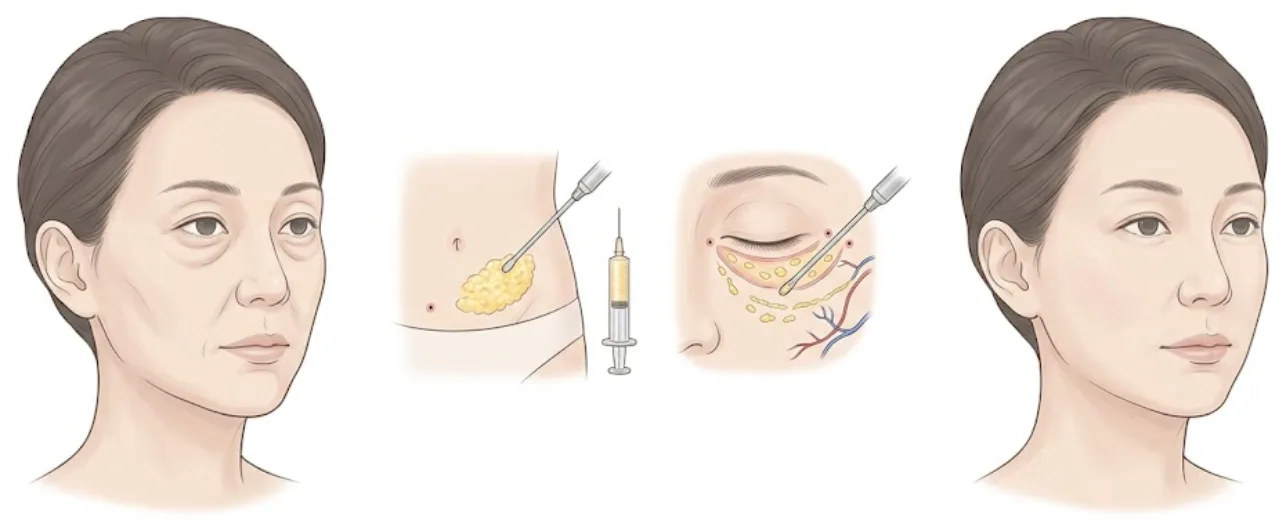
Illustration: the patient's own fat is gently taken from a donor area such as the abdomen, refined, and placed in small amounts where volume has been lost.
A new hollow, sunken look or over-flattened lid is the opposite problem (too much volume was moved or the trough emptied too far), and it is corrected by adding volume back, with nothing more taken away. That is often a small, carefully placed fat graft to refill the hollow and restore a smooth lid-to-cheek transition; fat grafting is a natural partner to this kind of correction because it replaces like with like. Over-hollowing is genuinely harder to fix than a residual bag, which is one reason careful surgeons move fat conservatively the first time.
The surface problems sit between these: a lump or ridge is smoothed and redistributed, an uneven side is balanced toward the other, and a repositioned pocket that can be felt is eased into a flatter lie. What almost never helps is simply repeating the same full operation as if nothing were done. The skill lies in matching the response to the specific fault, whether that is releasing more, adding a little, or smoothing. And where a 'shadow' turns out to be pigment or a tethering ligament, you are told so plainly, because surgery would not change it.
Timing
When to wait and when to act
Timing is the most important decision in this revision. The lower lid settles slowly, so for most concerns the advice is to wait, often longer than for other eye procedures. In the first weeks and even months the area is still de-swelling, the repositioned fat is still integrating, and firmness and minor unevenness are still resolving. Operating into a lid that is still settling to fix a bump or a bag that would have smoothed on its own makes a clean correction harder and, on this unforgiving contour, risks trading one irregularity for another.
As a general principle, a surgeon prefers to let a fat repositioning settle for a couple of months at least before judging whether a bag truly remains, whether a hollow is real, and whether the two sides match, assessing a calm lower lid once the swelling and bruising have gone. Adding volume to correct a hollow, especially, should wait until it is clear the hollow is a true deficit that will not fill as swelling and the fat's final position stabilise. Rushing to touch up a lid that is still settling is the most common avoidable mistake.
The exception, where prompt review matters more than patience, is signs such as spreading redness, discharge, unusual or worsening pain, a sudden change in the white of the eye, or any change in vision. Those are seen early. For the far more common cosmetic concerns of a residual bag, a hollow, a lump or asymmetry, there is no urgency and every reason to let the area settle fully before deciding. You can compare what a repositioning realistically achieves on the when-will-I-see-results page before planning any correction.
Technique
What a careful redo involves
A careful revision begins with reading the first surgery and the current anatomy: how much fat was repositioned and where, whether a true bag remains or a hollow has formed, whether the surface irregularity is fat, swelling or scar, and whether a dark trough is contour or pigment. Examining the lid in different gazes and lighting separates a volume problem from a shadow problem. A surprising number of 'bags' or 'shadows' turn out to be skin, ligament or lingering swelling that a redo would not change.
For a residual bag, the surgeon usually returns through the same transconjunctival, scarless route to release and reposition or conservatively reduce the remaining fat, checking the contour smooths without over-emptying the trough. For a hollow, the correction is additive, commonly a small fat graft placed to refill the deficit and soften the lid-to-cheek line; for a lump or ridge, the fat is redistributed and eased flat. Because the inside-the-lid approach is preserved for most of this work, a well-planned revision generally adds no visible external scar.
Revision on the lower lid is more demanding than the first procedure. The tissue has been operated on, over-hollowing is hard to reverse, and the margin between too little and too much is small, so it is best done on a fully settled lid by an experienced surgeon working conservatively. The recovery sensations resemble a primary repositioning: swelling, bruising and firmness that settle over weeks to a couple of months. The goal is to correct the specific fault with the smallest effective step, without moving more fat on a lid that has already been treated.
At Garnet
How Garnet approaches under-eye revision
Garnet is a single-surgeon clinic in Apgujeong, Seoul. Dr. In-Soo Baek is a board-certified plastic surgeon (Korean medical licence no. 77407) and the only operating doctor. He assesses each revision himself, plans it himself, performs it himself and reviews every follow-up, with structured reviews at 1, 3 and 6 months. For an under-eye revision, where telling a true deficit from lingering swelling or a shadow from pigment is so much of the judgement, that continuity matters: the surgeon who examines your lid is the one accountable for whether to wait, release more, or add volume.
Revision assessment at Garnet is deliberately unhurried and frank. That includes being willing to say that a slowly settling lower lid needs more time before any redo, that a small touch of grafted volume is all a hollow needs, or that a dark trough comes from skin colour or a ligament and surgery would not change it. There is no consultation fee and no pressure to book, because a sound under-eye revision decision should never be rushed.
If you are considering correcting an earlier under-eye fat repositioning from abroad, you can begin without travelling. Send your history and clear photos of the under-eye area in different gazes and lighting for a pre-assessment, and read the guide for international patients for how stay length and remote follow-up are handled.
Real Results
Before & After
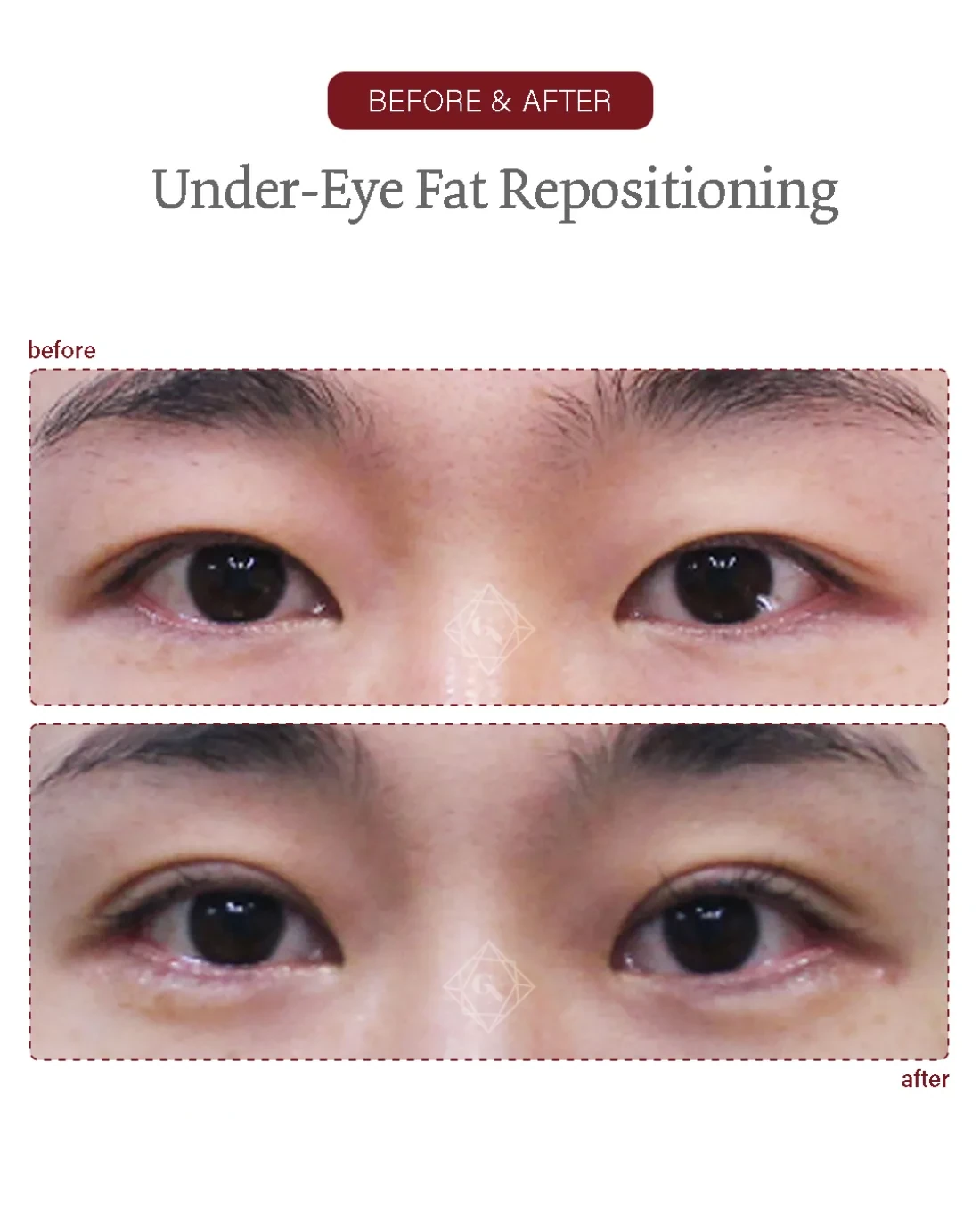
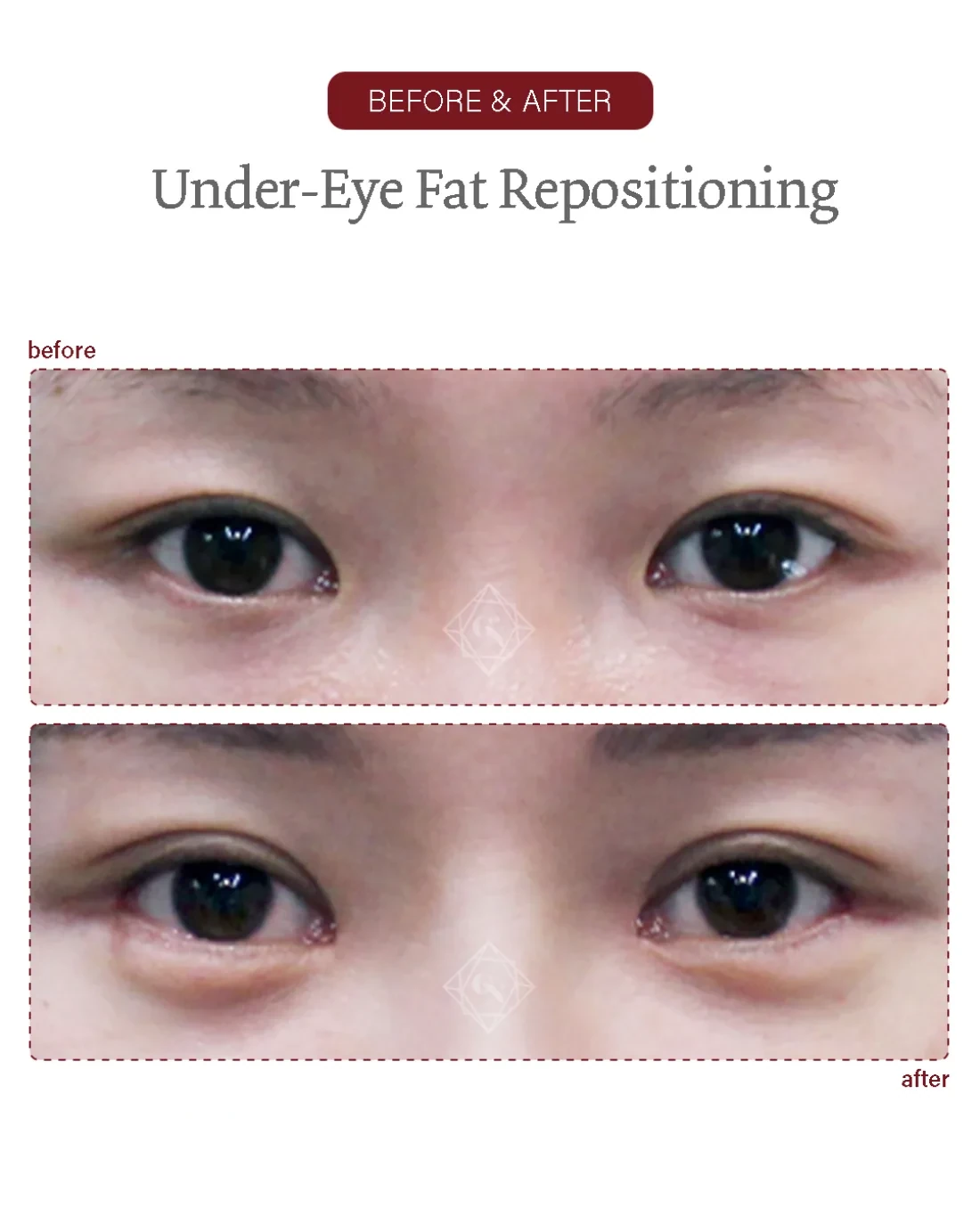
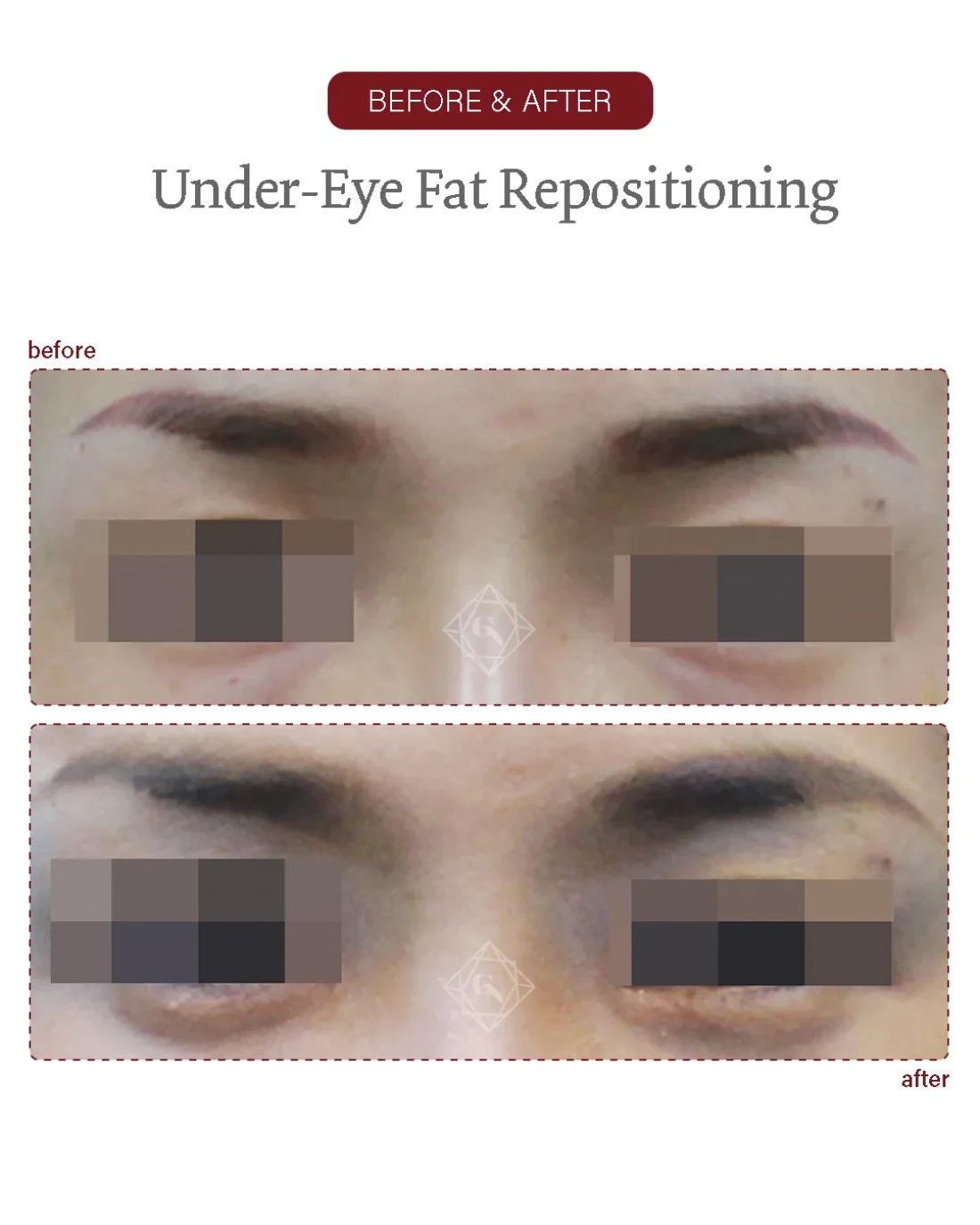
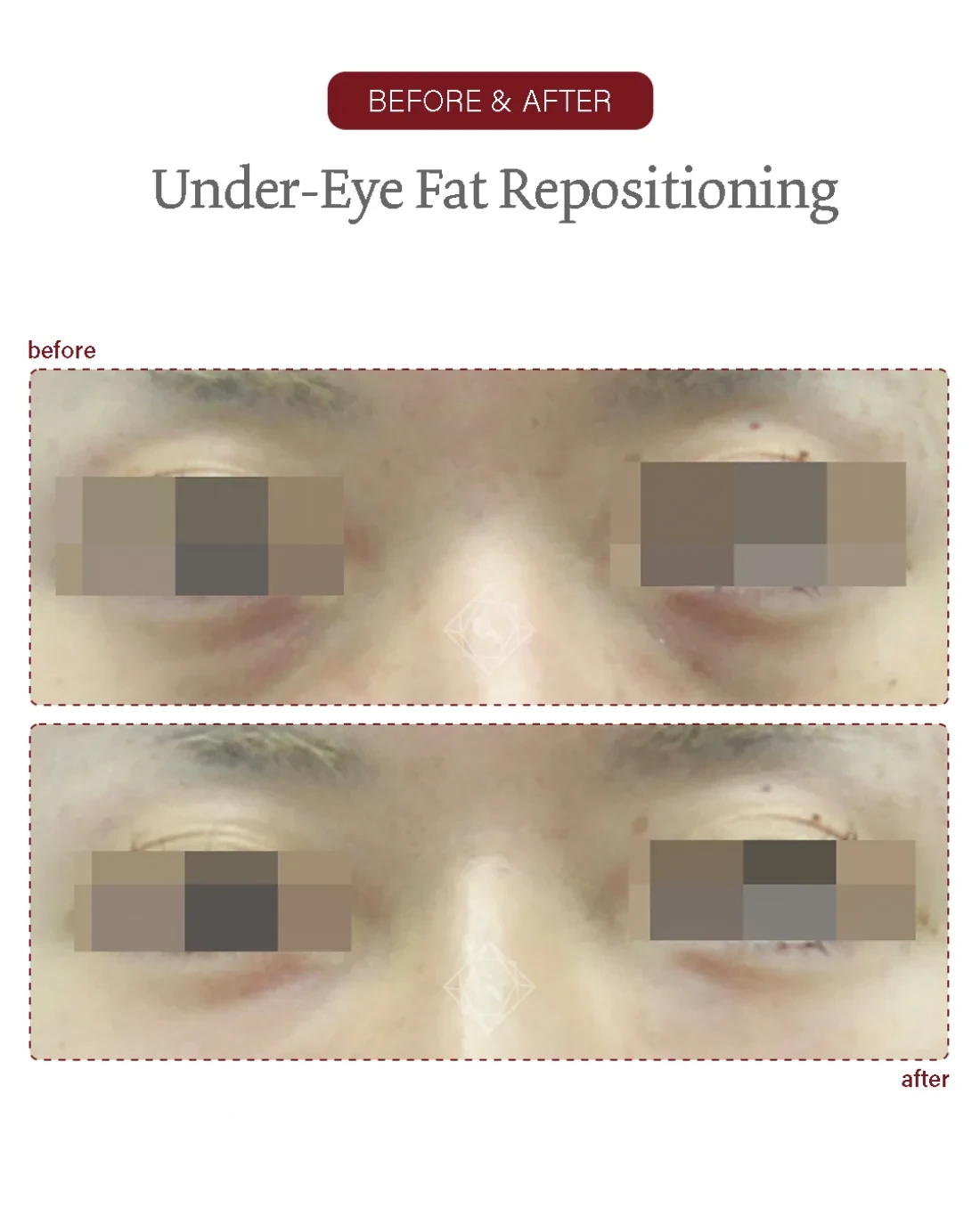
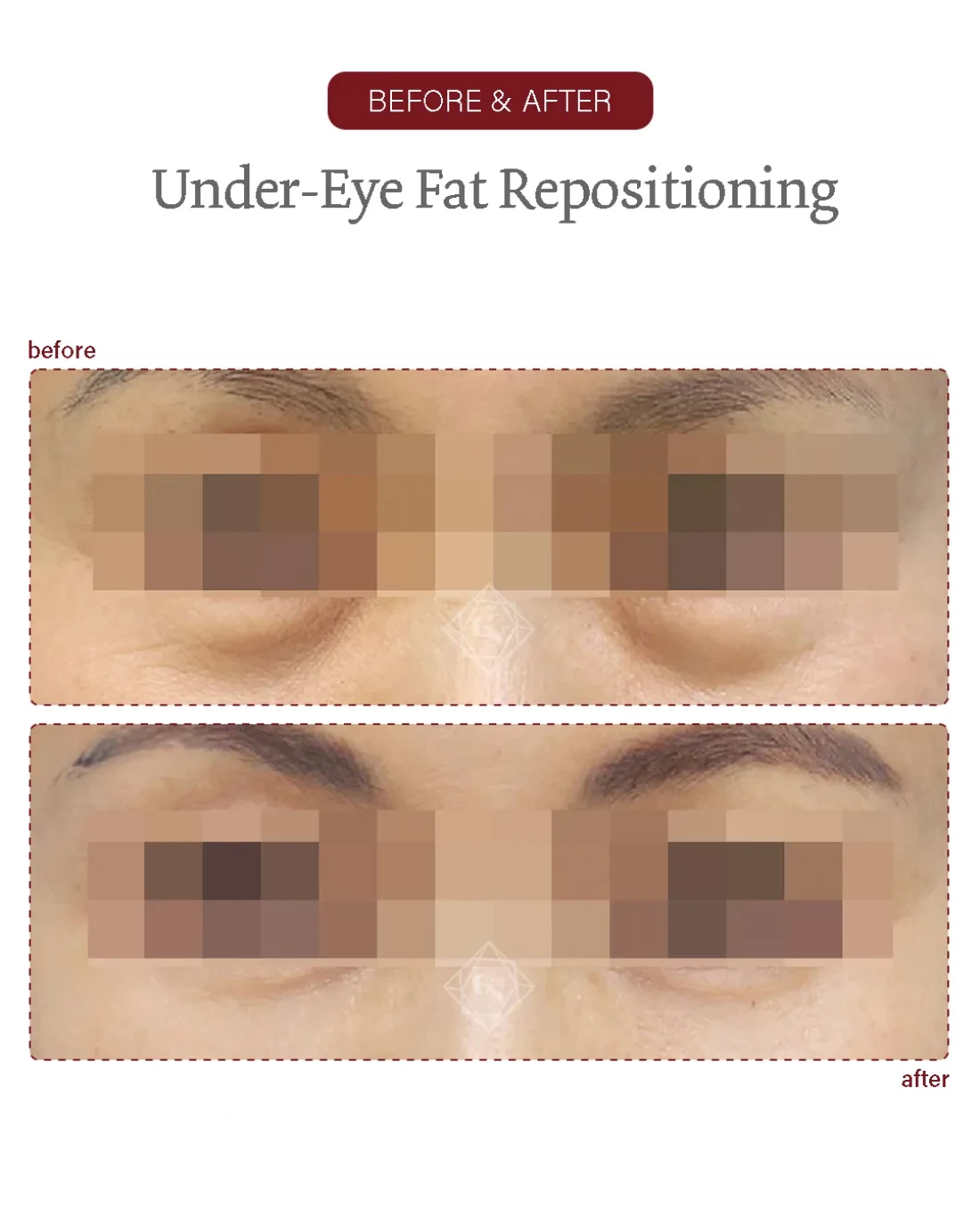
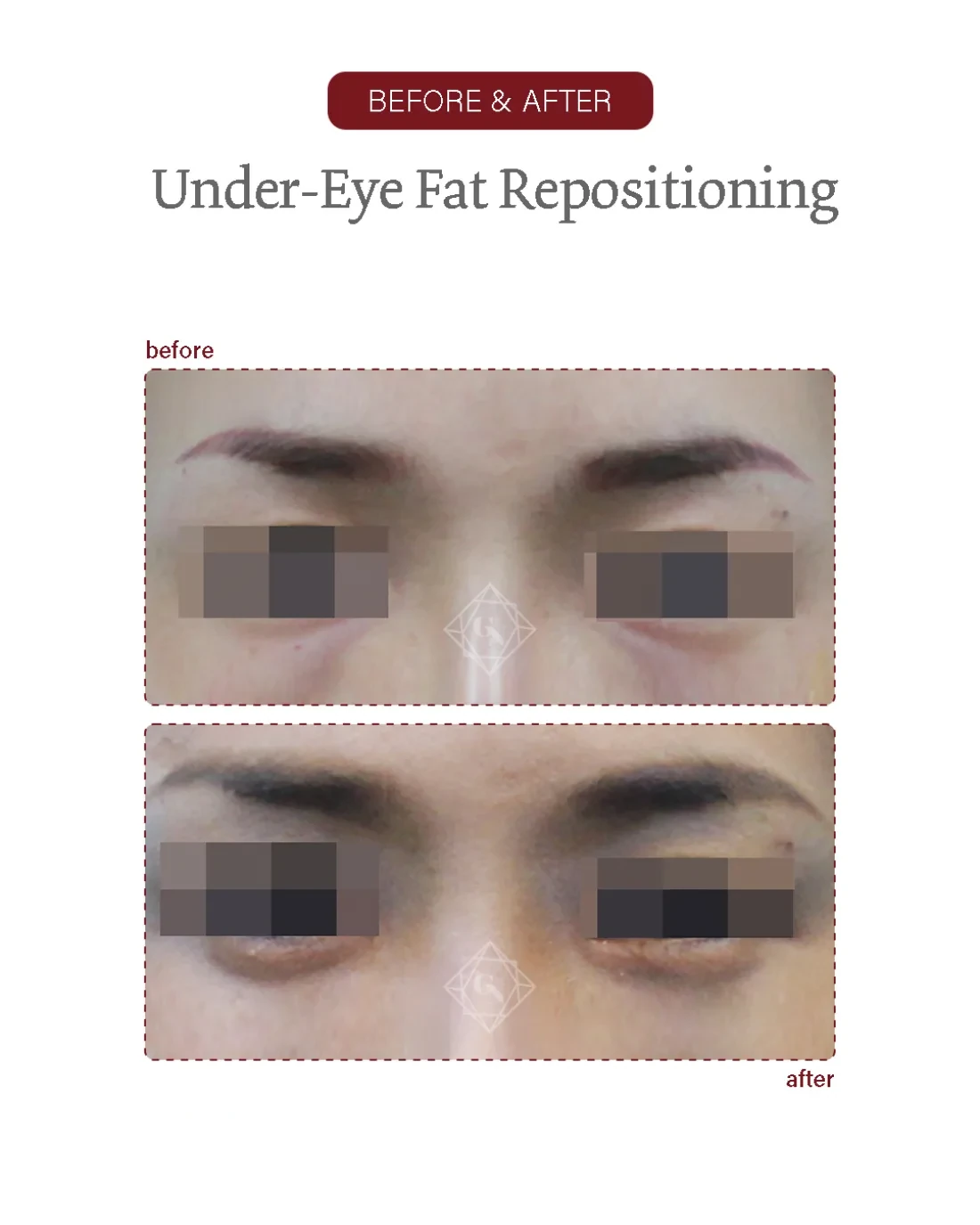
Under-eye fat repositioning before/after of actual Garnet patients (published with consent; each set labelled with date, procedure and clinic). Photographed under comparable conditions. Results, recovery and suitability vary by individual and are not guaranteed.
Prices
Price at Garnet
Under-eye fat repositioning
From₩2,500,000 + VATExcluding VAT (10% VAT is added at payment)Book now
Same price as Korean patients. Prices shown exclude 10% VAT; your written quote, issued after the in-person consultation, shows the full amount payable.
Dr. In-Soo Baek
Director & sole operating surgeon
Korean medical licence no. 77407
Operate on what you came for. Trained at Korea University Medical Center. Every case planned, performed and reviewed by the same hands.
1Operating surgeon
~2Surgeries per day
7Registered techniques
Board-certified plastic surgeon
Plastic surgery training at Korea University College of Medicine & graduate school
Korean Society of Plastic and Reconstructive Surgeons member, in its facial-contour, eye & rhinoplasty groups
Consults, operates and follows up each case himself
Peer-reviewed papers behind the facts on this page. Each describes findings in its own study group — not results at Garnet — and none predicts your own outcome.
Stutman RL et al. Tear Trough Deformity: Review of Anatomy and Treatment Options. Aesthetic Surgery Journal. 2012. doi:10.1177/1090820x12442372
Palmer FR et al. Transconjunctival Blepharoplasty: Complications and Their Avoidance: A Retrospective Analysis and Review of the Literature. Archives of Otolaryngology - Head and Neck Surgery. 1993. doi:10.1001/archotol.1993.01880210083011
Susanna CN et al. Lower Blepharoplasty. Facial Plastic Surgery Clinics of North America. 2026. doi:10.1016/j.fsc.2026.06.012
FAQ
Common questions
Can an under-eye fat repositioning be revised or corrected?
Often, yes, though the correction is matched to the fault. A residual or returning bag can be released and repositioned again through the same scarless route; a new hollow is corrected by adding volume, usually a small fat graft, with nothing more removed; and lumps or asymmetry are smoothed or balanced. It should follow a careful assessment on a fully settled lower lid, never a quick decision, because this area settles slowly.
I still have a bag after under-eye fat repositioning. Do I need revision?
Not necessarily yet. In the first weeks and months, swelling can sit on top of a good result and mimic a remaining bag. A clear bulge that persists once the lid has fully settled may reflect fat that was not completely released or repositioned, and can usually be corrected by going back through the inside of the lid. But wait for full settling first, because operating too early risks correcting swelling that would have resolved.
My under-eye looks hollow or sunken after surgery. Can that be fixed?
Usually, yes, by adding volume back. A hollow means too much fat was moved or the trough emptied too far, and it is typically corrected with a small, carefully placed fat graft to refill the deficit and restore a smooth lid-to-cheek transition. Over-hollowing is harder to fix than a residual bag, so it is assessed carefully and only once it is clear the hollow is real and not lingering swelling.
What does under-eye fat repositioning revision involve?
It depends on the fault. A residual bag is released and repositioned or conservatively reduced through the same transconjunctival, scarless route. A hollow is refilled, usually with a small fat graft. A lump or ridge is smoothed and redistributed, and an uneven side is balanced toward the other. Because most of the work stays inside the lid, a well-planned revision generally adds no visible external scar.
When is under-eye fat repositioning revision needed?
For early puffiness, firmness and unevenness, revision is rarely needed because they settle over weeks to a couple of months. Genuine reasons include a clear bag remaining once fully settled, a true hollow or sunken look, a persistent lump or ridge, or a real mismatch between the eyes. A dark trough that turns out to be pigment or a ligament is not a surgical problem. Signs of infection or any vision change are reviewed promptly.
How long should I wait before revising an under-eye fat repositioning?
Longer than for many eye procedures, because the lower lid settles slowly, commonly a couple of months at least before judging whether a bag truly remains, a hollow is real, or the two sides match. Correcting a hollow with added volume especially should wait until the deficit is clearly not just swelling. The exception is signs of infection, unusual pain or any change in vision, which are reviewed promptly.
My under-eye contour is lumpy or uneven. Will it stay that way?
Usually not. Lumpiness, ridging and unevenness are common in the early weeks as swelling and the repositioned fat settle, and most smooth out over the following weeks to a couple of months. A lump or ridge that clearly persists once the lid has fully settled can be smoothed and redistributed, and an uneven side balanced toward the other, but this is judged on a calm lid once swelling has gone.
Will under-eye revision leave a scar?
Usually not. Under-eye fat repositioning is done through the inside of the lower lid, and most revision work (releasing or repositioning a residual bag, smoothing a lump) uses the same scarless route, so it generally adds no visible external scar. If a hollow is corrected with a small fat graft, that is placed through tiny entry points that are normally inconspicuous once healed.
Is a residual bag or a hollow harder to fix?
A hollow is generally harder. A residual bag can often be improved by releasing and repositioning the remaining fat, whereas a hollow means volume was lost and has to be added back, usually with a fat graft that must take and settle evenly on a delicate contour. This is exactly why careful surgeons move fat conservatively the first time: it is easier to add a little later than to reverse over-hollowing.
Can I get an under-eye revision assessment from abroad before travelling?
Yes. You can send the history of your first surgery and clear photos of the under-eye area in different gazes and lighting for a pre-assessment online before committing to travel. You then have a realistic view of whether the concern is a true bag, a hollow, a surface irregularity or simply a shadow, and whether waiting for the lid to settle would be wiser, before planning a trip.
My mom recently had a brow lift and lower blepharoplasty with Dr. Baek, and our experience has been wonderful so far. The Garnet team was incredibly kind and welcoming, with Kelly assisting us as our English consultant—she made everything…
I’m so happy I chose this clinic for my lower blepharoplasty. I was traveling from abroad by myself, so I was a little nervous, but from the beginning I felt comfortable and truly cared for. Everyone was kind, patient, and professional…
Came in for an in-person consult and ended up choosing Garnet and Dr.Baek for my non-incisional DES and tiplasty/alarplasty. I communicated with Kelly (English consultant) from the start till now (3 weeks post-op). She really help me feel…
My under-eyes have been sagging and folding for years... I tried to cover it up with makeup, but it actually got stuck in the wrinkles and made it stand out even more. While going for consultations, I noticed that the bigger the hospital…
Considering correcting or refining an earlier under-eye fat repositioning? Send your history and photos for a no-obligation pre-assessment, including a frank view on whether the concern is a residual bag, a hollow, an irregularity or simply a shadow, and whether waiting for the lower lid to settle serves you better.
Send photos and your question before you travel. An English-speaking coordinator reviews every enquiry and replies with guidance on whether surgery is appropriate, the likely plan and timing.
✓ Reviewed by the clinic coordinator, not a bot
✓ Photo-based pre-assessment before you fly
✓ Foreign-patient scheduling & after-care
✓ One surgeon for consultation, surgery and follow-up
Prefer to chat now? Reach the coordinator directly:








 T S7 months ago



