Epicanthoplasty revision is surgery to correct or improve the inner corner after a previous procedure that healed unevenly, was overdone, left a noticeable scar or web, or made the eyes look too close together. Revision is more demanding than a first operation. Not every concern needs surgery, and the ones that do are best addressed after the inner-corner tissue has fully settled.
The short answer
Common reasons for revision are an overcorrected (too-open) inner corner, a visible web or scar band, eyes that look too close together, or under-correction that left the fold.
Revision is technically harder than the first surgery because it works through scar tissue, so a conservative, anatomy-led assessment matters even more.
Timing is critical: scars and swelling usually need months to settle before revision is considered, and some early concerns improve on their own.
At Garnet a board-certified plastic surgeon assesses each case and will say when revision is not needed, or not yet.
Most people who ask about epicanthoplasty revision fall into a few groups. Some feel their inner corners were opened too much, so the eyes look too close together or the inner corner shows too much pink and looks unnatural; this is an overcorrection. Others feel too little was changed and the original Mongolian fold is still covering the inner corner, which is an under-correction. A third group is concerned not with the shape but with the healing: a visible scar band, redness that has not faded, or a small web of skin pulling at the inner corner.
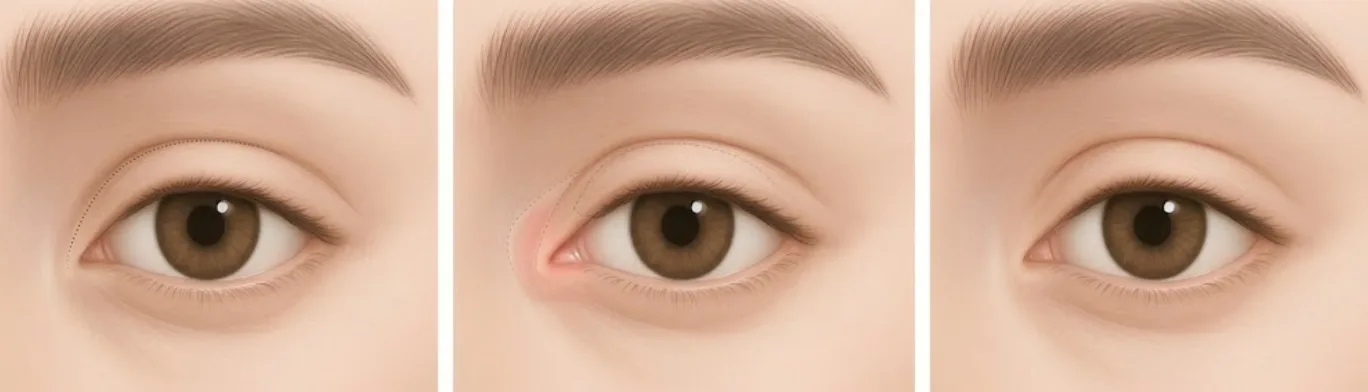
Illustration: the skin fold covering the inner corner is released along the dotted line so the inner corner opens slightly while the eye keeps its own shape.
It helps to understand that the inner corner is an area where small differences are very visible, and where the change from the original surgery was measured in millimetres. That is also why some concerns that feel significant in the early weeks settle on their own as swelling resolves and the scar matures. Distinguishing a result that simply needs more healing time from one that genuinely needs revision is the first and most important judgement.
If you are still in the early healing phase after a first procedure, it is worth reading the sibling guides on the recovery timeline and scars and healing before assuming something is wrong. Many early appearances are a normal stage of recovery and are no reason for further surgery.
Overcorrection & webs
Overcorrection, visible webs and scarring
The concern that most often prompts revision is overcorrection: an inner corner opened more than the face can comfortably carry, which can make the eyes look too close together, expose too much of the pink inner corner, or simply look “done.” Because opening the corner is far easier than closing it again, overcorrection is one of the more difficult problems to address and is exactly why a conservative first operation matters so much.
A second issue is a visible web or scar band: a small fold or tethered line of scar tissue at the inner corner that can pull or look raised. Some webbing reflects the original technique; some reflects how an individual's tissue healed. A revision aimed at a web works to release and reposition tissue and to soften the scar, but scar tissue is less predictable than untouched skin, so realistic expectations are essential. The goal of correction is usually improvement and a more natural look. Perfection cannot be guaranteed.
Scarring concerns alone do not always need surgery. A pink, firm inner-corner scar in the first months is a normal stage that usually fades, and non-surgical scar care can help. Reserving surgical revision for a scar or web that has matured and is still genuinely problematic avoids operating on an area that would have improved on its own. The parent epicanthoplasty overview explains how the original Two-way™ release is planned to minimise these issues in the first place.
Harder than first
Why revision is harder than the first surgery
Revision epicanthoplasty is more technically demanding than a primary procedure. The surgeon is now working through scar tissue at the inner corner, and scar is stiffer, less elastic and heals less predictably than fresh, untouched skin. The original anatomy of the inner corner may also have been altered. There is less tissue to work with, particularly when correcting an overcorrected corner, where the challenge is to recreate a natural-looking fold instead of simply opening further.
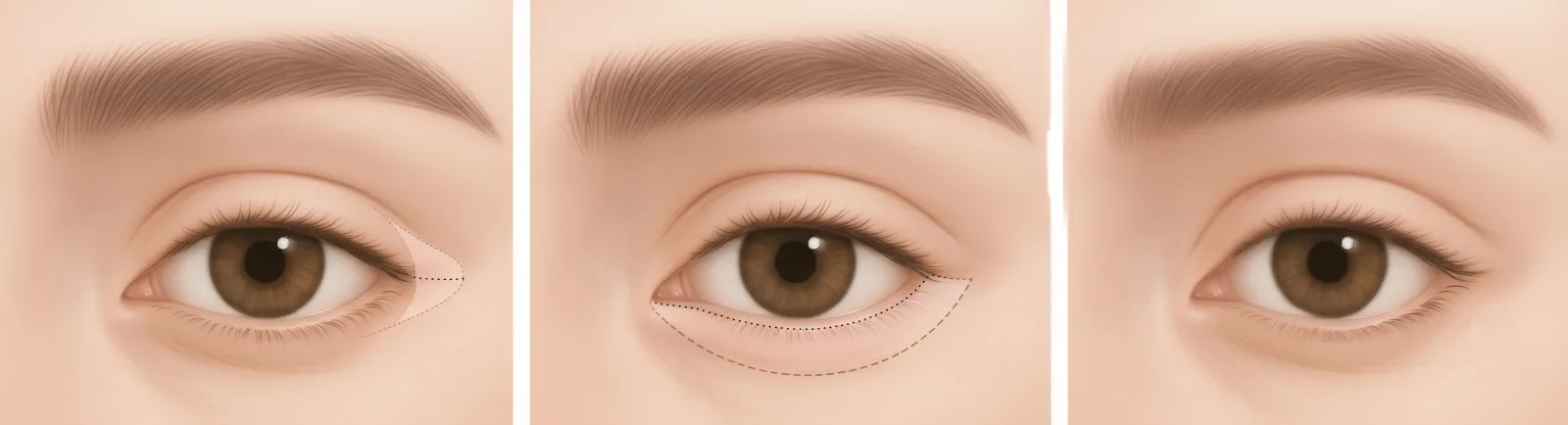
Illustration: the outer corner is extended and the lower-lid line gently lowered along the dotted lines, softening the angle of the eye.
Because of this, revision rewards a careful, conservative, anatomy-led approach far more than an ambitious one. The aim is realistic improvement and balance. A dramatic re-do is not the goal, and a surgeon who promises an ideal result is over-promising. A measured plan that improves the inner corner while respecting the limits of healed tissue is the responsible approach, and sometimes the right advice is that a particular concern is better left alone.
This is also why who performs a revision matters. A surgeon who assesses you in person, examines the existing scar and explains candidly what can and cannot be improved gives you better information than one who simply agrees to operate. If you are weighing whether the inner corner or an adjacent feature is the real issue, related procedures such as lateral canthoplasty on the outer corner may be discussed as part of a complete assessment.
Timing
When to consider epicanthoplasty revision, and when to wait
Timing is one of the most important parts of revision, because operating too early can make things worse. Inner-corner tissue continues to settle for months after the first surgery: swelling resolves, the scar softens and pales, and the final shape becomes clear only once healing has matured. Many concerns that look like a problem at a few weeks improve substantially over the following months, so the general principle is to wait until the area has fully settled, commonly several months to around a year, before deciding on revision.
There are exceptions. A clear functional problem, a tethered web that keeps getting worse, or a complication should be reviewed promptly instead of waited out. That is why staying in contact with a surgeon during healing matters. For the common cosmetic concerns (an inner corner that looks slightly too open, a scar that is still pink, a shape that feels not quite right), patience is usually part of the treatment itself.
If you had your first procedure elsewhere and are now abroad, you do not need to fly back and forth to get an opinion on timing. You can send photos for an online pre-assessment from abroad, and be told whether the area still needs time, whether revision is realistic, and roughly when it would be appropriate to consider it.
At Garnet
How Garnet assesses a revision case
Garnet is a single-surgeon clinic in Apgujeong, Seoul, where Dr. In-Soo Baek is a board-certified plastic surgeon (Korean medical licence no. 77407) and the only operating doctor. For a revision, the same surgeon who would perform the correction is the one who examines your inner corner, reviews how the first procedure healed, and tells you plainly whether revision is needed, whether it should wait, or whether the area is best left alone. The clinic's policy is to address only what genuinely benefits you and to avoid over-recommending.
Because revision is harder and the margin for improvement narrower, the assessment is candid about what is realistically achievable. The aim is a more natural, balanced inner corner, and the surgeon will explain the limits of working through scar tissue and will not promise perfection. If you do proceed, follow-up is structured at 1, 3 and 6 months so the corrected area is reviewed carefully as it settles, with a dedicated coordinator alongside you throughout.
For an international patient, the practical path is usually an online assessment first, then a planned visit only if revision is appropriate and well-timed. The epicanthoplasty for international patients guide explains how a trip is structured, and the parent epicanthoplasty page sets out the original technique that revision works to improve upon. The most useful first step is an opinion from the surgeon on whether, and when, revision makes sense for your inner corners.
Dr. In-Soo Baek
Director & sole operating surgeon
Korean medical licence no. 77407
Operate on what you came for. Trained at Korea University Medical Center. Every case planned, performed and reviewed by the same hands.
1Operating surgeon
~2Surgeries per day
7Registered techniques
Board-certified plastic surgeon
Plastic surgery training at Korea University College of Medicine & graduate school
Korean Society of Plastic and Reconstructive Surgeons member, in its facial-contour, eye & rhinoplasty groups
Consults, operates and follows up each case himself
Peer-reviewed papers behind the facts on this page. Each describes findings in its own study group — not results at Garnet — and none predicts your own outcome.
Mao R et al. Dual‐plane epicanthoplasty in Chinese blepharoplasty. Journal of Cosmetic Dermatology. 2020. doi:10.1111/jocd.13418
Yang L et al. Epicanthoplasty With Rotated-advanced-back Cut Flap. Journal of Craniofacial Surgery. 2020. doi:10.1097/scs.0000000000007164
Zeng L et al. Epicanthoplasty with Epicanthal Dermatic Tension-Releasing Incision Based on Skin Projection of Inner Canthal Ligament. Aesthetic Plastic Surgery. 2017. doi:10.1007/s00266-017-0829-8
FAQ
Common questions
Can a previous epicanthoplasty be corrected?
In many cases yes, though revision is more demanding than the first surgery. Whether the concern is an overcorrected inner corner, a visible web or scar, eyes that look too close together, or an under-correction that left the fold, a board-certified surgeon can assess what is realistically improvable. The goal is a more natural, balanced inner corner. Perfection cannot be guaranteed.
What does epicanthoplasty revision involve?
It depends on the problem. Correcting an overcorrected corner aims to recreate a more natural fold; addressing a web or scar band works to release and reposition tissue and soften the scar; under-correction may involve a further, careful release. Because revision works through scar tissue, it is planned conservatively, and the approach is tailored to your specific healed anatomy.
When should I consider epicanthoplasty revision?
Generally only after the area has fully settled, commonly several months to around a year, because inner-corner tissue keeps changing as swelling resolves and the scar matures, and many early concerns improve on their own. Exceptions are a clear functional problem or a worsening web, which should be reviewed promptly.
Why is revision harder than the first surgery?
Revision works through scar tissue, which is stiffer, less elastic and heals less predictably than fresh skin, and the original inner-corner anatomy may have been altered. There is also often less tissue to work with, especially when correcting an overcorrection. This is why a conservative, anatomy-led plan and realistic expectations matter more than an ambitious approach.
Can an overcorrected (too-open) inner corner be fixed?
It can often be improved, but it is one of the harder problems because opening the corner is far easier than recreating a natural fold. Revision aims to restore a more balanced, natural-looking inner corner. Fully reversing the change is not the aim. A candid assessment of what is achievable is essential before deciding to proceed.
Will revision remove my scar completely?
No surgery can promise a scar-free result. Revision can aim to soften, reposition or improve a visible web or scar band, but it also creates new healing, and scar tissue is less predictable. Often a pink, firm scar in the first months simply needs time and scar care, so revision is reserved for matured scars that remain genuinely problematic.
I think my eyes look too close together now. Can that be helped?
Eyes that look too close together after epicanthoplasty usually reflect an inner corner opened more than the face comfortably carries. This can sometimes be improved with revision aimed at restoring a more natural fold, though it is technically challenging. An in-person assessment of your inner-corner distance and healed tissue is needed to say what is realistic.
How long should I wait after my first epicanthoplasty before revision?
As a general principle, wait until the inner corner has fully settled, often several months to around a year, so that swelling resolves and the scar matures before deciding. Operating too early can worsen the result. The right timing varies by individual and is best confirmed by a surgeon reviewing how your area is healing.
Can I get an opinion if my first surgery was done elsewhere?
Yes. You do not need to have had your first procedure at Garnet to be assessed. You can send clear photos for an online pre-assessment from abroad and be told whether revision is realistic, whether the area still needs time, and roughly when correction would be appropriate, before committing to travel.
Who would perform my revision at Garnet?
At Garnet the only operating doctor is Dr. In-Soo Baek, a board-certified plastic surgeon. The same surgeon who assesses your revision case performs the correction and reviews your healing at the structured 1-, 3- and 6-month follow-ups, so the person planning the surgery is the person carrying it out.
My mom recently had a brow lift and lower blepharoplasty with Dr. Baek, and our experience has been wonderful so far. The Garnet team was incredibly kind and welcoming, with Kelly assisting us as our English consultant—she made everything…
I’m so happy I chose this clinic for my lower blepharoplasty. I was traveling from abroad by myself, so I was a little nervous, but from the beginning I felt comfortable and truly cared for. Everyone was kind, patient, and professional…
Came in for an in-person consult and ended up choosing Garnet and Dr.Baek for my non-incisional DES and tiplasty/alarplasty. I communicated with Kelly (English consultant) from the start till now (3 weeks post-op). She really help me feel…
My under-eyes have been sagging and folding for years... I tried to cover it up with makeup, but it actually got stuck in the wrinkles and made it stand out even more. While going for consultations, I noticed that the bigger the hospital…
If you are unhappy with a previous inner-corner result, send photos for a no-obligation assessment of whether and when revision makes sense before you plan a trip.
Send photos and your question before you travel. An English-speaking coordinator reviews every enquiry and replies with guidance on whether surgery is appropriate, the likely plan and timing.
✓ Reviewed by the clinic coordinator, not a bot
✓ Photo-based pre-assessment before you fly
✓ Foreign-patient scheduling & after-care
✓ One surgeon for consultation, surgery and follow-up
Prefer to chat now? Reach the coordinator directly:







 T S7 months ago



