Epicanthoplasty is a small but precise operation that opens the inner corner of the eye by releasing the Mongolian fold. Because the incision sits in such a visible, expressive part of the face, patients want to know what happens on day 1, day 3, day 7 and in the weeks after. A vague “a week or two” does not answer that. Below, each stage of healing after a Two-way™ inner-corner release is set out in order, based on how Dr. Baek performs it and the follow-up schedule he uses.
The short answer
The first milestone is suture removal at around seven days; most of the early swelling and the dressing phase fall within this first week.
Visible redness and tightness at the inner corner are normal for the first few weeks and fade gradually.
Many people feel presentable enough to return to desk work and social settings within one to two weeks, though the inner-corner scar keeps maturing for months.
Dr. Baek, who releases the fold, also checks the inner corners at each scheduled follow-up, and patients from abroad can send photos for these checks after flying home.
Epicanthoplasty opens the inner corner of the eye by releasing the band of skin known as the Mongolian fold (epicanthal fold) that partly covers it. At Garnet the procedure is performed as a Two-way™ release, addressing both the medial and upper components of that fold, through an incision at the inner canthus, the inner corner of the eye. Because the incision is small and sits in a natural corner, the recovery is driven less by a large wound and more by how the delicate corner tissue settles and how the fine scar matures.
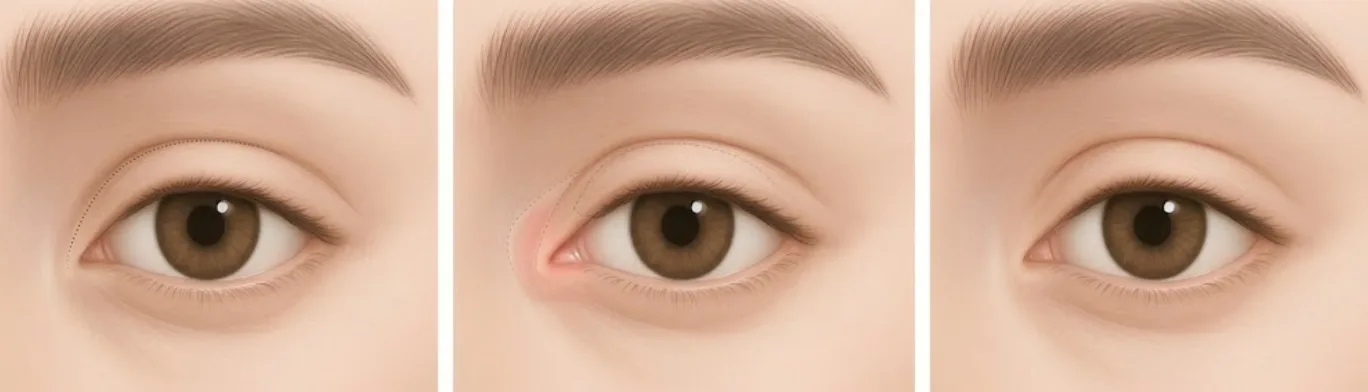
Illustration: the skin fold covering the inner corner is released along the dotted line so the inner corner opens slightly while the eye keeps its own shape.
Knowing what you are healing from sets realistic expectations. There is no large dressing covering the eye and no long downtime in the sense of being bedbound. The early limits are about swelling, redness and protecting fine sutures, and you can still function day to day. The visible journey is gradual: the corner looks its most worked-on in the first days, then steadily calms down.
Epicanthoplasty is also frequently combined with double-eyelid surgery, since opening the inner corner and forming a crease often work together for a balanced eye shape. If your plan combines procedures, your recovery follows the same overall arc but you should expect a little more swelling across the upper lid as well, and Dr. Baek explains how the combined inner-corner and crease work will heal for you. You can read the procedure overview on the epicanthoplasty page.
Days 1 to 7
Days 1 to 7 after epicanthoplasty, up to suture removal
Day 1 to 2 is the peak of swelling and bruising. The inner corners feel tight and look pink to red, and there may be light bruising and a little oozing or crusting along the incision line, which is normal. Cool compresses (as directed), keeping your head elevated when resting and sleeping, and avoiding bending or straining all help bring the swelling down faster. You are mobile and can manage gentle daily activity at home, but this is a rest-and-protect phase.
Over days 3 to 5 the puffiness at the inner canthus normally starts to go down, and any bruising shifts colour as it clears. The inner corner is still visibly red and the fine sutures are in place, so the area still looks clearly operated-on. Keep the incision clean exactly as instructed, avoid rubbing the eyes, and keep screen time and reading short, as the eyes tire and may feel dry. Close-up photos of the inner corners are best postponed at this point, though most people feel comfortable.
Around day 7 the sutures are removed, the key first-week milestone at Garnet. Taking out the fine inner-corner stitches takes only a few minutes, and the canthus usually looks neater straight away while staying pink. After this point you can usually be more relaxed about light daily activity. Many international patients plan to be in Seoul through this suture-removal visit so the surgeon can check the closure in person before they consider travelling home.
Weeks 2 to 4
Weeks 2 to 4: the inner corner settles and daily life resumes
Through the second week, residual swelling continues to fade and the redness softens. By around the end of week one to the middle of week two, many people feel presentable enough to return to desk work and ordinary social settings. The corners are no longer obviously swollen, though a close look still shows a pink, healing line. Light makeup can usually be worn once the incision has fully closed and your surgeon confirms it is safe, which helps cover residual redness.
Into weeks three and four, the eye shape looks much more natural and the new inner corner reads as part of your face rather than a recent operation. Light exercise comes back step by step on Dr. Baek's advice; heavy straining, swimming and anything that could knock the eye stay off the list for now. Harder workouts return last, because the released fold tissue at the inner canthus is still remodelling.
What is normal at this stage is a subtle pinkness and occasional tightness at the very inner corner that you notice more than anyone else does. Pain that grows, redness that spreads or any discharge from the inner corner is not part of normal healing, so message the clinic if you see it. Dr. Baek handles your recovery himself, which gives you one direct contact for questions about the canthus.
Months 1 to 6
Months 1 to 6: epicanthoplasty scar maturation and the final result
The visible result of epicanthoplasty arrives in two stages: the shape settles within the first weeks, but the scar itself keeps maturing for months. From the first month onward the inner-corner incision continues to fade, going from pink toward your natural skin tone. A faint line may be detectable up close for a while, which is expected for any incision and improves steadily.
By around three months the corner usually looks settled and the scar has paled noticeably; by six months it has typically matured to a faint mark that is hard to see in normal light. Garnet builds structured follow-ups into recovery at one, three and six months, which line up well with these milestones. Each visit (or remote check) lets the surgeon confirm the corner is healing as planned and the scar is maturing normally.
Healing speed varies with skin type and aftercare, and the inner corner is a high-movement area, so patience matters. Avoiding sun on the fresh scar, not rubbing the eyes and following the surgeon's guidance on any scar care all help the final result. For a sense of when the look is truly final, the when will I see results page covers it in more detail.
Aftercare
Epicanthoplasty aftercare and red flags to watch
After epicanthoplasty, aftercare mostly means protecting the small incision at the inner canthus. Keep the incision clean as instructed, do not rub or pull at the inner corners, and avoid eye makeup until your surgeon confirms the wound is fully closed. Keep your head elevated for the first nights, use cool compresses as directed in the first couple of days, and rest your eyes from long screen sessions while they feel tired and dry; lubricating drops can help if recommended.
Smoking slows healing of the inner-corner wound, and alcohol in the first days can add to the swelling, so leave both alone. Hold off on swimming, saunas and vigorous exercise until cleared, and protect the healing scar from strong sun. These simple habits do most of the work of getting a clean, faint inner-corner scar.
Most discomfort is mild and improves day by day. Get in touch with the clinic straight away if the pain at the inner corner gets worse instead of better, if redness or warmth spreads, if pus-like discharge appears, if a stitch loosens before day 7, or if your vision changes suddenly. Pinkness, tightness and mild swelling are normal healing; knowing them from a warning sign lets you recover with confidence.
At Garnet
Epicanthoplasty follow-up at Garnet and your flight home
At Garnet, a one-surgeon clinic in Apgujeong, Seoul, Dr. In-Soo Baek (board-certified plastic surgeon, Korean medical licence no. 77407) carries out every Two-way™ inner-corner release himself and sees each patient at follow-up. For an international patient that continuity is the practical value: the person who opened your inner corner is the same person who checks the closure at suture removal and reviews the scar at one, three and six months, with no hand-off between consultation, surgery and after-care.
For planning a flight home, the usual anchor is the suture-removal visit at around 7 days. Many patients arrange to remain in Seoul until the surgeon has removed the sutures and confirmed the closure looks good, then travel once cleared. A short flight after inner-corner surgery is usually manageable earlier than a long-haul one, and Dr. Baek advises on yours from how the corners are healing and where you are going. The when can I fly after surgery guide covers flight timing in general.
If you are still deciding, you can start with a no-obligation pre-assessment from abroad: send photographs through an online consultation and the surgeon will give a candid view of whether epicanthoplasty suits your eye shape, how it might combine with double-eyelid surgery, and what recovery would realistically look like for you before you book any travel.
Dr. In-Soo Baek
Director & sole operating surgeon
Korean medical licence no. 77407
Operate on what you came for. Trained at Korea University Medical Center. Every case planned, performed and reviewed by the same hands.
1Operating surgeon
~2Surgeries per day
7Registered techniques
Board-certified plastic surgeon
Plastic surgery training at Korea University College of Medicine & graduate school
Korean Society of Plastic and Reconstructive Surgeons member, in its facial-contour, eye & rhinoplasty groups
Consults, operates and follows up each case himself
Peer-reviewed papers behind the facts on this page. Each describes findings in its own study group — not results at Garnet — and none predicts your own outcome.
Fineide FA et al. Minimizing Postoperative Scars in Epicanthoplasty: A Concise Review. Journal of Cosmetic Dermatology. 2025. doi:10.1111/jocd.70603
He Z et al. Comparison of Modified Asymmetric Inverse Z-plasty and Z-plasty in the Correction of Epicanthal Folds. Aesthetic Plastic Surgery. 2025. doi:10.1007/s00266-025-05282-0
Wijaya WA et al. A Novel Thunderbolt Z-Epicanthoplasty for Asians. Aesthetic Plastic Surgery. 2022. doi:10.1007/s00266-022-02934-3
FAQ
Common questions
How long does epicanthoplasty recovery take?
The inner-corner stitches come out at around 7 days, and by then most early swelling has gone down. Within 1 to 2 weeks many patients are comfortable going back to a desk job and seeing people. The inner-corner scar then keeps maturing for months, usually settling into a faint line by around three to six months. See also our epicanthoplasty page. See also our epicanthoplasty page. See also our epicanthoplasty page.
What is epicanthoplasty recovery like day by day?
Days 1 to 2 are peak swelling and tightness with possible light bruising. Days 3 to 5 see swelling start to ease while the corner stays red. At about day 7 the stitches are removed and the canthus looks neater. Through weeks 2 to 4 redness fades and the shape looks natural, while the scar continues to mature over the following months. See also our epicanthoplasty page. See also our epicanthoplasty page. See also our epicanthoplasty cost in korea page.
When can I return to work after epicanthoplasty?
Office work usually resumes 1 to 2 weeks after epicanthoplasty, often close to the day-7 stitch removal. The inner corner will still be pink up close, and light makeup (once the surgeon confirms the wound is closed) can help cover residual redness. Manual or strenuous jobs wait until Dr. Baek gives the go-ahead. See also our epicanthoplasty cost in korea page. See also our epicanthoplasty cost in korea page. See also our epicanthoplasty scars and healing page.
When are the stitches removed after epicanthoplasty?
Garnet takes out the inner-corner stitches about 7 days after epicanthoplasty. Suture removal is quick, and the inner corner often looks noticeably tidier immediately afterward, although it remains pink while the scar continues to mature over the following weeks and months.
How long does swelling and redness last after epicanthoplasty?
Most of the inner-corner swelling settles during week 1, and any bruising clears over 1 to 2 weeks. A subtle pinkness and occasional tightness at the very inner corner can linger for several weeks and fades gradually. The scar pales toward your skin tone over the following months.
Is epicanthoplasty usually combined with double-eyelid surgery?
Often, yes. Opening the inner corner and forming an eyelid crease frequently work together for a balanced eye shape, so the two are commonly combined. Recovery follows the same overall arc, but expect a little more swelling across the upper lid. Dr. Baek explains how your particular combination is likely to heal.
When can I fly home after epicanthoplasty?
Many international patients plan to stay in Seoul through the suture-removal visit at around day seven, then travel once the surgeon confirms the closure looks good. Short-haul flights are generally easier sooner than long-haul. Your surgeon gives guidance based on your healing and itinerary.
What aftercare follows epicanthoplasty?
Keep the incision clean, do not rub the inner corners, avoid eye makeup until the wound is fully closed, keep your head elevated for the first nights, use cool compresses as directed, and rest your eyes from long screen time. Avoid smoking, alcohol, swimming, saunas and vigorous exercise until cleared, and protect the scar from sun.
What recovery signs mean I should contact the clinic?
Reach out if inner-corner pain is getting worse, redness or warmth is spreading, pus-like discharge appears, a stitch loosens before removal, or your vision changes suddenly. Mild pinkness, tightness and swelling that improve day by day are normal. Dr. Baek follows your epicanthoplasty recovery himself, so your questions go straight to him.
Can Garnet check my inner corners after I fly home?
Yes. The operating surgeon reviews your recovery, and after you travel home you can continue remotely by sending photographs at intervals, alongside structured follow-ups at one, three and six months, so the surgeon can confirm the corner and scar are healing normally or step in early if needed.
My mom recently had a brow lift and lower blepharoplasty with Dr. Baek, and our experience has been wonderful so far. The Garnet team was incredibly kind and welcoming, with Kelly assisting us as our English consultant—she made everything…
I’m so happy I chose this clinic for my lower blepharoplasty. I was traveling from abroad by myself, so I was a little nervous, but from the beginning I felt comfortable and truly cared for. Everyone was kind, patient, and professional…
Came in for an in-person consult and ended up choosing Garnet and Dr.Baek for my non-incisional DES and tiplasty/alarplasty. I communicated with Kelly (English consultant) from the start till now (3 weeks post-op). She really help me feel…
My under-eyes have been sagging and folding for years... I tried to cover it up with makeup, but it actually got stuck in the wrinkles and made it stand out even more. While going for consultations, I noticed that the bigger the hospital…
Planning epicanthoplasty from abroad? Send photos for a no-obligation pre-assessment, and the surgeon will explain whether it suits your eye shape and what recovery would look like for you, before you book any travel.
Send photos and your question before you travel. An English-speaking coordinator reviews every enquiry and replies with guidance on whether surgery is appropriate, the likely plan and timing.
✓ Reviewed by the clinic coordinator, not a bot
✓ Photo-based pre-assessment before you fly
✓ Foreign-patient scheduling & after-care
✓ One surgeon for consultation, surgery and follow-up
Prefer to chat now? Reach the coordinator directly:









 T S7 months ago



