Epicanthoplasty and double eyelid surgery are often mentioned in the same breath, but they change different parts of the eye. Epicanthoplasty opens the inner corner by releasing the small fold that covers it; double eyelid surgery creates or defines the crease across the upper lid. One lengthens the eye horizontally, the other shapes it vertically. Which you need depends on the anatomy of your particular eyes, and very often the plan is a considered combination of the two.
The short answer
Epicanthoplasty (the Two-way™ method at Garnet) releases the inner-corner Mongolian fold in two directions (medial and upper) to open and lengthen the inner eye; sutures are removed at around 7 days.
Double eyelid surgery creates the upper-lid crease, by a buried-suture method with no incision or by a full incision when more definition or skin tidy-up is needed, with sutures out at 5 to 7 days.
The deciding factor is not which is better but which dimension your eye needs: horizontal opening at the inner corner, vertical definition across the lid, or both.
The same board-certified surgeon assesses your eye shape and inner-corner fold together and will tell you plainly whether you need one, the other, both, or neither.
The core difference: opening the corner vs building a crease
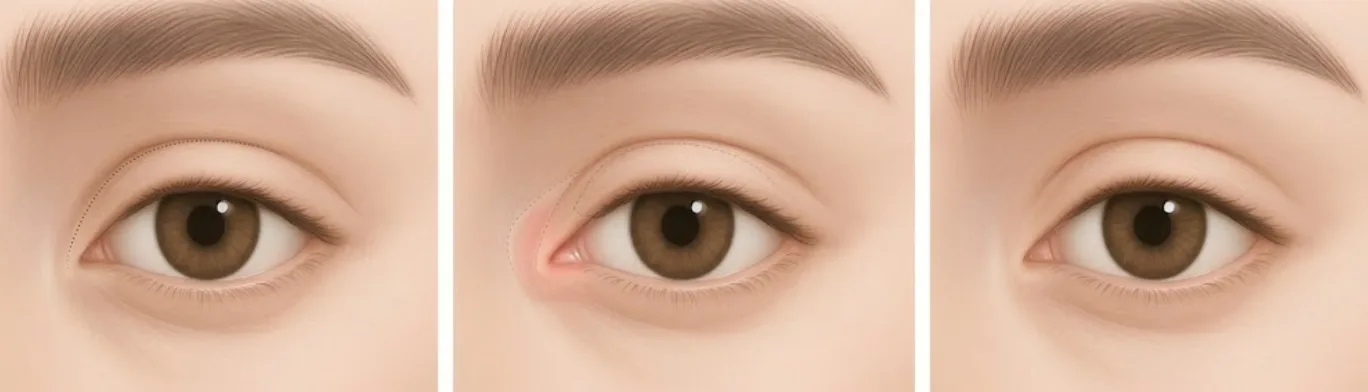
These two procedures work on different axes of the same eye. Epicanthoplasty addresses the inner corner: many eyes have a small fold of skin, the epicanthal or Mongolian fold, that covers the true inner corner and makes the eye look shorter and more closed. Releasing that fold opens the corner and lengthens the eye horizontally. At Garnet this is the Two-way™ method, releasing the fold in two directions, medial and upper, through an inner-canthal approach, with sutures out at around 7 days.
Illustration: the skin fold covering the inner corner is released along the dotted line so the inner corner opens slightly while the eye keeps its own shape.
Double eyelid surgery works on the vertical dimension: it creates or defines the crease that runs across the upper lid. It can be done without an incision, using a buried-suture method that forms the crease line and comes out at around 5 days, or with a full upper-lid incision when firmer definition or a tidy-up of redundant skin is needed, with sutures at around 7 days. So one procedure opens the eye from the inside corner outward, and the other shapes it from the lash line up. They complement each other; one cannot stand in for the other.
What each does
What epicanthoplasty and double eyelid surgery each do
Epicanthoplasty changes the length and openness of the eye at its inner end. By releasing the covering fold, it exposes more of the inner corner, which can make close-set-looking eyes appear longer and can soften a sharp or hooded inner angle. It refines the shape of the inner corner and leaves the crease alone. Because it works at a delicate junction, the healing and the fine scar are part of the conversation — covered in epicanthoplasty scars and healing. It does not, on its own, create a lid crease.
Double eyelid surgery changes whether and how clearly the upper lid folds. The non-incision, buried-suture route forms a crease without cutting and suits lids that are not heavy, while the incision route allows firmer, more durable definition and lets the surgeon remove a little excess skin or address a heavy lid at the same time. Which route fits depends on lid thickness, skin and what you want the crease to do; the candidacy is set out in who incision double eyelid surgery is for. It does not, on its own, open the inner corner.
Who each suits
Who epicanthoplasty or double eyelid surgery suits
Epicanthoplasty suits eyes whose inner corner is covered by a prominent fold that shortens the eye or blunts the inner angle. These are people who feel their eyes look small or close-set at the inner end, while the crease itself may be fine. It is a matter of degree: not every fold needs releasing, and over-opening the corner is a real consideration, so correct candidacy matters more than the request. Many people add it to a crease procedure instead of choosing one over the other.
Double eyelid surgery suits eyes that lack a defined crease, have an uneven or faint one, or carry a heavy lid that could benefit from definition and a little skin tidy-up. The non-incision method suits lighter lids and those wanting a reversible, lower-downtime route; the incision method suits heavier lids or those wanting firmer, longer-lasting definition. Many people considering one of these are genuinely candidates for both. The assessment therefore looks at the inner corner and the upper-lid crease together.
How they combine
Why they are so often combined
In practice epicanthoplasty and double eyelid surgery are frequently performed together, because the two changes reinforce each other. A new crease makes the upper lid look bigger and more open vertically; opening the inner corner extends that effect horizontally, so the eye reads as larger and better proportioned overall. Doing the crease alone can sometimes leave the inner corner looking crowded against a newly defined lid, and opening the corner alone leaves the lid undefined. That is why they are so often planned as a pair.
Even so, combining them is a judgement about your specific anatomy. Some eyes need only a crease; some need only the corner opened; some are best left with a lighter touch than the fullest version of either. A careful surgeon will map what each part of your eye needs and propose the combination, or the single procedure, that actually suits it. Both are not bundled just because they are commonly sold together. The right plan is the one your eye anatomy calls for.
Which fits you
Which one fits your eyes
As a general guide: if your main concern is a short-looking eye with a covered inner corner, epicanthoplasty is the procedure that addresses it. If your main concern is the absence or faintness of a lid crease, double eyelid surgery is the procedure that addresses it. If your eyes show both, a covered corner and no defined crease, the plan is usually a combination tuned to how much each part needs. A standard package is not the starting point.
The wrong reasons to choose are also worth naming. Opening an inner corner that does not need it, or building a crease that fights your natural lid, can look overdone, and results at this delicate junction are hard to reverse. This is exactly where an in-person assessment earns its place: the fold, the lid thickness and the crease you want are all things a surgeon reads together. Your inner-corner fold and crease can be reviewed from photos in an online consultation before you decide on either procedure.
At Garnet
An epicanthoplasty and double eyelid assessment at Garnet
Garnet is a single-surgeon clinic in Apgujeong, Seoul. Dr. In-Soo Baek is a board-certified plastic surgeon (Korean medical licence no. 77407) who performs both epicanthoplasty and double eyelid surgery himself, with tens of thousands of eye procedures behind him. Because one surgeon assesses the whole eye, he can weigh the inner-corner fold against the crease and tell you candidly whether you need corner opening, a crease, both, or neither. No part is pushed just because a particular doctor tends to do it.
After an eye procedure, Dr. Baek himself checks the inner corner and crease at 1, 3 and 6 months, and continues by message once international patients are home. Garnet is registered with Korea's foreign-patient programme. The most useful next step is a no-obligation online assessment: send photos and get a clear read on whether epicanthoplasty, double eyelid surgery, a combination, or neither is right for your eyes before you plan a trip.
Dr. In-Soo Baek
Director & sole operating surgeon
Korean medical licence no. 77407
Operate on what you came for. Trained at Korea University Medical Center. Every case planned, performed and reviewed by the same hands.
1Operating surgeon
~2Surgeries per day
7Registered techniques
Board-certified plastic surgeon
Plastic surgery training at Korea University College of Medicine & graduate school
Korean Society of Plastic and Reconstructive Surgeons member, in its facial-contour, eye & rhinoplasty groups
Consults, operates and follows up each case himself
Peer-reviewed papers behind the facts on this page. Each describes findings in its own study group — not results at Garnet — and none predicts your own outcome.
Fineide FA et al. Minimizing Postoperative Scars in Epicanthoplasty: A Concise Review. Journal of Cosmetic Dermatology. 2025. doi:10.1111/jocd.70603
He Z et al. Comparison of Modified Asymmetric Inverse Z-plasty and Z-plasty in the Correction of Epicanthal Folds. Aesthetic Plastic Surgery. 2025. doi:10.1007/s00266-025-05282-0
Park JI et al. Park Z-Epicanthoplasty. Facial Plastic Surgery Clinics of North America. 2007. doi:10.1016/j.fsc.2007.04.001
FAQ
Common questions
What is the difference between epicanthoplasty and double eyelid surgery?
They change different parts of the eye. Epicanthoplasty releases the fold covering the inner corner, opening and lengthening the eye horizontally. Double eyelid surgery creates or defines the crease across the upper lid, shaping it vertically. One opens the corner, the other builds the crease, which is why they are often combined.
Is epicanthoplasty or double eyelid surgery better for me?
Neither is universally better; it depends on your eye anatomy. A covered inner corner that shortens the eye points to epicanthoplasty; an absent or faint crease points to double eyelid surgery. Many eyes need both. Examining the fold and the lid in person is the reliable way to tell which applies to you.
Are epicanthoplasty and double eyelid surgery usually done together?
They often are, because the changes reinforce each other: a crease opens the lid vertically while opening the inner corner lengthens the eye horizontally, so together they look more balanced. Combining them is still a judgement about your specific anatomy; some eyes need only one.
Does double eyelid surgery open the inner corner?
No. Double eyelid surgery creates the upper-lid crease; it does not release the inner-corner fold. If a covered inner corner is your concern, epicanthoplasty is the procedure that opens it. The two address different dimensions of the eye, which is why they are assessed together.
What is the difference between non-incision and incision double eyelid surgery?
The non-incision, buried-suture method forms a crease without cutting and suits lighter lids, with sutures out at around 5 days. The incision method uses a full upper-lid incision for firmer, longer-lasting definition and lets the surgeon tidy excess skin, with sutures at around 7 days. Lid thickness and your goals decide which fits.
Is epicanthoplasty reversible if I don't like it?
Results at the inner corner are delicate and hard to reverse, which is why candidacy and restraint matter more than at many other sites. Over-opening a corner that did not need it can look overdone. A careful surgeon assesses whether your fold genuinely warrants release before recommending it, and sometimes advises against it.
How long is the recovery for each?
Both are lid procedures with sutures removed within about a week: epicanthoplasty at around 7 days, non-incision crease at around 5 days and incision crease at around 7 days. Combining them does not change suture timing dramatically but may mean a little more early swelling. Your own timeline follows the method chosen for your crease and how your lids heal.
Will opening my inner corner leave a scar?
Epicanthoplasty works at the inner-corner junction, so there is a fine scar there that matures over time. How it settles depends on your skin and healing, and it is a legitimate part of the decision — discussed in detail on the epicanthoplasty scars and healing page. A surgeon will tell you plainly what to expect for your skin.
Who decides which procedure I should have?
You do, with a clear assessment. At Garnet Dr. Baek performs both epicanthoplasty and double eyelid surgery and assesses the whole eye himself. He weighs the inner-corner fold against the crease and tells you candidly which suits you, sometimes advising against a procedure, or a lighter version.
Can I get this assessment before travelling to Korea?
Yes. Send close-up photos of your eyes and discuss whether epicanthoplasty, double eyelid surgery, a combination or neither fits them in an online consultation before you commit to travel. Garnet is registered with Korea's foreign-patient programme, and corner and crease checks continue remotely once you are home.
My mom recently had a brow lift and lower blepharoplasty with Dr. Baek, and our experience has been wonderful so far. The Garnet team was incredibly kind and welcoming, with Kelly assisting us as our English consultant—she made everything…
I’m so happy I chose this clinic for my lower blepharoplasty. I was traveling from abroad by myself, so I was a little nervous, but from the beginning I felt comfortable and truly cared for. Everyone was kind, patient, and professional…
Came in for an in-person consult and ended up choosing Garnet and Dr.Baek for my non-incisional DES and tiplasty/alarplasty. I communicated with Kelly (English consultant) from the start till now (3 weeks post-op). She really help me feel…
My under-eyes have been sagging and folding for years... I tried to cover it up with makeup, but it actually got stuck in the wrinkles and made it stand out even more. While going for consultations, I noticed that the bigger the hospital…
Send photos and your question before you travel. An English-speaking coordinator reviews every enquiry and replies with guidance on whether surgery is appropriate, the likely plan and timing.
✓ Reviewed by the clinic coordinator, not a bot
✓ Photo-based pre-assessment before you fly
✓ Foreign-patient scheduling & after-care
✓ One surgeon for consultation, surgery and follow-up
Prefer to chat now? Reach the coordinator directly:









 T S7 months ago



