Epicanthoplasty opens the inner corner of the eye by releasing the Mongolian fold, the small web of skin that covers the inner canthus in many Asian eyes. It can make a short eye look longer and more defined. It does not suit everyone, and your candidacy depends on your specific anatomy.
The short answer
The strongest candidates have a prominent Mongolian (epicanthal) fold that hides the inner corner and gives a short, rounded eye shape.
It is very often planned together with double-eyelid surgery, because the fold can blunt the inner end of a new crease.
A subtle or absent fold, an already-wide inner-corner distance, or a wish for a dramatic change are reasons to be cautious or to decline.
At Garnet a board-certified plastic surgeon assesses candidacy in person and will tell you plainly if the procedure will not help you.
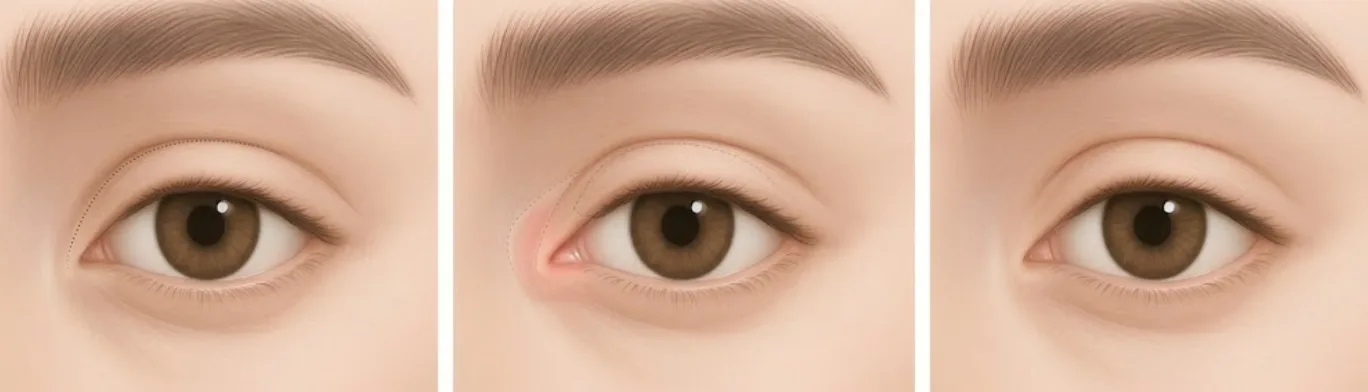
Many Asian eyes have an epicanthal fold: a small band of skin, often called the Mongolian fold, that drapes over the inner corner (the inner canthus). When that fold is prominent it hides the pink inner corner, shortens the visible eye, and can make the eyes look slightly more rounded or more widely spaced than they are. Epicanthoplasty releases that band so the inner corner is exposed, which tends to lengthen the eye horizontally and sharpen its inner end.
Illustration: the skin fold covering the inner corner is released along the dotted line so the inner corner opens slightly while the eye keeps its own shape.
At Garnet the procedure is performed as a Two-way™ release, a medial and upper release of the Mongolian-fold band through an inner-canthal incision, with sutures removed at about seven days. Because the change is measured in millimetres, the question of candidacy is really a question of degree: how much fold you have, how short the eye looks because of it, and how the inner corner sits relative to the rest of your face.
It is worth being clear about what it does not do. Epicanthoplasty does not create a double-eyelid crease, lift a droopy lid, or change the outer corner. Those are separate operations such as double-eyelid surgery and lateral canthoplasty. Understanding that boundary is the first step in deciding whether it is the right procedure for you.
Good candidate
Who is a good candidate
The clearest candidates have a genuinely prominent epicanthal fold that covers the inner corner, paired with a short or rounded palpebral fissure (the visible opening of the eye). If, when you gently pull the skin at the inner corner outward in the mirror, the eye looks noticeably longer and the inner corner becomes visible, that is the effect epicanthoplasty is designed to create. People in this group often feel their eyes look “closed off,” tired, or further apart than they like.
A second common candidate is someone who wants their eyes to look a little more defined and harmonious overall, where the fold is the single feature holding back the result of other eye surgery. In these cases a small inner-corner release can do more for balance than a larger or more aggressive operation elsewhere. The outcomes they want are usually modest, proportionate changes: the eye opened enough to look refreshed, without looking altered.
Good candidates also share a mindset as well as an anatomy: realistic expectations, an understanding that the inner-corner area heals with a fine scar that fades over months, and a willingness to be guided by the surgeon's assessment. If your goal is a natural, slightly longer and clearer eye with no dramatic transformation, epicanthoplasty is more likely to suit you.
With double eyelid
Why it so often pairs with double-eyelid surgery
Epicanthoplasty and double-eyelid surgery are frequently planned together, and understanding why helps clarify candidacy. A double-eyelid crease runs across the upper lid, but a prominent Mongolian fold can cover and blunt the inner end of that crease, so the new fold looks shorter or fades out before it reaches the inner corner. Releasing the epicanthal fold lets the crease continue cleanly toward the inner eye, which is why the two procedures complement each other.
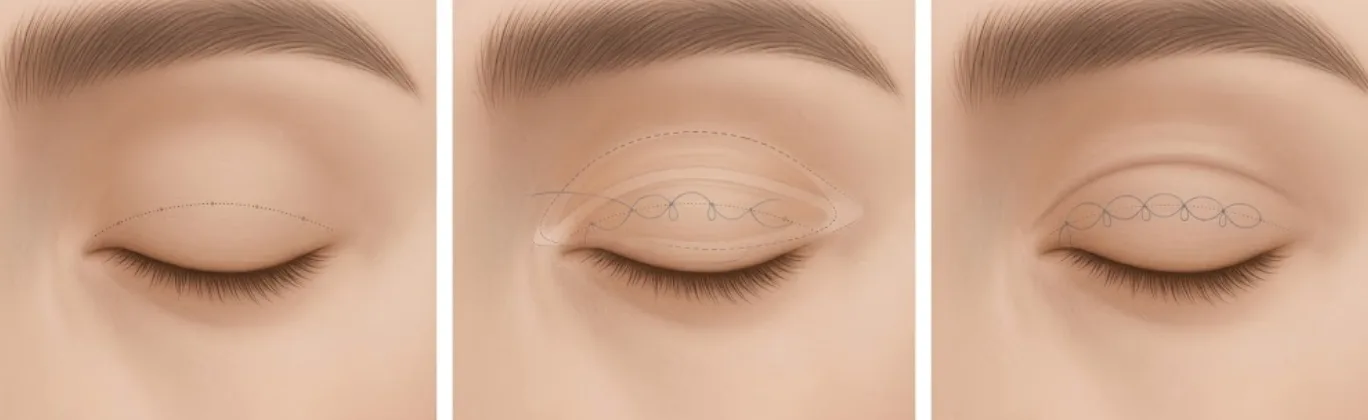
Illustration: a thin buried suture is looped along the planned crease through tiny points, with no skin incision, so the lid folds at the new line.
This means many people who come asking about a double-eyelid result are, on assessment, also candidates for a small inner-corner release, and some who ask specifically about epicanthoplasty are better served by addressing the crease first. You may not need both. The inner corner and the upper-lid crease do interact, though. A surgeon assessing you for one should look at the other. You can read more on the crease itself in our guide to non-incision double-eyelid surgery.
When the two are combined, the two recoveries overlap and do not double, and the inner-corner sutures still come out at around seven days. If you are weighing a combined plan, the sibling guides on recovery and scars and healing explain what the inner-corner part of the recovery looks like in detail.
Not suited
Who is not suited to epicanthoplasty, and why
Some people are better advised against epicanthoplasty. If your epicanthal fold is subtle or already minimal, releasing it changes little and adds a scar for limited benefit. If the distance between your inner corners is already on the wider side, opening the corners further can make the eyes look too close together or unbalanced, a result that is difficult to reverse. And if your inner corner is already well exposed, there may simply be nothing to open.
Expectations also matter. Epicanthoplasty is a millimetre-scale refinement; anyone hoping for a dramatic, “completely different eyes” change is likely to be disappointed and is not a good candidate for it alone. Overdone inner-corner surgery is one of the more common reasons people later seek revision and correction, which is precisely why a conservative, anatomy-led assessment matters more than an ambitious one.
A surgeon who tells you that the procedure will not help you, or that less is better than more, is giving you very useful information. At Garnet the policy is to address only the area you came for and not to over-recommend, so declining a procedure that will not benefit you is a normal part of the consultation.
Assessment
How candidacy is assessed at Garnet
Garnet is a single-surgeon clinic in Apgujeong, Seoul, where Dr. In-Soo Baek is a board-certified plastic surgeon (Korean medical licence no. 77407) and the only operating doctor. He consults, performs the operation himself and reviews every follow-up, so the person who assesses your candidacy is the same person who would carry out the surgery. The assessment looks at the size of your fold, the shape and length of the eye, the inner-corner distance, and how the inner corner relates to any double-eyelid crease.
For international patients the first step is usually an online consultation from abroad: you send clear photos of your eyes, and before you commit to travel you get a pre-assessment of whether epicanthoplasty would help, whether it should be combined with anything, or whether it is not the right choice. If you do proceed, follow-up is structured at one, three and six months so the inner-corner result is reviewed as it settles.
If you are still deciding between procedures, it can help to read the parent overview at epicanthoplasty alongside this candidacy guide, and to look at what the process looks like for international patients. The assessment has one aim: to tell you plainly whether opening the inner corner is right for your eyes.
Dr. In-Soo Baek
Director & sole operating surgeon
Korean medical licence no. 77407
Operate on what you came for. Trained at Korea University Medical Center. Every case planned, performed and reviewed by the same hands.
1Operating surgeon
~2Surgeries per day
7Registered techniques
Board-certified plastic surgeon
Plastic surgery training at Korea University College of Medicine & graduate school
Korean Society of Plastic and Reconstructive Surgeons member, in its facial-contour, eye & rhinoplasty groups
Consults, operates and follows up each case himself
Peer-reviewed papers behind the facts on this page. Each describes findings in its own study group — not results at Garnet — and none predicts your own outcome.
Zeng L et al. Epicanthoplasty with Epicanthal Dermatic Tension-Releasing Incision Based on Skin Projection of Inner Canthal Ligament. Aesthetic Plastic Surgery. 2017. doi:10.1007/s00266-017-0829-8
Hwang K et al. Historical Vignettes of Epicanthoplasty. Journal of Craniofacial Surgery. 2016. doi:10.1097/scs.0000000000002512
Wang S et al. Epicanthal fold correction: Our experience and comparison among three kinds of epicanthoplasties. Journal of Plastic, Reconstructive & Aesthetic Surgery. 2013. doi:10.1016/j.bjps.2013.01.028
FAQ
Common questions
Who is a good candidate for epicanthoplasty?
The strongest candidates have a prominent Mongolian (epicanthal) fold that covers the inner corner of the eye, giving a short or rounded eye shape. If gently pulling the inner-corner skin outward in the mirror makes the eye look longer and exposes the pink inner corner, that is the effect the surgery is designed to create. Realistic expectations and a wish for a natural, modest change also make someone a better candidate.
Am I suitable for epicanthoplasty if my fold is small?
Often not. If your epicanthal fold is subtle or already minimal, releasing it changes very little while still adding a fine scar, so the benefit is limited. A surgeon assessing your eyes can tell you whether there is enough fold to make a meaningful, balanced difference, or whether you are better leaving the inner corner alone.
When is epicanthoplasty not recommended?
It is generally not recommended when the fold is minimal, when the inner corners are already widely spaced (opening them further can make the eyes look too close together), when the inner corner is already exposed, or when someone expects a dramatic transformation from what is a millimetre-scale refinement. In these situations a careful surgeon will advise against it.
Do I need double-eyelid surgery as well?
Not necessarily, but the two interact. A prominent fold can blunt the inner end of a double-eyelid crease, so the procedures are often planned together for a cleaner result. Some people who ask about epicanthoplasty are better served by addressing the crease first. An assessment of one eyelid feature should always consider the other.
Will epicanthoplasty make my eyes look bigger?
It tends to make the eye look longer and more defined by exposing the inner corner; it does not make the eye dramatically larger. The change is measured in millimetres, so the realistic goal is a refreshed, slightly longer and clearer eye, a proportionate refinement.
Can epicanthoplasty make my eyes look too close together?
It can, if it is overdone or if the inner-corner distance was already on the wider side. Opening the corners too much reduces the gap between the eyes and can look unbalanced, which is one reason a conservative, anatomy-led assessment matters. A careful surgeon plans the release to keep your features in proportion.
Is there an age limit for epicanthoplasty?
There is no strict age rule; suitability is based on anatomy and general health more than on age alone. What matters is having a prominent fold that genuinely affects the eye shape, stable expectations, and the ability to heal normally. A board-certified plastic surgeon assesses these factors individually at consultation.
Can I find out if I'm a candidate before flying to Korea?
Yes. You can send clear photos of your eyes for an online pre-assessment from abroad, and the surgeon will tell you whether epicanthoplasty would help, whether it should be combined with double-eyelid surgery, or whether it is not the right choice for you, all before you commit to travel.
What does epicanthoplasty involve at Garnet?
At Garnet it is performed as a Two-way™ medial and upper release of the Mongolian-fold band through an inner-canthal incision, with sutures removed at about seven days. The same board-certified surgeon, Dr. In-Soo Baek, consults, operates and reviews the follow-up at one, three and six months.
Who will perform the surgery if I go ahead?
At Garnet the operating doctor is the only surgeon, Dr. In-Soo Baek, a board-certified plastic surgeon. The surgeon who assesses your candidacy is the same one who performs the operation and reviews your recovery, so you always know who is in the room.
My mom recently had a brow lift and lower blepharoplasty with Dr. Baek, and our experience has been wonderful so far. The Garnet team was incredibly kind and welcoming, with Kelly assisting us as our English consultant—she made everything…
I’m so happy I chose this clinic for my lower blepharoplasty. I was traveling from abroad by myself, so I was a little nervous, but from the beginning I felt comfortable and truly cared for. Everyone was kind, patient, and professional…
Came in for an in-person consult and ended up choosing Garnet and Dr.Baek for my non-incisional DES and tiplasty/alarplasty. I communicated with Kelly (English consultant) from the start till now (3 weeks post-op). She really help me feel…
My under-eyes have been sagging and folding for years... I tried to cover it up with makeup, but it actually got stuck in the wrinkles and made it stand out even more. While going for consultations, I noticed that the bigger the hospital…
Send photos and your question before you travel. An English-speaking coordinator reviews every enquiry and replies with guidance on whether surgery is appropriate, the likely plan and timing.
✓ Reviewed by the clinic coordinator, not a bot
✓ Photo-based pre-assessment before you fly
✓ Foreign-patient scheduling & after-care
✓ One surgeon for consultation, surgery and follow-up
Prefer to chat now? Reach the coordinator directly:







 T S7 months ago



