An endoscopic forehead lift repositions the brow and smooths the upper face, and the lift it creates is long-lasting. No facial surgery stops time, though. Knowing what endures and what slowly changes is the most realistic way to set your expectations before you book.
The short answer
An endoscopic forehead lift is long-lasting: most patients keep a clear, refreshed result for many years.
The lift holds because the brow is fixed in its new position while tissues heal and re-anchor. At Garnet this is done with 5-point fixation using two Endotine devices and bone tunnelling.
No forehead lift is permanent. Your face keeps ageing, so the brow gradually descends again at its natural rate from the new, higher starting point.
How long it lasts depends more on your skin, tissue quality and the strength of the initial fixation than on the brand of any single device.
How long does an endoscopic forehead lift actually last?
An endoscopic forehead lift is a long-lasting procedure. Unlike a non-surgical thread or energy-based brow lift, which softens the brow temporarily, a surgical forehead lift physically repositions the brow and the soft tissue of the forehead and fixes it in place while it heals. Most patients keep a clear, noticeably refreshed result for many years. An injectable, by comparison, is measured in months.
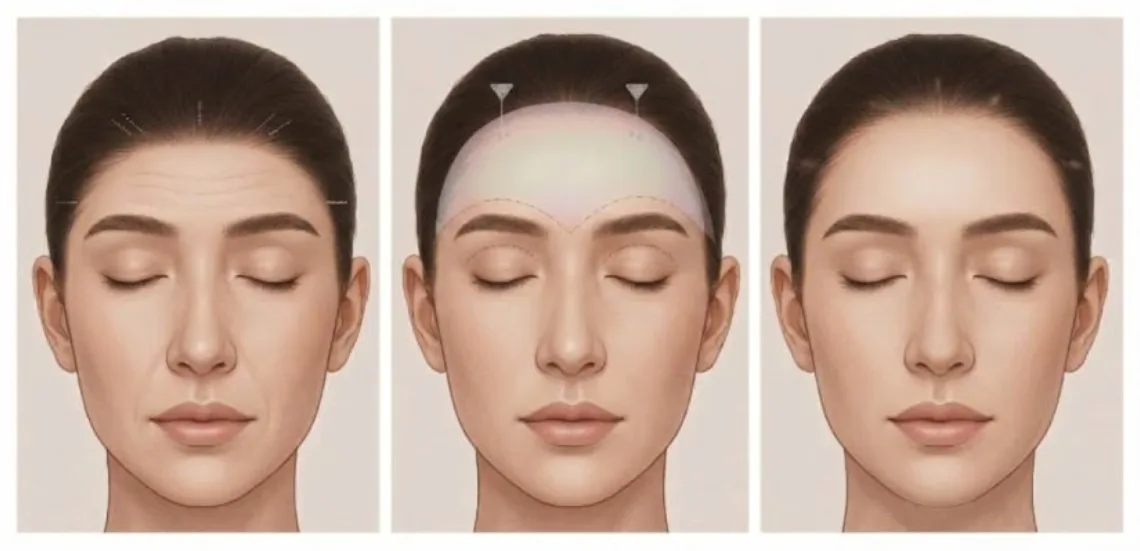
Illustration: the forehead and brow are lifted from within and held at fixation points behind the hairline (Pentafix™), rather than pulled at the skin.
It helps to think in two phases. In the first months the swelling settles and the final brow position becomes visible, as covered in detail on the forehead lift recovery timeline page. After that, the result is stable, and what you see at six months to a year is broadly what you keep for a long time. From there, ageing resumes gradually, so the brow very slowly descends again, but from the new, higher starting point your surgery created.
No surgeon can promise an exact number of years, because longevity is individual. Skin elasticity, tissue thickness, bone structure, sun exposure and how your face ages all play a part. An assessment of your own brow and forehead anatomy at consultation will tell you far more than any general figure. That is exactly the kind of forehead lift conversation worth having before you commit.
Why it holds
Why the forehead lift holds: fixation explained
The durability of a forehead lift comes down to fixation: how securely the lifted brow is anchored in its new position while the tissues heal and re-attach. A lift that is well fixed and allowed to heal in place tends to last; a lift that relies only on tension or weak fixation is more prone to settling back down sooner. This is the single most important technical factor in how long your result lasts.
At Garnet the forehead lift is performed endoscopically through small ports in the scalp, behind the hairline, using a 5-point fixation technique (registered as Pentafix™ with the Korean IP Office). The brow is held with two Endotine fixation devices combined with bone tunnelling, small channels that let the tissue be anchored directly to firm points on the skull. Sutures are typically removed at around ten days, by which time the deep fixation is doing the work of holding the lift.
Endotine devices are absorbable: they hold the brow firmly during the critical early healing window and then dissolve over time, once your own healed tissue has taken over the job of maintaining the position. So the long-term hold comes from your tissue, re-anchored in a higher position while the device protected it. That is why the quality and number of fixation points, and unhurried healing, matter more for longevity than any single component.
Permanent?
Is a forehead lift permanent?
Put plainly, a forehead lift is not permanent, and no reputable surgeon will tell you it is. Surgery resets the clock; it does not stop it. Your skin continues to lose elasticity, soft tissue continues to descend, and the underlying bone changes slowly with age, exactly as it would have done without surgery. What the lift does is give you a higher, smoother starting point, so the same ageing process leaves you looking refreshed for many years longer than you otherwise would.
A useful way to picture it: if your brow had drifted down over a decade or more, a lift can return it to where it was years ago, and then it ages again at your natural pace from there. The benefit is durable and meaningful, and it works as a head start. It does not freeze the brow in place. Patients who go in expecting a permanent, never-changing result are setting themselves up for disappointment; patients who understand it as a long-lasting reset are usually very satisfied.
If, many years later, you wanted to refresh the result, that is a conversation for the future. It would not mean the first surgery failed. The relevant question at that point is whether a touch-up or a revision is appropriate (covered on the forehead lift revision and correction page), and it is a decision best made with the surgeon who knows your anatomy.
What affects it
What affects how long your forehead lift lasts
Several factors decide whether your result sits at the longer or shorter end of the range. Tissue quality is foremost: thicker, more elastic skin holds a lift better than thin, sun-damaged or very lax skin. Age at surgery matters too: a lift done when ageing is moderate often reads as long-lasting because there is less ongoing descent to compete with. Bone structure and brow weight, your genetics, and the rate at which your face naturally ages all feed into the outcome.
Lifestyle plays a real, if undramatic, role. Significant sun exposure accelerates collagen loss and skin laxity, smoking impairs healing and tissue quality, and large weight fluctuations change the facial soft tissue. None of these will undo a well-fixed lift overnight, but over years they influence how gracefully the result holds. Protecting your skin from the sun is the most useful long-term habit.
Finally, the surgery itself: the strength and number of fixation points, whether healing was unhurried, and whether the right amount of lift was chosen for your anatomy. Over-elevating a brow can look unnatural and is harder to maintain; a measured, well-fixed lift sized to your face tends to both look natural and last. A surgeon who assesses you candidly, and who at Garnet also performs the operation personally and reviews your healing, is well placed to get this balance right. You can find out where you sit on this range in an online consultation before you travel.
Maintaining it
Keeping your result for as long as possible
There is no maintenance procedure that is strictly required after a forehead lift; the lift itself does the work. But a few sensible habits help your result hold at the longer end of its range. Consistent sun protection is the single most valuable one, because ultraviolet exposure is the biggest driver of the skin laxity that ages a brow. A stable weight, not smoking, and good general skin care all support tissue quality over the years.
Some patients later choose light, non-surgical maintenance — for example, a small amount of muscle-relaxing treatment to soften the forehead muscles that pull the brow down, which can complement and gently support a surgical lift. This is optional and is a separate decision to make with a clinician once your surgical result has fully settled. It does not change the lift; it works alongside it.
The most important form of maintenance is good follow-up. Seeing the same surgeon at structured intervals after surgery means your healing is checked, the brow position is confirmed as it settles, and any concern is caught early. At Garnet, follow-ups are scheduled at 1, 3 and 6 months with the same surgeon who operated. That is useful continuity for an international patient, and something you can continue by messenger after you fly home.
At Garnet
How Garnet approaches forehead lift longevity
Garnet is a single-surgeon clinic in Apgujeong, Seoul. Dr. In-Soo Baek, a board-certified plastic surgeon (Korean medical licence no. 77407), is the only operating doctor. He assesses your brow, performs the forehead lift himself and reviews each follow-up. For a procedure whose longevity depends so heavily on fixation and unhurried healing, having one surgeon responsible from consultation through recovery removes a lot of the variability.
The forehead lift uses an endoscopic 5-point fixation technique with two Endotine devices and bone tunnelling, registered as Pentafix™ and designed to anchor the brow securely while your own tissue re-attaches in its new position. Garnet caps the day at two surgeries, so each operation has unhurried time, and the clinic does not over-recommend: if a forehead lift is not the right answer for your concern, you will be told so.
Garnet is registered with Korea's foreign-patient programme and coordinates consultation, scheduling and after-care for international visitors. The most reliable way to learn how long a forehead lift might last for your specific anatomy is a pre-assessment of your brow and forehead. You can start with a no-obligation online consultation and send photos before you plan a trip.
Prices
Price at Garnet
Pentafix™ forehead lift
From₩5,000,000 + VATExcluding VAT (10% VAT is added at payment)Book now
Same price as Korean patients. Prices shown exclude 10% VAT; your written quote, issued after the in-person consultation, shows the full amount payable.
Dr. In-Soo Baek
Director & sole operating surgeon
Korean medical licence no. 77407
Operate on what you came for. Trained at Korea University Medical Center. Every case planned, performed and reviewed by the same hands.
1Operating surgeon
~2Surgeries per day
7Registered techniques
Board-certified plastic surgeon
Plastic surgery training at Korea University College of Medicine & graduate school
Korean Society of Plastic and Reconstructive Surgeons member, in its facial-contour, eye & rhinoplasty groups
Consults, operates and follows up each case himself
Peer-reviewed papers behind the facts on this page. Each describes findings in its own study group — not results at Garnet — and none predicts your own outcome.
Starkman SJ et al. Association of Corrugator Supercilii and Procerus Myectomy With Endoscopic Browlift Outcomes. JAMA Facial Plastic Surgery. 2019. doi:10.1001/jamafacial.2018.2084
Quatela V et al. Endoscopic Browplasty. Facial Plastic Surgery. 2018. doi:10.1055/s-0038-1637728
Terella AM et al. Technical Considerations in Endoscopic Brow Lift. Clinics in Plastic Surgery. 2013. doi:10.1016/j.cps.2012.06.004
FAQ
Common questions
How long does an endoscopic forehead lift last?
It is a long-lasting procedure, and its result is measured in years. Most patients keep a clearly refreshed result for many years, after which the brow slowly descends again at its natural rate from the new, higher starting point. No exact number applies to everyone — your skin and tissue quality matter most.
Is a forehead lift permanent?
No. A forehead lift resets your brow to a higher, smoother position, but it does not stop ageing. Your face continues to change at its natural pace afterwards, so the result is a durable head start. It does not freeze the brow permanently. Any surgeon who promises permanence is overstating it.
When might I need a forehead lift redone?
Many patients never feel the need to. If, many years later, ageing has brought the brow down again and you want to refresh the result, a touch-up or revision can be discussed then. That is a future decision and does not mean the first surgery failed. It is covered on our forehead lift revision page.
Why does the lift last as long as it does?
Because the brow is securely fixed in its new position while the tissues heal and re-anchor. At Garnet this is done with a 5-point fixation technique using two absorbable Endotine devices and bone tunnelling. The devices hold the brow during healing and then dissolve once your own tissue maintains the position.
Do the Endotine devices stay in my forehead forever?
No. Endotine fixation devices are absorbable. They hold the brow firmly through the critical early healing window and then gradually dissolve over time, once your own healed tissue has taken over the job of keeping the brow in its lifted position. The long-term hold comes from your own tissue once the device has dissolved.
What makes one person's result last longer than another's?
Mainly tissue quality: thicker, more elastic skin holds a lift longer than thin or very lax skin. Age at surgery, bone structure, genetics, sun exposure, smoking and weight changes all play a part, as does how securely the lift was fixed and whether the right amount of elevation was chosen for your anatomy.
Can I do anything to make my forehead lift last longer?
Consistent sun protection is the most valuable habit, because UV exposure drives the skin laxity that ages a brow. A stable weight, not smoking and good skin care all help. Some patients add optional, non-surgical maintenance later, but nothing extra is strictly required; the lift itself does the work.
Is a surgical forehead lift more lasting than a thread or laser brow lift?
Yes. Non-surgical thread and energy-based brow treatments soften the brow temporarily and are measured in months. A surgical endoscopic forehead lift physically repositions and fixes the brow, so its result is far more durable and is measured in years. The two address different levels of concern.
How does follow-up affect my long-term result?
Structured follow-up lets the surgeon confirm the brow is settling correctly and catch any concern early, which supports a stable long-term result. At Garnet, follow-ups are scheduled at 1, 3 and 6 months with the same surgeon who operated, and can continue by messenger after you return home.
Can I find out how long it would last for me before flying to Korea?
Yes. Longevity depends on your individual anatomy, so an assessment of your skin, tissue and brow position tells you more than any general figure. You can send photos for a no-obligation online consultation with the operating surgeon before you commit to travel.
My mom recently had a brow lift and lower blepharoplasty with Dr. Baek, and our experience has been wonderful so far. The Garnet team was incredibly kind and welcoming, with Kelly assisting us as our English consultant—she made everything…
I’m so happy I chose this clinic for my lower blepharoplasty. I was traveling from abroad by myself, so I was a little nervous, but from the beginning I felt comfortable and truly cared for. Everyone was kind, patient, and professional…
Came in for an in-person consult and ended up choosing Garnet and Dr.Baek for my non-incisional DES and tiplasty/alarplasty. I communicated with Kelly (English consultant) from the start till now (3 weeks post-op). She really help me feel…
My under-eyes have been sagging and folding for years... I tried to cover it up with makeup, but it actually got stuck in the wrinkles and made it stand out even more. While going for consultations, I noticed that the bigger the hospital…
Wondering how long a forehead lift would last for your face? Send photos for a no-obligation pre-assessment with the operating surgeon before you plan a trip.
Send photos and your question before you travel. An English-speaking coordinator reviews every enquiry and replies with guidance on whether surgery is appropriate, the likely plan and timing.
✓ Reviewed by the clinic coordinator, not a bot
✓ Photo-based pre-assessment before you fly
✓ Foreign-patient scheduling & after-care
✓ One surgeon for consultation, surgery and follow-up
Prefer to chat now? Reach the coordinator directly:









 T S7 months ago



