If a previous forehead lift settled too soon, left the brows uneven, or lifted too high, revision surgery can often improve it. A careful assessment matters more than rushing back to the operating room. Some concerns resolve with time; others are genuinely correctable, and telling the two apart is the first job.
The short answer
Common reasons for forehead lift revision include relapse (the brow dropping again), asymmetry between the two sides, over-elevation or a surprised look, and visible or troublesome scarring.
Timing is critical: many early concerns soften as swelling settles and the result matures, so revision is usually best considered only once healing is complete.
Revision is more complex than a first lift. Scarred tissue, altered anatomy and previous fixation all matter, so it calls for careful planning and a realistic assessment of what can improve.
The consultation may conclude that waiting, or a non-surgical adjustment, is wiser than another operation. Over-recommendation does not serve you.
Most forehead lifts go well, but a minority of patients are left wanting a correction. The reasons cluster into a few groups: the brow has descended again sooner than hoped (relapse); the two sides sit unevenly (asymmetry); the brow was lifted too high or the result looks surprised or unnatural (over-elevation); or there is a concern about scarring or hairline change. Sometimes the issue is simply that the result did not match what the patient expected, even if it is technically sound.
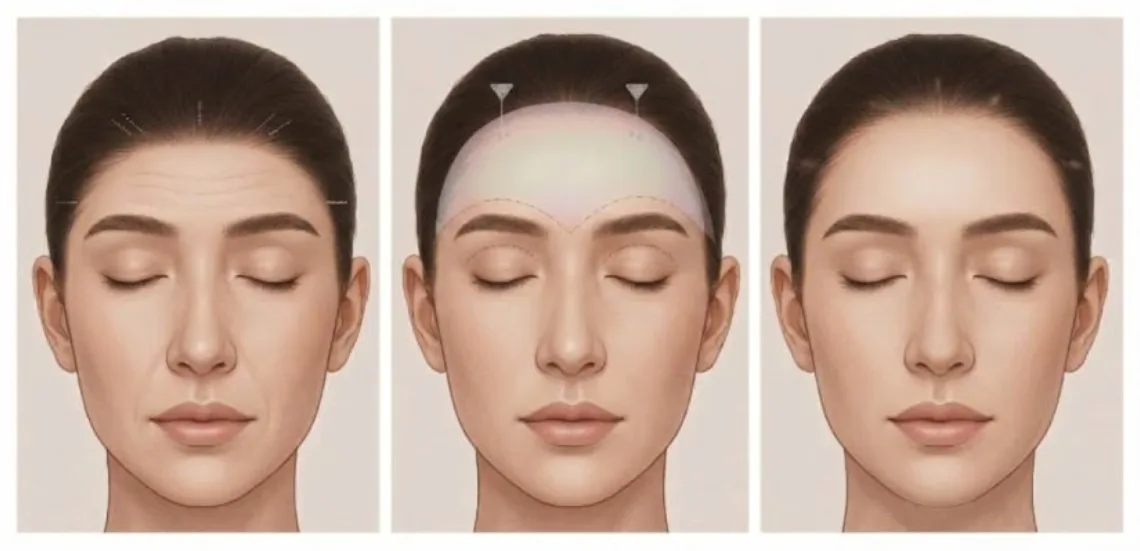
Illustration: the forehead and brow are lifted from within and held at fixation points behind the hairline (Pentafix™), rather than pulled at the skin.
Genuine surgical problems need to be separated from the normal, temporary appearance of a healing forehead. In the first months, swelling, tightness and an initially high-looking brow are common and usually settle into a more natural position. Concerns that look alarming early often resolve on their own. That is why a revision assessment starts by asking how far along the healing is, before deciding anything. The recovery timeline explains what's normal and when the result truly settles.
Whatever the reason, revision is a different undertaking from a first forehead lift. It deals with tissue that has already been operated on and healed, so the planning is more individual. Sometimes the realistic improvement is modest, or waiting is wiser. A surgeon who tells you that, without promising a perfect fix, is giving you the assessment you actually need.
Relapse
Relapse: when the brow drops again
Relapse means the lifted brow has descended again, partly or fully losing the elevation the surgery created. A degree of settling is expected and normal: the brow gradually ages from its new, higher starting point, as explained on the how long it lasts page. Relapse becomes a candidate for revision when the descent is more, or sooner, than the natural ageing process should account for.
Early relapse can have several explanations: fixation that didn't hold as firmly as intended, healing that was disrupted by too much early activity, or tissue that was always going to be challenging to hold, such as very thin, lax or heavy brow tissue. Understanding the likely cause matters, because a revision that doesn't address why the first lift dropped risks the same outcome. This is part of why revision planning is more involved than a first procedure.
Where relapse is genuine and healing is complete, a revision can re-elevate and re-fix the brow, often paying particular attention to the strength and number of fixation points given what happened the first time. As with any lift, the aim is a measured, natural elevation that holds, with no push for the highest possible brow. The surgeon will also tell you plainly if your tissue quality limits how much durable improvement is realistic.
Asymmetry
Asymmetry, over-elevation and the surprised look
Asymmetry, with one brow sitting higher than the other, is one of the more common reasons people consider revision. One caveat first: nearly everyone has some natural brow asymmetry, and early swelling after surgery frequently looks uneven before settling symmetrically. Apparent asymmetry in the first weeks to months is often not a true problem. Genuine, persistent asymmetry that remains after full healing is what revision addresses, by adjusting the elevation or fixation on one or both sides.
Over-elevation, a brow lifted too high, can read as a permanently surprised or startled look, sometimes with the inability to fully relax the forehead. This is generally harder to correct than under-correction, because lowering an over-lifted brow and softening a surprised appearance is a delicate, individualised undertaking. It underlines why a measured lift sized to your anatomy matters at the first operation: a natural, slightly conservative lift is easier to live with and to refine than an aggressive one.
A careful revision assessment looks at the whole upper face — brow height and shape, eyelid position, the forehead muscles and how they move, and your natural baseline asymmetry. No single feature is treated in isolation. Sometimes a non-surgical adjustment, such as muscle-relaxing treatment to balance the forehead, is a more proportionate answer than another operation. The right plan depends entirely on your specific anatomy and what is realistically achievable, which is why an individual online consultation is the right starting point.
Timing
When should you consider revision?
Timing is one of the most important and most misunderstood parts of revision. The strong default is to wait until healing is complete before judging the result or operating again. Tissues need time to settle, swelling to fully resolve, scars to mature and the final brow position to declare itself, and this commonly takes many months. Many concerns that feel urgent at six weeks have softened or resolved by six months. Rushing back too early risks operating on a result that would have improved on its own, and on tissue that is not ready.
There are sensible exceptions. A clear, early surgical problem (a fixation that has obviously failed, a wound issue, signs of infection) is assessed and managed promptly, and that is a conversation to have with your surgeon straight away. But for aesthetic concerns such as height, shape or mild asymmetry, patience usually serves you better than speed. Allowing the result to fully mature also gives a revision surgeon a stable starting point to plan from.
If you are weighing revision, the most useful first step is an assessment of where you are in healing and what is realistically correctable. For an international patient who had the first surgery elsewhere, that can begin remotely: sending photos and your history for a candid opinion before committing to travel often clarifies whether revision is warranted now, later, or not at all.
What's involved
What forehead lift revision involves
Revision surgery has to work with an upper face that has already been operated on, which makes it more individual than a first lift. The surgeon must account for previous incisions and scar tissue, any change to the hairline, the position and state of earlier fixation, and how the tissues healed. There is no single template: the plan is built around what was done before, why the result is as it is, and what can realistically be improved. This is also why a thorough history and, where possible, details of the original surgery are so valuable.
Depending on the concern, revision may re-elevate and re-fix a dropped brow, rebalance an asymmetric result, soften an over-elevated or surprised appearance, or address scarring. As with a first endoscopic lift, secure fixation while the tissues heal is central to a durable result, and the recovery has a similar character (tightness, swelling, numbness and a gradual settling), though healing in previously operated tissue can be a little less predictable. Realistic expectations are essential: revision aims for meaningful improvement and cannot guarantee a perfect outcome.
Because revision is more demanding, continuity of care is especially valuable. Having one surgeon assess you, plan the revision, perform it personally and review your healing reduces the uncertainty that comes with operating on someone else's earlier work. For an international patient, structured follow-up afterwards, and the ability to be reviewed remotely once home, is part of doing a revision responsibly.
At Garnet
How Garnet approaches revision and correction
Garnet is a single-surgeon clinic in Apgujeong, Seoul. Dr. In-Soo Baek is a board-certified plastic surgeon (Korean medical licence no. 77407) and the only operating doctor. For a revision, that means the same surgeon assesses what can realistically be improved, plans it, performs the operation himself and reviews your recovery. With surgery as individual as revision, that continuity removes a great deal of uncertainty about who is making the judgements.
Garnet does not over-recommend. The assessment may conclude that waiting for healing to complete, or a non-surgical adjustment, is the better answer than another operation, and you will be told so plainly. When revision is appropriate, the forehead lift uses an endoscopic 5-point fixation technique (registered as Pentafix™, with two Endotine devices and bone tunnelling), with attention to secure fixation given what happened the first time. The day is capped at two surgeries, so each case has unhurried time.
Garnet is registered with Korea's foreign-patient programme and coordinates consultation, scheduling and after-care for international visitors, with forehead lift follow-ups at 1, 3 and 6 months and review by messenger after you return home. If you are considering correcting a previous forehead lift, the right first step is a no-obligation online consultation: send photos and your history before you plan a trip.
Prices
Price at Garnet
Pentafix™ forehead lift
From₩5,000,000 + VATExcluding VAT (10% VAT is added at payment)Book now
Same price as Korean patients. Prices shown exclude 10% VAT; your written quote, issued after the in-person consultation, shows the full amount payable.
Dr. In-Soo Baek
Director & sole operating surgeon
Korean medical licence no. 77407
Operate on what you came for. Trained at Korea University Medical Center. Every case planned, performed and reviewed by the same hands.
1Operating surgeon
~2Surgeries per day
7Registered techniques
Board-certified plastic surgeon
Plastic surgery training at Korea University College of Medicine & graduate school
Korean Society of Plastic and Reconstructive Surgeons member, in its facial-contour, eye & rhinoplasty groups
Consults, operates and follows up each case himself
Peer-reviewed papers behind the facts on this page. Each describes findings in its own study group — not results at Garnet — and none predicts your own outcome.
Dutton JW et al. The Hairline Brow Lift. Clinics in Plastic Surgery. 2022. doi:10.1016/j.cps.2022.01.004
Kim IS et al. Forehead Lift for Asians. Facial Plastic Surgery Clinics of North America. 2021. doi:10.1016/j.fsc.2021.06.002
Saltz R et al. My Evolution with Endoscopic Brow-Lift Surgery. Facial Plastic Surgery Clinics of North America. 2021. doi:10.1016/j.fsc.2021.02.007
FAQ
Common questions
Can a previous forehead lift be corrected?
Often, yes. Revision surgery can re-elevate a dropped brow, rebalance asymmetry, soften an over-elevated or surprised look, or address scarring. But revision works with already-operated tissue, so the realistic improvement is individual. An assessment of what can genuinely be corrected comes first, before any decision to operate.
What does forehead lift revision involve?
It is more individual than a first lift, because the surgeon must account for previous incisions, scar tissue, hairline changes and earlier fixation. Depending on the concern it may re-elevate and re-fix the brow, rebalance asymmetry, soften over-elevation, or address scarring, planned around what was done before and why the result is as it is.
When should I consider a forehead lift revision?
Usually only once healing from the first surgery is complete, which commonly takes many months. Many early concerns, such as swelling, a high-looking brow or mild unevenness, settle on their own. Clear early problems like failed fixation or infection are assessed promptly, but aesthetic concerns are best judged on a fully matured result.
My brow has dropped again — is that relapse?
Some settling is normal, because the brow ages from its new higher starting point. It is considered relapse worth reviewing when the descent is more, or sooner, than natural ageing should explain. The cause (weak fixation, disrupted healing or challenging tissue) matters, because a revision needs to address why the first lift dropped.
Can asymmetry after a forehead lift be fixed?
Genuine, persistent asymmetry that remains after full healing can often be improved by adjusting elevation or fixation on one or both sides. Nearly everyone has some natural brow asymmetry, and early swelling frequently looks uneven before settling, so true asymmetry is judged only once healing is complete.
I think my brows were lifted too high — can that be corrected?
An over-elevated brow or a surprised look can sometimes be corrected, though lowering an over-lifted brow is generally a more delicate undertaking than re-lifting a dropped one. The right approach is individual, and sometimes a non-surgical adjustment is more proportionate. A careful assessment of your whole upper face guides what is realistic.
Is revision riskier or harder than the first surgery?
Revision is more complex because it works with tissue that has already been operated on, healed and scarred, and healing can be a little less predictable. It is approached with careful, individual planning and realistic expectations. The aim is meaningful improvement, with no guarantee of an ideal result. Continuity of care helps manage that complexity.
Should I have revision with the original surgeon or a new one?
Either can be appropriate, but what matters is a careful assessment and clear continuity. Whoever you choose, details of the original surgery are valuable, and having one surgeon assess, plan, perform and follow up the revision reduces uncertainty, particularly when operating on someone else's earlier work.
Might I be told revision isn't the right answer?
Yes, and that's a good sign. The assessment may conclude that waiting for healing to finish, or a non-surgical adjustment, serves you better than another operation. A plain "not yet" or "not needed" is more useful than a procedure you don't need.
Can I get a revision opinion before travelling to Korea?
Yes. If you had your first forehead lift elsewhere, you can send photos and your surgical history for a candid opinion in an online consultation before committing to travel. That often clarifies whether revision is warranted now, later, or not at all, and what improvement is realistic.
My mom recently had a brow lift and lower blepharoplasty with Dr. Baek, and our experience has been wonderful so far. The Garnet team was incredibly kind and welcoming, with Kelly assisting us as our English consultant—she made everything…
I’m so happy I chose this clinic for my lower blepharoplasty. I was traveling from abroad by myself, so I was a little nervous, but from the beginning I felt comfortable and truly cared for. Everyone was kind, patient, and professional…
Came in for an in-person consult and ended up choosing Garnet and Dr.Baek for my non-incisional DES and tiplasty/alarplasty. I communicated with Kelly (English consultant) from the start till now (3 weeks post-op). She really help me feel…
My under-eyes have been sagging and folding for years... I tried to cover it up with makeup, but it actually got stuck in the wrinkles and made it stand out even more. While going for consultations, I noticed that the bigger the hospital…
Considering correcting a previous forehead lift? Send photos and your history for a no-obligation pre-assessment of what can realistically be improved before you plan a trip.
Send photos and your question before you travel. An English-speaking coordinator reviews every enquiry and replies with guidance on whether surgery is appropriate, the likely plan and timing.
✓ Reviewed by the clinic coordinator, not a bot
✓ Photo-based pre-assessment before you fly
✓ Foreign-patient scheduling & after-care
✓ One surgeon for consultation, surgery and follow-up
Prefer to chat now? Reach the coordinator directly:









 T S7 months ago



