An endoscopic forehead lift is done through small scalp ports under anaesthesia, and most patients who expected it to be very painful are surprised that it isn't. The experience afterwards is usually more about tightness and numbness than sharp pain. This page explains exactly what to expect.
The short answer
An endoscopic forehead lift is performed under anaesthesia, so you feel nothing during the operation itself.
Afterwards most patients report tightness, pressure and numbness across the scalp more than sharp pain, and it is well controlled with ordinary pain relief.
Scalp numbness around the small incisions is normal and expected; it fades gradually over weeks to months as nerves recover.
Realistic pain expectations come from your own consultation. Your anaesthesia plan and recovery depend on your anatomy and health, assessed by the surgeon who operates.
Most patients find this reassuring: an endoscopic forehead lift is generally not a very painful procedure. Because it is done under anaesthesia, you feel nothing during the operation. Afterwards, the dominant sensations are usually tightness, pressure and a feeling of the scalp being snug. Sharp, stabbing pain is not typical. Many patients describe the first day or two as a tight, heavy, slightly achy feeling across the forehead and scalp, comparable to a firm headache, and well managed with prescribed pain relief.
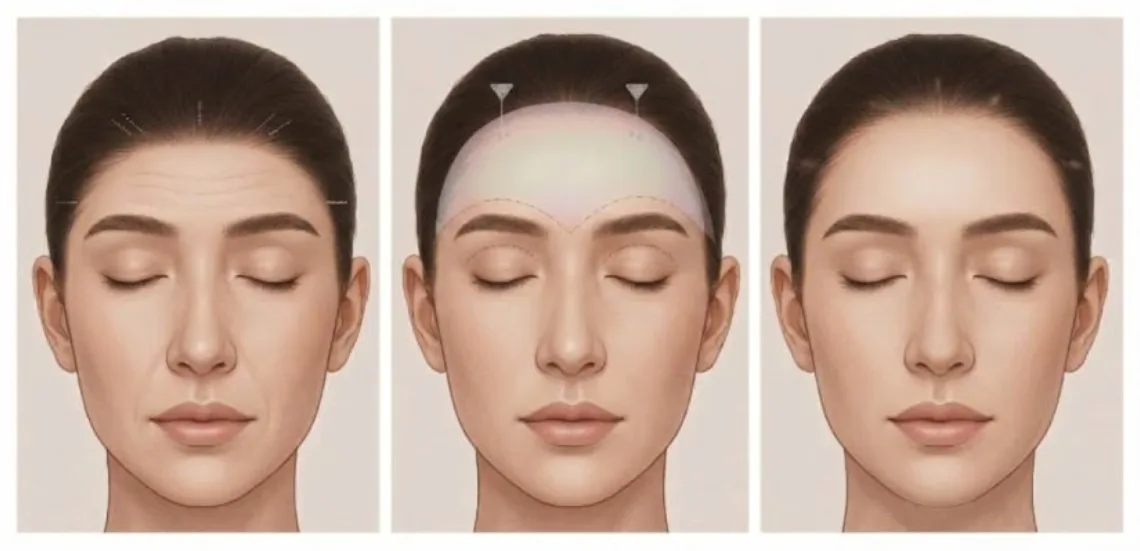
Illustration: the forehead and brow are lifted from within and held at fixation points behind the hairline (Pentafix™), rather than pulled at the skin.
Part of the reason discomfort is moderate is the endoscopic approach itself. The surgery is done through several small ports hidden behind the hairline, with no long incision across the scalp. This generally means less tissue disruption and a gentler recovery than older open techniques. The tight sensation comes from the deep fixation that holds the lift.
Everyone's pain threshold differs, so it is fair to say some patients feel more than others. What is consistent is that the discomfort is short-lived and controllable: it is most noticeable in the first few days and then eases steadily. For a realistic picture of the whole arc (swelling, tightness and when normal sensation returns), the forehead lift recovery timeline page maps it out day by day. For the procedure overview, see the main forehead lift page.
Anaesthesia
What anaesthesia is used for a forehead lift?
An endoscopic forehead lift is performed under anaesthesia so that the operation itself is comfortable. Depending on the patient and the surgical plan, this is commonly done under sedation combined with local anaesthetic, often called twilight or sleep anaesthesia, or under general anaesthesia. With sedation, you are in a deeply relaxed, sleep-like state and the scalp is numbed locally, so you are comfortable and unaware of the surgery; with general anaesthesia you are fully asleep. Either way, you do not feel the procedure.
Which approach suits you depends on your health, your anatomy, whether the forehead lift is combined with other surgery, and your own preference. The surgeon and the anaesthesia team work this out with you at consultation and pre-operative assessment; a webpage cannot settle it. A thorough clinic will review your medical history, medications and any prior reactions to anaesthesia before confirming the plan, and a coordinator can answer your questions in advance.
It is worth asking, before you book, who administers and monitors your anaesthesia and how you are looked after as it wears off. Feeling groggy, a little nauseated or unsteady for a short while as sedation or general anaesthesia clears is normal, which is why patients rest at the clinic until safe to leave. You can raise all of these questions in an online consultation before you travel.
Numbness
Scalp numbness vs pain: what's normal
One of the most common and least understood parts of forehead lift recovery is numbness. Because small nerves in the scalp are inevitably disturbed during the lift, it is normal to feel numbness, tingling, an itchy or "pins and needles" sensation, or patches of reduced feeling across the forehead and scalp, especially around and behind the incision sites. This is not pain, and it is not a complication; it is an expected part of healing.
Numbness and altered sensation typically improve gradually over weeks to several months as the nerves recover, and most patients regain normal feeling. The numb feeling can actually mask discomfort early on, which is part of why severe pain is uncommon. Some patients also notice temporary itching as nerves regenerate, which is usually a sign of healing. It helps to expect this in advance so it doesn't alarm you.
It is useful to distinguish ordinary recovery sensations (tightness, pressure, numbness, mild ache, itching) from warning signs. The everyday sensations are expected and ease over time. Sharp, escalating or one-sided pain that keeps getting worse, especially with redness, heat, swelling or fever, is a different matter and should be reported promptly. The next section sets out what to watch for.
Managing it
How discomfort is managed day by day
Pain after a forehead lift is managed with ordinary measures. You'll typically be given prescribed pain relief for the first few days, when tightness and ache are most noticeable, and most patients step down to simpler over-the-counter relief soon after. Keeping your head elevated, including sleeping propped up on pillows for the first week or so, and gentle cold compresses where advised help reduce swelling, which in turn reduces the tight, heavy feeling.
The first two to three days are usually the peak; discomfort then eases steadily through the first week. Sutures are typically removed at around ten days, after which the scalp feels progressively more normal, though tightness can linger longer as deep tissues heal and numbness slowly resolves. Avoiding strenuous activity, bending and heavy lifting in the early period keeps pressure off the healing forehead and helps you stay comfortable.
Following the clinic's after-care instructions closely is the single best way to keep discomfort low: how to wash, how to sleep, which activities to avoid and when. Having the same surgeon review your recovery at structured follow-ups means anything that feels off can be checked early. For international patients, that continuity matters: at Garnet the operating surgeon reviews follow-ups at one, three and six months and can answer questions by messenger after you fly home.
Red flags
When discomfort means you should seek help
Most forehead lift recoveries are uneventful, but knowing the difference between expected sensations and warning signs lets you relax about the former and act on the latter. Expected: tightness, pressure, mild to moderate ache settling over days, numbness, tingling and itching that improve over weeks. These do not need urgent attention.
Reasons to contact your clinic promptly include pain that is severe or getting worse, pain concentrated on one side, or discomfort accompanied by spreading redness, heat, increasing swelling, discharge from an incision, or a fever. These can signal infection or another issue that is far easier to manage when caught early. Sudden, severe or unusual symptoms always warrant prompt medical advice, locally if you have already travelled home.
This is one reason after-care access matters as much as the surgery. Before you book, ask who manages a complication and how you reach the surgeon after you return to your country. At a single-surgeon clinic the operating surgeon stays responsible for your recovery and can review you by messenger from abroad, with clear guidance on when to seek local care. If a previous lift has left you with persistent pain or an unexpected result, that is a separate conversation — see forehead lift revision and correction.
At Garnet
How Garnet approaches comfort and anaesthesia
Garnet is a single-surgeon clinic in Apgujeong, Seoul. Dr. In-Soo Baek is a board-certified plastic surgeon (Korean medical licence no. 77407) and the only operating doctor. He assesses you, performs the forehead lift himself and reviews your recovery. The forehead lift is done endoscopically through small scalp ports using a 5-point fixation technique (registered as Pentafix™), an approach designed to lift securely while keeping tissue disruption modest.
Your anaesthesia plan is decided with you at consultation and pre-operative assessment, based on your health and the surgical plan, so you understand exactly how you'll be kept comfortable before the day. Garnet caps the day at two surgeries, which means unhurried operating time and unhurried recovery monitoring afterwards while sedation wears off.
Garnet is registered with Korea's foreign-patient programme and coordinates consultation, scheduling and after-care for international visitors, with a dedicated coordinator from consult to recovery. If you're nervous about pain or anaesthesia, the most reassuring next step is to ask directly: you can start with a no-obligation online consultation and raise every question before you plan a trip.
Prices
Price at Garnet
Pentafix™ forehead lift
From₩5,000,000 + VATExcluding VAT (10% VAT is added at payment)Book now
Same price as Korean patients. Prices shown exclude 10% VAT; your written quote, issued after the in-person consultation, shows the full amount payable.
Dr. In-Soo Baek
Director & sole operating surgeon
Korean medical licence no. 77407
Operate on what you came for. Trained at Korea University Medical Center. Every case planned, performed and reviewed by the same hands.
1Operating surgeon
~2Surgeries per day
7Registered techniques
Board-certified plastic surgeon
Plastic surgery training at Korea University College of Medicine & graduate school
Korean Society of Plastic and Reconstructive Surgeons member, in its facial-contour, eye & rhinoplasty groups
Consults, operates and follows up each case himself
Peer-reviewed papers behind the facts on this page. Each describes findings in its own study group — not results at Garnet — and none predicts your own outcome.
Walrath JD et al. The Open Brow Lift. Clinics in Plastic Surgery. 2013. doi:10.1016/j.cps.2012.06.002
McGuire CS et al. Novel Pretrichial Browlift Technique and Review of Methods and Complications. Dermatologic Surgery. 2009. doi:10.1111/j.1524-4725.2009.01247.x
Kamrava B et al. Understanding The Forehead Through The Endo-Coronal Forehead Lift. Facial Plastic Surgery Clinics of North America. 2026. doi:10.1016/j.fsc.2025.08.002
FAQ
Common questions
Is an endoscopic forehead lift painful?
Generally not very. The operation is done under anaesthesia, so you feel nothing during it. Afterwards most patients report tightness, pressure and numbness across the scalp more than sharp pain. It is usually likened to a firm headache for the first day or two, and well controlled with prescribed pain relief.
What anaesthesia is used for a forehead lift?
It is performed under anaesthesia so the surgery is comfortable. Depending on the patient and plan this is commonly sedation with local anaesthetic (a deeply relaxed, sleep-like state) or general anaesthesia. The right choice is decided with the surgeon and anaesthesia team based on your health and the surgical plan.
How much does it hurt afterwards?
Discomfort is usually moderate and short-lived. The first two to three days are the peak, with a tight, heavy, achy feeling, and it eases steadily through the first week. Most patients move from prescribed pain relief to simple over-the-counter relief quickly. Everyone's pain threshold differs, so experiences vary.
Why is my scalp numb after a forehead lift?
Small nerves in the scalp are unavoidably disturbed during the lift, so numbness, tingling and patches of reduced feeling, especially near the incisions, are normal and expected. This is not pain or a complication. Sensation typically returns gradually over weeks to several months as the nerves recover.
Will I be awake during the surgery?
No. Whether you have sedation with local anaesthetic or general anaesthesia, you will not feel or be aware of the operation. With sedation you are in a deeply relaxed, sleep-like state; with general anaesthesia you are fully asleep. You rest at the clinic afterwards until the anaesthesia has safely worn off.
How long does the tight feeling last?
The tightness is most noticeable in the first days and eases through the first week, but a snug or tight sensation can linger longer as deep tissues heal and numbness slowly resolves. This is normal. The deep fixation holding the lift is what creates the tightness.
How is pain managed after surgery?
With ordinary measures: prescribed pain relief for the first few days, keeping the head elevated (including sleeping propped up early on), gentle cold compresses where advised, and avoiding strenuous activity. Following the clinic's after-care instructions closely is the most effective way to keep discomfort low.
When should I worry about pain after a forehead lift?
Tightness, mild ache, numbness and itching that improve over time are expected. Contact your clinic promptly if pain is severe, getting worse, or one-sided, or if it comes with spreading redness, heat, increasing swelling, discharge or fever. These are easier to manage when caught early.
Is itching after a forehead lift normal?
Yes. Temporary itching is common as the disturbed nerves regenerate and is generally a sign of healing. It tends to come and go during recovery and settles as sensation normalises. If itching is accompanied by spreading redness or other warning signs, mention it to your clinic.
Can I ask about pain and anaesthesia before travelling to Korea?
Yes, and it's worth doing. You can discuss your likely anaesthesia, how discomfort is managed, who monitors your anaesthesia, and how after-care works once you fly home in an online consultation with the operating surgeon before you commit to travel.
My mom recently had a brow lift and lower blepharoplasty with Dr. Baek, and our experience has been wonderful so far. The Garnet team was incredibly kind and welcoming, with Kelly assisting us as our English consultant—she made everything…
I’m so happy I chose this clinic for my lower blepharoplasty. I was traveling from abroad by myself, so I was a little nervous, but from the beginning I felt comfortable and truly cared for. Everyone was kind, patient, and professional…
Came in for an in-person consult and ended up choosing Garnet and Dr.Baek for my non-incisional DES and tiplasty/alarplasty. I communicated with Kelly (English consultant) from the start till now (3 weeks post-op). She really help me feel…
My under-eyes have been sagging and folding for years... I tried to cover it up with makeup, but it actually got stuck in the wrinkles and made it stand out even more. While going for consultations, I noticed that the bigger the hospital…
Send photos and your question before you travel. An English-speaking coordinator reviews every enquiry and replies with guidance on whether surgery is appropriate, the likely plan and timing.
✓ Reviewed by the clinic coordinator, not a bot
✓ Photo-based pre-assessment before you fly
✓ Foreign-patient scheduling & after-care
✓ One surgeon for consultation, surgery and follow-up
Prefer to chat now? Reach the coordinator directly:









 T S7 months ago



